
Personal development — the deliberate effort to improve who you are — is now backed by hard science, and the news is genuinely encouraging: your personality is not fixed. For decades, psychology assumed that character was essentially “locked in” by early adulthood. Recent research tells a very different story. Studies indicate that roughly 65% of people experience measurable changes in at least one personality dimension over a 10-year period, and that intentional interventions can produce detectable shifts in as little as 3 to 6 months. Whether you want to become more resilient, more self-disciplined, or simply kinder to yourself, the psychological tools to get there are well-documented and accessible.
This article distills the latest findings from personality psychology — including the Big Five personality traits framework, the HEXACO model, grit and resilience research, and non-cognitive skills science — into a practical, step-by-step guide. You will learn not just that change is possible, but exactly how to make it happen.
Once again, personality researcher and author of Villain Encyclopedia, Tokiwa (@etokiwa999), will provide the explanation.
※We have developed the HEXACO-JP Personality Assessment! It has more scientific basis than MBTI. Tap below for details.

目次
- 1 Can Personality Really Change? What Science Says
- 2 The 4 Core Mechanisms Behind Personality Change
- 3 Personal Dev Through Non-Cognitive Skills: What the Research Shows
- 4 Why Self-Esteem Drops — and How to Rebuild It Scientifically
- 5 Building Grit and Self-Control: Personal Dev Lessons from Personality Psychology
- 6 A 6-Step Roadmap for Systematic Personality Improvement
- 7 Related In-Depth Articles
- 8 Related In-Depth Articles (Continued)
- 9 Frequently Asked Questions
- 9.1 How long does it typically take to change your personality?
- 9.2 Does personality become harder to change as you get older?
- 9.3 Are there any risks or downsides to trying to change your personality?
- 9.4 Can an introverted person become more extraverted through personal development?
- 9.5 What is the relationship between grit and personality change?
- 9.6 What daily habits are most effective for personality improvement?
- 9.7 How does the Big Five personality model relate to self-improvement?
- 10 Summary: The Science of Becoming Who You Want to Be
- 11 Try Taking the Proper Personality Test “HEXACO-JP”!
- 12 Scientific Background of the 16 Types
- 13 FAQ and Important Notes
Can Personality Really Change? What Science Says
Modern psychology now broadly agrees that personality traits are malleable, not permanent. The once-dominant view — that character crystallizes in your twenties and stays put — has been overturned by decades of longitudinal studies. The key insight is that personality exists on a spectrum of change: some traits shift more easily than others, and the pace of change varies by age and circumstance, but virtually no trait is entirely immune to intentional effort.
The Big Five personality traits model — which measures Openness, Conscientiousness, Extraversion, Agreeableness, and Neuroticism — is the most widely used scientific framework for understanding personality. Research using this model consistently shows that these dimensions are influenced by environment, experience, and deliberate practice. The HEXACO model, an extension of the Big Five that adds a Honesty-Humility dimension, similarly demonstrates that character traits respond to context and effort over time.
Here is a summary of what the research evidence suggests about personality change:
- Approx. 65% of people experience a meaningful shift in at least one personality trait over a decade.
- Intentional interventions — such as cognitive behavioral therapy (CBT) or structured coaching — can produce measurable changes within 3 to 6 months.
- Cognitive behavioral therapy has been shown to improve specific personality characteristics, particularly those linked to anxiety and low conscientiousness.
- Daily habits like mindfulness meditation and reflective journaling tend to accelerate personality change over time.
That said, personality change is rarely overnight. It tends to unfold gradually, requires consistency, and is best approached as a long-term project rather than a quick fix. The encouraging reality is that science-based methods make the journey not just possible but highly achievable for most people.
The 4 Core Mechanisms Behind Personality Change
Personality change tends to occur through 4 distinct psychological mechanisms, and understanding them helps you design a smarter self-improvement strategy. Rather than trying to “just be different,” effective personal development targets at least one of these levers deliberately.
Cognitive change means altering the way you think about events, yourself, and the world. This is the foundation of CBT: identifying automatic negative thoughts, examining whether they are realistic, and replacing them with more constructive interpretations. For example, reframing a failure as “evidence of what I need to practice” rather than “proof that I am not capable” gradually builds resilience and reduces neuroticism — one of the most studied traits in personality change research.
Behavioral change works in the opposite direction: instead of changing thoughts first, you change actions first, and the mindset follows. Research in behavioral psychology suggests that consistently performing kind acts, for instance, cultivates a more agreeable and empathetic personality over time. Small, repeated actions eventually become character.
- Cognitive change — Modifying thought patterns and belief systems (e.g., through journaling, therapy, or self-questioning).
- Behavioral change — Building new behavioral habits that, when sustained, reshape underlying traits.
- Emotional change — Developing the capacity to recognize, regulate, and constructively express emotions.
- Environmental change — Deliberately restructuring your surroundings, social circle, or daily routines to support the person you want to become.
The most effective personal development programs tend to combine at least 2 or 3 of these mechanisms simultaneously. For example, pairing mindfulness practice (emotional change) with a new social routine (behavioral + environmental change) creates overlapping reinforcement, which tends to produce faster and more durable results than any single approach alone.
Personal Dev Through Non-Cognitive Skills: What the Research Shows
Non-cognitive skills are a cluster of psychological abilities — separate from academic intelligence — that research consistently links to success in life, work, and relationships. They include self-discipline, perseverance, empathy, creativity, and emotional regulation. Unlike IQ, which tends to be relatively stable, non-cognitive skills are considered highly trainable, making them a central target in applied personal development science.
The most effective approach to building these skills combines deliberate practice with regular reflection. Setting specific, achievable micro-goals — then reviewing your progress honestly — creates a feedback loop that accelerates improvement. Research also highlights that learning from failure is just as important as celebrating success: treating setbacks as data rather than verdicts is a hallmark of people who grow their non-cognitive capabilities most rapidly.
One particularly well-studied example is self-regulation, which can be improved through mindfulness-based training. Studies suggest that as little as 10 minutes of focused mindfulness practice per day, maintained consistently for around 3 weeks, begins to produce measurable improvements in attention control and impulse management.
- Goal-setting skills — Using the SMART framework (Specific, Measurable, Achievable, Relevant, Time-bound) to create clear targets that build motivational momentum.
- Time management — Techniques like the Pomodoro Method (25 minutes of focused work, 5-minute break) train the brain to sustain effortful attention.
- Communication and empathy — Active listening exercises and perspective-taking practice gradually strengthen interpersonal sensitivity.
- Problem-solving ability — Deliberately combining logical analysis with creative brainstorming strengthens cognitive flexibility.
- Resilience — Stress-inoculation practices and positive reappraisal techniques build the capacity to bounce back from adversity.
Research data suggests that improvements in non-cognitive skills are not limited to academic performance. They tend to produce downstream benefits in career outcomes, earnings potential, and relationship quality as well. Notably, approximately 80% of people who engage in structured non-cognitive skill training report some form of improvement within 6 months — a compelling reason to prioritize these abilities in any serious self-improvement plan.
Why Self-Esteem Drops — and How to Rebuild It Scientifically
Low self-esteem is a psychological state in which a person chronically undervalues their own worth, and it tends to act as one of the most significant barriers to meaningful personality growth. The good news is that self-esteem is not a fixed trait — it is a habit of thinking about yourself, and habits can be changed.
Research points to several common roots of low self-esteem: early childhood experiences (particularly criticism-heavy or unpredictable environments), perfectionist thinking patterns, and the tendency to compare oneself unfavorably to others. In the modern context, excessive use of social media — which exposes people to carefully curated highlight reels of others’ lives — has emerged as a notable contributor to self-esteem erosion, especially among younger adults.
One of the most evidence-supported routes to rebuilding self-esteem is correcting cognitive distortions — the irrational thought patterns (such as all-or-nothing thinking, catastrophizing, or mind-reading) that fuel negative self-appraisal. Alongside this, intentionally creating small “wins” and then pausing to genuinely acknowledge them trains the brain to register its own competence more accurately.
- Self-compassion practice — Treating yourself with the same kindness you would offer a close friend who is struggling. Research suggests this reduces shame and increases motivation more effectively than harsh self-criticism.
- Success journaling — Writing down 3 small things you did well each day redirects attention from failure to progress and gradually recalibrates your self-view.
- Values clarification — Identifying what genuinely matters to you (rather than what you feel you “should” value) anchors your identity in something stable and authentic.
- Strengths inventory — Systematically identifying your personal strengths shifts focus from deficit to capability, creating a more balanced self-image.
- Healthy boundary-setting — Learning to say no and communicate needs assertively protects self-esteem from being eroded by consistently unequal relationships.
Studies indicate that improving self-esteem has cascading positive effects: creativity, problem-solving, stress tolerance, and relationship quality all tend to improve alongside it. Many people begin noticing meaningful shifts within roughly 3 months of consistent practice — though the depth of change correlates strongly with how regularly the practices are applied.
Building Grit and Self-Control: Personal Dev Lessons from Personality Psychology
Grit — defined as the combination of sustained passion and perseverance toward long-term goals — is one of the most powerful predictors of real-world success, and personal dev research suggests it can be deliberately cultivated. Popularized in part through research on high-achieving individuals across fields ranging from military training to spelling-bee competition, grit has been shown to predict outcomes that raw talent alone does not. In many studies, individuals with higher grit scores outperform those with higher IQs when it comes to achieving long-term objectives.
Self-control is the complementary ability to regulate impulses, resist immediate temptations, and stay aligned with longer-term values. Research consistently shows that people with strong self-control tend to be healthier, more financially stable, and more satisfied in their relationships — not because life is easier for them, but because they navigate difficulty more effectively. Crucially, self-control behaves somewhat like a muscle: it can be fatigued by overuse in the short term but strengthened through consistent, progressive training over weeks and months.
Practical strategies grounded in personality psychology include the following:
- Growth mindset cultivation — Actively reinforcing the belief that abilities are developed through effort, not fixed at birth. This belief tends to dramatically reduce the fear of failure that stifles grit.
- Deliberate practice — Targeting your specific weak points with focused, structured effort rather than simply repeating what you already do well.
- Environment design — Proactively eliminating temptations and friction from your surroundings so that the desired behavior becomes the path of least resistance.
- Progress tracking — Regular reviews of where you are relative to your goals maintain motivation and enable timely course corrections.
- Implementation intentions — Pre-planning your responses to foreseeable obstacles (“If X happens, I will do Y”) significantly boosts follow-through rates on difficult goals.
According to self-improvement science, grit and self-control are deeply interconnected: strengthening one tends to reinforce the other. Research suggests that most people begin noticing tangible improvements in their day-to-day behavior within approximately 4 to 8 weeks of consistent practice — a realistic timeframe that makes it worth starting today rather than waiting for the “right moment.”
A 6-Step Roadmap for Systematic Personality Improvement
The most reliable approach to changing your personality is a structured, sequential process — not willpower alone. Science-based personal development tends to fail not because the person lacks motivation, but because the process lacks structure. The following 6-step framework integrates insights from personality change research, behavioral science, and applied psychology into a repeatable system.
The journey begins with honest self-assessment. Using validated tools such as a Big Five personality traits questionnaire gives you an objective baseline — a clear picture of where you currently stand across key dimensions. This prevents you from working on vague or misidentified targets and ensures your efforts are properly aimed.
Once you understand your starting point, you set a specific, measurable goal. For example, rather than “I want to be less anxious,” a well-formed goal might be: “I will practice 10 minutes of diaphragmatic breathing each morning and limit news consumption to 20 minutes per day for the next 8 weeks.” Then you build a daily action plan — starting small enough that consistency is nearly guaranteed, and gradually scaling up as the habit stabilizes.
- Step 1 — Self-assessment: Use validated personality tools to establish an honest, objective baseline.
- Step 2 — Goal-setting: Define specific, measurable personality goals with a realistic timeline.
- Step 3 — Action planning: Break the goal into daily micro-behaviors that are small enough to do consistently.
- Step 4 — Implementation and tracking: Practice the target behaviors daily and keep a simple progress log.
- Step 5 — Periodic review: Every 2 to 4 weeks, evaluate what is working and adjust your approach accordingly.
- Step 6 — Consolidation and expansion: Once a new trait-behavior becomes habitual, maintain it and begin working on the next target.
Throughout the process, recording your experiences is especially valuable — journaling or logging behavior makes change visible, which sustains motivation during inevitable plateaus. Seeking honest feedback from a trusted person also helps you spot blind spots that internal reflection alone tends to miss. Setbacks are not signs of failure; in personality change research, they are considered a normal part of the process. The people who succeed are not those who never stumble, but those who resume after stumbling.
Related In-Depth Articles
- How to Improve Narcissism — Latest Research Explained
- Can Personality Feedback Improve Moral Character? Paper Explained
- The Limits of Non-Cognitive Skills: Meta-Analysis of 500 Studies
- How to Improve Negative Thinking with Mindfulness
- Can Writing a Gratitude Letter Improve Humility? Paper Explained
- Improve Humility Through Group Counseling — Paper Explained
- Behavioral Activation to Improve Extraversion, Conscientiousness, and Emotionality — Paper Explained
- How Sustained Effort Changes Extraversion, Conscientiousness, and Emotionality — Paper Explained
- Can an App Change Your Extraversion, Conscientiousness, and Emotionality? — Paper Explained
- Scientifically Effective Methods from Positive Psychology
- Can Democracy Improve the Economy? Latest Research
- Does IQ or Non-Cognitive Ability Better Overcome Disadvantaged Backgrounds?
- Are Conscientiousness and IQ Negatively Related? Research on High-IQ Individuals
- The Downsides of High Conscientiousness — More Is Not Always Better
- Practical Examples of Self-Control Training — Meta-Analysis Explained
Related In-Depth Articles (Continued)
- Better Health, Grades, and Income Through Self-Control — Methods Explained
- The Right Methods of Early Childhood Education and Their Long-Term Effects
- How to Improve Machiavellianism — Latest Research Explained
- Why Non-Cognitive Skills Matter Most for Those in Poverty
- How Children Can Develop Grit and Perseverance
- Social Media and Politics: Can Algorithms Really Change Your Views?
- 30–50% of Non-Cognitive Skills Are Genetic — Latest Research
- How Life Planning Can Change Your Personality — Income and Relationships Explained
- How Parents Influence Children’s Conscientiousness — Income and Genetics
- Changing Personality Through Psychotherapy — CBT and More, Explained
- Is Fatigue a Personality Trait? How to Check and Improve It Scientifically
- How to Improve Dark Triad Traits — Latest Research Explained
- Is IQ More Important Than Grit? Is Effort Pointless? — Paper Explained
- Improve Sleep Quality by Changing Your Personality — The Psychology of Insomnia
- The Power to Change Your Life: Personality, IQ, and Socioeconomic Status Explained
Frequently Asked Questions
How long does it typically take to change your personality?
Research suggests that the timeline varies considerably by individual and by which trait is being targeted. Surface-level behavioral changes — such as speaking up more in conversations — can appear within a few weeks. Deeper shifts in core personality dimensions, as measured by the Big Five personality traits, more commonly take between 6 months and 2 years of consistent effort. Early signs of change, however, are often noticeable within 3 to 6 months. Patience and consistency matter far more than intensity of effort.
Does personality become harder to change as you get older?
Personality plasticity does tend to decrease with age — younger people generally show faster and wider personality change. However, research does not support the idea that change becomes impossible in adulthood. Studies indicate that meaningful personality improvement has been documented even in people in their 60s and beyond. The key factors are motivation, method, and consistency — not age. With the right approach, adults at any stage of life can achieve significant personal development.
Are there any risks or downsides to trying to change your personality?
Rapid or externally imposed personality change — particularly when it involves rejecting core aspects of who you are — can carry psychological risks, including identity confusion and increased stress. Research suggests the healthiest approach is gradual, values-aligned change: improving how you express your personality rather than erasing it. Keeping your core values intact while working on specific behavioral patterns tends to produce sustainable results. If you are navigating significant psychological challenges, working with a qualified counselor or therapist is advisable.
Can an introverted person become more extraverted through personal development?
Introversion and extraversion reflect relatively stable differences in how people process stimulation and restore energy. While the underlying orientation tends to be persistent, behavioral skills associated with extraversion — such as initiating conversations, networking, and public speaking — can absolutely be learned and improved. Studies indicate that introverts who practice social behaviors regularly become more comfortable and effective in social settings, without necessarily changing how they recharge. The goal is adaptive flexibility, not personality erasure.
What is the relationship between grit and personality change?
Grit — sustained passion and perseverance toward long-term goals — is both a target of personality change and an enabler of it. Research on grit and resilience shows that people with higher grit scores are significantly more likely to stick with self-improvement programs long enough to see results. Importantly, grit itself is considered a trainable non-cognitive skill. Building it through small progressive challenges creates a positive cycle: more grit leads to more consistent practice, which leads to more personality change, which further reinforces grit.
What daily habits are most effective for personality improvement?
Research-supported daily habits for personality improvement include: reflective journaling (10–15 minutes reviewing thoughts, behaviors, and progress), mindfulness meditation (as little as 10 minutes to improve self-regulation), deliberate exposure to situations that challenge your target trait (e.g., volunteering to speak if you want to reduce social anxiety), and success logging to build self-esteem. Consistency matters more than duration — shorter daily practices tend to outperform occasional intensive sessions for personality change.
How does the Big Five personality model relate to self-improvement?
The Big Five personality traits model — measuring Openness, Conscientiousness, Extraversion, Agreeableness, and Neuroticism — provides the most scientifically validated framework for identifying which aspects of personality to target in a self-improvement plan. Research using this model shows that Conscientiousness (linked to discipline and reliability) and Neuroticism (linked to emotional instability) are among the most change-responsive traits, making them high-value targets for personal development efforts. Free and validated Big Five assessments are widely available online.
Summary: The Science of Becoming Who You Want to Be
The central message of modern personality psychology is both simple and empowering: you are not stuck with the personality you have today. Research across the Big Five personality traits, HEXACO model, grit and resilience science, and non-cognitive skills literature converges on the same conclusion — deliberate, structured effort produces real, measurable personality change at any age. The process involves working across 4 psychological mechanisms (cognitive, behavioral, emotional, and environmental), targeting high-leverage non-cognitive skills like self-control and perseverance, rebuilding self-esteem from a scientifically grounded foundation, and following a systematic 6-step roadmap that keeps your efforts organized and sustainable.
There is no single shortcut, but there is a clear path. Meaningful personal development does not require you to reinvent yourself — it asks only that you show up consistently, reflect honestly, and keep moving forward even when progress feels slow. If you are curious about where your own Big Five profile currently stands and which traits offer the greatest room for growth, exploring your personality baseline is the most grounded first step you can take on this journey.
Try Taking the Proper Personality Test “HEXACO-JP”!
While MBTI and 16personalities are popular as “gateways to knowing yourself,” experiencing a scientifically-backed personality test is the best way to truly understand your strengths and risks.
That’s where we recommend the HEXACO assessment available in Japanese: “HEXACO-JP“.
HEXACO-JP visualizes your personality tendencies numerically based on six factors: Honesty-Humility, Emotionality, Extraversion, Agreeableness, Conscientiousness, and Openness.
By simply answering straightforward questions, you can gain helpful insights for self-understanding, relationships, and workplace communication.
If you’re curious about “What type of person am I?”, start by taking HEXACO-JP and examine yourself from a scientific perspective.
Scientific Background of the 16 Types
MBTI Overview
MBTI is a psychological theory that classifies personality into 16 types.
To begin with, MBTI is an abbreviation for Myers-Briggs Type Indicator.
MBTI classifies personality into 16 types by combining the following 4 indicators.
In other words, MBTI expresses one’s personality tendencies in 4 letters such as “ISTJ” or “ENFP”. There is a very famous similar system called 16personalities, but this is created by combining MBTI and Big Five.
Big Five Overview
One of the most prominent trait theories in personality psychology is the “Big Five”.
Big Five measures five traits: Openness, Conscientiousness, Extraversion, Agreeableness, and Neuroticism.
Also, while 16personalities and MBTI use type classification (e.g., either extraverted or introverted), a major difference is that Big Five evaluates traits on a continuous numerical scale (e.g., extraversion 3.5).
Furthermore, it has been studied for a long time, has many research papers, and extensive research has been conducted in other fields such as academic achievement, income, brain, and genetics. It can be said that Big Five has relatively stronger scientific backing.
Correlation Between MBTI, Big Five, and HEXACO
There are correlations between MBTI’s 4 indicators and Big Five’s 5 factors.
A representative study showing this correlation is the paper “The relationship between the revised NEO-Personality Inventory and the Myers-Briggs Type Indicator“.
According to this paper, the correlations between MBTI and Big Five are as follows.
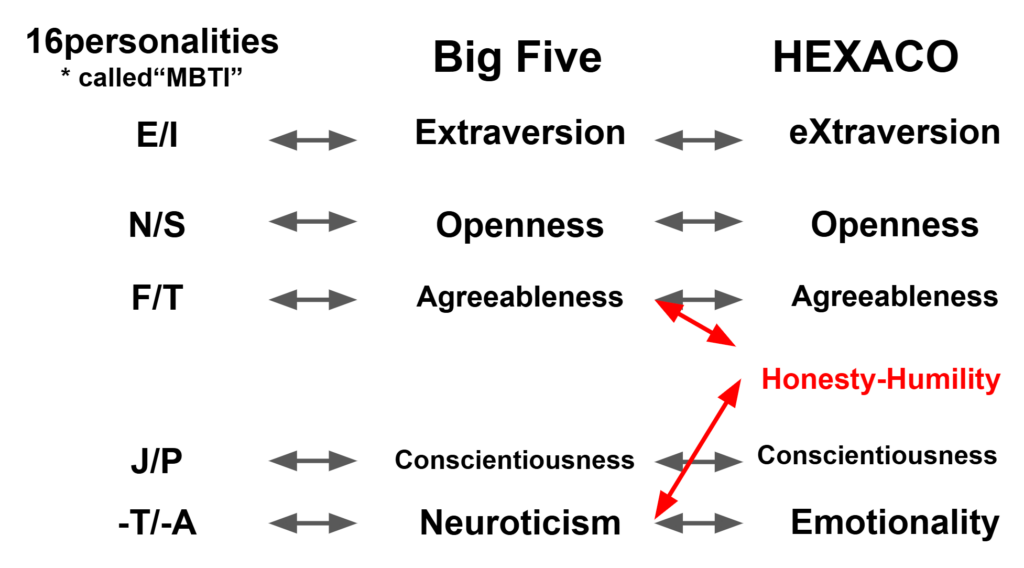
Also, in 16personalities, which was created with reference to MBTI and Big Five, neuroticism from Big Five is called “Identity“, and is classified as either Assertive or Turbulent.
On the far right is the relatively new personality assessment “HEXACO“. It is an improved version of Big Five with one additional indicator “Honesty-Humility”. Research on bullying and harassment perpetrators is active in HEXACO studies.
Since 16personalities and MBTI have weak scientific evidence, this article provides detailed explanations of 16personalities personality types based on their correlations with Big Five and HEXACO.

FAQ and Important Notes
HEXACO results differ from 16personalities (commonly known as MBTI test) or MBTI (original)
- Personality is influenced by genetics and environment, so when the environment changes, responses also change (for example, emotional responses change when you’re tired, etc.). For more details on genetics, see here.
- There are variations in responses depending on age. For more details, see here.
- Type classification is based on whether each value is 3 or above, or below 3, so values close to 3 are more likely to change results depending on how questions are asked or the environment at the time. Please look at the numerical values rather than the type.
- For MBTI (original) and 16personalities (commonly known as MBTI test), it’s unclear how much statistical processing was done at the question design stage as no research papers can be found. On the other hand, papers on Big Five and HEXACO can be easily found, and this HEXACO-JP test is based on research papers.
- While there aren’t many research papers comparing MBTI and 16personalities with everyday behaviors (academic performance, income, etc.) or with the brain and genetics, there are numerous studies on Big Five and HEXACO.
- HEXACO is a variation of Big Five elements, so they are similar but distinct. HEXACO’s Honesty-Humility is extracted from Big Five’s Agreeableness and Neuroticism.
If you have any other questions, please contact us through our inquiry form.
Personality test results are merely “hints” for your life
As mentioned earlier, personality is influenced by genetics and environment. Due to genetic influence, there is a certain range of variation, but answers can vary to some extent depending on the environment.
Also, while Big Five and HEXACO research papers conduct correlation analyses with academic performance and income, the correlation coefficients are not as large as those in natural science experiments. Correlation coefficients range from -1 to 1, but most are around -0.4 to 0.4. Of course, there are higher ones too, but they’re not 0.8 or 0.9 – they’re relatively lower in comparison.
However, since there is various research available, please think of it as “more than fortune-telling, less than natural science.” I’m not 100% denying psychology or fortune-telling.

Writer & Supervisor: Eisuke Tokiwa
Personality Psychology Researcher / CEO, SUNBLAZE Inc.
As a child he experienced poverty, domestic abuse, bullying, truancy and dropping out of school — first-hand exposure to a range of social problems. He spent 10 years researching these issues and published Encyclopedia of Villains through Jiyukokuminsha. Since then he has independently researched the determinants of social problems and antisocial behavior (work, education, health, personality, genetics, region, etc.) and has published 2 peer-reviewed journal articles (Frontiers in Psychology, IEEE Access). His goal is to predict the occurrence of social problems. Spiky profile (WAIS-IV).
Expertise: Personality Psychology / Big Five / HEXACO / MBTI / Prediction of Social Problems
Researcher profiles: ORCID / Google Scholar / ResearchGate
Social & Books: X (@etokiwa999) / note / Amazon Author Page