Do you know about the ENFP-T type?
This is one of the indicators that represents personality, and it has a significant impact on our behavior and way of thinking.
In this article, we will explain in detail what characteristics ENFP-T people have, including aspects of health, work, and interpersonal relationships.
Understanding your own and others’ personalities well may lead to better communication and self-understanding.
Please read this while comparing it with your own and your friends’ personalities.
Once again, personality researcher and author of Villain Encyclopedia, Tokiwa (@etokiwa999), will provide the explanation.
※We have developed the HEXACO-JP Personality Assessment! It has more scientific basis than MBTI. Tap below for details.

目次
- 1 Scientific Background of ENFP-T (Campaigner・Turbulent)
- 2 Scientific Analysis of ENFP-T (Campaigner – Turbulent Type)
- 2.1 Tends to Get Along Well with People Who Have Both NF Traits
- 2.2 Making New Friends
- 2.3 Relatively High Possibility of High IQ
- 2.4 Spirituality
- 2.5 Psychotherapy May Reduce Neuroticism Tendency
- 2.6 Have Many SNS Friends
- 2.7 Post updates and photos on social media, especially many emotional posts
- 2.8 When using social media, communicate through likes and encouraging comments
- 2.9 Likely to actively gather information on social media
- 2.10 Engage in altruistic activities such as volunteering
- 2.11 In children, there is a possibility of being gifted
- 2.12 Common among HSPs
- 2.13 Prefer salty, sour, and fatty foods due to stress
- 2.14 Relatively poor sleep quality
- 2.15 Prone to smoking
- 2.16 Prone to gambling
- 2.17 Prone to internet addiction
- 2.18 For males, prone to becoming cheated-on husbands
- 2.19 Prone to premature death
- 2.20 Prone to hoarding
- 2.21 Mindfulness practice reduces neuroticism
- 2.22 Uses emotion-focused coping
- 2.23 Takes high risks, has bias toward risks due to high neuroticism
- 2.24 Common in Japan’s Tohoku, Kyushu, and Metropolitan Areas
- 2.25 Schwartz Values: Hedonism, Stimulation, Self-Direction, Universalism, Benevolence
- 2.26 Particular About Clothing
- 2.27 Investment Behavior: Herd Behavior (Easily Influenced by Others’ Words and Actions)
- 3 In Conclusion
Scientific Background of ENFP-T (Campaigner・Turbulent)
Overview of MBTI
MBTI is a psychological theory that classifies personality into 16 types.
MBTI is an acronym for Myers-Briggs Type Indicator.
MBTI classifies personality into 16 types by combining the following four indicators.
In other words, MBTI expresses your personality tendencies with four letters such as “ISTJ” or “ENFP”. There is the very famous 16personalities which is similar, but this is different from MBTI.
Overview of Big Five
One of the most influential trait theories in personality psychology is the “Big Five”.
Big Five measures five traits: Openness, Conscientiousness, Extraversion, Agreeableness, and Neuroticism.
Also, a major difference is that while 16personalities and MBTI use type classification (for example, either extraverted or introverted), Big Five evaluates traits with continuous numerical values (for example, extraversion 3.5).
Furthermore, it has been studied for a long time, has many research papers, and extensive research has been conducted in other fields such as academic ability, income, brain, and genetics. Big Five can be said to have relatively stronger scientific support.
Correlation Between MBTI, Big Five, and HEXACO
There is a correlation between MBTI’s 4 indicators and Big Five’s 5 factors.
A representative study showing this correlation is the paper “The relationship between the revised NEO-Personality Inventory and the Myers-Briggs Type Indicator“.
According to this paper, the correlation between MBTI and Big Five is as follows.
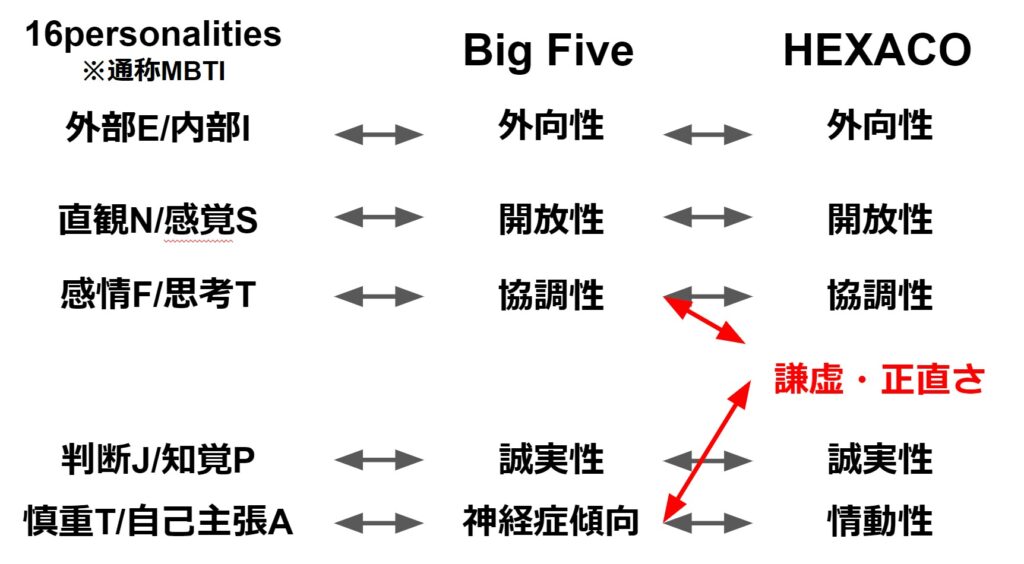
Also, in 16personalities, which was created with reference to MBTI and Big Five, neuroticism from Big Five is called “Identity“, classified as either Assertive or Turbulent.
On the far right is the relatively new personality assessment “HEXACO“. It has been improved by adding one indicator “Honesty-Humility” to Big Five.
Based on this correlation, this article will explain the personality types of 16personalities in detail.
Since these are originally Big Five and HEXACO research, if you want to know your personality more scientifically than MBTI or 16personalities, please try this HEXACO personality test.
What is ENFP-T (Campaigner・Turbulent)?
ENFP-T is a type with high Extraversion (E), high Openness (N), high Agreeableness (F), low Conscientiousness (P), and high Neuroticism (T) in Big Five. Characteristics:
- High creativity and sensitivity
- Self-doubt and perfectionism
- Longing for deep connections with others
- Sensitivity to social evaluation
- Strong curiosity for new experiences
They enjoy generating innovative ideas and sharing them with others, but may also feel anxious about their abilities and decisions. In interpersonal relationships, they seek deep bonds but are sensitive to others’ reactions and evaluations.
They are open to change and new experiences, but tend to feel stressed by uncertainty. While they have a fear of failure, this also serves as a driving force that promotes self-understanding and growth.
Scientific Analysis of ENFP-T (Campaigner – Turbulent Type)
Tends to Get Along Well with People Who Have Both NF Traits
ENFP-T type individuals have particularly high affinity with people who possess both intuitive (N) and feeling (F) characteristics. This type tends to score high in openness and agreeableness in the Big Five. They are interested in new ideas and possibilities, and are sensitive to others’ emotions with strong empathy.
ENFP-T individuals easily build deep bonds with people who share similar NF traits, and can enjoy imaginative conversations and emotional exchanges with each other.
Combined with their extraverted (E) nature, this becomes a strength in building attractive human relationships. For more details, please see this article.
Making New Friends
ENFP-T types excel at making new friends due to their extraverted (E) nature. This type, which scores high in extraversion in the Big Five, tends to be sociable and active, actively seeking new encounters. Their energetic and curious attitude attracts people around them and allows them to easily start conversations.
The intuitive (N) aspect of ENFP-T makes them interested in diverse topics and enjoy interacting with people from various backgrounds. Additionally, their feeling (F) characteristic helps them build empathetic connections with others.
The ENFP-T’s attitude of naturally connecting with people without hesitation, even in new environments, becomes a major strength in building rich human relationships. For more details, please see this article.
Relatively High Possibility of High IQ
ENFP-T type individuals may have relatively high IQ due to their intuitive (N) characteristics. This type, which scores high in openness in the Big Five, tends to quickly understand new ideas and concepts and excel at abstract thinking.
ENFP-T excels at pattern recognition and connecting different pieces of information. Their creativity and imagination are utilized in problem-solving and innovative thinking. Additionally, their extraverted (E) nature leads to many opportunities to absorb new knowledge through communication with others and deepen their understanding.
However, IQ is a multifaceted concept, and the intellectual abilities of ENFP-T may not necessarily be fully measurable through standard IQ tests alone. Their strengths may particularly lie in linguistic intelligence and creative thinking. For more details, please see this article.
Spirituality
ENFP-T type individuals tend to have strong interest in spirituality due to their intuitive (N) and feeling (F) characteristics. They have a strong tendency to seek meaning and purpose in life, and connections with transcendent things.
This type, which scores high in openness and agreeableness in the Big Five, is open to new thoughts and beliefs, and enjoys deep introspection and spiritual exploration. ENFP-T seeks to understand the connection between self and world, and tries to find greater purpose and meaning.
Their emotional aspect, combined with intuition, brings about a strong longing for mystical experiences and spiritual growth. Additionally, their extraverted (E) nature encourages spiritual exploration together with others and sharing those experiences.
For ENFP-T, spirituality can be more than just faith; it can become an important element of self-realization and personal growth. For more details, please see this article.
Psychotherapy May Reduce Neuroticism Tendency
ENFP-T type individuals, especially those with turbulent (-T) characteristics, may see reduced neuroticism tendency through psychotherapy. This type, which tends to score high in neuroticism in the Big Five, has a tendency to easily feel stress and anxiety.
ENFP-T, due to their feeling (F) characteristics, are sensitive to their own emotions and internal issues. Psychotherapy provides opportunities for them to deepen self-understanding and learn more effective ways to manage emotions.
The intuitive (N) aspect facilitates insights and awareness during therapy, helping to discover new coping strategies. The extraverted (E) nature helps build good relationships with therapists, making the treatment process more effective.
Through psychotherapy, ENFP-T can increase self-acceptance and improve stress management skills. This can improve overall mental health and potentially reduce neuroticism tendency. For more details, please see this article.
Have Many SNS Friends
People with the ENFP-T type tend to have many friends on social media due to their extraverted (E) nature. This type, which has high extraversion in the Big Five, actively communicates online and enjoys connecting with new people.
The intuitive (N) aspect of ENFP-T encourages them to interact with a wide range of people through diverse interests and topics. They are always open to new ideas and perspectives, and enjoy meeting people from various backgrounds through social media.
Their feeling (F) trait enables warm interactions even online, helping them build deep friendships. ENFP-Ts build intimate relationships with many people by commenting empathetically on others’ posts and candidly sharing their own experiences and emotions.
However, due to their turbulent (-T) trait, they may feel some anxiety or concerns about online interactions. Nevertheless, their sociability and curiosity serve as the driving force for building rich relationships on social media. Please see this article for more details.
People with the ENFP-T type, due to their extraverted (E) nature and turbulent (-T) trait, tend to frequently post updates and photos on social media, with particularly many emotional posts. This type, which has high extraversion and neuroticism in the Big Five, has a strong desire for self-expression and emotional sharing.
ENFP-Ts feel connected to others and gain opportunities for self-expression by actively sharing daily events and thoughts. Their feeling (F) aspect reflects a wide range of emotions in their posts, including joy, excitement, and sometimes anxiety and sadness.
Their intuitive (N) trait sometimes adds original perspectives and deep insights to their posts. Additionally, the turbulent (-T) characteristic creates anxiety and concerns about self-disclosure, but this can sometimes promote emotional expression instead.
For ENFP-Ts, social media serves as a place for self-expression and emotional sharing, and a tool for building deep connections with others. Please see this article for more details.
People with the ENFP-T type, due to their extraverted (E) and feeling (F) traits, tend to actively communicate with others through social media. They particularly often show positive and supportive reactions such as “likes” and encouraging comments.
This type, which has high extraversion and agreeableness in the Big Five, prefers to react empathetically to others’ posts and express positive emotions. ENFP-Ts genuinely celebrate others’ joy and success, and send warm words of encouragement to those in difficult situations.
Their intuitive (N) aspect helps them read the emotions and intentions behind others’ posts and respond appropriately. Additionally, the turbulent (-T) trait sometimes leads to excessively compassionate reactions.
For ENFP-Ts, “likes” and encouraging comments on social media are not mere superficial reactions, but sincere expressions of emotion and means to deepen connections with others. Such behavior enhances their presence within online communities and leads to building favorable relationships. Please see this article for more details.
People with the ENFP-T type are highly likely to actively gather information through social media due to their intuitive (N) trait. This type, which has high openness in the Big Five, has strong curiosity about new knowledge and perspectives.
ENFP-Ts are interested in diverse topics and enjoy accessing a wide range of information through social media. They actively explore news, trends, and new ideas, trying to broaden their knowledge and perspective.
Their extraverted (E) nature encourages them to actively react to others’ posts and shared information and participate in discussions. This allows them to gain deeper insights and multi-faceted perspectives.
The turbulent (-T) trait sometimes creates concerns about the reliability and accuracy of information, but this can also lead to the habit of checking diverse information sources.
For ENFP-Ts, social media is not just a place for socializing, but a valuable resource for personal growth and learning. Their eagerness to gather information serves as the driving force to constantly absorb new knowledge and deepen their understanding of the world. Please see this article for more details.
Engage in altruistic activities such as volunteering
People with the ENFP-T type tend to actively participate in altruistic activities such as volunteering due to their extraverted (E) and feeling (F) traits. This type, which has high extraversion and agreeableness in the Big Five, finds great joy in helping others and contributing to society.
ENFP-Ts, with their empathy and compassion for others, feel deeply about various social issues and people in difficult situations. They have a strong desire to use their abilities and time to make the world a better place.
Their intuitive (N) aspect helps them understand the root causes of social problems and come up with creative solutions. Additionally, their extraverted nature enables them to enjoy team activities and meeting new people.
The turbulent (-T) trait sometimes makes them anxious about whether their contribution is sufficient, but this can also bring about even greater effort and dedication.
For ENFP-T, volunteer activities are not merely acts of kindness, but opportunities for self-realization and personal growth. Their enthusiasm and creativity have the potential to positively impact many people’s lives. Please see this article for more details.
In children, there is a possibility of being gifted
ENFP-T type children may be gifted (children with high intellectual ability or creativity) due to their intuitive (N) characteristics. This type, which has high openness in the Big Five, may show abstract thinking and creative problem-solving abilities from an early age.
ENFP-T children have rich imagination and curiosity, showing strong interest in complex concepts and new ideas. They may have interest in diverse fields, ask original questions, or discover unexpected connections.
Their extraverted (E) nature encourages them to express their intellectual curiosity in social contexts, deepening their learning through communication with others. The feeling (F) aspect may manifest as high empathy or emotional intelligence.
The turbulent (-T) trait may sometimes lead to self-criticism or perfectionist tendencies, but this can also lead to high achievement motivation.
However, not all ENFP-T children are gifted, and it varies depending on individual abilities and environment. The important thing is to recognize their unique talents and interests and provide appropriate support. Please see this article for more details.
Common among HSPs
ENFP-T type people, especially those with intuitive (N) and turbulent (-T) characteristics, have a relatively high possibility of being HSP (Highly Sensitive Person). This type, which has high openness and high neuroticism in the Big Five, tends to react sensitively to environmental stimuli.
ENFP-T, due to their intuitive nature, sensitively perceive the atmosphere around them and subtle changes. They may react strongly not only to physical stimuli such as sound, light, smell, and touch, but also to others’ emotions and social situations.
The feeling (F) aspect further heightens this sensitivity, leading to the ability to deeply understand and empathize with others’ emotions and needs. The extraverted (E) trait brings a tendency to seek social stimulation, but at the same time makes them prone to stress from excessive stimulation.
The turbulent (-T) characteristic may create anxiety and concerns about this sensitivity, but it can also become a factor that deepens self-understanding and consideration for others.
ENFP-T HSPs can utilize their sensitivity as creativity and empathy, while appropriate self-care and boundary setting become important. Please see this article for more details.
Prefer salty, sour, and fatty foods due to stress
ENFP-T type people, especially those with turbulent (-T) characteristics, tend to prefer salty, sour, and fatty foods under stressful situations. This type, which has high neuroticism in the Big Five, is sensitive to stress and may use food for emotional regulation.
ENFP-T, due to their feeling (F) nature, may have emotional experiences closely linked to eating behavior. When feeling stressed, they tend to seek comfort in foods high in salt or fat. This is because these foods have the effect of temporarily improving mood.
The intuitive (N) aspect may deepen insights into the relationship between food and emotional states, but this doesn’t necessarily lead to healthy choices. The extraverted (E) trait may increase opportunities to share meals with others as a way to relieve stress.
The turbulent (-T) characteristic may bring concerns and guilt about eating behavior during stress, but this could potentially lead to a long-term review of healthy eating habits.
For ENFP-T, it’s important to be aware of eating behavior during stress and find healthy alternatives. Incorporating other stress relief methods such as exercise or meditation may also be effective. Please see this article for more details.
Relatively poor sleep quality
ENFP-T type people, especially those with prospecting (P) and turbulent (-T) characteristics, tend to have relatively poor sleep quality. This type, which has high neuroticism and relatively low conscientiousness in the Big Five, may face challenges with sleep quality and quantity.
ENFP-T, due to their intuitive (N) nature, may continue thinking about new ideas and possibilities late into the night. This mental activity can interfere with calming the mind at bedtime.
The prospecting (P) trait can make it difficult to establish regular sleep habits. They prefer flexibility and tend to resist setting strict bedtimes.
The turbulent (-T) characteristic can cause anxiety and worries to interfere with sleep. Dwelling on future uncertainties or past events can make it difficult to fall asleep or cause waking up in the middle of the night.
For ENFP-T, to ensure quality sleep, it may be important to establish relaxation habits before bedtime or set aside time to organize thoughts.
Also, recognizing the importance of a regular sleep schedule and gradually making it a habit can be effective. Please see this article for more details.
Prone to smoking
People with the ENFP-T type, especially those with extraverted (E) and turbulent (-T) traits, tend to be more prone to smoking habits. In the Big Five model, this type with high extraversion and high neuroticism may choose smoking as a means of stress relief or socialization.
Due to their extraverted nature, ENFP-Ts may start smoking in social situations. Cigarettes can serve as conversation starters or a means of feeling connected with others.
The turbulent (-T) trait brings a tendency to feel stress and anxiety more easily, and they may choose smoking as a way to alleviate these emotions. The temporary mood-improving effects of nicotine may reinforce this choice.
The intuitive (N) aspect may understand the health risks of smoking while being interested in its momentary effects or symbolic meaning. The feeling (F) trait makes them more susceptible to being influenced by emotional experiences and memories related to smoking.
For ENFP-Ts, it’s important to find healthy alternatives to smoking for stress relief and socialization. It may also be beneficial to deeply consider the relationship between smoking risks and their own health and values. For more details, please see this article.
Prone to gambling
People with the ENFP-T type, especially those with prospecting (P) and turbulent (-T) traits, tend to be drawn to gambling. In the Big Five model, this type with high openness, lower conscientiousness, and high neuroticism may find the stimulation and uncertainty of gambling appealing.
Due to their intuitive (N) nature, ENFP-Ts may be interested in gambling patterns and strategies, enjoying imagining the possibilities of winning. The prospecting (P) trait brings a tendency to seek new experiences and adventures, making them attracted to the excitement of gambling.
The extraverted (E) aspect may make gambling in social environments like casinos feel appealing. The feeling (F) trait can cause them to strongly experience the highs and disappointments of gambling.
The turbulent (-T) trait brings a tendency to feel stress and anxiety easily, and they may choose gambling as a means of escaping these emotions. Additionally, expectations of big wins may lead to underestimating risks.
For ENFP-Ts, it’s important to recognize the appeal of gambling while understanding the importance of sound financial management and self-control. Finding safer and more constructive forms of stimulation and adventure as alternatives to gambling may also be beneficial. For more details, please see this article.
Prone to internet addiction
People with the ENFP-T type, especially those with prospecting (P) and turbulent (-T) traits, tend to be prone to internet addiction. In the Big Five model, this type with high openness, lower conscientiousness, and high neuroticism is easily drawn to the infinite possibilities and stimulation of the internet.
Due to their intuitive (N) nature, ENFP-Ts are strongly attracted to diverse information and new ideas online. Their curiosity prompts them to explore new websites and apps one after another.
The extraverted (E) aspect makes them enjoy active interactions on social media and online communities, potentially strengthening their desire to be constantly connected. The feeling (F) trait intensifies their tendency to seek emotional experiences and empathy online.
The prospecting (P) trait brings difficulty with time management, where “just 5 more minutes” can extend to hours. The turbulent (-T) trait increases the possibility of using the internet as a means of escaping real-world stress and anxiety.
For ENFP-Ts, it’s important to establish healthy usage habits while leveraging the benefits of the internet. By balancing offline activities and real human relationships, they can lead a more fulfilling life. For more details, please see this article.
For males, prone to becoming cheated-on husbands
ENFP-T type males, especially those with turbulent (-T) traits, may statistically be more prone to becoming cheated-on husbands. However, this is not determined solely by individual personality and behavior, as many factors including relationships and environment have an influence.
ENFP-T males, due to their feeling (F) nature, are sensitive to their partner’s emotional needs and try to build deep relationships. However, the turbulent (-T) trait can sometimes create a lack of confidence or anxiety, which may affect their relationship with their partner.
The extraverted (E) aspect brings a sociable and attractive personality, but it may also potentially trigger their partner’s jealousy. The intuitive (N) trait makes them pursue ideal relationships, but gaps with reality may arise.
The prospecting (P) tendency may sometimes lead to behaviors that appear unpredictable or unstable. This may cause anxiety in their partner.
For ENFP-T males, open communication and deepening mutual understanding are important. By increasing self-awareness and building trust with their partner, they can construct more stable relationships. For more details, please see this article.
Prone to premature death
ENFP-T type individuals, particularly those with exploratory (P) and turbulent (-T) traits, may have a statistically slightly higher tendency toward early mortality risk. However, this is the result of many complex interacting factors and varies greatly depending on individual lifestyle habits and environment.
ENFP-Ts, due to their extraverted (E) and intuitive (N) nature, tend to seek new experiences and stimulation. This can sometimes lead to high-risk behaviors. The exploratory (P) characteristic can make it difficult to establish planning and regular lifestyle habits.
The feeling (F) aspect causes them to experience stress and emotional fluctuations intensely, which can potentially affect health in the long term. The turbulent (-T) trait makes them prone to anxiety and stress, which can negatively impact physical health.
However, ENFP-Ts’ creativity and adaptability can become strengths in forming healthy lifestyle habits. Their sociability helps build supportive human relationships, which can potentially lead to longevity.
For ENFP-Ts, it’s important to increase self-awareness and consciously choose healthy lifestyles.
By incorporating health-promoting behaviors into daily life such as regular exercise, balanced diet, and learning stress management techniques, they can live longer and healthier lives. For more details, please see this article.
Prone to hoarding
ENFP-T type individuals, particularly those with intuitive (N) and turbulent (-T) traits, may be prone to hoarding behavior depending on the situation. In the Big Five, this type with high openness and high neuroticism can react sensitively to future uncertainty.
ENFP-Ts, due to their intuitive nature, tend to easily imagine future possibilities and potential risks. This can lead to behaviors of securing more supplies than necessary during crisis situations or uncertain times.
The feeling (F) aspect is strongly influenced by emotions such as anxiety and fear, which can promote hoarding behavior. The extraverted (E) trait makes them react sensitively to others’ actions and social trends, potentially making them more susceptible to conforming to collective hoarding behaviors.
The turbulent (-T) characteristic makes them feel anxiety and worry strongly, which can manifest as hoarding behavior as excessive preparation for “just in case” scenarios.
For ENFP-Ts, it’s important to recognize this tendency and make rational judgments. Gathering information from reliable sources, long-term planning, and seeking expert advice when necessary will help avoid overreaction.
It’s also important to consider the balance of supply and demand in the community and be conscious of social responsibility. For more details, please see this article.
Mindfulness practice reduces neuroticism
ENFP-T type individuals, particularly those with turbulent (-T) traits, may reduce their neuroticism by practicing mindfulness. For this type with high neuroticism in the Big Five, mindfulness can be a particularly effective practice.
ENFP-Ts, due to their intuitive (N) nature, often tend to dwell on future possibilities or past events. Mindfulness helps direct attention to the present moment and reduces excessive worry and rumination.
The turbulent (-T) characteristic brings anxiety and self-critical thinking, but mindfulness cultivates the ability to notice these thought patterns and distance oneself from them.
For ENFP-Ts, mindfulness becomes a powerful tool for deepening self-understanding and improving stress management skills.
Through regular practice, they can cultivate a more calm state of mind and reduce neuroticism. We recommend trying various mindfulness techniques such as meditation, yoga, and conscious breathing methods. For more details, please see this article.
Uses emotion-focused coping
ENFP-T type individuals, due to their feeling (F) and turbulent (-T) traits, tend to use emotion-focused coping as a stress management method. In the Big Five, this type with high agreeableness and high neuroticism tends to focus on emotions when facing stressful situations.
ENFP-Ts, due to their emotional nature, may show strong emotional reactions when facing stressful situations. In emotion-focused coping, they try to recognize, express, and manage these emotions. For example, they might confide their feelings to friends or write emotions in a diary.
The intuitive (N) aspect promotes deep contemplation of the meaning and emotional impact behind stressful situations. The extraverted (E) trait brings a tendency to prefer processing emotions through communication with others.
The turbulent (-T) characteristic intensifies anxiety and concerns about stressful situations, but also serves as motivation to cope with these emotions.
For ENFP-Ts, emotion-focused coping is a natural coping method, but it’s also important to balance it with problem-solving coping. While recognizing and processing emotions is important, don’t forget to simultaneously seek concrete problem-solving strategies. Exploring creative emotional expression methods such as meditation and art therapy may also be effective.
Takes high risks, has bias toward risks due to high neuroticism
ENFP-T type individuals, particularly those with exploratory (P), intuitive (N), and turbulent (-T) traits, tend to take high risks while potentially having biases toward risks due to their high neuroticism.
ENFP-Ts, due to their intuitive and exploratory nature, are strongly attracted to new experiences and possibilities. This can sometimes lead to high-risk choices.
On the other hand, the characteristics of the turbulent type (-T) generate anxiety and concerns, which can sometimes lead to excessive vigilance against risks. This high level of neuroticism can bias risk assessment and potentially make objective judgment difficult at times.
For ENFP-T, seeking feedback from trusted others would also be helpful in reducing bias. Please see this article for more details.
Common in Japan’s Tohoku, Kyushu, and Metropolitan Areas
ENFP-T type people may tend to be relatively common in Japan’s Tohoku, Kyushu, and metropolitan areas in terms of regional distribution.
The extroverted (E) and feeling (F) characteristics of ENFP-T may harmonize with the warm human relationships and community atmosphere of Tohoku and Kyushu.
The intuitive (N) and exploratory (P) aspects may be compatible with the diversity and stimulating environment of metropolitan areas. The various opportunities and new experiences that big cities offer may satisfy the curiosity and adventurous spirit of ENFP-T.
The turbulent (-T) characteristics may be related to the social and economic uncertainty and changes common to these regions. Environmental changes and social pressures may be factors that heighten the neurotic tendencies of ENFP-T.
For ENFP-T, understanding the relationship between their personality traits and the characteristics of their residential area may be beneficial for leading a more fulfilling life. Please see this article for more details.
Schwartz Values: Hedonism, Stimulation, Self-Direction, Universalism, Benevolence
ENFP-T type people tend to particularly value hedonism, stimulation, self-direction, universalism, and benevolence in Schwartz’s value theory. These values are deeply connected to ENFP-T personality traits.
The values of hedonism and stimulation are related to ENFP-T’s extroverted (E) and exploratory (P) characteristics. They seek new experiences and sensations, placing value on enjoying life. This tendency reflects their adventurous spirit and curiosity.
The value of self-direction is connected to ENFP-T’s intuitive (N) aspect. They value independent thinking and action, cherishing the freedom to express themselves. This serves as the foundation that supports their creativity and originality.
The values of universalism and benevolence are strongly related to ENFP-T’s feeling (F) characteristics. They value the welfare and harmony of humanity as a whole, cherishing understanding and tolerance toward others. This tendency reflects their strong empathetic ability and social concern.
The turbulent (-T) characteristics may sometimes bring anxiety and self-doubt in pursuing these values, but at the same time provide opportunities for deeper self-reflection and growth.
For ENFP-T, recognizing these values and practicing them in daily life is important for enhancing self-realization and personal satisfaction. At the same time, it’s also important to balance them with other values. Please see this article for more details.
Particular About Clothing
ENFP-T type people, especially those with extroverted (E) and intuitive (N) characteristics, tend to be particular about their clothing. For them, fashion is an important means of self-expression and a place to demonstrate creativity.
Due to their extroverted nature, ENFP-T prefer to express themselves in social situations. Clothing becomes an effective way to communicate their individuality and mood to the outside world. They may choose unique styles that attract people’s attention or clothing that reflects their inner selves.
Their intuitive aspect promotes creativity and experimentation in fashion. ENFP-T tend to be interested in new trends and unusual items, enjoying creating their own unique style. They may express their imagination and artistic sense through clothing.
The feeling (F) characteristic may give emotional meaning to clothing choices. They may connect clothing with emotional states, such as how certain outfits bring confidence or comfort.
The exploratory (P) tendency brings a tendency to flexibly change clothing according to mood and situation, rather than sticking to a fixed style.
For ENFP-T, clothing is not merely a matter of appearance, but becomes part of expressing their self-identity and creative self-realization. However, due to turbulent (-T) characteristics, they may sometimes feel anxiety about their clothing choices. Please see this article for more details.
Investment Behavior: Herd Behavior (Easily Influenced by Others’ Words and Actions)
ENFP-T type people, especially those with extroverted (E) and turbulent (-T) characteristics, may have a tendency toward herd behavior in investment behavior, meaning they are easily influenced by other people’s words and actions.
Due to their extroverted nature, ENFP-T have strong interest in interactions with others and social trends.
In the investment context, this can lead to a tendency to be easily influenced by market atmosphere and other investors’ opinions.
They are likely to conform to surrounding enthusiasm or fear, potentially resulting in investment decisions based on crowd psychology.
The turbulent (-T) characteristics may heighten anxiety and concerns about investing, potentially strengthening the tendency to overly depend on others’ opinions and actions. Lack of confidence may promote behavior that follows crowd movements rather than making independent judgments.
For ENFP-T, it is important to recognize this tendency and make efforts to make more objective and independent investment decisions. Please see this article for more details.
In Conclusion
People with ENFP-T personality type have very unique and attractive personalities. While they love new things and enjoy interacting with people, they also have aspects where they sometimes become anxious or feel stress easily.
People with this personality are creative and highly sensitive, and can understand others’ feelings well. However, due to that sensitivity, they sometimes become prone to stress.
However, caution is needed as they sometimes become impulsive or easily influenced by others’ opinions.
The tendencies introduced are originally from Big Five and HEXACO research, so if you want to know your personality more scientifically than MBTI or 16personalities, please try this HEXACO personality test.

Writer & Supervisor: Eisuke Tokiwa
Personality Psychology Researcher / CEO, SUNBLAZE Inc.
As a child he experienced poverty, domestic abuse, bullying, truancy and dropping out of school — first-hand exposure to a range of social problems. He spent 10 years researching these issues and published Encyclopedia of Villains through Jiyukokuminsha. Since then he has independently researched the determinants of social problems and antisocial behavior (work, education, health, personality, genetics, region, etc.) and has published 2 peer-reviewed journal articles (Frontiers in Psychology, IEEE Access). His goal is to predict the occurrence of social problems. Spiky profile (WAIS-IV).
Expertise: Personality Psychology / Big Five / HEXACO / MBTI / Prediction of Social Problems
Researcher profiles: ORCID / Google Scholar / ResearchGate
Social & Books: X (@etokiwa999) / note / Amazon Author Page