Do you know about the ISTP-A type?
This is one of the indicators that represents personality, and it has a significant impact on our behavior and way of thinking.
In this article, we will explain in detail what characteristics ISTP-A people have, including their health, work, and interpersonal relationships.
By understanding your own personality and that of those around you, it may lead to better communication and self-understanding.
Please read while comparing it with your own and your friends’ personalities.
Once again, personality researcher and author of Villain Encyclopedia, Tokiwa (@etokiwa999), will provide the explanation.
※We have developed the HEXACO-JP Personality Assessment! It has more scientific basis than MBTI. Tap below for details.

目次
- 1 Scientific Background of ISTP-A (Virtuoso – Assertive)
- 2 Scientific Analysis of ISTP-A (Virtuoso – Assertive Type)
- 2.1 Easy to get along with people who have both S and T traits
- 2.2 Properly maintain social distancing for infection control
- 2.3 Relatively common among scientists
- 2.4 Common among writers/editors, artists/creators, and counselors/therapists
- 2.5 Tendency to hold right-wing authoritarianism (RWA) ideology and social dominance orientation (SDO) ideology
- 2.6 Less prone to perfectionism and able to think and act flexibly
- 2.7 Common among bullying perpetrators
- 2.8 Common among cyberbullying perpetrators
- 2.9 Possibility of psychopathy
- 2.10 Common among problem employees
- 2.11 Common in Japan’s Hokuriku Region
- 3 In Conclusion
Scientific Background of ISTP-A (Virtuoso – Assertive)
Overview of MBTI
MBTI is a psychological theory that classifies personality into 16 types.
MBTI is the abbreviation for Myers-Briggs Type Indicator.
MBTI classifies personality into 16 types by combining the following four indicators.
In other words, MBTI expresses your personality tendencies with four letters such as “ISTJ” or “ENFP”. There is the very famous 16personalities which is similar, but this is different from MBTI.
Overview of Big Five
One of the most influential trait theories in personality psychology is the “Big Five”.
Big Five measures five traits: Openness, Conscientiousness, Extraversion, Agreeableness, and Neuroticism.
Also, while 16personalities and MBTI use type classification (e.g., either extroverted or introverted), Big Five evaluates traits with continuous numerical values (e.g., extraversion 3.5), which is a major difference.
Furthermore, it has been studied for a long time, has many research papers, and extensive research has been conducted in other fields such as academic ability, income, brain, and genetics. It can be said that Big Five has relatively stronger scientific backing.
Correlation between MBTI, Big Five, and HEXACO
There are correlations between MBTI’s four indicators and Big Five’s five factors.
A representative study showing this correlation is the paper “The relationship between the revised NEO-Personality Inventory and the Myers-Briggs Type Indicator“.
According to this paper, the correlation between MBTI and Big Five is as follows.
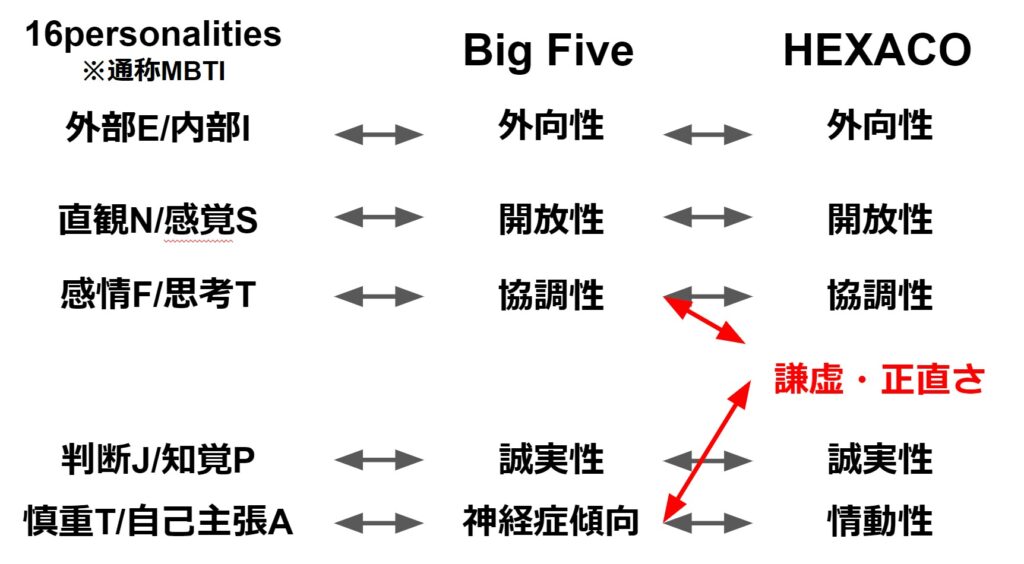
Also, in 16personalities, which was created based on MBTI and Big Five, the neuroticism of Big Five is called “Identity” and is classified as either Assertive or Turbulent.
On the far right is “HEXACO“, a relatively new personality assessment. It has been improved by adding one indicator “Honesty-Humility” to Big Five.
This article will explain the personality types of 16personalities in detail based on these correlations.
Since these are originally Big Five and HEXACO research, if you want to know your personality more scientifically than MBTI or 16personalities, please try this HEXACO personality test.
What is ISTP-A (Virtuoso – Assertive)?
ISTP-A is a type with low extraversion (I), low openness (S), low agreeableness (T), low conscientiousness (P), and low neuroticism (A) in Big Five.
- High adaptability and problem-solving ability
- Practical skills and manual dexterity
- Logical thinking and calm judgment
- Confident independence
- Flexibility and adventurous spirit
They excel at finding creative and efficient solutions to specific problems. They focus on the present moment and value practical experience.
In interpersonal relationships, they value personal space while cooperating when necessary. They welcome change and new challenges, and due to their high stress tolerance, they can respond calmly even in crisis situations. They have a strong sense of self-efficacy and believe in their own abilities.
Scientific Analysis of ISTP-A (Virtuoso – Assertive Type)
Easy to get along with people who have both S and T traits
ISTP-A individuals possess both sensing (S) and thinking (T) characteristics. This indicates low openness and low agreeableness in Big Five terms. ISTP-A people are compatible with those who prefer realistic and analytical thinking.
They focus on concrete facts and details, and prefer to make logical judgments. Therefore, they tend to build deep relationships with people who have similar thought processes.
ISTP-A individuals value practical approaches and calm analysis, so they can build friendly relationships with people who share the same values.
For more details, please see this article.
The “I” in ISTP-A represents introversion, which means low extraversion in Big Five terms. This characteristic works advantageously for adhering to social distancing in infection control measures.
ISTP-A individuals value alone time and tend not to prefer excessive contact with others. Therefore, they can naturally maintain the social distancing required as infection control measures.
They value their personal space and have no resistance to maintaining appropriate distance from others. This characteristic is helpful in practicing important preventive measures during infectious disease outbreaks.
ISTP-A individuals also tend to follow social norms and instructions, so they are proactive about adhering to infection control guidelines.
For more details, please see this article.
Relatively common among scientists
ISTP-A types are relatively common among scientists. This is because their introverted (I) and logical (T) characteristics, along with their high adaptability (-A), are well-suited to the field of science.
ISTP-A individuals tend to have low extraversion and low agreeableness in Big Five terms. This is suitable for the scientific world that requires independent research and deep thinking.
They excel at logical analysis based on concrete data and facts, and have a high potential for generating new discoveries and innovative ideas.
Additionally, the high adaptability of ISTP-A matches the flexible thinking and problem-solving abilities required in the scientific world.
For more details, please see this article.
Common among writers/editors, artists/creators, and counselors/therapists
The “I” (introversion) in ISTP-A indicates low extraversion in Big Five terms. This characteristic is compatible with professions such as writers/editors, artists/creators, and counselors/therapists.
Introverted personality makes it easy to concentrate on deep thinking and creative work, which is suitable for the independent work environments required in these professions.
ISTP-A individuals have the ability to deeply understand their own inner selves and others’ emotions, which is important for success as counselors or therapists.
Additionally, their logical thinking (T) connects to their ability to organize information and communicate clearly as writers or editors.
ISTP-A individuals with creativity and independence are likely to demonstrate talent as artists or creators as well.
For more details, please see this article.
The “S” (sensing) and “T” (thinking) characteristics of ISTP-A indicate low openness and low agreeableness in Big Five terms. These characteristics may be related to right-wing authoritarianism (RWA) and social dominance orientation (SDO) ideologies.
ISTP-A individuals tend to value concrete facts and traditional values, which can connect with RWA characteristics of respect for existing authority and tradition.
Additionally, their logical thinking (T) may have affinity with SDO’s way of thinking that emphasizes social hierarchy and order.
However, this is merely a tendency and can vary greatly depending on individual values and experiences. ISTP-A individuals do not necessarily hold these beliefs.
For more details, please see this article.
Less prone to perfectionism and able to think and act flexibly
The “P” (Perceiving) trait in ISTP-A indicates low conscientiousness in Big Five terms. This characteristic makes them less prone to perfectionism and enables flexible thinking and action.
ISTP-A individuals excel at responding flexibly to situations as they arise. They have the ability to find optimal solutions that fit the circumstances at hand, without being bound by strict rules or plans.
This flexibility becomes a great strength in problem-solving and creative work. ISTP-A individuals maintain an open attitude toward new information and changing environments, and can effectively utilize them.
Because they can find practical and efficient solutions without seeking excessive perfection, they are likely to lead less stressful lives.
For more details, please see this article.
Common among bullying perpetrators
The combination of “S” (Sensing), “T” (Thinking), “P” (Perceiving) in ISTP-A, along with the Assertive (-A) trait, unfortunately tends to be commonly found among bullying perpetrators.
This indicates tendencies toward low openness, low agreeableness, and low conscientiousness in Big Five terms. These traits can sometimes lead to a lack of empathy and consideration for others.
ISTP-A individuals have the ability to focus on concrete reality (S), make logical judgments (T), and flexibly adapt to situations (P-A). However, when these traits work in a negative direction, they can lead to behaviors such as disregarding others’ emotions or manipulating others for personal gain.
However, this is merely a statistical tendency, and not all ISTP-A individuals engage in bullying. Individual values, education, and environment have significant influence.
For more details, please see this article.
Common among cyberbullying perpetrators
The “T” (Thinking) and “P” (Perceiving) traits in ISTP-A indicate tendencies toward low agreeableness and low conscientiousness in Big Five terms. These traits tend to be commonly found among cyberbullying perpetrators.
ISTP-A individuals prioritize logical thinking (T), which may sometimes result in insufficient consideration for others’ emotions. Additionally, flexibility (P) can potentially lead to disregarding rules or moral constraints.
Online environments tend to create more emotional distance than face-to-face communication, which, combined with ISTP-A individuals’ low empathy, may potentially trigger cyberbullying behaviors.
However, this is a statistical tendency, and not all ISTP-A individuals engage in cyberbullying. Individual ethics and experiences have significant influence.
For more details, please see this article.
Possibility of psychopathy
The “T” (Thinking), “P” (Perceiving), and Assertive (-A) traits in ISTP-A indicate tendencies toward low agreeableness and low conscientiousness in Big Five terms. These traits may sometimes be associated with psychopathic tendencies.
ISTP-A individuals tend to prioritize logical thinking (T) and reason over emotion. When this becomes extreme, it may result in a lack of empathy for others’ emotions.
Additionally, flexibility (P) and adaptability (-A) may potentially lead to a tendency to act without being bound by moral constraints.
However, this is merely a possibility, and not all ISTP-A individuals have psychopathic tendencies. Psychopathy is a complex psychological state influenced by many factors including individual experiences, environment, and other personality traits.
For more details, please see this article.
Common among problem employees
The “T” (Thinking) and “P” (Perceiving) traits in ISTP-A indicate tendencies toward low agreeableness and low conscientiousness in Big Five terms. These traits may sometimes lead to problematic behaviors referred to as “monster employees.”
ISTP-A individuals prioritize logical thinking (T), so they may tend to prioritize their own judgment over organizational rules or others’ emotions. Additionally, flexibility (P) may sometimes lead to a lack of responsibility or disregard for commitments.
Their high adaptability (-A) can sometimes be used to justify self-centered behavior.
However, this is merely a statistical tendency, and not all ISTP-A individuals become monster employees. Personal work ethics, values, and workplace environment have significant influence.
Please see this article for more details.
Common in Japan’s Hokuriku Region
The “T” (Thinking) characteristic of ISTP-A shows a tendency toward low agreeableness in Big Five terms. Interestingly, there is a tendency for people with this trait to be relatively common in Japan’s Hokuriku region.
The Hokuriku region is an area where harsh natural environments and traditional culture are deeply rooted. Such an environment may serve as fertile ground for nurturing ISTP-A type people who value logical thinking and practical approaches.
ISTP-A individuals excel at concrete problem-solving abilities, which may be a characteristic that helps them adapt to Hokuriku’s climate and geographical features.
Additionally, Hokuriku’s traditional craftsman spirit and culture of taking a thorough approach to tasks are considered to have high compatibility with ISTP-A characteristics.
However, it should be noted that this is a general tendency, and individual differences and diversity within regions are also significant.
Please see this article for more details.
In Conclusion
ISTP-A individuals have very unique personalities. They value their alone time while being able to think logically and act flexibly.
This personality type may be suited for creative professions such as scientists, artists, and writers. They also have strengths in high problem-solving abilities and the ability to respond calmly even in emergencies.
However, they sometimes struggle to understand others’ emotions or may disregard rules. When this becomes extreme, it can potentially cause trouble in interpersonal relationships.
What’s important is to make use of your strengths while being mindful of your weaknesses. And to interact with diverse people and understand each other’s differences.
The tendencies introduced are originally based on Big Five and HEXACO research, so if you want to understand personality more scientifically than MBTI or 16personalities, please try this HEXACO personality test.

Writer & Supervisor: Eisuke Tokiwa
Personality Psychology Researcher / CEO, SUNBLAZE Inc.
As a child he experienced poverty, domestic abuse, bullying, truancy and dropping out of school — first-hand exposure to a range of social problems. He spent 10 years researching these issues and published Encyclopedia of Villains through Jiyukokuminsha. Since then he has independently researched the determinants of social problems and antisocial behavior (work, education, health, personality, genetics, region, etc.) and has published 2 peer-reviewed journal articles (Frontiers in Psychology, IEEE Access). His goal is to predict the occurrence of social problems. Spiky profile (WAIS-IV).
Expertise: Personality Psychology / Big Five / HEXACO / MBTI / Prediction of Social Problems
Researcher profiles: ORCID / Google Scholar / ResearchGate
Social & Books: X (@etokiwa999) / note / Amazon Author Page