
Do you know about the ESTJ-A type?
This is one of the indicators that represents personality, and it has a major influence on our behavior and way of thinking.
In this article, we will explain in detail what characteristics ESTJ-A people have, including their health, work, and interpersonal relationships.
Understanding your own and others’ personalities well may lead to better communication and self-understanding.
Please read while comparing with your own and your friends’ personalities.
Once again, personality researcher and author of Villain Encyclopedia, Tokiwa (@etokiwa999), will provide the explanation.
※We have developed the HEXACO-JP Personality Assessment! It has more scientific basis than MBTI. Tap below for details.

目次
- 1 Scientific Background of ESTJ-A (Executive – Assertive)
- 2 Scientific Explanation of ESTJ-A (Executive・Assertive Type)
- 2.1 Good Physical Health
- 2.2 Easily Gets Along with People Who Have Both S and T Traits
- 2.3 Making New Friends
- 2.4 Many SNS Friends
- 2.5 Properly Performs Infection Prevention Measures Like Hand Washing
- 2.6 Capable at Work, High Performance
- 2.7 Tend to be liked by students when becoming teachers
- 2.8 Excessive perfectionism
- 2.9 Prefer fast food, ice cream, chocolate, and cocoa; avoid meat
- 2.10 Pay attention to health and prefer vegetables, dairy products, and nuts
- 2.11 Prone to having right-wing authoritarianism (RWA) and social dominance orientation (SDO) ideologies
- 2.12 Tend to have relatively high income
- 2.13 High self-esteem
- 2.14 Employ problem-focused coping
- 2.15 Competence and relatedness needs of self-determination theory are easily satisfied
- 2.16 Perform calm risk management
- 2.17 Common in Japan’s Hokuriku Region
- 2.18 Schwartz Values: Power, Achievement, Security
- 2.19 Investment Behavior: Disposition Effect and Overconfidence
- 3 In Conclusion
Scientific Background of ESTJ-A (Executive – Assertive)
Overview of MBTI
MBTI is a psychological theory that classifies personality into 16 types.
MBTI is an abbreviation for Myers-Briggs Type Indicator.
MBTI classifies personality into 16 types by combining the following 4 indicators.
In other words, MBTI expresses your personality tendencies with 4 letters such as “ISTJ” or “ENFP”. There is the very famous 16personalities which is similar, but this is different from MBTI.
Overview of Big Five
One of the most prominent trait theories in personality psychology is the “Big Five”.
Big Five measures five traits: Openness, Conscientiousness, Extraversion, Agreeableness, and Neuroticism.
Also, while 16personalities and MBTI use type classification (e.g., either extraverted or introverted), Big Five evaluates traits with continuous numerical values (e.g., extraversion 3.5), which is a major difference.
Furthermore, it has been studied for a long time, has many research papers, and extensive research has been conducted in other fields such as academic ability, income, brain, and genetics. Big Five can be said to have relatively stronger scientific backing.
Correlation Between MBTI, Big Five, and HEXACO
There are correlations between MBTI’s 4 indicators and Big Five’s 5 factors.
A representative study showing this correlation is the paper “The relationship between the revised NEO-Personality Inventory and the Myers-Briggs Type Indicator“.
According to this paper, the correlation between MBTI and Big Five is as follows.
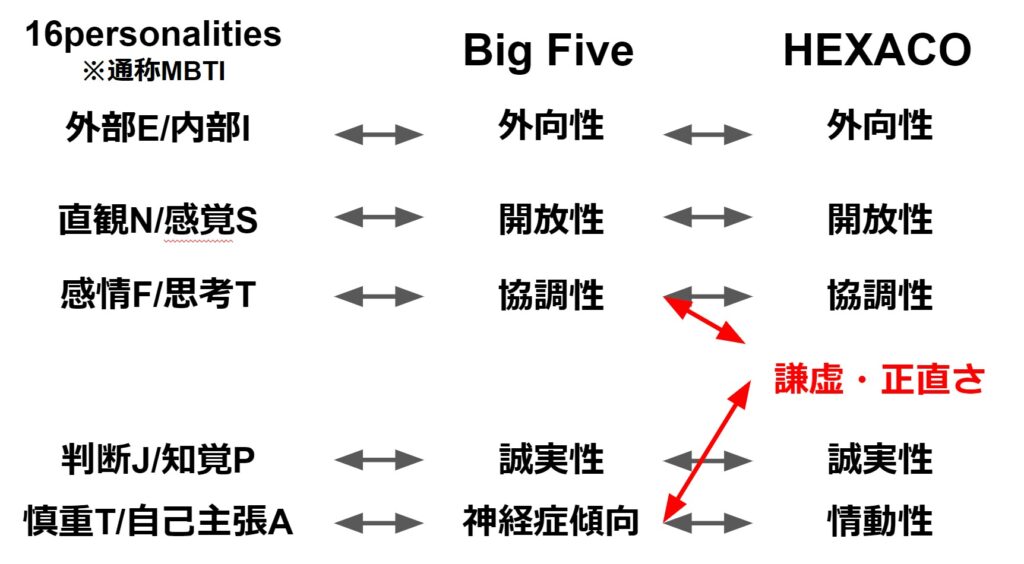
Also, in 16personalities, which was created with reference to MBTI and Big Five, the neuroticism of Big Five is called “Identity“, and is classified as either Assertive or Turbulent.
On the far right is “HEXACO“, which is a relatively new personality assessment. It has been improved by adding one indicator “Honesty-Humility” to Big Five.
This article will explain the personality types of 16personalities in detail based on these correlations.
Since these are originally Big Five and HEXACO research, if you want to know your personality more scientifically than MBTI or 16personalities, please try this HEXACO personality test.
What is ESTJ-A (Executive – Assertive)?
ESTJ-A is a type with high Extraversion (E), low Openness (S), low Agreeableness (T), high Conscientiousness (J), and low Neuroticism (A) in Big Five.
- Strong organizational skills and leadership
- Logical and practical problem-solving abilities
- High sense of responsibility and efficiency
- Confident decision-making
- Emphasis on tradition and order
They are good at setting clear goals and efficiently achieving them. They make judgments based on facts and experience, and value rules and procedures.
In interpersonal relationships, they prefer direct communication and clearly convey expectations. They are cautious about change, but adapt quickly once they understand the necessity. They have high stress tolerance and can demonstrate calm leadership even in difficult situations.
Scientific Explanation of ESTJ-A (Executive・Assertive Type)
Good Physical Health
ESTJ-A type individuals generally tend to have good physical health. This is related to their high conscientiousness (J) and low neuroticism (-A) characteristics in the Big Five. ESTJ-A individuals are planned and responsible with high stress tolerance, making it easier for them to maintain healthy lifestyle habits. They tend to naturally practice behaviors necessary for health maintenance, such as regular living rhythms, moderate exercise, and balanced diet.
Also, being mentally stable, they tend to maintain a good mind-body balance. However, there are individual differences, so this cannot be said universally.
Please see this article for more details.
Easily Gets Along with People Who Have Both S and T Traits
ESTJ-A type individuals tend to have high affinity with people who also possess S and T characteristics. This is related to their low openness (S) and low agreeableness (T) characteristics in the Big Five.
ESTJ-A individuals prefer realistic and logical thinking, so they easily empathize with people who have similar values and ways of thinking.
They value concrete facts and experiences and tend to prioritize theory over emotion, so they easily hit it off with people who take similar approaches.
However, this doesn’t mean they can’t get along with other types. Interacting with diverse people also provides opportunities to learn new perspectives and ways of thinking.
Please see this article for more details.
Making New Friends
ESTJ-A type individuals tend to be good at making new friends. This is related to their high extraversion (E) characteristic in the Big Five. ESTJ-A individuals have sociable and active personalities and feel energized by interacting with people.
They can actively jump into new environments and confidently introduce themselves or start conversations.
Also, their practical and straightforward communication style is likely to make a good impression on many people.
However, it’s also important to sometimes consider others’ emotions. When building new friendships, it’s good to pay attention to the other person’s pace and preferences.
Please see this article for more details.
Many SNS Friends
ESTJ-A type individuals tend to actively interact on SNS and have many friends. This is related to their high extraversion (E) characteristic in the Big Five. ESTJ-A individuals prefer to actively communicate not only in the real world but also online.
They tend to efficiently utilize SNS to build extensive networks and actively engage in information exchange and opinion sharing.
Also, they have little resistance to sharing their thoughts and experiences, which may make it easier to increase followers and friends. However, it’s important to maintain balance with real human relationships so as not to become too biased toward online interactions.
Please see this article for more details.
Properly Performs Infection Prevention Measures Like Hand Washing
ESTJ-A type individuals tend to reliably practice health maintenance behaviors such as infection prevention measures. This is related to their high conscientiousness (J) characteristic in the Big Five. ESTJ-A individuals value discipline and have a strong sense of responsibility, so they can properly follow recommended infection prevention measures such as hand washing and mask wearing.
Due to their planned nature and attention to detail, they can easily make behaviors to minimize infection risk into habits. Also, being conscious of consideration for others and social responsibility, they can take actions that consider the health of people around them. However, it’s also important to maintain flexibility and respond according to situations.
Please see this article for more details.
Capable at Work, High Performance
ESTJ-A type people tend to exhibit high performance at work. This is related to their characteristics of high conscientiousness (J) and low neuroticism (-A) in the Big Five. ESTJ-A people possess planning ability, efficiency, and a sense of responsibility, enabling them to steadily progress toward goal achievement.
Because they prefer logical thinking and practical approaches, they excel at problem-solving and can make effective decisions.
Additionally, their high stress tolerance and ability to respond calmly under pressure also contribute to their high performance. However, it’s important to sometimes maintain flexibility and listen to others’ opinions.
Please see this article for more details.
Tend to be liked by students when becoming teachers
When ESTJ-A type people become teachers, they tend to be liked by their students. This is related to their characteristics of high extraversion (E), high conscientiousness (J), and low neuroticism (-A) in the Big Five.
ESTJ-A teachers provide clear instructions and structured lessons, facilitating student understanding.
Their energetic and confident attitude attracts students’ interest and enhances their motivation to learn.
Additionally, their fair and consistent responses and leadership skills toward goal achievement are factors that make it easy to gain trust from students. However, it’s important to also consider individual students’ needs and emotions and maintain a flexible approach.
Please see this article for more details.
Excessive perfectionism
ESTJ-A type people sometimes tend to fall into excessive perfectionism. This is related to their characteristic of high conscientiousness (J) in the Big Five. ESTJ-A people set high standards and strive to achieve them, but sometimes those standards may be unrealistic.
While their attention to detail and intolerance of mistakes leads to high-quality work, it may also increase the risk of stress and burnout syndrome.
Additionally, because they have high expectations of others as well, this may create friction in interpersonal relationships. It’s important to maintain balance and have moderate flexibility.
Please see this article for more details.
Prefer fast food, ice cream, chocolate, and cocoa; avoid meat
ESTJ-A type people tend to prefer fast food and sweets but relatively avoid meat. This is related to their characteristics of high extraversion (E) and low neuroticism (-A) in the Big Five. ESTJ-A people tend to prefer easily consumable fast food because they lead social and active lives.
Also, because they have high stress tolerance, they sometimes enjoy sweet things like ice cream and chocolate as rewards.
They might also use warm drinks like cocoa for relaxation and mood changes. The tendency to avoid meat may come from health consciousness or environmental considerations.
However, these are general tendencies and may vary depending on individual preferences and values.
Please see this article for more details.
Pay attention to health and prefer vegetables, dairy products, and nuts
ESTJ-A type people tend to maintain health-conscious eating habits and particularly prefer vegetables, dairy products, and nuts.
This is related to their characteristic of high conscientiousness (J) in the Big Five. ESTJ-A people are planned and responsible, so they also pay attention to their health management.
They strive for nutritionally balanced meals and try to obtain vitamins and minerals from vegetables, calcium from dairy products, and quality fats and protein from nuts.
They may also recognize that these foods are effective for long-term health maintenance. However, preferences may vary depending on individual taste, constitution, and living environment.
Please see this article for more details.
ESTJ-A type people tend to be prone to having right-wing authoritarianism (RWA) and social dominance orientation (SDO) ideologies.
This is related to their characteristics of low openness (S) and low agreeableness (T) in the Big Five. ESTJ-A people tend to value traditional values and social order, and are prone to accepting authority and hierarchical structures.
RWA emphasizes obedience to existing authority and traditional norms, while SDO tends to view social hierarchies and inequality in a positive light.
The practical and logical thinking style of ESTJ-A may have an affinity with these ideologies. However, this is a general tendency and can vary greatly depending on individual experiences, education, and environment.
It is important to understand diverse values and strive to avoid prejudice.
Please see this article for more details.
Tend to have relatively high income
People with ESTJ-A type tend to have relatively high incomes. This is related to characteristics of high extraversion (E), low agreeableness (T), high conscientiousness (J), and low neuroticism (-A) in the Big Five. ESTJ-A individuals demonstrate goal-oriented and efficient work performance and are likely to exhibit leadership, making them more likely to obtain career advancement opportunities.
Logical thinking and practical approaches tend to be highly valued in business settings. Additionally, having high stress tolerance and being able to respond calmly even in responsible positions may also be factors leading to high income. However, it’s important to note that income is influenced by various factors including industry and economic conditions, not just individual ability and effort.
Please see this article for more details.
High self-esteem
People with ESTJ-A type generally tend to have high self-esteem. This is related to characteristics of high extraversion (E), high conscientiousness (J), and low neuroticism (-A) in the Big Five.
ESTJ-A individuals have a confident attitude and clear goal awareness, with high self-efficacy.
They trust their own abilities and judgment and have an attitude of tackling difficult situations positively. Additionally, having a strong achievement orientation, they tend to enhance their self-evaluation by accomplishing goals.
Their sociable personality may also make it easier to receive positive feedback from others, contributing to maintaining self-esteem. However, excessive confidence can sometimes create friction with others, so it’s important to maintain a balance with humility.
Please see this article for more details.
Employ problem-focused coping
People with ESTJ-A type tend to employ problem-focused coping when facing stress or problems. This is related to characteristics of high extraversion (E) and high conscientiousness (J) in the Big Five.
ESTJ-A individuals prefer approaches that directly solve problems.
Specifically, they are likely to adopt methods such as identifying the cause of problems, logically thinking of solutions, creating action plans, and putting them into practice. They emphasize fact-based responses rather than being swayed by emotions.
While this method is effective in many cases, it’s important to recognize that sometimes emotional care is also necessary and respond flexibly.
People with ESTJ-A type tend to have their needs for competence and relatedness in self-determination theory easily satisfied.
This is related to characteristics of high extraversion (E), high conscientiousness (J), and low neuroticism (-A) in the Big Five. ESTJ-A individuals possess the ability to act effectively toward goal achievement, making it easy to gain a sense of competence.
Additionally, through their sociable personality and leadership, they can easily build good relationships with people around them, and their relatedness needs tend to be easily satisfied.
Their confident attitude and practical approach also lead to gaining trust and respect from others. However, it’s important to also pay attention to autonomy needs and aim for balanced self-realization.
Please see this article for more details.
Perform calm risk management
People with ESTJ-A type tend to perform calm risk management. This is related to characteristics of high conscientiousness (J) and low neuroticism (-A) in the Big Five.
ESTJ-A individuals can objectively evaluate risks and take appropriate countermeasures using logical thinking and practical approaches.
They are skilled at making judgments based on facts and data without being swayed by emotions, and strategically planning to reduce risks.
Additionally, having high stress tolerance, they can maintain composure even in crisis situations and take effective responses. However, it’s also important to sometimes listen to intuition and others’ opinions and conduct risk management from multiple perspectives.
Please see this article for more details.
Common in Japan’s Hokuriku Region
People with the ESTJ-A type tend to be relatively common in Japan’s Hokuriku region. This may be related to the Big Five characteristic of low agreeableness (T).
The culture and temperament of the Hokuriku region may have an affinity with ESTJ-A characteristics.
For example, the Hokuriku region tends to value tradition, which may align with ESTJ-A people’s respect for order and discipline.
Additionally, the practical and steady character of Hokuriku people who have adapted to harsh climate conditions may also share common ground with ESTJ-A characteristics.
For more details, please see this article.
Schwartz Values: Power, Achievement, Security
People with the ESTJ-A type tend to value power, achievement, and security in Schwartz’s theory of values.
This is related to the Big Five characteristics of high extraversion (E), low openness (S), and low agreeableness (T).
ESTJ-A people tend to value social status and influence over others (power), cherish personal success and proof of ability (achievement), and seek stability and harmony (security).
These values align with ESTJ-A’s goal-oriented and practical personality. However, being too biased toward these values can lead to friction with others and lack of flexibility, so maintaining balance is important.
Also, the priority of values may change depending on individual experiences and environment.
For more details, please see this article.
Investment Behavior: Disposition Effect and Overconfidence
People with the ESTJ-A type may show tendencies toward disposition effects and overconfidence in their investment behavior. This is related to the Big Five characteristics of high extraversion (E) and high conscientiousness (J).
The disposition effect refers to the tendency to sell profitable investments early while holding onto losing investments for longer periods. ESTJ-A people may be prone to falling into this behavioral pattern due to their emphasis on goal achievement.
Regarding overconfidence, their confident personality may lead them to overestimate their judgment abilities and risk management skills, potentially taking on more risk than appropriate.
These tendencies can negatively affect long-term investment performance, so it’s important to maintain objective analysis and calm judgment. Actively incorporating expert advice would also be effective.
For more details, please see this article.
In Conclusion
People with the ESTJ-A type tend to be extraverted, organized, and prefer logical thinking.
They may be good at speaking in front of groups and bringing people together. They also have strong motivation toward goals and many are health-conscious.
They’re skilled at making friends and tend to be actively engaged on social media.
In studies and work, they can make plans and proceed efficiently. However, they may sometimes seek perfection too much and accumulate stress.
While people of this type can act with confidence, they may sometimes be insensitive to others’ feelings. Therefore, it’s important to sometimes pause and listen to the opinions of those around them.
The tendencies introduced are originally from Big Five and HEXACO research, so if you want to understand personality more scientifically than MBTI or 16personalities, please try this HEXACO personality test.

Writer & Supervisor: Eisuke Tokiwa
Personality Psychology Researcher / CEO, SUNBLAZE Inc.
As a child he experienced poverty, domestic abuse, bullying, truancy and dropping out of school — first-hand exposure to a range of social problems. He spent 10 years researching these issues and published Encyclopedia of Villains through Jiyukokuminsha. Since then he has independently researched the determinants of social problems and antisocial behavior (work, education, health, personality, genetics, region, etc.) and has published 2 peer-reviewed journal articles (Frontiers in Psychology, IEEE Access). His goal is to predict the occurrence of social problems. Spiky profile (WAIS-IV).
Expertise: Personality Psychology / Big Five / HEXACO / MBTI / Prediction of Social Problems
Researcher profiles: ORCID / Google Scholar / ResearchGate
Social & Books: X (@etokiwa999) / note / Amazon Author Page