
Do you know about the ISTJ-A type? This is one of the indicators that represents personality, and it greatly influences our behavior and way of thinking.
In this article, we will explain in detail what characteristics ISTJ-A people have, including aspects of health, work, and interpersonal relationships.
Understanding your own and others’ personalities well may lead to better communication and self-understanding.
Please try reading while comparing with your own and your friends’ personalities.
Once again, personality researcher and author of Villain Encyclopedia, Tokiwa (@etokiwa999), will provide the explanation.
※We have developed the HEXACO-JP Personality Assessment! It has more scientific basis than MBTI. Tap below for details.

目次
- 1 Scientific Background of ISTJ-A (Logistician・Assertive)
- 2 Scientific Explanation of ISTJ-A (The Administrator – Assertive Type)
- 2.1 Good Physical Health
- 2.2 Easily Get Along with People Who Have Both S and T Traits
- 2.3 Properly Maintain Social Distance for Infection Control
- 2.4 Properly Perform Hand Washing and Other Infection Control Measures
- 2.5 High Work Competence and Performance
- 2.6 Relatively Common Among Scientists
- 2.7 Common Among Writers/Editors, Artists/Creators, and Counselors/Therapists
- 2.8 Excessive Pursuit of Perfectionism
- 2.9 Health-Conscious and Prefer Vegetables, Dairy Products, and Nuts
- 2.10 Prone to Right-Wing Authoritarianism (RWA) and Social Dominance Orientation (SDO) Ideologies
- 2.11 Relatively Likely to Have Higher Annual Income
- 2.12 Relatively High Self-Esteem
- 2.13 Conducts Calm Risk Management
- 2.14 Common in Japan’s Hokuriku Region
- 2.15 Schwartz’s Values: Security
- 3 In Conclusion
Scientific Background of ISTJ-A (Logistician・Assertive)
Overview of MBTI
MBTI is a psychological theory that classifies personality into 16 types.
MBTI is an abbreviation for Myers-Briggs Type Indicator.
MBTI classifies personality into 16 types by combining the following 4 indicators.
In other words, MBTI expresses your personality tendencies with 4 letters such as “ISTJ” or “ENFP”. There is the very famous 16personalities which is similar, but this is different from MBTI.
Overview of Big Five
One of the most prominent trait theories in personality psychology is the “Big Five”.
Big Five measures five traits: openness, conscientiousness, extraversion, agreeableness, and neuroticism.
Also, while 16personalities and MBTI use type classification (e.g., either extroverted or introverted), Big Five evaluates traits with continuous numerical values (e.g., extraversion 3.5), which is another major difference.
Furthermore, it has been studied for a long time, has many papers, and much research has been conducted in other fields such as academic ability, income, brain, and genetics. Big Five can be said to have relatively stronger scientific backing.
Correlation Between MBTI, Big Five, and HEXACO
There are correlations between the 4 MBTI indicators and the 5 Big Five factors.
A representative study showing this correlation is the paper “The relationship between the revised NEO-Personality Inventory and the Myers-Briggs Type Indicator“.
According to this paper, the correlations between MBTI and Big Five are as follows:
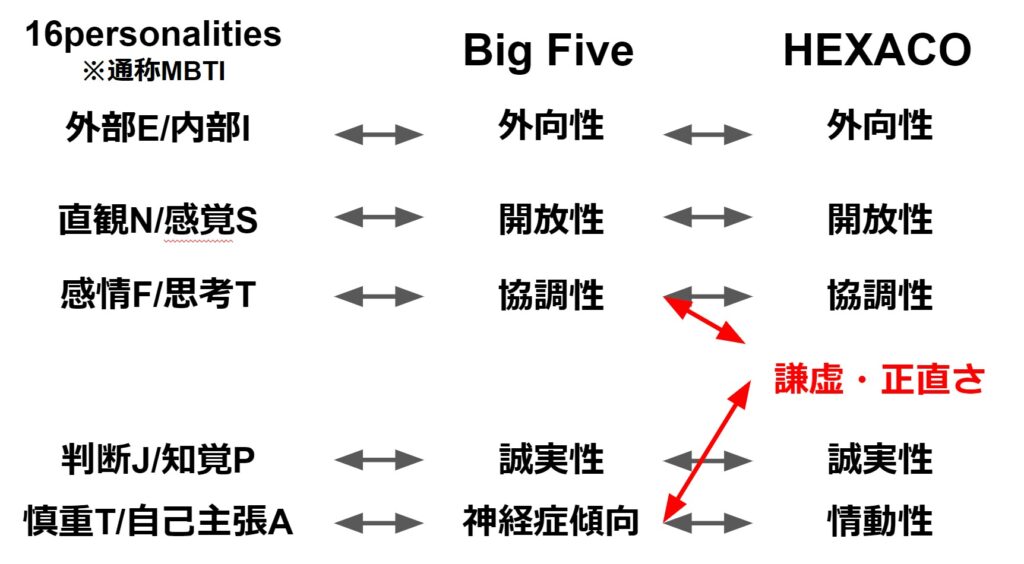
Also, in 16personalities, which was created with reference to MBTI and Big Five, the Big Five neuroticism is called “Identity” and is classified as either Assertive or Turbulent.
On the far right is “HEXACO“, a relatively new personality assessment. It has been improved by adding one indicator “Honesty-Humility” to Big Five.
This article will explain 16personalities personality types in detail based on these correlations.
Since these are originally Big Five and HEXACO research, if you want to know your personality more scientifically than MBTI or 16personalities, please try this HEXACO personality test.
What is ISTJ-A (Logistician・Assertive)?
ISTJ-A is a type with low extraversion (I), low openness (S), low agreeableness (T), high conscientiousness (J), and low neuroticism (A) in Big Five. Characteristics:
- High sense of responsibility and reliability
- Logical and systematic thinking
- Values tradition and order
- Confident decision-making
- Pursuit of efficiency and practicality
They pay attention to detail and achieve their goals efficiently by strictly adhering to rules and procedures. They make decisions based on facts and experience, and value stability. In interpersonal relationships, they prefer honesty and direct communication.
While they are cautious about change, they will adapt if they understand the necessity. They have high stress tolerance and can handle difficult situations calmly.
Scientific Explanation of ISTJ-A (The Administrator – Assertive Type)
Good Physical Health
People with ISTJ-A personality type tend to have good physical health. This is related to their high conscientiousness (J) and low neuroticism (-A) characteristics in the Big Five personality traits.
ISTJ-A individuals tend to maintain regular lifestyle habits and pay attention to health management. Being planned and responsible, they are likely to practice regular exercise and proper dietary management.
Additionally, their high stress tolerance and ability to maintain mind-body balance also contribute to health maintenance.
For more details about the characteristics of ISTJ-A types that make healthy lifestyle habits easy to develop, please see this article.
Easily Get Along with People Who Have Both S and T Traits
ISTJ-A individuals tend to build intimate relationships easily with people who possess both Sensing (S) and Thinking (T) characteristics.
This is related to their low openness (S) and low agreeableness (T) characteristics in the Big Five. ISTJ-A individuals prefer realistic and logical thinking, so they can easily empathize with people who have similar thought processes.
ISTJ-A individuals, who prefer practical approaches and fact-based discussions, can communicate smoothly with people who have S and T characteristics, leading to deeper mutual understanding.
For more details about the types of people who are compatible with ISTJ-A, please see this article.
Properly Maintain Social Distance for Infection Control
ISTJ-A individuals tend to properly maintain social distance for infection control. This is related to their low extraversion (I) characteristic in the Big Five.
ISTJ-A individuals with introverted nature have little resistance to maintaining distance from others and tend to value alone time. Therefore, they can naturally practice social distancing as an infection control measure.
Additionally, their strong sense of responsibility and rule-abiding personality also helps with implementing infection control measures. ISTJ-A individuals are likely to take social demands and expert advice seriously and take appropriate actions.
For more details about ISTJ-A characteristics in infection control, please see this article.
Properly Perform Hand Washing and Other Infection Control Measures
ISTJ-A individuals tend to properly practice basic preventive measures such as hand washing for infection control. This is related to their high conscientiousness (J) characteristic in the Big Five.
ISTJ-A individuals, who are planned and pay attention to details, are likely to easily incorporate infection prevention habits such as hand washing and disinfection into their daily routines. Their strong sense of responsibility and discipline leads to reliable execution of these preventive measures.
Additionally, ISTJ-A individuals have high self-management abilities and sufficient health awareness, so they can naturally take actions to reduce infection risks.
For more details about ISTJ-A behavioral characteristics in infection control, please see this article.
High Work Competence and Performance
ISTJ-A individuals tend to demonstrate high performance at work. This is related to their high conscientiousness (J) and low neuroticism (-A) characteristics in the Big Five.
ISTJ-A characteristics such as planning ability, sense of responsibility, and attention to detail directly contribute to improved productivity in the workplace. They excel at meeting deadlines and delivering high-quality deliverables.
Additionally, having high stress tolerance and emotional stability (-A), they can respond calmly even under pressure. This enables them to maintain consistently high performance.
For more details about ISTJ-A strengths in the workplace, please see this article.
Relatively Common Among Scientists
People with the ISTJ-A type tend to have a relatively high likelihood of excelling as scientists. This is related to their Big Five characteristics of low extraversion (I), low openness (S), low agreeableness (T), high conscientiousness (J), and low neuroticism (-A).
The logical thinking ability, attention to detail, and perseverance of ISTJ-A individuals make them well-suited for scientific research. They can value objective data and approach problem-solving with a systematic methodology.
Additionally, their patience for working on long-term projects and their emphasis on accuracy in results are factors that contribute to success as scientists.
For more details about the compatibility between ISTJ-A and the scientific profession, please see this article.
Common Among Writers/Editors, Artists/Creators, and Counselors/Therapists
Surprisingly, people with the ISTJ-A type are also commonly found in professions such as writers/editors, artists/creators, and counselors/therapists. This is mainly related to their Big Five characteristic of low extraversion (I).
ISTJ-A individuals with introverted tendencies have aptitude for these professions that require deep concentration and introspective thinking. As writers and editors, their attention to detail and logical composition skills become strengths.
As artists and creators, they can leverage their unique perspectives and meticulous work abilities. As counselors and therapists, their listening skills and analytical approach prove valuable.
For more details about the relationship between ISTJ-A and creative professions, please see this article.
Excessive Pursuit of Perfectionism
People with the ISTJ-A type sometimes tend to fall into excessive perfectionism. This is related to their Big Five characteristic of high conscientiousness (J).
ISTJ-A individuals with high standards and attention to detail tend to seek perfection in all tasks. While this trait produces high-quality results, it can sometimes cause excessive stress or delays.
They may struggle to accept the concept of “good enough” and sometimes get so caught up in minor details that overall progress is delayed.
For more details about ISTJ-A perfectionist tendencies and management methods, please see this article.
Health-Conscious and Prefer Vegetables, Dairy Products, and Nuts
People with the ISTJ-A type tend to be health-conscious and prefer nutritious foods such as vegetables, dairy products, and nuts. This is related to their Big Five characteristic of high conscientiousness (J).
ISTJ-A individuals, who are planned and have high self-management abilities, understand the importance of healthy eating and have personalities that make it easy to practice. They tend to be mindful of nutritionally balanced meals and actively incorporate foods that are good for the body.
Additionally, they are likely to build regular eating habits with the goal of long-term health maintenance. Vegetables, dairy products, and nuts are foods considered to be highly nutritious and beneficial for health, matching ISTJ-A preferences.
For more details about ISTJ-A dietary habits and health management, please see this article.
Prone to Right-Wing Authoritarianism (RWA) and Social Dominance Orientation (SDO) Ideologies
People with the ISTJ-A type tend to be prone to right-wing authoritarianism (RWA) and social dominance orientation (SDO) ideologies. This is related to their Big Five characteristics of low openness (S) and low agreeableness (T).
ISTJ-A individuals who value traditional values and existing social order have personalities that easily accept authority and hierarchical structures. Because they prefer stability and order, they are likely to sympathize with conservative political ideologies.
Additionally, their tendency to emphasize logical thinking and pursue efficiency may lead them to view social hierarchies and competition positively.
However, it’s important to note that this is merely a tendency and can vary greatly depending on individual experiences and environment.
For more details about ISTJ-A political tendencies, please see this article.
Relatively Likely to Have Higher Annual Income
People with the ISTJ-A type tend to be more likely to earn relatively high annual incomes. This is related to their Big Five characteristics of low agreeableness (T), high conscientiousness (J), and low neuroticism (-A).
The logical thinking ability, planning skills, and sense of responsibility of ISTJ-A are highly valued characteristics in many workplaces. They can work efficiently and produce high-quality results, making them likely to receive opportunities for promotion and salary increases.
Additionally, being emotionally stable (-A) and having high stress tolerance, they are often entrusted with responsible positions and advanced duties.
However, annual income is determined by various factors including individual effort and environment.
For more details about ISTJ-A career trends, please see this article.
Relatively High Self-Esteem
People with the ISTJ-A type tend to have relatively high self-esteem. This is related to their high conscientiousness in the Big Five (J) and low neuroticism (-A) characteristics.
ISTJ-A individuals have strong self-discipline, responsibility, and steadily work toward goal achievement. These traits make it easier for them to evaluate their abilities and value positively.
Additionally, being emotionally stable (-A) and having high tolerance for stress and anxiety, they can act with confidence. Their logical thinking ability and problem-solving skills also contribute to enhancing their sense of self-efficacy.
For more details about ISTJ-A self-esteem and psychological health, please see this article.
Conducts Calm Risk Management
People with the ISTJ-A type tend to conduct calm and effective risk management. This is related to their high conscientiousness in the Big Five (J) and low neuroticism (-A) characteristics.
ISTJ-A individuals possess logical thinking and attention to detail, enabling them to properly analyze and evaluate potential risks. They can make balanced risk management decisions based on objective data without being swayed by emotions (-A).
Additionally, their strong planning skills and sense of responsibility allow them to formulate concrete measures for risk mitigation and execute them reliably.
For more details about ISTJ-A risk management approaches, please see this article.
Common in Japan’s Hokuriku Region
People with the ISTJ-A type tend to be relatively common in Japan’s Hokuriku region. This is thought to be mainly related to their low agreeableness in the Big Five (T) characteristic.
The cultural characteristics and environment of the Hokuriku region may have high compatibility with ISTJ-A personality traits. For example, conservative culture that values tradition and practical thinking styles for adapting to harsh natural environments may align with ISTJ-A characteristics.
However, this is merely a statistical trend, and it’s important to note that individual differences and other factors have significant influence.
For more details about the relationship between regional characteristics and personality types, please see this article.
Schwartz’s Values: Security
People with the ISTJ-A type tend to value “security” in Schwartz’s theory of values. This is related to their low openness (S) and high conscientiousness (J) characteristics in the Big Five.
ISTJ-A individuals prefer stability and order, and like to live in predictable environments. They tend to value not only personal safety but also social harmony and national security.
This value is closely connected to ISTJ-A’s planning skills and discipline, leading to behaviors that pursue risk avoidance and long-term stability.
Additionally, their attitude of respecting traditional norms and social systems is thought to derive from this “security” value.
For more details about ISTJ-A values and behavioral tendencies, please see this article.
In Conclusion
People with the ISTJ-A type are characterized by being organized, having a strong sense of responsibility, and paying attention to details.
They tend to demonstrate high performance in health management and work, and value stability and order.
On the other hand, they may also tend to fall into perfectionism or dislike change.
By understanding these characteristics, it becomes easier to find ways to leverage your strengths and compensate for your weaknesses.
What’s important is that personality types are merely tendencies, and individual differences are significant.
It’s crucial to grow while cherishing your individuality, using ISTJ-A characteristics as a reference.
Understanding personality helps with self-understanding and understanding others.
This could be a good opportunity to think about your own personality and that of the people around you.
The tendencies introduced are originally based on Big Five and HEXACO research, so if you want to understand personality more scientifically than MBTI or 16personalities, please try this HEXACO personality test.

Writer & Supervisor: Eisuke Tokiwa
Personality Psychology Researcher / CEO, SUNBLAZE Inc.
As a child he experienced poverty, domestic abuse, bullying, truancy and dropping out of school — first-hand exposure to a range of social problems. He spent 10 years researching these issues and published Encyclopedia of Villains through Jiyukokuminsha. Since then he has independently researched the determinants of social problems and antisocial behavior (work, education, health, personality, genetics, region, etc.) and has published 2 peer-reviewed journal articles (Frontiers in Psychology, IEEE Access). His goal is to predict the occurrence of social problems. Spiky profile (WAIS-IV).
Expertise: Personality Psychology / Big Five / HEXACO / MBTI / Prediction of Social Problems
Researcher profiles: ORCID / Google Scholar / ResearchGate
Social & Books: X (@etokiwa999) / note / Amazon Author Page