Do you know about the ENFP-A type?
This is one of the indicators that represents personality, and it has a major influence on our behavior and way of thinking.
In this article, we will explain in detail what characteristics ENFP-A people have, including their health, work, and interpersonal relationships.
Getting to know your own and others’ personalities well may lead to better communication and self-understanding.
Please read this while comparing it with your own and your friends’ personalities.
Once again, personality researcher and author of Villain Encyclopedia, Tokiwa (@etokiwa999), will provide the explanation.
※We have developed the HEXACO-JP Personality Assessment! It has more scientific basis than MBTI. Tap below for details.

目次
- 1 Scientific Background of ENFP-A (Campaigner, Assertive Type)
- 2 Scientific Explanation of ENFP-A (The Campaigner – Assertive Type)
- 2.1 Prone to Feeling Happy
- 2.2 Lucky
- 2.3 Easily Get Along with People Who Have Both N and F
- 2.4 Making New Friends
- 2.5 Relatively High Possibility of Having High IQ
- 2.6 Spirituality
- 2.7 Has Many Social Media Friends
- 2.8 Post Updates and Photos on Social Media
- 2.9 Communicate Through Likes and Encouraging Comments on Social Media
- 2.10 Likely to Actively Gather Information on Social Media
- 2.11 Engage in Altruistic Activities Such as Volunteering
- 2.12 Have High-Quality Social Capital
- 2.13 Prone to Career Success
- 2.14 In Children, There May Be Giftedness
- 2.15 Prefer Fast Food, Ice Cream, Chocolate, Cocoa, Meat, Biscuits, Cake, and Cookies
- 2.16 Relatively High Optimism
- 2.17 Relatively High Resilience
- 2.18 Autonomy and Relatedness Needs in Self-Determination Theory Are Easily Satisfied
- 2.19 Take high risks, less likely to regret even if they fail
- 2.20 Common in Kyushu, Okinawa, and metropolitan areas of Japan
- 2.21 Schwartz’s values: Hedonism, stimulation, self-direction, universalism, benevolence
- 2.22 Particular about clothing
- 3 In conclusion
Scientific Background of ENFP-A (Campaigner, Assertive Type)
Overview of MBTI
MBTI is a psychological theory that classifies personality into 16 types.
MBTI is an abbreviation for Myers-Briggs Type Indicator.
MBTI classifies personality into 16 types by combining the following four indicators.
In other words, MBTI expresses one’s personality tendencies with four letters such as “ISTJ” or “ENFP”. There is the very famous 16personalities which is similar, but this is different from MBTI.
Overview of Big Five
One of the most influential trait theories in personality psychology is the “Big Five”.
Big Five measures five traits: Openness, Conscientiousness, Extraversion, Agreeableness, and Neuroticism.
Also, while 16personalities and MBTI use type classification (e.g., either extroverted or introverted), Big Five evaluates traits with continuous numerical values (e.g., extraversion 3.5), which is a major difference.
Furthermore, it has been studied for a long time, has many papers, and extensive research has been conducted in other fields such as academic ability, income, brain, and genetics. Big Five can be said to have relatively stronger scientific backing.
Correlation Between MBTI, Big Five, and HEXACO
There is a correlation between MBTI’s four indicators and Big Five’s five factors.
A representative study showing this correlation is the paper “The relationship between the revised NEO-Personality Inventory and the Myers-Briggs Type Indicator“.
According to this paper, the correlation between MBTI and Big Five is as follows.
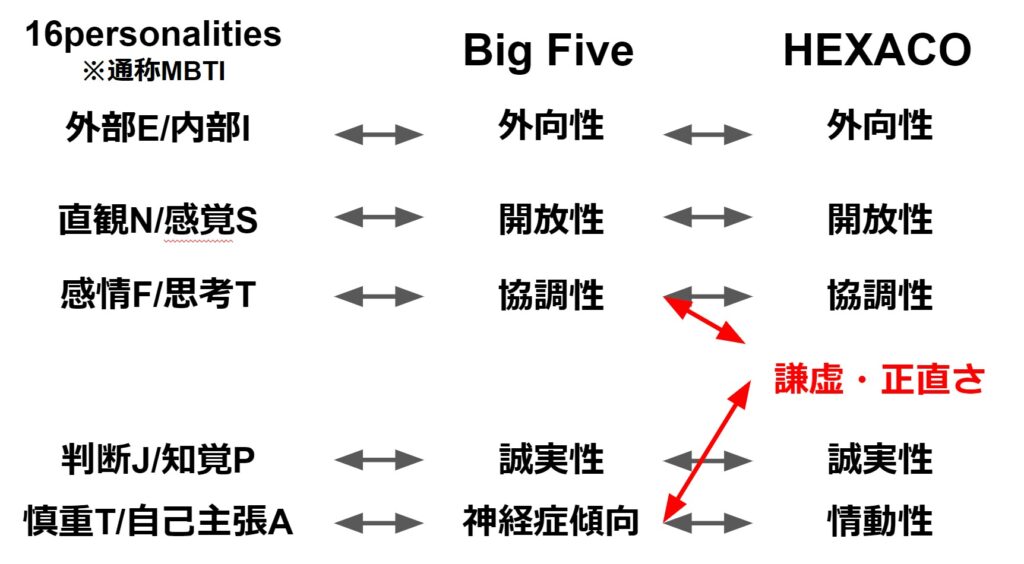
Also, in 16personalities, which was created with reference to MBTI and Big Five, the neuroticism of Big Five is called “Identity” and is classified as either Assertive or Turbulent.
On the far right is “HEXACO“, a relatively new personality assessment. It has been improved by adding one indicator, “Honesty-Humility”, to Big Five.
This article will provide detailed explanations of 16personalities personality types based on this correlation.
Since it was originally research on Big Five and HEXACO, if you want to know your personality more scientifically than MBTI or 16personalities, please try this HEXACO personality test.
What is ENFP-A (Campaigner, Assertive Type)?
ENFP-A is a type with high extraversion (E), high openness (N), high agreeableness (F), low conscientiousness (P), and low neuroticism (A) in Big Five. Characteristics:
- Rich creativity and enthusiasm
- High adaptability and flexibility
- Values deep connections with others
- Confident self-expression
- Positive worldview
They feel joy in generating new ideas and sharing them with others. They use their intuition and empathy to inspire people and find innovative solutions.
In interpersonal relationships, they seek sincere and meaningful interactions and respect diversity. They welcome change and challenges, and constantly explore new possibilities. They have high stress tolerance and positively view failures as learning opportunities.
Scientific Explanation of ENFP-A (The Campaigner – Assertive Type)
Prone to Feeling Happy
ENFP-A individuals tend to feel happy easily. With high extraversion (E) and agreeableness (F) and low neuroticism (-A), they are likely to experience positive emotions. They enjoy interacting with others and easily gain happiness by building good relationships with people around them.
Additionally, they have high stress tolerance and can maintain a positive attitude even in difficult situations. These characteristics combined make ENFP-A individuals tend to find happiness easily in daily life.
Please see this article for more details.
Lucky
ENFP-A individuals tend to feel lucky. With high extraversion (E) and openness (N) and low neuroticism (-A), they tend to be open to new opportunities and possibilities and take proactive action.
This allows them to seize opportunities without missing them, resulting in feeling “lucky.” Their optimistic nature also helps them find positive aspects even in difficult situations, which may feel like attracting good fortune.
Please see this article for more details.
Easily Get Along with People Who Have Both N and F
ENFP-A individuals tend to get along easily with people who have both intuition (N) and feeling (F). This is because ENFP-A themselves have both intuitive and emotional aspects.
NF-type people who are imaginative and highly sensitive can easily understand each other’s thoughts and emotions, making it easy to build deep bonds. The characteristic is that they can easily create relationships where they stimulate each other by sharing ideas and providing emotional support.
Please see this article for more details.
Making New Friends
ENFP-A individuals are good at making new friends. With high extraversion (E), they feel energized by interacting with people and actively try to build new relationships.
Their curious and sociable nature allows them to naturally start conversations in various situations and show interest in others. Also, with their warm personality and tendency to accept others easily, they can get along well even with people they meet for the first time. ENFP-A individuals tend to build diverse friendships easily.
Please see this article for more details.
Relatively High Possibility of Having High IQ
ENFP-A individuals have a relatively high possibility of having high IQ. With high openness (N) and low neuroticism (-A), they tend to have high ability to understand new ideas and concepts and think creatively.
They prefer abstract thinking and are good at finding patterns, and these characteristics tend to lead to high scores on IQ tests. However, since IQ has large individual differences, this cannot be generalized. ENFP-A individuals often have strong intellectual curiosity and maintain a positive attitude toward learning.
Please see this article for more details.
Spirituality
ENFP-A individuals tend to be interested in spirituality. The combination of intuition (N) and feeling (F) strengthens their tendency to seek life’s meaning, purpose, and connection with transcendent things.
Being imaginative and highly sensitive, they tend to be interested in the invisible world and spiritual growth. They also show interest in self-exploration and personal growth, and tend to seek to find connections with themselves and the world by exploring the deeper aspects of life.
Please see this article for more details.
Has Many Social Media Friends
ENFP-A individuals tend to have many friends on social media. Due to their high extroversion (E), they can actively enjoy interactions even online.
They are open to meeting new people and will find interesting individuals on social media to connect with. Their open and friendly personality also makes them approachable online, making them well-liked by many. ENFP-A individuals are likely to build extensive networks through social media.
Please see this article for more details.
Post Updates and Photos on Social Media
ENFP-A individuals tend to actively post updates and photos on social media. Due to their high extroversion (E) and openness (N), they find joy in sharing their experiences and thoughts with others.
They actively post about new experiences and interesting discoveries, enjoying interactions with followers. Their creative side may also lead them to post with unique perspectives and expressive methods. ENFP-A individuals’ social media posts tend to be energetic and attractive.
Please see this article for more details.
Communicate Through Likes and Encouraging Comments on Social Media
When using social media, ENFP-A individuals tend to actively communicate through “likes” and encouraging comments. Due to their high extroversion (E) and agreeableness (F), they find joy in supporting others and engaging in positive interactions.
They empathize with followers’ posts and try to build good relationships online by offering warm words. ENFP-A individuals excel at encouraging people around them through social media and creating positive atmospheres.
Please see this article for more details.
Likely to Actively Gather Information on Social Media
ENFP-A individuals are likely to actively gather information through social media. Due to their high openness (N), they have a strong curiosity about new knowledge and information.
They are interested in various topics and will follow diverse information sources on social media to explore the latest trends and new ideas. They also tend to quickly grasp important points from large amounts of information using their intuitive understanding. ENFP-A individuals are highly likely to absorb broad knowledge through social media and expand their perspectives.
Please see this article for more details.
Engage in Altruistic Activities Such as Volunteering
ENFP-A individuals tend to actively participate in altruistic activities such as volunteering. Due to their high extroversion (E) and agreeableness (F), they find joy in helping others and contributing to society.
They have high empathy for people’s and society’s problems and think about how they can use their abilities to help. They also tend to seek new experiences, so they are likely to be interested in various forms of volunteer activities and participate actively.
ENFP-A individuals may try to achieve self-realization and support for others simultaneously through social contribution activities.
Please see this article for more details.
Have High-Quality Social Capital
ENFP-A individuals tend to have high-quality social capital. Due to their high extroversion (E) and agreeableness (F), and low neuroticism (-A), they are likely to build good relationships across a wide range.
They excel at connecting with diverse people and building trust relationships.
Their attitude of understanding and supporting others also makes it easy for them to create reciprocal relationships. ENFP-A individuals tend to easily obtain various forms of “capital” such as information, opportunities, and emotional support through these rich human relationships.
Please see this article for more details.
Prone to Career Success
People with ENFP-A personality tend to be successful in their careers. With high extraversion (E) and agreeableness (F), and low neuroticism (-A), they are characterized by their ability to build good workplace relationships and their strong resilience to stress.
Being creative and adaptable, they can flexibly respond to various situations.
Additionally, with high communication skills and the ability to effectively convey ideas, they are likely to demonstrate leadership. ENFP-A individuals have a high potential to build fulfilling careers while leveraging their strengths.
For more details, please see this article.
In Children, There May Be Giftedness
In the case of ENFP-A children, there is a possibility they may be gifted (intellectually talented children). With high openness (N), they tend to excel in abstract thinking and creative problem-solving abilities.
They are curious and highly motivated to learn, and may possess the ability to quickly understand complex concepts. They also tend to be highly sensitive and have deep insight.
However, determining giftedness requires comprehensive evaluation by professionals. For ENFP-A children, appropriate environment and support will be important for nurturing their unique talents.
For more details, please see this article.
Prefer Fast Food, Ice Cream, Chocolate, Cocoa, Meat, Biscuits, Cake, and Cookies
ENFP-A individuals tend to prefer foods such as fast food, ice cream, chocolate, cocoa, meat, biscuits, cake, and cookies. With high extraversion (E) and openness (N), they tend to enjoy new flavors and stimulating food experiences.
These foods may align with the ENFP-A personality in that they provide immediate satisfaction and are easily shared in social settings. They may also have a tendency to seek sensory pleasures, which could explain their attraction to these sweet and rich-flavored foods.
For more details, please see this article.
Relatively High Optimism
ENFP-A individuals tend to have relatively high optimism. With high extraversion (E), openness (N), and agreeableness (F), and low neuroticism (-A), they tend to approach life with a positive attitude.
Even in difficult situations, they can find positive aspects and think of creative solutions.
Additionally, they easily receive support through good relationships with others, which contributes to their optimistic outlook. ENFP-A individuals can leverage this optimism to approach various challenges with a positive attitude.
For more details, please see this article.
Relatively High Resilience
ENFP-A individuals tend to have relatively high resilience (recovery ability). With high extraversion (E), openness (N), and agreeableness (F), and low neuroticism (-A), they possess the ability to flexibly respond to stress and adversity.
Even when facing difficult situations, they can find creative solutions and maintain a positive attitude.
Additionally, they easily receive support through connections with others, which contributes to enhancing their resilience. ENFP-A individuals have a high potential to overcome various life challenges by leveraging this recovery ability.
For more details, please see this article.
Autonomy and Relatedness Needs in Self-Determination Theory Are Easily Satisfied
ENFP-A individuals tend to easily satisfy the autonomy and relatedness needs in self-determination theory. With high extraversion (E) and agreeableness (F), and low neuroticism (-A), they can act according to their own will while building good relationships with others.
By valuing their authenticity while maintaining connections with people around them, they are likely to achieve a balanced sense of fulfillment. Additionally, with their tendency to actively seek new experiences and relationships, they have characteristics that make it easier to achieve both self-realization and harmonious human relationships.
Please see this article for more details.
Take high risks, less likely to regret even if they fail
ENFP-A individuals tend to take high risks and have the characteristic of not regretting much even if they fail.
Due to their high openness (N) and spontaneity (P), they are proactive toward new possibilities and find value in taking on challenges.
They tend to view failure as a learning opportunity and value the experience and knowledge gained from it.
Additionally, their optimistic nature helps them easily look forward even after failure. ENFP-A individuals may leverage this risk-taking attitude to pursue new opportunities and growth possibilities.
Please see this article for more details.
Common in Kyushu, Okinawa, and metropolitan areas of Japan
ENFP-A types tend to be relatively common in Japan’s Kyushu, Okinawa, and metropolitan areas.
The culture and environment of these regions may foster people with extroverted (E), intuitive (N), and feeling (F) characteristics.
For example, the warm human relationships and open atmosphere of Kyushu and Okinawa, and the diversity and stimulating environment of metropolitan areas, may align with ENFP-A characteristics.
Please see this article for more details.
Schwartz’s values: Hedonism, stimulation, self-direction, universalism, benevolence
ENFP-A individuals tend to value hedonism, stimulation, self-direction, universalism, and benevolence in Schwartz’s theory of values. These values align well with ENFP-A’s extroversion (E), openness (N), and agreeableness (F) characteristics.
They tend to seek new experiences and enjoyment (hedonism, stimulation), value being true to themselves (self-direction), while simultaneously considering the happiness of others and society as a whole (universalism, benevolence). ENFP-A individuals are likely to live their lives balancing self-actualization and social contribution based on these values.
Please see this article for more details.
Particular about clothing
ENFP-A individuals tend to be particular about their clothing. Due to their high extroversion (E) and openness (N), they value clothing as a means of self-expression and may prefer individualistic and creative styles.
They are interested in new fashion trends and enjoy unique styling by adding their own interpretation. They may also find joy in expressing their inner self and mood through clothing. For ENFP-A individuals, clothing may serve as an outlet for self-expression and creativity, not just appearance.
Please see this article for more details.
In conclusion
ENFP-A individuals have very unique and attractive characteristics.
They enjoy interacting with people and are skilled at generating new ideas. They tend to seek fun and stimulating experiences and view life positively.
They are good at making friends and actively communicate on social media. They are unlikely to be discouraged by difficulties and try to solve problems through creative methods.
They are also interested in helping others and participating in volunteer activities. Their individuality is likely to show in their clothing and food preferences as well.
The tendencies introduced are originally from Big Five and HEXACO research, so if you want to understand personality more scientifically than MBTI or 16personalities, please try this HEXACO personality test.

Writer & Supervisor: Eisuke Tokiwa
Personality Psychology Researcher / CEO, SUNBLAZE Inc.
As a child he experienced poverty, domestic abuse, bullying, truancy and dropping out of school — first-hand exposure to a range of social problems. He spent 10 years researching these issues and published Encyclopedia of Villains through Jiyukokuminsha. Since then he has independently researched the determinants of social problems and antisocial behavior (work, education, health, personality, genetics, region, etc.) and has published 2 peer-reviewed journal articles (Frontiers in Psychology, IEEE Access). His goal is to predict the occurrence of social problems. Spiky profile (WAIS-IV).
Expertise: Personality Psychology / Big Five / HEXACO / MBTI / Prediction of Social Problems
Researcher profiles: ORCID / Google Scholar / ResearchGate
Social & Books: X (@etokiwa999) / note / Amazon Author Page