
Once again, personality researcher and author of Villain Encyclopedia, Tokiwa (@etokiwa999), will provide the explanation.
※We have developed the HEXACO-JP Personality Assessment! It has more scientific basis than MBTI. Tap below for details.

Understanding the link between personality and development can fundamentally change the way you raise children — and the results can last a lifetime. Many parents find themselves puzzled when a child excels academically yet struggles to make friends, or shows clear intelligence but gives up at the first sign of difficulty. Recent educational research points to a powerful explanation: the skills that matter most for long-term success are often the ones that no standardized test can measure. These are called non-cognitive skills, and learning how to nurture them is one of the most valuable things any parent or educator can do.
This article draws on the latest findings in personality psychology, attachment theory, and social emotional learning (SEL) to give you a comprehensive, practical guide to building your child’s inner strengths. Whether you are a parent frustrated by daily conflicts at home, a teacher looking for evidence-based tools, or simply someone curious about character development in children, you will find science-backed strategies here that are clear enough for any reader to apply.
目次
- 1 How Personality and Development Unfold in Children
- 2 What Are Non-Cognitive Skills — and Why Do They Matter More Than Grades?
- 3 The 50/50 Rule: How Genes and Environment Shape Personality
- 4 SEL Education: Building Non-Cognitive Skills Through Social Emotional Learning
- 5 Understanding Parenting Frustration Through Personality Psychology
- 6 How a Parent’s Own Personality Shapes Character Development in Children
- 7 Practical Strategies for Nurturing Non-Cognitive Skills at Home
- 8 Frequently Asked Questions
- 8.1 At what age can non-cognitive skills start to be developed in children?
- 8.2 Why do siblings raised in the same home often have completely different personalities?
- 8.3 My child is quite introverted — should I try to make them more outgoing?
- 8.4 How can I help a child who spends too much time on video games develop better self-control?
- 8.5 What can I do if my child is academically strong but struggles socially?
- 8.6 Does parental divorce affect a child’s personality development?
- 8.7 Is there a reliable way to measure whether a child’s non-cognitive skills are improving?
- 9 Summary: Investing in the Skills That Last a Lifetime
- 10 Related Articles
- 11 Try Taking the Proper Personality Test “HEXACO-JP”!
- 12 Scientific Background of the 16 Types
- 13 FAQ and Important Notes
How Personality and Development Unfold in Children
A child’s personality tends to emerge from a continuous interaction between inborn temperament and the surrounding environment, with the period from birth to age 3 considered especially critical. Personality psychology research consistently shows that the quality of early attachment relationships lays the psychological foundation for nearly every aspect of character that follows. This is the core premise of attachment theory parenting: the bonds formed in the earliest years shape how a child will relate to others, manage emotions, and approach challenges for decades to come.
Character development in children does not happen all at once. It unfolds in recognizable stages, each building on the last. Around 6 months of age, basic temperamental traits — including activity level, regularity of biological rhythms, and approach or withdrawal tendencies — begin to emerge. Between ages 1 and 2, a sense of self starts to form. By age 3, the foundations of how a child relates to others are largely in place. Throughout each of these windows, the way parents and caregivers respond plays an outsized role in shaping the outcome.
- 0–6 months: Formation of basic trust — the child learns whether the world is safe and reliable based on how consistently caregivers respond to needs.
- 6 months–2 years: Establishment of secure attachment — a stable emotional bond with a primary caregiver that serves as the base for all future relationships.
- 2–6 years: Development of autonomy and early social skills — children begin to test boundaries, cooperate with peers, and regulate simple emotions.
- 6–12 years: Consolidation of learning attitudes and cooperation — study habits, persistence, and the ability to work in groups become more defined.
Crucially, research suggests that personality continues to evolve throughout life. Adolescence is sometimes called the “second formation period” of character, because the experiences of the teenage years tend to leave a strong imprint on adult personality traits. This means that early investment is valuable, but it also means that it is never too late to create a more supportive environment. The sooner intentional, well-informed parenting begins, however, the greater the cumulative benefit for the child’s non-cognitive skills.
What Are Non-Cognitive Skills — and Why Do They Matter More Than Grades?
Non-cognitive skills are the psychological and social capacities that standardized tests cannot capture, yet research suggests they are among the strongest predictors of life success. They include self-control, perseverance, empathy, curiosity, cooperation, and emotional regulation — qualities that determine how well a person navigates real-world challenges long after school exams are forgotten. Understanding non-cognitive skills is inseparable from understanding personality and development, because these qualities are rooted in the same temperamental and environmental forces that shape character.
Research drawing on Nobel Prize-winning work in economics indicates that early investment in non-cognitive skills tends to yield returns of roughly 7% to 10% per year in adult outcomes such as employment, income, and health. In practical terms, this means that nurturing a child’s curiosity, resilience, and self-regulation may produce even greater long-term gains than intensive academic tutoring. Cognitive ability — IQ and academic knowledge — matters, but non-cognitive skills appear to multiply its effects.
- Self-regulation: The ability to manage impulses and sustain effort toward a goal — a key predictor of academic achievement, health, and relationship quality in adulthood.
- Social competence: The capacity to cooperate, communicate, and build positive relationships — essential for both professional and personal success.
- Motivation and grit: The drive to persist through difficulty rather than giving up — closely linked to long-term achievement across many life domains.
- Self-awareness: The ability to recognize and reflect on one’s own emotions and behavior — foundational for emotional intelligence and good decision-making.
- Metacognition: Understanding and managing one’s own learning processes — this skill tends to improve academic performance by helping children study more strategically.
It is also worth noting that non-cognitive skills and academic learning are not competing priorities — they tend to reinforce each other. A child with strong self-control can focus during lessons, leading to better knowledge retention. A child with high curiosity explores topics independently, achieving deeper understanding. In this sense, non-cognitive skills are not just a complement to academic learning; they are its engine. Building these skills early creates a self-reinforcing cycle of engagement and growth.
The 50/50 Rule: How Genes and Environment Shape Personality
Twin studies consistently suggest that genetic and environmental factors each account for roughly 50% of personality variation — a finding that carries enormous practical implications for parents. The fact that environment contributes approximately half of the influence means that the choices adults make around a child genuinely matter, even when that child has strong inborn temperamental tendencies. Personality is not destiny, and no child’s character is fixed at birth.
The genetic component provides the raw material: a predisposition toward certain levels of the Big Five personality traits — openness to experience, conscientiousness, extraversion, agreeableness, and neuroticism. These tendencies emerge early and tend to remain relatively stable across the lifespan. However, they represent tendencies, not fixed outcomes. The environmental half of the equation shapes how those tendencies are expressed, amplified, or moderated.
- Genetic factors (approx. 50%): Baseline temperament, emotional sensitivity, and fundamental response patterns — the biological starting point that each child brings into the world.
- Shared environment (approx. 10%): Factors common to all children in the same household, such as family income, parenting philosophy, neighborhood, and cultural values.
- Non-shared environment (approx. 40%): Individual experiences that differ between siblings — birth order effects, unique friendships, specific school events, illnesses, and the countless micro-interactions that make each person’s life story distinct.
The relatively small contribution of shared environment — only around 10% — often surprises parents. It helps explain why 2 children raised in the same home by the same parents can develop markedly different personalities. Each child occupies a slightly different psychological niche within the family, perceives parental behavior differently, and accumulates a unique set of formative experiences outside the home. This insight suggests that rather than applying a uniform parenting strategy, it tends to be more effective to tailor responses to each child’s individual temperament. Research also indicates that the influence of environment grows stronger during adolescence, making the teen years a particularly important window for thoughtful guidance.
SEL Education: Building Non-Cognitive Skills Through Social Emotional Learning
Social Emotional Learning (SEL) is a structured, evidence-based approach to developing the emotional and relational skills that underpin non-cognitive development — and its effects have been documented across decades of follow-up research. SEL education programs, now widely implemented across the United States, Europe, and parts of Asia, teach children to understand and manage emotions, build empathy, and make responsible decisions. For any parent or educator interested in character development in children, SEL represents one of the most rigorously tested frameworks available.
Large-scale follow-up studies indicate that children who participate in quality SEL programs show academic performance improvements averaging around 11 percentile points compared to peers who did not receive such programs. Problem behaviors tend to decrease by approximately 10%. Perhaps most strikingly, longitudinal tracking conducted 18 years after program completion has found significantly higher employment rates and incomes among SEL participants — evidence that these early interventions create lasting benefits that extend well into adulthood.
- Self-awareness: Recognizing one’s own emotions, values, and strengths — the starting point for all other SEL competencies and a cornerstone of healthy personality and development.
- Self-management: Regulating emotions and behaviors appropriately in different situations — includes impulse control, goal-setting, and stress management.
- Social awareness: Understanding the perspectives and feelings of others, including people from different backgrounds — the foundation of empathy and inclusive behavior.
- Relationship skills: Communicating clearly, cooperating effectively, and resolving conflicts constructively — skills that directly predict career and relationship success.
- Responsible decision-making: Making ethical, constructive choices about personal and social behavior — helps children develop moral reasoning alongside practical judgment.
Implementing SEL at home does not require a formal curriculum. The most powerful approach tends to start with parents modeling emotional literacy themselves. When a child expresses anger or sadness, responding with phrases like “It sounds like you’re feeling really frustrated right now — let’s think about this together” validates the emotion without reinforcing unhelpful behavior. Over time, this consistent, empathic stance teaches children that emotions are manageable and that challenges can be approached collaboratively. These everyday interactions, repeated thousands of times across childhood, are the raw material from which non-cognitive skills are built.
Understanding Parenting Frustration Through Personality Psychology
A significant portion of parenting frustration tends to stem not from a child’s “bad behavior” but from mismatches between parent and child personality types, combined with unrealistic expectations about developmental stages. When parents gain a clearer understanding of both their own temperament and their child’s, many conflicts begin to look less like defiance and more like natural differences in how people process the world — differences that can be bridged with the right approach.
Consider a common scenario: a highly extraverted parent who energizes easily through social interaction raises a strongly introverted child who needs quiet time to recharge. The parent may interpret the child’s withdrawal as antisocial or sulky behavior, when in fact the child is simply managing sensory overload. Conversely, a parent who scores high in conscientiousness — valuing order, routine, and careful planning — may clash regularly with a child high in openness, who thrives on novelty and resists schedules. Neither profile is problematic; the friction arises from the mismatch and the lack of a framework for understanding it.
- Temperament mismatches: Differences in activity level, emotional sensitivity, and adaptability between parent and child can create friction that is mistaken for willful defiance.
- Developmentally misaligned expectations: Asking a 3-year-old to “control themselves” to the same standard as a 10-year-old sets both parent and child up for failure.
- Transmission of parental neuroticism: Research suggests that parents high in anxiety or emotional instability may unintentionally model stress responses that children absorb and replicate.
- Fatigue-driven overreactions: When parents are physically or emotionally depleted, minor behaviors tend to trigger disproportionate responses that damage trust over time.
The most practical first step for reducing parenting frustration is to objectively assess your own Big Five personality traits. A parent who recognizes high neuroticism in themselves can deliberately practice the “pause and reframe” habit — taking a breath before reacting and asking, “Is this behavior actually dangerous or disrespectful, or is it simply inconvenient for me right now?” Additionally, reinterpreting a child’s challenging behavior as a developmental process rather than a character flaw tends to produce calmer responses. This shift in perspective not only reduces conflict but also supports the child’s emotional security and, through that, their non-cognitive development.
How a Parent’s Own Personality Shapes Character Development in Children
A parent’s personality traits influence a child’s development through both genetic transmission and the daily environment they create — making parental self-awareness one of the most underutilized tools in child-rearing. Studies examining Big Five personality traits in parents consistently find that parental conscientiousness and agreeableness are among the strongest predictors of positive non-cognitive outcomes in children, though every trait carries both potential benefits and potential risks depending on how it is expressed.
A conscientious parent who emphasizes routines, goal-setting, and follow-through naturally models self-regulation for their child. Children in these households tend to develop stronger executive function and study habits. An agreeable parent who responds with warmth and empathy creates the kind of secure attachment environment that attachment theory parenting identifies as essential for healthy emotional development. At the same time, even traits that seem straightforwardly positive can become counterproductive in excess — a highly conscientious parent who cannot tolerate imperfection may inadvertently communicate that mistakes are catastrophic, undermining a child’s willingness to take healthy risks.
- Neuroticism: High levels tend to be associated with stress responses that children can easily absorb through observation — but parents who are aware of this tendency can use it as a motivation to build their own emotion-regulation skills, ultimately becoming more attuned caregivers.
- Extraversion: Extraverted parents often provide rich social modeling, helping children observe how to initiate conversations and navigate group dynamics — particularly valuable for children who are naturally shy.
- Openness to experience: Parents high in openness tend to create stimulating, curiosity-rich home environments that fuel intrinsic motivation and creative thinking in children.
- Agreeableness: Warmth and empathy from a highly agreeable parent promote secure attachment and emotional safety, both central to healthy personality and development.
- Conscientiousness: Structured, reliable parenting provides children with a blueprint for responsibility, planning, and delayed gratification — foundational non-cognitive skills.
It is important to emphasize that no personality profile makes someone a “good” or “bad” parent. Research suggests that what matters most is self-knowledge and intentionality. A parent high in neuroticism who has developed strong emotional regulation strategies may actually be more sensitive to a child’s subtle emotional cues than someone who has never needed to examine their own reactions. An introverted parent can provide a calm, reflective home environment that fosters concentration and introspection. The goal is not to change who you are but to understand your own tendencies well enough to consciously create the conditions in which your child’s unique personality can flourish.
Practical Strategies for Nurturing Non-Cognitive Skills at Home
The most effective approaches to building non-cognitive skills in children are those embedded in everyday routines rather than reserved for special lessons — consistency and relationship quality matter far more than any single intervention. The following strategies are drawn from the convergence of attachment theory parenting, SEL education principles, and personality psychology research. Each one includes both the rationale behind it and a concrete method for putting it into practice.
1. Use Emotion Coaching Instead of Dismissal or Punishment
When a child is upset, the instinctive parental responses are often either to minimize (“It’s not a big deal”) or to discipline (“Stop crying or you’ll go to your room”). Research on emotional development suggests that neither approach builds self-regulation. Emotion coaching — naming the feeling, validating it, and then collaboratively problem-solving — teaches children that emotions are informative rather than dangerous. Practice: the next time your child becomes upset, try saying “I can see you’re really angry. That makes sense. What do you think would help right now?” This 3-step response (observe, validate, redirect) builds emotional vocabulary and impulse control simultaneously.
2. Create Structured Opportunities for Gradual Challenge
Perseverance and grit are not personality traits that children either have or don’t have — they are skills built through repeated experiences of working through manageable difficulty. The key word is “manageable”: tasks that are too easy produce boredom, while tasks that are too hard produce anxiety and avoidance. Research on skill development suggests that the optimal learning zone sits just beyond a child’s current comfort level. Practice: help your child identify 1 activity per week that is slightly challenging — a puzzle just above their current level, a new recipe to help cook, or a short book in a slightly harder genre. Celebrate the effort explicitly (“I noticed you kept trying even when it was hard”) rather than only the result.
3. Model the Behavior You Want to See
Children learn far more from observation than from instruction. A parent who talks about the importance of patience while visibly losing their temper at traffic is teaching impatience, regardless of their words. Research on social learning suggests that children under age 12 in particular absorb behavioral templates from primary caregivers with remarkable fidelity. Practice: identify 1 non-cognitive skill you most want your child to develop — perhaps resilience or empathy — and deliberately practice it visibly in front of them. If you make a mistake, model the repair process too: “I got frustrated earlier and said something unkind. I’m going to apologize because that matters.”
4. Prioritize Unstructured Play and Child-Led Activities
In an era of tightly scheduled enrichment activities, unstructured play is increasingly rare — yet research on child development consistently identifies free play as one of the most powerful contexts for building self-regulation, creativity, and social problem-solving. When children direct their own play, they practice negotiating rules, managing frustration, and sustaining attention without adult prompting. Practice: aim to protect at least 30 minutes of child-led, screen-free play each day. Resist the urge to intervene unless safety is at risk. The conflicts children navigate during free play — who gets which toy, what the rules are, how to include a reluctant friend — are precisely the social-emotional exercises that build long-term character.
5. Adjust Your Approach to Each Child’s Individual Temperament
Because non-shared environment accounts for approximately 40% of personality variation, the same parenting strategy can produce very different outcomes in different children. An approach that builds confidence in a bold, sociable child might overwhelm a sensitive, introverted one. Practice: spend 10–15 minutes of undivided, one-on-one time with each child daily, following their lead in terms of activity and conversation. This “special time” serves multiple functions: it builds secure attachment, helps you observe each child’s unique temperament up close, and allows you to calibrate your approach to what actually works for that individual rather than relying on a one-size-fits-all method.
Frequently Asked Questions
At what age can non-cognitive skills start to be developed in children?
Non-cognitive skills begin developing from birth. Research suggests that the period from 0 to 6 years is particularly critical, as this is when attachment bonds, basic trust, and foundational emotional regulation patterns are established. However, because the brain retains a degree of plasticity throughout life, it is possible to strengthen these skills during adolescence and even adulthood with the right support. Early investment tends to yield the greatest returns, but meaningful improvement is achievable at any stage.
Why do siblings raised in the same home often have completely different personalities?
Siblings differ in personality primarily because of individual genetic variation and what researchers call the “non-shared environment” — the unique set of experiences each child accumulates outside of (and sometimes within) the family. Birth order, distinct friendships, different teachers, and even illness at key developmental moments all contribute. Studies indicate that parents also tend to respond differently to each child without realizing it, and children perceive and internalize the same parenting behaviors in different ways. These combined factors produce meaningfully different personality profiles even among children raised under the same roof.
My child is quite introverted — should I try to make them more outgoing?
Introversion is not a flaw to be corrected; it is a legitimate personality style with its own strengths. Introverted children tend to concentrate deeply, think carefully before acting, and form fewer but more meaningful relationships. Pressuring them to become more extraverted can generate anxiety and erode self-confidence without producing genuine social growth. A more evidence-informed approach is to honor the child’s introverted nature while gradually introducing manageable social situations and equipping them with specific communication skills — so they can engage comfortably when they choose to, rather than feeling forced.
How can I help a child who spends too much time on video games develop better self-control?
Self-control is a skill built incrementally rather than imposed through restriction. Research on self-regulation training suggests that involving the child in designing the rules tends to produce better compliance than top-down mandates. Try co-creating a screen-time agreement that uses visual timers so the child can track time independently. Simultaneously, introduce alternative activities that offer comparable stimulation and a sense of achievement. Reinforce rule-following with specific, genuine praise (“You stopped when the timer went off — that took real discipline”) rather than focusing primarily on violations.
High cognitive ability and strong social skills are independent dimensions of development, so it is not uncommon for a child to excel in one while lagging in the other. To build social awareness, try discussing the emotions of characters in books, films, or real-life stories during relaxed family time — this develops perspective-taking in a low-pressure context. Socially, starting with small-group or 1-on-1 activities in areas the child is genuinely passionate about tends to be more effective than forcing large group participation. Shared-interest clubs or hobby-based classes can organically create peer connections around common ground.
Does parental divorce affect a child’s personality development?
Research suggests that the quality of the home environment before, during, and after a divorce matters more than the divorce itself. Prolonged parental conflict — whether or not it ends in separation — tends to be more damaging to a child’s emotional development than a peaceful single-parent household. The most protective factors following a divorce include maintaining at least one stable, secure attachment relationship, minimizing children’s exposure to adult conflict, and providing age-appropriate explanations alongside consistent emotional support. When these conditions are met, many children demonstrate considerable resilience over time.
Is there a reliable way to measure whether a child’s non-cognitive skills are improving?
Because non-cognitive skills do not lend themselves to conventional testing, observational tracking tends to be more informative than formal assessments. Useful indicators include: how long a child persists on a frustrating task, how quickly they recover emotionally after a setback, how frequently they show spontaneous acts of empathy toward others, and how willingly they attempt unfamiliar challenges. Keeping a simple weekly journal of these observations makes change visible over time. Regularly asking children open-ended questions — “What was hard for you this week, and how did you handle it?” — also builds the self-awareness that is itself a core non-cognitive skill.
Summary: Investing in the Skills That Last a Lifetime
The science of personality and development offers a genuinely optimistic message: while genes give each child a starting point, roughly half of what shapes character comes from environment — and that environment is something parents, teachers, and communities can actively influence. Non-cognitive skills such as self-regulation, empathy, and perseverance are not fixed qualities that children either possess or lack; they are capacities that grow through secure relationships, emotionally intelligent parenting, and consistent, well-calibrated challenge. SEL education, attachment theory parenting, and an understanding of Big Five personality traits each provide practical tools for supporting this growth. The window of greatest opportunity is early childhood, but meaningful development continues across the entire lifespan.
If today’s article sparked curiosity about where your own personality patterns might be shaping your parenting — or where your child’s temperament sits across key traits — exploring your own Big Five profile can be a surprisingly illuminating first step. Discover which personality dimensions are at work in your family, and see how that self-knowledge can translate into more confident, connected parenting.
Related Articles
- IQ and Academic Performance Are Very Strongly Correlated — Research Explained
- Does More Education Mean Higher Income? A 7-Country Twin Study Comparison
- Lifespan Heritability Is 20–40% — Research on the Genes That Influence Longevity
- Happiness Is 30–40% Heritable — How to Claim Your Own Well-Being
- Self-Determination Theory Explained — High Motivation Is About 50% Genetic
- Dark Triad Heritability Is 30–60% — Causes of the Dark Triad Explained
- How to Strengthen SEL (Social and Emotional Learning) — The RULER Method
- How Do School Grades Relate to Job Performance? Research by Education Level and Field
- The Limits of Non-Cognitive Skills — Insights from a Meta-Analysis of 500 Studies
- How Children Can Develop Social-Emotional Skills — Research Review
- What Is Self-Compassion? Methods and Effects Explained Through Research
- What Should Early Childhood Education Include? A Science-Based Guide
- Self-Efficacy Heritability Is 75% — Research on the Confidence Gap
- How Parent-Adolescent Conflict Affects Depression in Children — Latest Research
- Marriage Is About 60% Heritable, Divorce About 30% — Research Explained
- Improving Humility Through Group Counseling — Research Review
- Intelligence Heritability — Is Raw Intelligence 80% Nature? Research Explained
- Adverse Childhood Experiences (ACEs): How Abuse Can Increase Adult Drug Use Tenfold
- Does IQ or Non-Cognitive Ability Better Compensate for a Disadvantaged Upbringing?
- Self-Objectification — How Comparing Yourself to Others Erodes Your Sense of Self
- Concrete Examples of Self-Regulation Training — Meta-Analysis Review
- Better Self-Control Improves Health, Grades, and Income — How-To Guide
- What Causes the Dark Triad? Genetic, Evolutionary, and Developmental Influences
- IQ and Belief in Fortune-Telling — Do Less Educated People Believe More Easily?
- Personality Heritability Is 40–50% — Research on Anxiety, Curiosity, and More
- What Determines Youth Health? Parents, Friends, Inequality, and More — Research Review
- What Determines Income? Parents, IQ, Appearance, Personality, and Interviews — Research Review
- Income Heritability Reaches 60% With Age — Home Environment Matters More When Young
- Children’s EQ — How SEL Builds Social and Emotional Skills, Explained Through Research
- Gender Differences Are the Result of Evolution, Not Culture — Research Review
Try Taking the Proper Personality Test “HEXACO-JP”!
While MBTI and 16personalities are popular as “gateways to knowing yourself,” experiencing a scientifically-backed personality test is the best way to truly understand your strengths and risks.
That’s where we recommend the HEXACO assessment available in Japanese: “HEXACO-JP“.
HEXACO-JP visualizes your personality tendencies numerically based on six factors: Honesty-Humility, Emotionality, Extraversion, Agreeableness, Conscientiousness, and Openness.
By simply answering straightforward questions, you can gain helpful insights for self-understanding, relationships, and workplace communication.
If you’re curious about “What type of person am I?”, start by taking HEXACO-JP and examine yourself from a scientific perspective.
Scientific Background of the 16 Types
MBTI Overview
MBTI is a psychological theory that classifies personality into 16 types.
To begin with, MBTI is an abbreviation for Myers-Briggs Type Indicator.
MBTI classifies personality into 16 types by combining the following 4 indicators.
In other words, MBTI expresses one’s personality tendencies in 4 letters such as “ISTJ” or “ENFP”. There is a very famous similar system called 16personalities, but this is created by combining MBTI and Big Five.
Big Five Overview
One of the most prominent trait theories in personality psychology is the “Big Five”.
Big Five measures five traits: Openness, Conscientiousness, Extraversion, Agreeableness, and Neuroticism.
Also, while 16personalities and MBTI use type classification (e.g., either extraverted or introverted), a major difference is that Big Five evaluates traits on a continuous numerical scale (e.g., extraversion 3.5).
Furthermore, it has been studied for a long time, has many research papers, and extensive research has been conducted in other fields such as academic achievement, income, brain, and genetics. It can be said that Big Five has relatively stronger scientific backing.
Correlation Between MBTI, Big Five, and HEXACO
There are correlations between MBTI’s 4 indicators and Big Five’s 5 factors.
A representative study showing this correlation is the paper “The relationship between the revised NEO-Personality Inventory and the Myers-Briggs Type Indicator“.
According to this paper, the correlations between MBTI and Big Five are as follows.
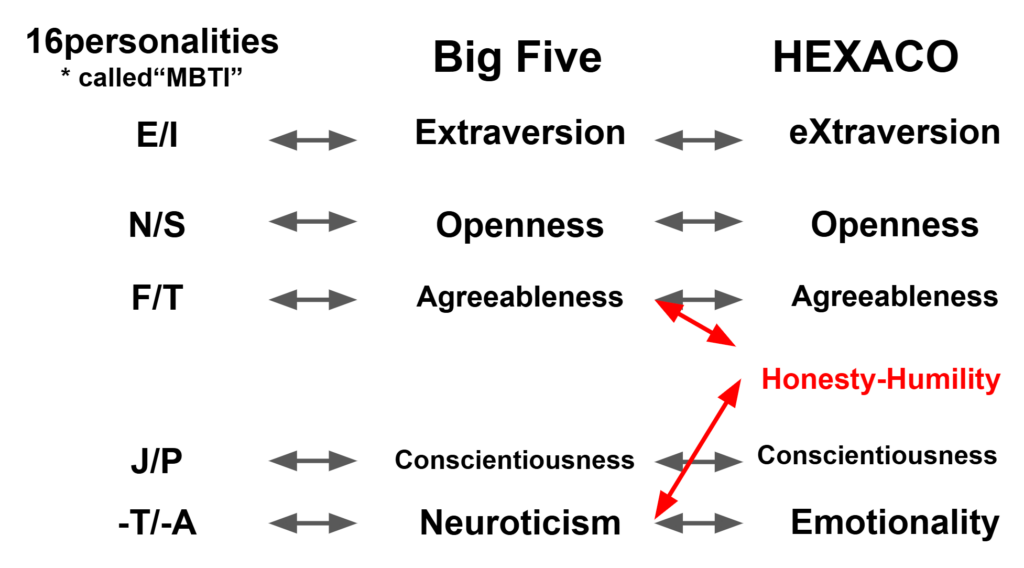
Also, in 16personalities, which was created with reference to MBTI and Big Five, neuroticism from Big Five is called “Identity“, and is classified as either Assertive or Turbulent.
On the far right is the relatively new personality assessment “HEXACO“. It is an improved version of Big Five with one additional indicator “Honesty-Humility”. Research on bullying and harassment perpetrators is active in HEXACO studies.
Since 16personalities and MBTI have weak scientific evidence, this article provides detailed explanations of 16personalities personality types based on their correlations with Big Five and HEXACO.

FAQ and Important Notes
HEXACO results differ from 16personalities (commonly known as MBTI test) or MBTI (original)
- Personality is influenced by genetics and environment, so when the environment changes, responses also change (for example, emotional responses change when you’re tired, etc.). For more details on genetics, see here.
- There are variations in responses depending on age. For more details, see here.
- Type classification is based on whether each value is 3 or above, or below 3, so values close to 3 are more likely to change results depending on how questions are asked or the environment at the time. Please look at the numerical values rather than the type.
- For MBTI (original) and 16personalities (commonly known as MBTI test), it’s unclear how much statistical processing was done at the question design stage as no research papers can be found. On the other hand, papers on Big Five and HEXACO can be easily found, and this HEXACO-JP test is based on research papers.
- While there aren’t many research papers comparing MBTI and 16personalities with everyday behaviors (academic performance, income, etc.) or with the brain and genetics, there are numerous studies on Big Five and HEXACO.
- HEXACO is a variation of Big Five elements, so they are similar but distinct. HEXACO’s Honesty-Humility is extracted from Big Five’s Agreeableness and Neuroticism.
If you have any other questions, please contact us through our inquiry form.
Personality test results are merely “hints” for your life
As mentioned earlier, personality is influenced by genetics and environment. Due to genetic influence, there is a certain range of variation, but answers can vary to some extent depending on the environment.
Also, while Big Five and HEXACO research papers conduct correlation analyses with academic performance and income, the correlation coefficients are not as large as those in natural science experiments. Correlation coefficients range from -1 to 1, but most are around -0.4 to 0.4. Of course, there are higher ones too, but they’re not 0.8 or 0.9 – they’re relatively lower in comparison.
However, since there is various research available, please think of it as “more than fortune-telling, less than natural science.” I’m not 100% denying psychology or fortune-telling.

Writer & Supervisor: Eisuke Tokiwa
Personality Psychology Researcher / CEO, SUNBLAZE Inc.
As a child he experienced poverty, domestic abuse, bullying, truancy and dropping out of school — first-hand exposure to a range of social problems. He spent 10 years researching these issues and published Encyclopedia of Villains through Jiyukokuminsha. Since then he has independently researched the determinants of social problems and antisocial behavior (work, education, health, personality, genetics, region, etc.) and has published 2 peer-reviewed journal articles (Frontiers in Psychology, IEEE Access). His goal is to predict the occurrence of social problems. Spiky profile (WAIS-IV).
Expertise: Personality Psychology / Big Five / HEXACO / MBTI / Prediction of Social Problems
Researcher profiles: ORCID / Google Scholar / ResearchGate
Social & Books: X (@etokiwa999) / note / Amazon Author Page