Do you know about the INFP-T type?
This is one of the indicators that represents personality, and it has a major impact on our behavior and way of thinking.
In this article, we will explain in detail what characteristics INFP-T people have, including their health, work, and interpersonal relationships.
By understanding your own and others’ personalities well, it may lead to better communication and self-understanding.
Please read while comparing it with your own and your friends’ personalities.
Once again, personality researcher and author of Villain Encyclopedia, Tokiwa (@etokiwa999), will provide the explanation.
※We have developed the HEXACO-JP Personality Assessment! It has more scientific basis than MBTI. Tap below for details.

目次
- 1 Scientific Background of INFP-T (Mediator・Turbulent Type)
- 2 Scientific Explanation of INFP-T (Mediator・Turbulent)
- 2.1 Tend to get along well with people who have both N and F traits
- 2.2 Slightly more likely to have high IQ, becomes even higher when neuroticism is reduced
- 2.3 Spirituality
- 2.4 Psychotherapy may increase extraversion and reduce neuroticism
- 2.5 When using social media, communicate through likes and encouraging comments
- 2.6 May actively gather information on social media
- 2.7 Properly maintaining social distance for infection control
- 2.8 Common among writers/editors, artists/creators, counselors/therapists
- 2.9 In children, there may be giftedness potential
- 2.10 Common among HSPs
- 2.11 Easily fatigued
- 2.12 Preferring salty, acidic, and fatty foods due to stress
- 2.13 Limiting Sweet Drinks
- 2.14 Poor Sleep Quality
- 2.15 Prone to Gambling
- 2.16 Prone to Internet Addiction
- 2.17 For Males, Prone to Being Cheated on as Husbands
- 2.18 Common among patients with mental illness
- 2.19 Prone to early mortality
- 2.20 Prone to hoarding behavior
- 2.21 Mindfulness practice reduces neuroticism
- 2.22 Employs emotion-focused coping
- 2.23 Takes high risks, develops bias toward risk due to high neuroticism
- 2.24 Common in Japan’s Tohoku, Kyushu, and Chugoku regions
- 2.25 Schwartz’s Values: Universalism, Benevolence
- 2.26 Preference for simple or practical clothing
- 3 Finally
Scientific Background of INFP-T (Mediator・Turbulent Type)
Overview of MBTI
MBTI is a psychological theory that classifies personality into 16 types.
To begin with, MBTI is an abbreviation for Myers-Briggs Type Indicator.
MBTI classifies personality into 16 types by combining the following four indicators.
In other words, MBTI expresses your personality tendencies with 4 letters such as “ISTJ” or “ENFP”. There is the very famous 16personalities as something similar, but this is different from MBTI.
Overview of Big Five
One of the most influential trait theories in personality psychology is the “Big Five.”
Big Five measures five traits: Openness, Conscientiousness, Extraversion, Agreeableness, and Neuroticism.
Also, while 16personalities and MBTI use type classification (e.g., either extraverted or introverted), Big Five evaluates traits with continuous numerical values (e.g., extraversion 3.5), which is also a major difference.
Furthermore, it has been studied for a long time, with many papers, and extensive research has been conducted in other fields such as academic ability, income, brain, and genetics. It can be said that Big Five has relatively stronger scientific backing.
Correlation between MBTI・Big Five・HEXACO
There is a correlation between MBTI’s 4 indicators and Big Five’s 5 factors.
A representative study showing this correlation is the paper “The relationship between the revised NEO-Personality Inventory and the Myers-Briggs Type Indicator“.
According to this paper, the correlation between MBTI and Big Five is as follows.
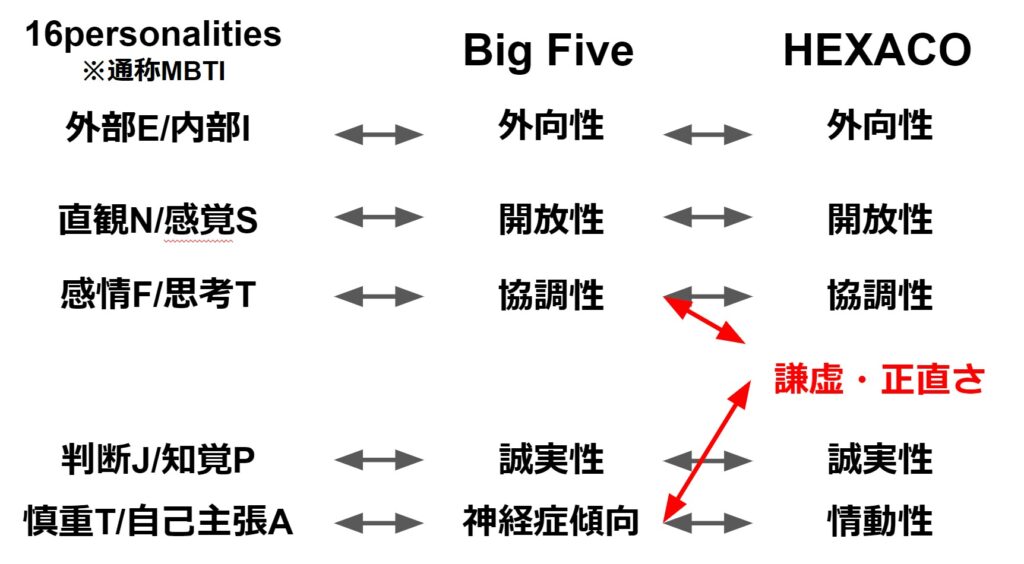
Also, in 16personalities, which was created with reference to MBTI and Big Five, Neuroticism from Big Five is called “Identity“, and is classified as either Assertive or Turbulent.
On the far right is the relatively new personality test “HEXACO“. It has been improved by adding one indicator “Honesty-Humility” to Big Five.
This article will provide detailed explanations of 16personalities personality types based on these correlations.
Since these are originally Big Five and HEXACO research, if you want to know your personality more scientifically than MBTI or 16personalities, please try this HEXACO personality test.
What is INFP-T (Mediator・Turbulent Type)?
INFP-T is a type with low Extraversion (I), high Openness (N), high Agreeableness (F), low Conscientiousness (P), and high Neuroticism (T) in Big Five. Characteristics:
- Strong idealism and sensitivity
- Self-doubt and perfectionism
- Creative self-expression
- Sensitivity to others’ opinions
- Internal conflict and desire for growth
They have rich imagination and deep emotions, feeling a strong sense of mission to make the world a better place. However, they often feel anxious about their abilities and decisions.
In interpersonal relationships, they seek genuine connections but are sensitive to criticism and rejection from others. They tend to feel stressed by change and uncertainty, but this also becomes a driving force that promotes self-understanding and growth.
Scientific Explanation of INFP-T (Mediator・Turbulent)
Tend to get along well with people who have both N and F traits
INFP-T individuals have intuitive (N) and feeling (F) characteristics. This indicates high openness and agreeableness in Big Five terms. They tend to empathize easily with people who have similar N and F traits and are likely to build deep friendships.
INFP-Ts are imaginative and highly sensitive, making them naturally compatible with people who have similar characteristics. They value relationships where they can freely share ideas and emotions.
These characteristics become great strengths in creative activities and human relationships. Please see this article for more details.
Slightly more likely to have high IQ, becomes even higher when neuroticism is reduced
The “N” (intuitive) in INFP-T indicates high openness in Big Five terms. This trait is related to intellectual curiosity and creativity, and tends to correlate with slightly higher than average IQ.
However, the “-T” (turbulent) represents high neuroticism, which may hinder the expression of intellectual abilities. By reducing neurotic tendencies, INFP-T individuals may be able to demonstrate their abilities with more confidence.
INFP-T individuals tend to be enthusiastic about self-growth and learning. Through these activities, they can further develop their intellectual abilities. Please see this article for more details.
Spirituality
The “NF” characteristics of INFP-T indicate high openness and agreeableness in Big Five terms. These traits are deeply connected to interest in spirituality.
INFP-T individuals have a strong interest in exploring the meaning and purpose of life. They tend to seek connections with transcendent things and enjoy thinking deeply about themselves and the world.
This trait may draw them to spiritual practices such as meditation and yoga. For INFP-T individuals, spirituality can become an important means of self-understanding and growth. Please see this article for more details.
Psychotherapy may increase extraversion and reduce neuroticism
The “I” (introversion) and “-T” (turbulent) in INFP-T indicate low extraversion and high neuroticism in Big Five terms. People with these traits may benefit greatly from psychotherapy.
Through psychotherapy, INFP-T individuals can deepen their self-understanding and improve their social skills. This may increase their extraversion and make communication with others smoother.
Additionally, therapy provides opportunities to learn coping methods for anxiety and stress, which can be expected to reduce neurotic tendencies. For INFP-T individuals, psychotherapy becomes a valuable tool for self-growth. Please see this article for more details.
The “F” (feeling) in INFP-T indicates high agreeableness in Big Five terms. This trait is also reflected in how they use social media.
INFP-T individuals tend to prefer encouraging and supporting others through social media. They show compassionate attitudes online by giving “likes” and leaving warm comments.
This method of communication allows INFP-Ts to utilize their empathy and kindness. At the same time, it can complement their introverted tendency to struggle with direct face-to-face communication, making it a comfortable social experience for INFP-Ts. Please see this article for more details.
The “N” (Intuition) in INFP-T indicates high openness in Big Five terms. This trait leads to strong curiosity toward new information and ideas.
INFP-T individuals tend to use social media not just as a communication tool, but also as a place for information gathering. They actively seek out articles and discussions on various topics, trying to expand their knowledge and perspective.
This enthusiasm for information gathering helps INFP-T individuals with personal growth and creativity enhancement. However, it’s also important to verify the reliability of information. Please see this article for more details.
The “I” (Introversion) in INFP-T indicates low extraversion in Big Five terms. This trait works advantageously for maintaining social distance in infection control measures.
INFP-T individuals originally value alone time and tend to have little resistance to maintaining physical distance from others. Therefore, they have a high possibility of naturally practicing social distancing as an infection control measure.
This trait helps protect individual and social health in situations like pandemics. However, attention to long-term feelings of isolation is necessary. Please see this article for more details.
Common among writers/editors, artists/creators, counselors/therapists
The “I” (Introversion) in INFP-T indicates low extraversion in Big Five terms. This trait is compatible with professions that excel in quiet, concentrated environments.
INFP-T individuals are creative and highly empathetic, so they often excel as writers, editors, artists, and creators. Their imagination and expressive ability become major strengths in these professions.
Additionally, INFP-T individuals who are skilled at understanding and supporting others’ emotions also have aptitude as counselors and therapists. In these professions, INFP-T’s deep insight and empathetic abilities are utilized. Please see this article for more details.
In children, there may be giftedness potential
The “N” (Intuition) in INFP-T indicates high openness in Big Five terms. This trait may sometimes be related to giftedness potential in children.
INFP-T children are often imaginative and skilled at abstract thinking. They may ask deep questions inappropriate for their age or understand complex concepts.
They may also show strong sensitivity and artistic talent. However, while being gifted, they may also face challenges due to high sensitivity and introversion. Appropriate support and understanding are important. Please see this article for more details.
Common among HSPs
The “N” (Intuition) and “-T” (Turbulent) in INFP-T indicate high openness and high neuroticism in Big Five terms. These traits overlap significantly with HSP (Highly Sensitive Person) characteristics.
INFP-T individuals tend to be very sensitive to subtle environmental changes and others’ emotions. They tend to react strongly to stimuli and process things deeply.
While this high sensitivity leads to artistic talent and deep empathetic ability, attention is also needed for overwork and sensory overload. It’s important to understand HSP traits and practice appropriate self-care. Please see this article for more details.
Easily fatigued
The “IP” (Introverted and Perceiving) and “-T” (Turbulent) traits in INFP-T indicate low extraversion, low conscientiousness, and high neuroticism in Big Five terms. This combination may lead to being easily fatigued.
INFP-T individuals consume a lot of energy in social interactions due to their introverted nature. They may also react sensitively to daily stress due to perfectionist tendencies and high sensitivity.
Furthermore, their low planning tendency (P) can make efficient energy management difficult. Appropriate rest and stress management are particularly important for INFP-T individuals. It’s recommended to value your own pace and regularly refresh yourself. Please see this article for more details.
Preferring salty, acidic, and fatty foods due to stress
The “-T” (Turbulent) in INFP-T indicates high neuroticism in Big Five terms. This trait may influence eating habits under stress.
INFP-T individuals tend to prefer salty, sour, and fatty foods when experiencing stress. While these foods can temporarily improve mood, they may lead to health problems in the long term.
This tendency is considered one of the stress coping mechanisms. It’s important for INFP-T individuals to find healthy ways to manage stress.
For example, incorporating healthier stress-relief methods such as meditation or exercise is recommended. Please see this article for more details.
Limiting Sweet Drinks
The “F” (Feeling) in INFP-T indicates high agreeableness in Big Five terms. This trait can be linked to awareness of healthy lifestyle habits.
INFP-T individuals tend to be sensitive to their own and others’ health. Therefore, they may recognize the negative health effects of excessive sweet drink consumption and tend to limit them.
Additionally, INFP-T individuals often have high motivation for self-improvement and may have strong motivation to make healthy choices. However, this varies by individual and doesn’t apply to all INFP-Ts.
Choosing healthy drinks is achieved through individual awareness and effort. Please see this article for more details.
Poor Sleep Quality
The “I” (Introversion), “P” (Perceiving), and “-T” (Turbulent) in INFP-T indicate low extraversion, low conscientiousness, and high neuroticism in Big Five terms. This combination of traits may affect sleep quality.
INFP-T individuals have rich inner worlds and may find themselves lost in thought late into the night. Additionally, their tendency toward low planning (P) may make it difficult to maintain regular bedtimes.
Furthermore, high neuroticism (-T) can cause anxiety and stress, potentially disrupting sleep. Establishing relaxing bedtime routines and regular sleep schedules is particularly important for INFP-T individuals.
Practices such as meditation and mindfulness may also help improve sleep quality. Please see this article for more details.
Prone to Gambling
The “P” (Perceiving) and “-T” (Turbulent) in INFP-T indicate low conscientiousness and high neuroticism in Big Five terms. These traits may influence gambling behavior.
INFP-T individuals tend to seek immediate stimulation and new experiences, which may lead to interest in gambling. Additionally, high neuroticism (-T) increases the possibility of relying on gambling as a means of stress relief.
However, this tendency varies greatly among individuals and doesn’t apply to all INFP-Ts. Finding healthy alternative activities and appropriate stress management methods is important. If you notice signs of gambling addiction, we recommend seeking professional support. Please see this article for more details.
Prone to Internet Addiction
The “P” (Perceiving) and “-T” (Turbulent) in INFP-T indicate low conscientiousness and high neuroticism in Big Five terms. These traits may increase the risk of internet addiction.
INFP-T individuals are curious and tend to seek new information and stimulation. The internet can become an infinite source to satisfy this desire. Additionally, their introverted nature may make them prefer online communication.
Furthermore, high neuroticism (-T) increases the possibility of relying on the internet as a means of escape from reality. It’s particularly important for INFP-T individuals to manage their online time and balance activities in the real world.
We recommend developing healthy internet usage habits. Please see this article for more details.
For Males, Prone to Being Cheated on as Husbands
The “-T” (Turbulent) in INFP-T indicates high neuroticism in Big Five terms. This trait may influence human relationships, particularly romantic relationships.
INFP-T males are highly sensitive and tend to be introspective. While these traits can create deep understanding and empathy, they can sometimes lead to lack of confidence or excessive worry.
Additionally, their idealistic nature may make them prone to dissatisfaction with real relationships. These factors may create distance between partners. However, this tendency varies greatly among individuals and can be improved through communication and deepening mutual understanding.
For INFP-T males, it is recommended to enhance self-esteem and strive for open communication. Please see this article for more details.
Common among patients with mental illness
INFP-T’s “IP” (Introverted and Perceiving) and “-T” (Turbulent) characteristics indicate low extraversion, low conscientiousness, and high neuroticism in terms of the Big Five. The combination of these traits may increase the risk of mental illness.
INFP-T individuals tend to be highly sensitive and introspective. While these traits can bring deep insight, they may also make them prone to anxiety and depression. Additionally, perfectionist tendencies and high ideals can create stress due to gaps with reality.
However, this does not mean that all INFP-T individuals will develop mental illness.
With proper self-care and professional support when needed, mental health can be maintained well. It’s important to deepen self-understanding and acquire stress management skills. Please see this article for more details.
Prone to early mortality
INFP-T’s “P” (Perceiving) and “-T” (Turbulent) characteristics indicate low conscientiousness and high neuroticism in terms of the Big Five. These traits may increase health risks.
INFP-T individuals may find it difficult to maintain healthy lifestyle habits due to their tendency toward low planning (P). Additionally, high neuroticism (-T) can cause chronic stress and anxiety, which may adversely affect physical health.
However, this tendency is not deterministic. For INFP-T individuals, it’s particularly important to establish regular lifestyle habits, acquire stress management techniques, and receive regular health checkups. We also recommend prioritizing self-care and seeking professional support when necessary.
This risk can be significantly reduced by maintaining a healthy lifestyle. Please see this article for more details.
Prone to hoarding behavior
INFP-T’s “N” (Intuitive) and “-T” (Turbulent) characteristics indicate high openness and high neuroticism in terms of the Big Five. These traits may lead to hoarding behavior, especially in uncertain situations.
INFP-T individuals tend to be imaginative and consider future possibilities. This can lead to behavior where they envision crisis situations and try to stockpile more than necessary. Additionally, high neuroticism (-T) can amplify anxiety and worry, potentially strengthening this tendency further.
However, this tendency can be controlled through awareness and self-management. For INFP-T individuals, it’s important to balance rational judgment with emotional reactions. We recommend referring to reliable information sources and avoiding excessive hoarding. Please see this article for more details.
Mindfulness practice reduces neuroticism
INFP-T’s “-T” (Turbulent) characteristic indicates high neuroticism in terms of the Big Five. Mindfulness practice may alleviate this trait and improve overall mental health.
INFP-T individuals tend to be highly sensitive and introspective. Mindfulness helps utilize these traits while reducing excessive worry and anxiety.
Through regular mindfulness practice, INFP-T individuals can develop the ability to focus on the present moment and objectively observe their thoughts and emotions. This may improve their responses to stress and enhance overall mental stability.
Mindfulness can be a powerful tool for improving INFP-T’s self-understanding and emotional management abilities. Please see this article for more details.
Employs emotion-focused coping
INFP-T’s “-T” (Turbulent) characteristic indicates high neuroticism in terms of the Big Five. This trait may lead to the selection of emotion-focused coping as a stress management method.
INFP-T individuals tend to be highly sensitive and experience emotions deeply. Therefore, when facing stress, they often focus on the emotions triggered by the situation rather than the problem itself.
Emotion-focused coping includes emotional expression, seeking social support, and meditation. These methods are compatible with INFP-T’s introspective nature and help with emotional processing.
However, balance with problem-solving coping is also important. For INFP-T individuals, we recommend using both approaches depending on the situation.
Takes high risks, develops bias toward risk due to high neuroticism
The “NP” (intuitive and perceiving) and “-T” (turbulent) aspects of INFP-T indicate high openness, low conscientiousness, and high neuroticism in Big Five terms. The combination of these traits can have complex effects on risk-taking behavior.
INFP-T individuals tend to be open to new experiences and possibilities (N) and prefer spontaneous decisions (P). These traits can sometimes lead to high risk-taking behavior.
On the other hand, high neuroticism (-T) can cause excessive worry and anxiety about risks. This can create biases that lead to overestimating risks or, conversely, taking risks to reduce anxiety.
For INFP-T individuals, it’s important to value objective information when assessing risks and maintain a balance between emotion and reason. Seeking others’ opinions when necessary may also be effective. Please see this article for more details.
Common in Japan’s Tohoku, Kyushu, and Chugoku regions
The observation that INFP-T tendencies are common in specific regions of Japan is interesting. This suggests that regional culture and environment may influence personality formation.
Tohoku, Kyushu, and the Chugoku region are known as areas rich in nature where traditional values remain deeply rooted. These environments may nurture the introspective and sensitive nature of INFP-T.
Additionally, the culture of these regions, which tends to value individuals’ inner lives and emphasize harmony, may also be related to INFP-T characteristics.
However, it’s important to note that this tendency is a generalization and individual differences are significant. Also, further research is needed on the relationship between regional characteristics and personality tendencies. Please see this article for more details.
Schwartz’s Values: Universalism, Benevolence
The “NF” characteristics of INFP-T indicate high openness and agreeableness in Big Five terms. These traits are closely related to the values of “universalism” and “benevolence” in Schwartz’s theory of values.
INFP-T individuals tend to value the welfare of all people and the protection of nature (universalism). They often have deep interest in major issues such as social justice and environmental protection.
They also tend to cherish the happiness of those close to them and value compassion and tolerance (benevolence). INFP-T individuals value building deep bonds with others and cherish supportive relationships.
These values are strongly connected to the idealistic nature of INFP-T and greatly influence their actions and life choices. Please see this article for more details.
Preference for simple or practical clothing
The “IN” (introverted and intuitive) characteristics of INFP-T indicate low extraversion and high openness in Big Five terms. These traits may also influence their clothing preferences.
INFP-T individuals tend to value inner meaning and significance, which may lead to an attitude that prioritizes inner qualities over appearance. Therefore, they may tend to prefer simple and practical clothing.
Additionally, their creativity and individualistic aspects (N) may lead to creating unique styles. However, this is often expressed as subtle uniqueness rather than flashiness.
For INFP-T individuals, clothing is a form of self-expression, and they tend to value a balance between comfort and individuality. Please see this article for more details.
Finally
INFP-T individuals are characterized by being imaginative, highly sensitive, and good at understanding others’ feelings. However, they also tend to be prone to stress and anxiety.
People with this personality type may be suited for creative work or jobs helping others. However, they need to be careful as they may be prone to fatigue or falling into bad habits.
Everyone should get to know their own personality well and think about ways to make the most of it. Living authentically leads to a fulfilling life.
The tendencies introduced are originally from Big Five and HEXACO research, so if you want to understand your personality more scientifically than MBTI or 16personalities, please try this HEXACO personality test.

Writer & Supervisor: Eisuke Tokiwa
Personality Psychology Researcher / CEO, SUNBLAZE Inc.
As a child he experienced poverty, domestic abuse, bullying, truancy and dropping out of school — first-hand exposure to a range of social problems. He spent 10 years researching these issues and published Encyclopedia of Villains through Jiyukokuminsha. Since then he has independently researched the determinants of social problems and antisocial behavior (work, education, health, personality, genetics, region, etc.) and has published 2 peer-reviewed journal articles (Frontiers in Psychology, IEEE Access). His goal is to predict the occurrence of social problems. Spiky profile (WAIS-IV).
Expertise: Personality Psychology / Big Five / HEXACO / MBTI / Prediction of Social Problems
Researcher profiles: ORCID / Google Scholar / ResearchGate
Social & Books: X (@etokiwa999) / note / Amazon Author Page