Do you know the INFJ-T type?
This is one of the indicators that represents personality, and it has a great influence on our behavior and way of thinking.
In this article, we will explain in detail what characteristics INFJ-T people have, including health, work, and interpersonal relationships.
By getting to know your own personality and that of those around you well, it may lead to better communication and self-understanding.
Please read while comparing with your own and your friends’ personalities.
Once again, personality researcher and author of Villain Encyclopedia, Tokiwa (@etokiwa999), will provide the explanation.
※We have developed the HEXACO-JP Personality Assessment! It has more scientific basis than MBTI. Tap below for details.

目次
- 1 Scientific Background of INFJ-T (Advocate – Turbulent)
- 2 Scientific Explanation of INFJ-T (Advocate – Turbulent Type)
- 2.1 Engaging in Health Behaviors
- 2.2 Tend to Get Along Well with People Who Have Both N and F
- 2.3 High Academic Achievement
- 2.4 Effective Online Learning
- 2.5 Slightly More Likely to Have High Intelligence IQ, Even Higher When Neuroticism is Reduced
- 2.6 Spirituality
- 2.7 Psychotherapy may increase extroversion and reduce neurotic tendencies
- 2.8 When using social media, communicate through likes and encouraging comments
- 2.9 May actively gather information on social media
- 2.10 Properly maintain social distance for infection prevention
- 2.11 Properly perform infection prevention measures such as handwashing
- 2.12 Having a certain number on a team improves team balance, even better when with extroverted people
- 2.13 Relatively Common Among Athletes, Even More So When Neuroticism is Low
- 2.14 Common Among Writers/Editors, Artists/Creators, and Counselors/Therapists
- 2.15 In Children, There May Be a Possibility of Being Gifted
- 2.16 Common Among HSPs
- 2.17 Perfectionism Pursued to Excess
- 2.18 Preference for salty, sour, and fatty foods due to stress
- 2.19 Avoiding sweet drinks
- 2.20 Health-conscious preference for vegetables, dairy products, and nuts; even more health-conscious when neuroticism tendency is low
- 2.21 In the case of men, tend to become cheated-on husbands
- 2.22 Prone to hoarding behavior
- 2.23 Common among cyberbullying victims
- 2.24 Practicing Mindfulness Reduces Neuroticism
- 2.25 Employing Emotion-Focused Coping
- 2.26 Attempts Relatively Calm Risk Management, but High Neuroticism Creates Bias Toward Risks
- 2.27 Common in Japan’s Kyushu and Chugoku Regions
- 2.28 Schwartz’s Values: Universalism, Benevolence
- 2.29 Prefers Simple or Practical Clothing
- 3 Finally
Scientific Background of INFJ-T (Advocate – Turbulent)
Overview of MBTI
MBTI is a psychological theory that classifies personality into 16 types.
MBTI is an abbreviation for Myers-Briggs Type Indicator.
MBTI classifies personality into 16 types by combining the following 4 indicators.
In other words, MBTI expresses one’s personality tendencies in 4 letters such as “ISTJ” or “ENFP”. A very famous similar one is 16personalities, but this is different from MBTI.
Overview of Big Five
One of the most influential trait theories in personality psychology is the “Big Five.”
The Big Five measures five traits: Openness, Conscientiousness, Extraversion, Agreeableness, and Neuroticism.
Also, while 16personalities and MBTI use type classification (e.g., either extroverted or introverted), Big Five evaluates traits on a continuous numerical scale (e.g., Extraversion 3.5), which is a major difference.
Furthermore, it has been studied for a long time, has many research papers, and extensive research has been conducted in other fields such as academic ability, income, brain, and genetics. Big Five can be said to have relatively stronger scientific backing.
Correlation Between MBTI, Big Five, and HEXACO
There are correlations between MBTI’s 4 indicators and Big Five’s 5 factors.
A representative study showing this correlation is the paper “The relationship between the revised NEO-Personality Inventory and the Myers-Briggs Type Indicator.”
According to this paper, the correlation between MBTI and Big Five is as follows:
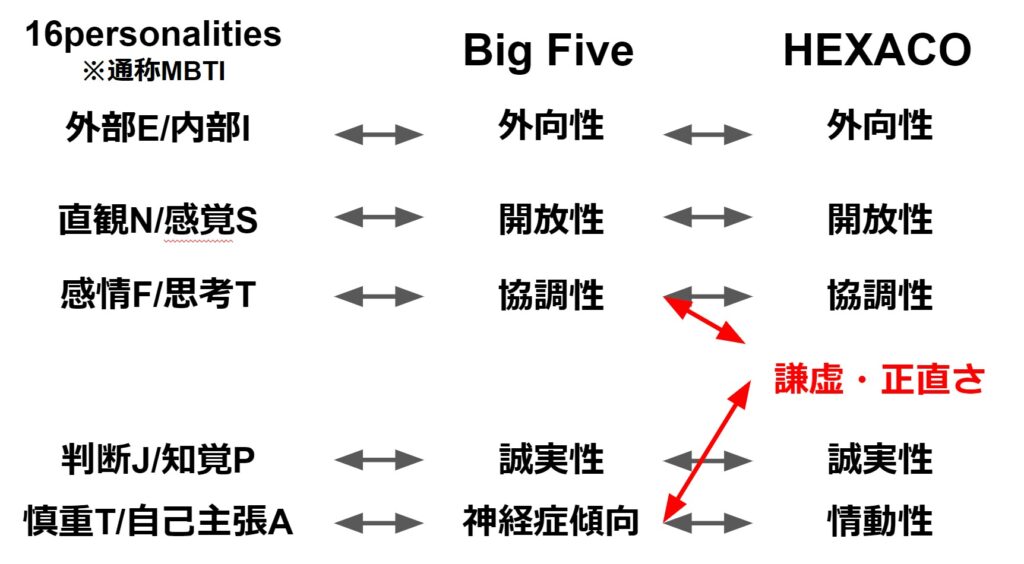
Also, in 16personalities, which was created with reference to MBTI and Big Five, the neuroticism of Big Five is called “Identity” and is classified as either Assertive or Turbulent.
On the far right is the relatively new personality assessment “HEXACO.” It has been improved by adding one indicator “Honesty-Humility” to Big Five.
This article will explain 16personalities personality types in detail based on these correlations.
Since these are originally Big Five and HEXACO studies, if you want to know your personality more scientifically than MBTI or 16personalities, please try this HEXACO personality test.
What is INFJ-T (Advocate – Turbulent)?
INFJ-T is a type with low Extraversion (I), high Openness (N), high Agreeableness (F), high Conscientiousness (J), and high Neuroticism (T) in Big Five. Characteristics:
- Strong idealism and perfectionism
- Sensitivity to others’ emotions
- Creative problem-solving ability
- Self-doubt and introspective tendencies
- Strong desire for social impact
They have deep insight and empathy, and feel a strong sense of mission to make the world a better place. However, they often question their own abilities and decisions.
In interpersonal relationships, they seek meaningful connections but also harbor anxiety about not being able to meet others’ expectations. They are prone to stress from change and uncertainty, but this also becomes a driving force for growth.
Scientific Explanation of INFJ-T (Advocate – Turbulent Type)
Engaging in Health Behaviors
INFJ-T types tend to be proactive about health behaviors. This is influenced by the F and J traits of MBTI. F indicates high agreeableness, and J indicates high conscientiousness, and these traits promote healthy lifestyle habits.
INFJ-T individuals tend to care not only about their own health but also about the health of those around them. They value maintaining healthy lifestyles including regular living habits, moderate exercise, and balanced diet.
Please see this article for more details.
Tend to Get Along Well with People Who Have Both N and F
INFJ-T types tend to build intimate relationships with people who have N and F traits. N indicates high openness, and F indicates high agreeableness. INFJ-T individuals are drawn to N-type people who are intuitive and imaginative, and F-type people who are highly empathetic. They can enjoy deep conversations and emotional connections with people who have these traits.
Also, since INFJ-T individuals themselves value intuition and emotion, they naturally tend to become intimate with people who share similar values and ways of thinking.
Please see this article for more details.
High Academic Achievement
INFJ-T types generally tend to have high academic achievement. This is influenced by the NFJ traits of MBTI. N indicates high openness and excels in the ability to understand new concepts and abstract ideas. F represents high agreeableness and enhances adaptability in learning environments. J indicates high conscientiousness and leads to a planned and disciplined learning attitude.
INFJ-T individuals tend to achieve excellent grades in various academic fields by leveraging their intuitive understanding and high sensitivity. They particularly tend to excel in the fields of humanities and social sciences.
Please see this article for more details.
Effective Online Learning
INFJ-T types tend to achieve high effectiveness in online learning. This is related to the NJ traits of MBTI. N indicates high openness and excels in the ability to adapt to new learning environments and technologies. J represents high conscientiousness and leads to high self-management ability and planning skills.
INFJ-T individuals have high ability to pursue learning independently and excel at information gathering and task completion in online environments. They can also effectively absorb online learning content by leveraging their intuitive understanding abilities.
Please see this article for more details.
Slightly More Likely to Have High Intelligence IQ, Even Higher When Neuroticism is Reduced
INFJ-T types tend to have relatively high intelligence IQ. This is related to the N trait of MBTI, namely high openness. N-types excel in abstract thinking and creative problem-solving abilities, which leads to high intelligence IQ.
However, the “T” in INFJ-T indicates high neuroticism. If neuroticism can be reduced, there is a possibility that intelligence IQ could become even higher. This is because reducing anxiety and stress allows for more effective utilization of intellectual abilities.
Please see this article for more details.
Spirituality
INFJ-T types tend to have high interest in spirituality. This is influenced by the NF traits of MBTI. N indicates high openness, and F indicates high agreeableness, and these traits promote the tendency to seek meaning and purpose in life and connection with transcendent things.
INFJ-T individuals prefer deep introspection and philosophical thinking, and tend to seek answers to life’s big questions. They also value connections with others, nature, and the universe, and often pursue spiritual growth and self-realization.
Please see this article for more details.
Psychotherapy may increase extroversion and reduce neurotic tendencies
When INFJ-T types receive psychotherapy, their extroversion may increase and their neurotic tendencies may decrease. I indicates introversion, and T indicates high neurotic tendencies. Through psychotherapy, by deepening self-understanding and improving social skills, they may become more extroverted.
Additionally, while INFJ-T individuals originally have sensitive and introspective tendencies, they may be able to reduce neurotic tendencies by learning stress management and emotional regulation skills through psychotherapy. This may enable them to maintain a more stable psychological state.
Please see this article for more details.
INFJ-T types tend to communicate through “likes” and encouraging comments when using social media. This is influenced by the F trait in MBTI, which represents high agreeableness. F types have high empathy for others and value being considerate of others’ emotions.
INFJ-T individuals strive for warm interactions even on social media, seeking to connect with others through positive reactions and supportive comments. Rather than merely exchanging information, they tend to try to build deep human relationships online by providing emotional support and encouragement.
Please see this article for more details.
INFJ-T types are likely to actively gather information through social media. This is related to the N trait in MBTI, which represents high openness. N types have strong curiosity about new knowledge and concepts and prefer to absorb various information.
INFJ-T individuals tend to use social media not only as a place for interaction but also as a place for learning. They effectively utilize social media to obtain the latest information and diverse perspectives on topics of interest. They also enjoy collecting information from a wide range of fields for self-growth and understanding of the world.
Please see this article for more details.
INFJ-T types tend to properly maintain social distance for infection prevention. This is influenced by the I trait in MBTI, which represents introversion. I types tend to have relatively less resistance to maintaining physical distance from others.
INFJ-T individuals prioritize the health and safety of themselves and others, so they deeply understand the necessity of infection prevention and seriously practice maintaining social distance. They also strive to maintain appropriate distance out of consideration for others. This tendency may be particularly prominent during health crises such as pandemics.
Please see this article for more details.
Properly perform infection prevention measures such as handwashing
INFJ-T types tend to reliably execute preventive measures such as handwashing for infection control. This is influenced by the J trait in MBTI, which represents high conscientiousness. J types value rules and procedures and act with a sense of responsibility.
INFJ-T individuals carefully practice recommended infection control measures such as handwashing and wearing masks to protect their own health and that of those around them. They can also incorporate these habits into their daily lives and continue to implement them consistently. Their high awareness of infection prevention and serious attitude leads to reliable implementation of countermeasures.
Please see this article for more details.
Having a certain number on a team improves team balance, even better when with extroverted people
When INFJ-T types exist in a certain number on a team, the overall balance of the team tends to improve. This is influenced by the FJ traits in MBTI. F represents high agreeableness, and J represents high conscientiousness, and these traits enhance team harmony and efficiency.
INFJ-T individuals play a role in facilitating interpersonal relationships within the team by utilizing their empathy and insight toward others.
Additionally, they approach tasks with planning and responsibility, contributing to improved team productivity. Furthermore, by collaborating with extroverted people, the introverted characteristics of INFJ-T can be complemented, potentially achieving more effective teamwork.
Please see this article for more details.
Relatively Common Among Athletes, Even More So When Neuroticism is Low
INFJ-T types tend to be relatively common among athletes. This is influenced by the FJ characteristics of MBTI. F indicates high agreeableness, and J indicates high conscientiousness, and these traits play important roles in sports.
INFJ-T individuals value teamwork and have the ability to work systematically toward goals. They are also skilled at developing strategies using their intuition and insight.
However, while T indicates high neuroticism, when this tendency is low, their aptitude as athletes may increase even further. This is because low neuroticism increases resistance to pressure and improves performance stability.
Please see this article for more details.
Common Among Writers/Editors, Artists/Creators, and Counselors/Therapists
INFJ-T types tend to pursue careers as writers/editors, artists/creators, and counselors/therapists. This is greatly influenced by the I characteristic of MBTI, namely introversion. I types tend to prefer introspective and creative work.
INFJ-T individuals possess rich imagination and deep insight, excelling in these professions. As writers or editors, they can convey emotion and contemplation through words.
As artists or creators, they have the ability to produce original works. As counselors or therapists, they can understand the depths of others’ hearts and provide appropriate support.
Please see this article for more details.
In Children, There May Be a Possibility of Being Gifted
INFJ-T type children have a relatively high possibility of being gifted (intellectually talented children). This is related to the N characteristic of MBTI, namely high openness. N type children tend to excel in abstract thinking and creative problem-solving abilities.
INFJ-T children may show deep insight and rich imagination from an early age. They often possess the ability to understand complex concepts and the power to generate original ideas. They are highly sensitive and may show early interest in moral issues. However, determining giftedness requires comprehensive evaluation by specialists.
Please see this article for more details.
Common Among HSPs
INFJ-T types tend to have a high possibility of being HSP (Highly Sensitive Person). This is influenced by the N and Turbulent-T characteristics of MBTI. N indicates high openness, and T indicates high neuroticism.
INFJ-T individuals are sensitive to environmental stimuli and excel at detecting subtle changes and nuances. They have large emotional fluctuations and are easily influenced by others’ emotions.
They also tend to prefer deep introspection and complex thinking. These characteristics overlap with HSP traits in many ways.
Please see this article for more details.
Perfectionism Pursued to Excess
INFJ-T types have strong perfectionist tendencies and may sometimes pursue perfection excessively. This is related to the J characteristic of MBTI, namely high conscientiousness. J types tend to value planning and discipline, setting high standards.
INFJ-T individuals hold high expectations for themselves and others, constantly seeking the best results.
While this perfectionism can lead to high-quality work and results, it may also cause excessive stress and self-criticism. Taking balance is important, but this can sometimes feel difficult to achieve.
Please see this article for more details.
Preference for salty, sour, and fatty foods due to stress
INFJ-T type individuals tend to prefer salty, sour, and fatty foods when experiencing stress. This is mainly influenced by the Turbulent-T characteristic, namely high neuroticism tendency.
Under stress, INFJ-T individuals may be drawn to these strongly flavored foods in search of psychological stability.
Foods high in salt and fat have the effect of temporarily improving mood, making them easily chosen as a means of stress relief. Additionally, sour foods tend to be favored for their mood-changing and refreshing effects.
For more details, please see this article.
Avoiding sweet drinks
INFJ-T type individuals tend to avoid sweet drinks. This is influenced by the F characteristic of MBTI, namely high agreeableness. F type individuals tend to prioritize health and consideration for others.
INFJ-T individuals have high awareness of their own health and the health of people around them, understanding the impact that excessive consumption of sweet drinks has on health. Therefore, they tend to consciously limit their intake of sweet drinks and try to make healthier choices. They may also avoid sweet drinks out of environmental consideration, taking into account issues of excessive sugar production and disposable containers.
For more details, please see this article.
Health-conscious preference for vegetables, dairy products, and nuts; even more health-conscious when neuroticism tendency is low
INFJ-T type individuals tend to be health-conscious and prefer vegetables, dairy products, and nuts. This is influenced by the J characteristic of MBTI, namely high conscientiousness. J type individuals have high planning ability and self-management skills, and try to maintain healthy lifestyle habits.
INFJ-T individuals strive for nutritionally balanced meals and tend to actively incorporate foods that are considered healthy, particularly vegetables, dairy products, and nuts. They understand the nutritional value and health benefits of these foods and try to incorporate them into their daily diet.
Furthermore, when neuroticism tendency (T) is low, the tendency to be even more health-conscious becomes stronger. This is because with less stress and anxiety, they can maintain healthy lifestyle habits more actively and sustainably.
For more details, please see this article.
In the case of men, tend to become cheated-on husbands
There is a suggestion that INFJ-T type men tend to become husbands who are cheated on. This may be mainly influenced by the Turbulent-T characteristic, namely high neuroticism tendency.
INFJ-T men, due to their sensitive and introspective nature, try to deeply understand their partner’s emotions and desires. However, they also tend to be self-critical and prone to anxiety, which may affect relationships. Additionally, due to their idealistic nature, they may easily feel dissatisfied with real relationships.
However, it’s important to note that this is a general tendency and individual differences are significant. Relationships can be strengthened by building healthy
communication and mutual understanding.
For more details, please see this article.
Prone to hoarding behavior
INFJ-T type individuals tend to engage in hoarding behavior depending on the situation. This is influenced by the MBTI N characteristic and the Turbulent-T trait. N indicates high openness, while T indicates high neuroticism tendency.
INFJ-T individuals intuitively predict future possibilities and tend to feel anxiety and crisis easily. Therefore, in situations such as disasters or social unrest, they may try to purchase more supplies than necessary. They may also try to stock up for family and close people out of consideration for others.
However, it’s important to appropriately control this tendency considering social impact. Maintaining a balance between calm judgment and moderate preparation is crucial.
For more details, please see this article.
Common among cyberbullying victims
It’s pointed out that INFJ-T type individuals tend to become victims of cyberbullying. This is due to the complex influence of MBTI NFJ characteristics and the Turbulent-T trait.
INFJ-T individuals are highly sensitive and react sensitively to others’ words and actions. They are also idealistic and tend to seek deep human relationships and meaningful interactions even online. However, this sensitivity and idealism may sometimes create vulnerability to negative comments and criticism online.
Furthermore, due to their introverted nature, they tend to handle difficult situations alone and may hesitate to seek help. The combination of these factors may make them more susceptible to cyberbullying.
Please see this article for more details.
Practicing Mindfulness Reduces Neuroticism
When INFJ-T type individuals practice mindfulness, there is a possibility that neuroticism tendencies may decrease. This is mainly related to the Turbulent-T characteristics, namely the high level of neuroticism.
INFJ-T individuals inherently possess sensitive and introspective personalities, but they also tend to feel anxiety and tension easily.
The practice of mindfulness cultivates the ability to focus consciousness on the present moment and observe things without judgment. This allows them to distance themselves from excessive worry and anxiety, and maintain a more calm state of mind.
Through regular mindfulness practice, INFJ-T individuals can deepen self-understanding and improve stress management abilities, potentially reducing neuroticism tendencies as a result.
Please see this article for more details.
Employing Emotion-Focused Coping
INFJ-T type individuals tend to employ emotion-focused coping when dealing with stress. This is mainly influenced by the Turbulent-T characteristics, namely the high level of neuroticism.
Emotion-focused coping is a method of dealing with stress situations by adjusting emotions and psychological states. INFJ-T individuals, with their highly sensitive and introspective nature, deeply explore and try to understand their emotions when faced with stressful situations.
This coping method includes meditation, journaling, immersion in artistic activities, and emotional exchanges with others. INFJ-T individuals attempt to process emotions and achieve mental stability through these methods.
Attempts Relatively Calm Risk Management, but High Neuroticism Creates Bias Toward Risks
INFJ-T type individuals tend to attempt relatively calm approaches to risk management while having bias toward risks due to high neuroticism. This is influenced by the MBTI J characteristics and Turbulent-T traits.
Due to the J characteristics, INFJ-T individuals try to evaluate and manage risks with planning and responsibility. They tend to logically analyze situations and attempt to implement appropriate countermeasures. However, due to the Turbulent-T characteristics, namely high neuroticism, they may overestimate potential threats and problems.
This can lead to being overly cautious about risks or assuming worst-case scenarios too much. To achieve balanced risk assessment, it is important to consciously distinguish between objective information gathering and one’s emotional reactions.
Please see this article for more details.
Common in Japan’s Kyushu and Chugoku Regions
There are indications that INFJ-T type individuals are relatively common in Japan’s Kyushu and Chugoku regions. This suggests that the INF and Turbulent-T characteristics may have high compatibility with the culture and values of these regions.
Kyushu and Chugoku regions traditionally have cultures rooted in warmth and emphasis on cooperation. The INF characteristics of introversion, intuition, and emotion-focused tendencies may harmonize well with such cultural backgrounds. Additionally, these regions often value caution and careful consideration as virtues, which aligns with Turbulent-T characteristics.
However, this tendency is based on statistical observations, and it’s important to note that individual differences are significant. Further research is needed regarding the relationship between regional characteristics and personality types.
Please see this article for more details.
Schwartz’s Values: Universalism, Benevolence
INFJ-T type individuals tend to value “Universalism” and “Benevolence” in Schwartz’s theory of values. This is greatly influenced by the MBTI NF characteristics.
The value of “Universalism” emphasizes the welfare of all people and nature protection. INFJ-T individuals often have strong interest in global issues such as fairness, social justice, and environmental protection.
The value of “Benevolence” emphasizes promoting the happiness of close people and maintaining good relationships. INFJ-T individuals show deep empathy and understanding toward others, and find joy in supporting people’s happiness and growth.
These values reflect the idealistic nature and strong consideration for others characteristic of INFJ-T individuals. In social contribution and relationship building, these values often serve as behavioral guidelines.
Please see this article for more details.
Prefers Simple or Practical Clothing
INFJ-T type individuals tend to prefer simple and practical clothing. This is influenced by the IN characteristics of MBTI. I indicates introversion, and N indicates high openness.
INFJ-T individuals tend to value inner qualities and functionality over appearance. Rather than flashy clothing or following the latest trends, they often choose simple and practical clothing that matches their values and lifestyle.
Additionally, this clothing preference reflects the introspective nature of INFJ-T individuals and their tendency to prioritize efficiency. They tend to prefer simple and functional clothing that allows them to focus on their inner thoughts and contemplation, rather than complex styling.
However, this is a general tendency and may vary depending on individual preferences and circumstances.
Please see this article for more details.
Finally
INFJ-T type people have very distinctive personalities. There might be people of this type among you as well.
INFJ-T people have deep thinking abilities and strong sensitivity, and they understand others’ feelings well. They pay attention to health and learning, and are suited for creative work. However, they also have aspects where they seek perfection too much or are prone to stress.
What’s important is to make use of your strengths while also facing your weak areas. For example, it would be good to practice mindfulness or strive for a balanced life.
It would be great if you all could carefully observe your own and others’ personalities, understand each other’s differences, and respect one another. This leads to better human relationships and a more fulfilling school life.
The tendencies introduced are originally from Big Five and HEXACO research, so if you want to know your personality more scientifically than MBTI or 16personalities, please try this HEXACO personality test.

Writer & Supervisor: Eisuke Tokiwa
Personality Psychology Researcher / CEO, SUNBLAZE Inc.
As a child he experienced poverty, domestic abuse, bullying, truancy and dropping out of school — first-hand exposure to a range of social problems. He spent 10 years researching these issues and published Encyclopedia of Villains through Jiyukokuminsha. Since then he has independently researched the determinants of social problems and antisocial behavior (work, education, health, personality, genetics, region, etc.) and has published 2 peer-reviewed journal articles (Frontiers in Psychology, IEEE Access). His goal is to predict the occurrence of social problems. Spiky profile (WAIS-IV).
Expertise: Personality Psychology / Big Five / HEXACO / MBTI / Prediction of Social Problems
Researcher profiles: ORCID / Google Scholar / ResearchGate
Social & Books: X (@etokiwa999) / note / Amazon Author Page