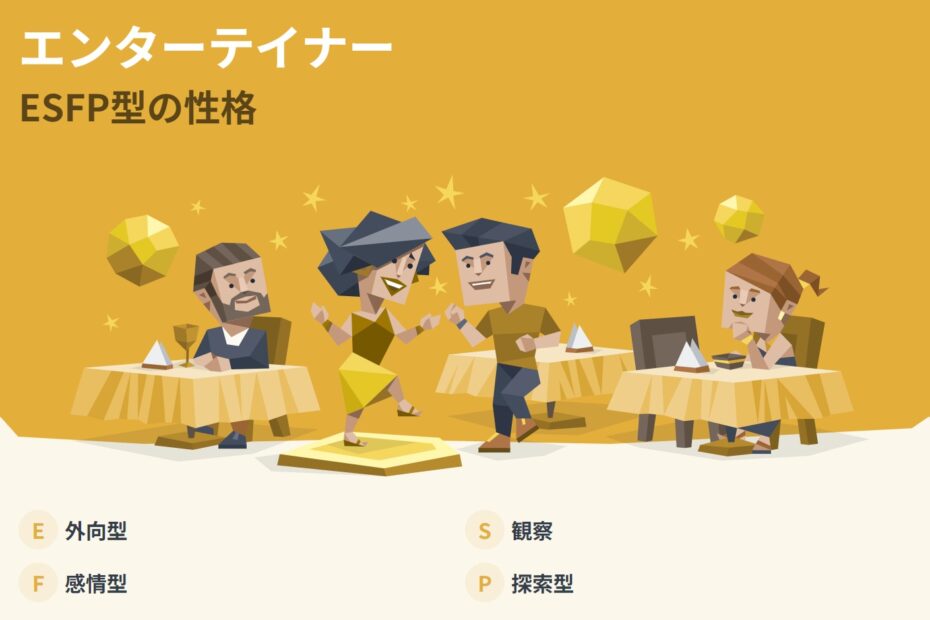
Do you know about the ESFP-A type?
This is one of the indicators that represents personality, and it has a significant impact on our behavior and way of thinking.
In this article, we will explain in detail what characteristics ESFP-A people have, including aspects of health, work, and relationships.
By better understanding your own personality and that of those around you, it may lead to better communication and self-understanding.
Please read while comparing it with your own personality and that of your friends.
Once again, personality researcher and author of Villain Encyclopedia, Tokiwa (@etokiwa999), will provide the explanation.
※We have developed the HEXACO-JP Personality Assessment! It has more scientific basis than MBTI. Tap below for details.

目次
- 1 Scientific Background of ESFP-A (Entertainer – Assertive)
- 2 Scientific Analysis of ESFP-A (Entertainer – Assertive Type)
- 2.1 Tends to Feel Happy Easily
- 2.2 Easily Get Along with People Who Have Both S and F Traits
- 2.3 Making New Friends
- 2.4 Have Many Friends on Social Media
- 2.5 When Using Social Media, They Communicate Through Likes and Encouraging Comments
- 2.6 Engage in Altruistic Activities Such as Volunteering
- 2.7 High quality social capital
- 2.8 Career success comes easily
- 2.9 Prefer fast food, ice cream, chocolate, cocoa, and avoid meat
- 2.10 Tend to hold right-wing authoritarianism (RWA) ideology
- 2.11 Self-determination theory needs for autonomy and relatedness are easily satisfied
- 2.12 Common in Okinawa, Japan
- 2.13 Schwartz’s Values: Hedonism, Benevolence
- 3 In Conclusion
Scientific Background of ESFP-A (Entertainer – Assertive)
Overview of MBTI
MBTI is a psychological theory that classifies personalities into 16 types.
In the first place, MBTI is an abbreviation for Myers-Briggs Type Indicator.
MBTI classifies personalities into 16 types by combining the following 4 indicators.
In other words, MBTI expresses one’s personality tendencies with 4 letters such as “ISTJ” or “ENFP”. A similar and very famous one is 16personalities, but this is different from MBTI.
Overview of Big Five
One of the most influential trait theories in personality psychology is the “Big Five.”
Big Five measures five traits: openness, conscientiousness, extraversion, agreeableness, and neuroticism.
Also, while 16personalities and MBTI use type classification (e.g., either extraverted or introverted), Big Five evaluates traits with continuous numerical values (e.g., extraversion 3.5), which is a major difference.
Furthermore, it has been studied for a long time, with many research papers, and extensive research has been conducted in other fields such as academic ability, income, brain, and genetics. It can be said that Big Five has relatively stronger scientific backing.
Correlation Between MBTI, Big Five, and HEXACO
There are correlations between MBTI’s 4 indicators and Big Five’s 5 factors.
A representative study showing this correlation is the paper “The relationship between the revised NEO-Personality Inventory and the Myers-Briggs Type Indicator“.
According to this paper, the correlations between MBTI and Big Five are as follows.
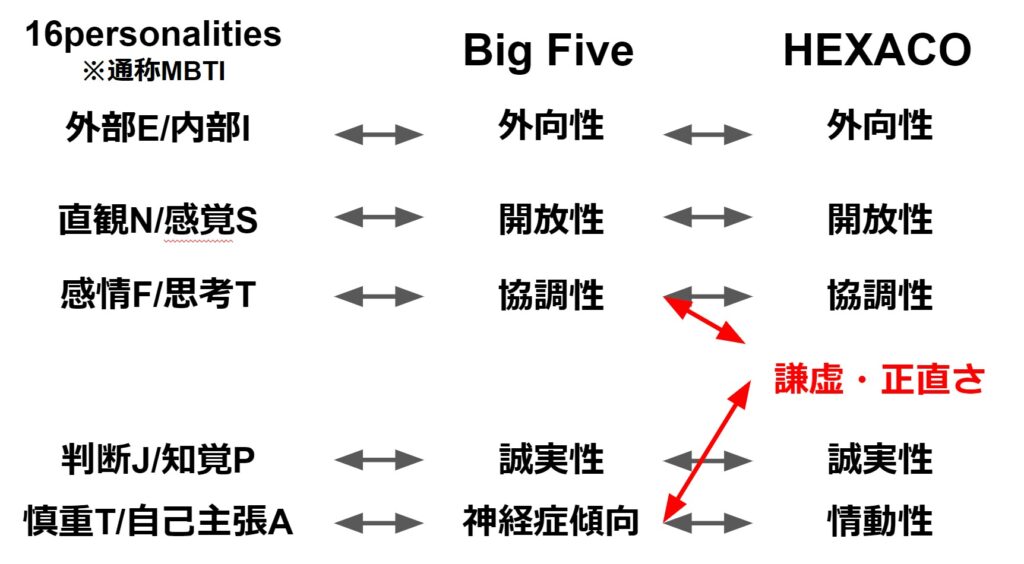
Also, in 16personalities, which was created with reference to MBTI and Big Five, neuroticism from Big Five is called “Identity” and is classified as either Assertive or Turbulent.
On the far right is “HEXACO“, a relatively new personality assessment. It has been improved by adding one indicator “Honesty-Humility” to Big Five.
This article will provide detailed explanations of 16personalities personality types based on these correlations.
Since these are originally Big Five and HEXACO research, if you want to know your personality more scientifically than MBTI or 16personalities, please try this HEXACO personality test.
What is ESFP-A (Entertainer – Assertive)?
ESFP-A is a type with high extraversion (E), low openness (S), high agreeableness (F), low conscientiousness (P), and low neuroticism (A) in Big Five.
- High sociability and optimism
- Present-oriented flexibility
- Deep empathy for others
- Confident self-expression
- Adventurous spirit and vitality
They make the most of the present moment and involve those around them to create a positive atmosphere. They learn through practical experience and express themselves naturally.
In interpersonal relationships, they approach others with warmth and compassion, and are sensitive to others’ emotions. They are open to change and new experiences, and have high stress tolerance, maintaining a positive attitude even in difficult situations. They have strong self-efficacy and believe in their own charm and abilities.
Scientific Analysis of ESFP-A (Entertainer – Assertive Type)
Tends to Feel Happy Easily
People with ESFP-A type tend to feel happiness easily. They have high extraversion (E), enjoy interacting with people, are feeling-oriented (F) and sensitive to their surroundings. Also, due to low neuroticism (-A), they are resilient to stress.
These characteristics combine to make it easy for them to find joy in daily life and experience positive emotions. They often derive happiness from human relationships and new experiences, and their optimistic nature also contributes to their happiness.
In terms of the Big Five, high extraversion and agreeableness with low neuroticism are related to high levels of happiness. For more details, please see this article.
Easily Get Along with People Who Have Both S and F Traits
People with ESFP-A type are sensing (S) with realistic thinking, while being feeling-oriented (F) and valuing human relationships. Therefore, they are compatible with and easily get along with people who also have S and F characteristics.
They can enjoy conversations on realistic topics while being considerate of each other’s emotions, making it easy to build balanced relationships. Sharing concrete experiences and sensations while understanding each other emotionally leads to intimate relationships.
In terms of the Big Five, somewhat low openness and high agreeableness are related to this tendency. For more details, please see this article.
Making New Friends
People with ESFP-A type are skilled at making new friends due to their extroverted (E) personality. They enjoy interacting with people and tend to actively engage in communication.
Their sociable and cheerful personality attracts people around them and creates opportunities for new encounters. Also, being curious and adventurous, they don’t miss chances to meet people in various situations.
They can naturally enjoy conversations even with people they meet for the first time and are skilled at opening others’ hearts. High extraversion in the Big Five is greatly related to this characteristic. For more details, please see this article.
Have Many Friends on Social Media
People with ESFP-A type tend to be active on social media and have many friends due to their extroverted (E) personality. Their sociability in the real world is reflected online, making it easy to build extensive networks on social media.
They are proactive about new encounters and communicate casually online as well. Also, due to their sensing (S) characteristics, they tend to prefer visual posts and immediate content, which is compatible with social media features.
High extraversion in the Big Five is related to active interaction on social media. For more details, please see this article.
When Using Social Media, They Communicate Through Likes and Encouraging Comments
People with ESFP-A type tend to engage in positive communication on social media due to their extroverted (E) and feeling-oriented (F) characteristics. They often give many “likes” and write encouraging comments.
They empathize with others’ posts and respond genuinely, building warm human relationships online as well. They are expressive with emotions and skilled at communicating while considering others’ feelings.
High extraversion and agreeableness in the Big Five are related to such behavior on social media. For more details, please see this article.
Engage in Altruistic Activities Such as Volunteering
People with ESFP-A type tend to participate in altruistic activities such as volunteering due to their extroverted (E) and feeling-oriented (F) characteristics. They find joy in helping others while enjoying interactions with people.
Due to their rich emotions and high empathy, they easily relate to the feelings of people in trouble and naturally want to lend a helping hand. Additionally, with their practical (S) side, they prefer to contribute to society through concrete actions.
High levels of extraversion and agreeableness in the Big Five are related to participation in such altruistic activities. Please see this article for more details.
ESFP-A type individuals tend to have high-quality social capital (relationship capital) due to their extraverted (E), feeling (F), and low neuroticism (-A) traits.
They excel at building wide networks and forming deep trusting relationships. Their sociable and warm personality leads to lasting good relationships. Additionally, their high stress tolerance allows them to flexibly handle relationship troubles.
Such high-quality relationships have positive effects on individual happiness and social success. High extraversion and agreeableness combined with low neuroticism in the Big Five are related to these characteristics. Please see this article for more details.
Career success comes easily
ESFP-A type individuals tend to succeed easily in their careers due to their extraverted (E) and low neuroticism (-A) traits. With high sociability and excellent interpersonal communication skills, they excel in work that leverages networking and teamwork.
Additionally, their high stress tolerance allows them to respond positively even in difficult situations. Their feeling (F) aspect helps with customer service and building relationships within teams.
Their flexibility and adaptability are strengths that allow them to thrive even in rapidly changing environments. High extraversion and low neuroticism in the Big Five are related to career success. Please see this article for more details.
Prefer fast food, ice cream, chocolate, cocoa, and avoid meat
ESFP-A type individuals tend to prefer fast food and sweets due to their extraverted (E) and low neuroticism (-A) traits. They prefer casual, enjoyable meals in social settings and are likely attracted to sweet things like ice cream, chocolate, and cocoa.
This may be related to a personality that seeks immediate satisfaction. On the other hand, they also tend to avoid meat. This could be influenced by empathy toward animals or health considerations stemming from their feeling (F) side.
However, food preferences vary greatly among individuals, so this cannot be generalized. High extraversion and low neuroticism in the Big Five may be related to these food tendencies. Please see this article for more details.
ESFP-A type individuals tend to hold right-wing authoritarianism (RWA) ideology due to their sensing (S) traits. Because they prefer realistic and concrete thinking, they tend to value existing order and traditional values.
However, this is not absolute. Their extraverted (E) and feeling (F) aspects can promote interaction and empathy with diverse people, potentially bringing flexible thinking.
Individual values are complex and influenced by various factors. Low openness in the Big Five may be related to this tendency, but other factors need to be considered as well. Please see this article for more details.
ESFP-A type individuals tend to have their needs for autonomy and relatedness in self-determination theory easily satisfied due to their extraverted (E), feeling (F), and low neuroticism (-A) traits.
Their sociable personality that values relationships helps satisfy the need for relatedness. Additionally, because they tend to act with confidence and make choices based on their own will, their need for autonomy is also easily satisfied.
Their high stress tolerance and tendency not to be swayed by others’ expectations also contribute to maintaining autonomy.
High extraversion and agreeableness combined with low neuroticism in the Big Five are related to the fulfillment of these needs. Please see this article for more details.
Common in Okinawa, Japan
ESFP-A type individuals, with their extraverted (E) and feeling (F) traits, tend to be commonly found in Okinawa Prefecture, Japan. This is because there are aspects where Okinawan cultural characteristics match the features of this personality type.
Okinawa’s warm climate, the warmth of its people, and the strength of community bonds are well-suited to sociable and emotionally expressive ESFP-A type individuals.
Additionally, Okinawa’s spirit of “Ichariba Chode” (once we meet, we are brothers/sisters) aligns with the open nature of this personality type.
The high levels of extroversion and agreeableness in the Big Five may be related to this regional tendency. For more details, please see this article.
Schwartz’s Values: Hedonism, Benevolence
ESFP-A type individuals, due to their extroverted (E), feeling (F), and perceiving (P) characteristics, tend to value “hedonism” and “benevolence” in Schwartz’s theory of values.
The value of “hedonism” is related to the tendency to enjoy life and seek sensory pleasures. ESFP-A type individuals value enjoying the present moment and actively seek positive experiences.
The value of “benevolence” shows a tendency to emphasize compassion and understanding toward others. Due to their feeling (F) characteristic, they are interested in others’ well-being and find joy in helping them.
These values influence the actions and decisions of ESFP-A type individuals. The high levels of extroversion and agreeableness in the Big Five are related to the emphasis on these values. For more details, please see this article.
In Conclusion
ESFP-A type individuals are very sociable and cheerful personality owners. They are good at making new friends and actively interact on social media.
They value relationships with others and often encourage people around them or participate in volunteer activities.
Additionally, people with this personality tend to feel happiness easily and have strong resistance to stress. Therefore, they have good interpersonal relationships and tend to succeed at work.
Regarding food preferences, they tend to prefer fast food and sweets, but there are also individual differences. As values, they cherish enjoying life and caring for others.
In Japan, they are said to be commonly found in Okinawa, but this is also a statistical tendency, and we should remember that there are individual differences.
The tendencies introduced are originally from Big Five and HEXACO research, so if you want to know your personality more scientifically than MBTI or 16personalities, please try this HEXACO personality test.