Do you know about the ISTP-T type?
This is one of the indicators that represents personality, and it has a major influence on our behavior and way of thinking.
In this article, we will explain in detail what characteristics ISTP-T people have, including aspects of health, work, and human relationships.
By getting to know your own and others’ personalities well, it may lead to better communication and self-understanding.
Please read this while comparing it with your own and your friends’ personalities.
Once again, personality researcher and author of Villain Encyclopedia, Tokiwa (@etokiwa999), will provide the explanation.
※We have developed the HEXACO-JP Personality Assessment! It has more scientific basis than MBTI. Tap below for details.

目次
- 1 Scientific Background of ISTP-T (Virtuoso・Turbulent Type)
- 2 Scientific Explanation of ISTP-T (Virtuoso – Turbulent)
- 2.1 Tend to get along well with people who have both S and T traits
- 2.2 Psychotherapy may increase extroversion and reduce neuroticism
- 2.3 Properly maintain social distance for infection control
- 2.4 Common among writers/editors, artists/creators, counselors/therapists
- 2.5 Common among those with ADHD
- 2.6 Prone to fatigue
- 2.7 Prone to Burnout
- 2.8 Perfectionism with Tendency to Feel Concern
- 2.9 Preference for Salty, Sour, and Greasy Foods Due to Stress
- 2.10 Poor Sleep Quality
- 2.11 Prone to Gambling
- 2.12 Prone to Alcohol Addiction, Nicotine Addiction, and Gambling Addiction
- 2.13 Prone to internet addiction
- 2.14 In the case of men, prone to becoming husbands who are cheated on
- 2.15 Common among criminals
- 2.16 Common among mental illness patients
- 2.17 Prone to early death
- 2.18 Tend to have Right-wing Authoritarianism (RWA) and Social Dominance Orientation (SDO) ideologies
- 2.19 Relatively common among bullying perpetrators
- 2.20 Common among cyberbullying perpetrators
- 2.21 Common among monster employees
- 2.22 Practicing mindfulness reduces neuroticism
- 2.23 Engaging in Emotion-Focused Coping
- 2.24 Developing Bias Toward Risk Due to High Neuroticism
- 2.25 Common in Japan’s Tohoku, Hokuriku, and Chugoku Regions
- 3 In Conclusion
Scientific Background of ISTP-T (Virtuoso・Turbulent Type)
Overview of MBTI
MBTI is a psychological theory that classifies personality into 16 types.
MBTI is an abbreviation for Myers-Briggs Type Indicator.
MBTI classifies personality into 16 types by combining the following 4 indicators.
In other words, MBTI expresses your personality tendencies with 4 letters such as “ISTJ” or “ENFP”. There is the very famous 16personalities which is similar, but this is different from MBTI.
Overview of Big Five
One of the most influential trait theories in personality psychology is the “Big Five.”
The Big Five measures five traits: Openness, Conscientiousness, Extraversion, Agreeableness, and Neuroticism.
Also, while 16personalities and MBTI use type classification (for example, either extraverted or introverted), the Big Five evaluates traits with continuous numerical values (for example, extraversion 3.5), which is a major difference.
Furthermore, it has been studied for a long time, has many research papers, and extensive research has been conducted in other fields such as academic ability, income, brain, and genetics. It can be said that the Big Five has relatively stronger scientific backing.
Correlation Between MBTI, Big Five, and HEXACO
There is a correlation between MBTI’s 4 indicators and Big Five’s 5 factors.
A representative study showing this correlation is the paper “The relationship between the revised NEO-Personality Inventory and the Myers-Briggs Type Indicator.”
According to this paper, the correlation between MBTI and Big Five is as follows.
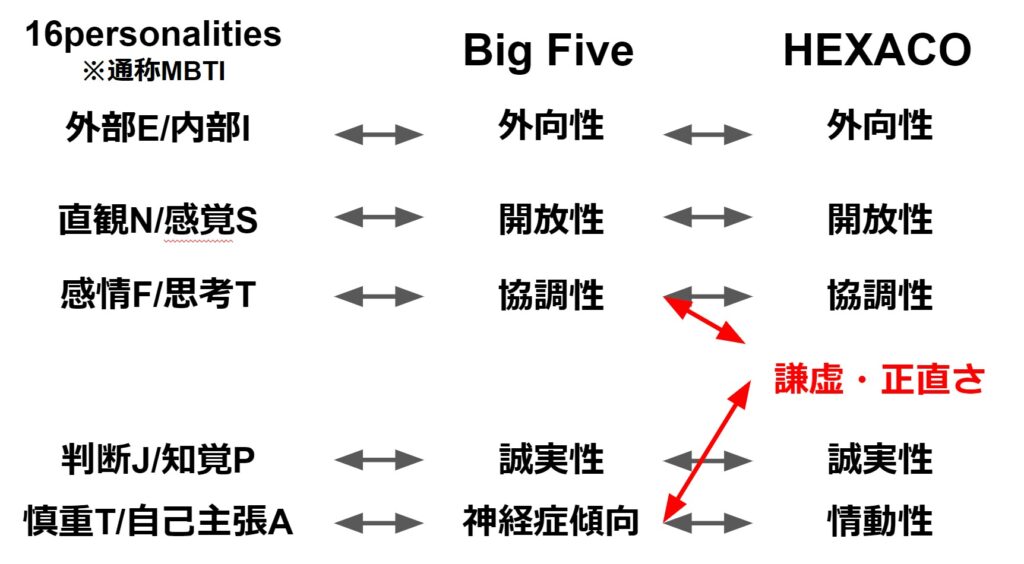
Also, in 16personalities, which was created with reference to MBTI and Big Five, the neuroticism of Big Five is called “Identity,” and it is classified as either Assertive or Turbulent.
On the far right is “HEXACO,” a relatively new personality assessment. It was improved by adding one indicator “Honesty-Humility” to the Big Five.
This article will provide detailed explanations of 16personalities personality types based on these correlations.
Since these are originally Big Five and HEXACO research, if you want to know your personality more scientifically than MBTI or 16personalities, please try this HEXACO personality assessment.
What is ISTP-T (Virtuoso・Turbulent Type)?
ISTP-T is a type with low extraversion (I), low openness (S), low agreeableness (T), low conscientiousness (P), and high neuroticism (T) in the Big Five. Characteristics:
- High problem-solving ability and adaptability
- Self-doubt and perfectionism
- Interest in practical skills
- Anxiety about social expectations
- Internal conflicts and desire for growth
They excel at finding creative solutions to specific problems, but they also tend to doubt their own abilities and decisions.
They focus on the present moment and value practical experience, but also harbor anxiety about long-term consequences. In interpersonal relationships, they value personal space but may feel anxious about social interactions.
While they welcome change and new challenges, they also have a fear of failure. This internal conflict becomes the driving force for continuous self-improvement.
Scientific Explanation of ISTP-T (Virtuoso – Turbulent)
Tend to get along well with people who have both S and T traits
ISTP-T individuals have high affinity with people who possess sensing (S) and thinking (T) characteristics. In the Big Five, they tend to have low openness and low agreeableness.
ISTP-T individuals prefer concrete and practical thinking and value logical analysis. Communication flows smoothly with people who share similar traits, and they easily understand each other’s thought patterns and behavioral tendencies, making it easier to build good relationships.
For more details, please see this article.
Psychotherapy may increase extroversion and reduce neuroticism
ISTP-T individuals have introverted (I) and turbulent (-T) characteristics. In the Big Five, they tend to have low extroversion and high neuroticism. Through psychotherapy, self-understanding may deepen and sociability may improve. Additionally, by learning coping methods for anxiety and stress, neuroticism may decrease.
For ISTP-T individuals, psychotherapy may be a good opportunity for self-growth. However, effectiveness varies among individuals, and proper support from specialists is important.
For more details, please see this article.
The introverted (I) traits of ISTP-T may work positively in infection control measures. In the Big Five, they tend to have low extroversion, so they naturally don’t prefer crowds and value alone time.
Therefore, ISTP-T individuals are likely to naturally maintain social distance and take actions suitable for infection control measures. However, this is a general tendency, and actual behavior may vary depending on individual awareness and circumstances.
For more details, please see this article.
Common among writers/editors, artists/creators, counselors/therapists
The introverted (I) traits of ISTP-T tend to be compatible with professions that require concentration. In the Big Five, they have low extroversion and tend to prefer working alone.
As writers or editors, they can utilize logical thinking (T) to construct text. As artists or creators, they can express their sensing aspects (S) to produce works. As counselors or therapists, they can utilize their observation and analytical skills.
However, these are general tendencies, and optimal professions vary depending on individual aptitude and interests.
For more details, please see this article.
Common among those with ADHD
The characteristics of ISTP-T, particularly the prospecting (P) and turbulent (-T) aspects, may partially overlap with ADHD tendencies. In the Big Five, they tend to have low conscientiousness and high neuroticism.
ISTP-T individuals are flexible and good at generating new ideas, but sometimes their concentration may not last. Additionally, their cautiousness may make them prone to anxiety.
However, there is no direct causal relationship between MBTI types and ADHD, and proper evaluation by specialists is necessary for ADHD diagnosis.
For more details, please see this article.
Prone to fatigue
The introverted (I), prospecting (P), and turbulent (-T) characteristics of ISTP-T may be related to energy consumption. In the Big Five, they tend to have low extroversion and low conscientiousness, and additionally high neuroticism, which may contribute to fatigue susceptibility.
ISTP-T individuals may be prone to mental fatigue, as they tend to drain energy through social interactions and constantly seek new ideas. Additionally, stress from their cautious nature may contribute to fatigue.
Proper rest and self-management are important.
Please see this article for more details.
Prone to Burnout
The introverted (I), exploratory (P), logical (T), and cautious (-T) traits of ISTP-T may be associated with burnout risk. In the Big Five, they tend to have low extraversion and low conscientiousness, plus high neuroticism, which may make them vulnerable to stress.
ISTP-T individuals tend to become absorbed in their areas of interest and seek perfection. They also expend significant energy in social interactions, which may lead to unconscious exhaustion.
Self-management and stress countermeasures are important. Please see this article for more details.
Perfectionism with Tendency to Feel Concern
The introverted (I), exploratory (P), logical (T), and cautious (-T) traits of ISTP-T may be linked to perfectionist tendencies. In the Big Five, they tend to have high neuroticism and are prone to feeling anxiety and concern.
ISTP-T individuals value logical thinking and tend to pay attention to details. While they constantly explore new ideas, their cautious nature may make them prone to feeling concern.
This perfectionism can sometimes enhance productivity, but when excessive, it can also become a source of anxiety and stress. Finding balance is important.
Please see this article for more details.
Preference for Salty, Sour, and Greasy Foods Due to Stress
The cautious (-T) trait of ISTP-T may influence stress coping and eating habits. In the Big Five, they tend to have high neuroticism and may be prone to feeling stress.
Under stress, ISTP-T individuals may tend to prefer salty, sour, and greasy foods. While these foods have a temporary mood-enhancing effect, they may lead to health problems in the long term.
It’s important to balance stress management with healthy eating habits. It would be good to explore stress relief methods other than food as well.
Please see this article for more details.
Poor Sleep Quality
The introverted (I), exploratory (P), and cautious (-T) traits of ISTP-T may affect sleep quality. In the Big Five, they tend to have low extraversion and low conscientiousness, plus high neuroticism, which may make it difficult to obtain quality sleep.
ISTP-T individuals may find it difficult to calm their minds at bedtime because they continue to turn ideas over in their heads. Also, anxiety and worries due to their cautious nature may interfere with sleep.
Regular sleep habits and proper stress management are important. Relaxation techniques and meditation may also be effective.
Please see this article for more details.
Prone to Gambling
The exploratory (P) and cautious (-T) traits of ISTP-T may be associated with interest in gambling. In the Big Five, they tend to have low conscientiousness and high neuroticism, which may lead to risk-taking behavior.
ISTP-T individuals tend to seek new experiences and may be attracted to the excitement of gambling. They also have a side that tries to develop strategies using logical thinking (T).
However, there is also a risk of gambling addiction, so it’s important to exercise self-control. Finding alternative means, such as experiencing thrills through healthy hobbies and activities, is also important.
Please see this article for more details.
Prone to Alcohol Addiction, Nicotine Addiction, and Gambling Addiction
The introverted (I), logical (T), exploratory (P), and cautious (-T) characteristics of ISTP-T may be associated with addiction risk. In the Big Five, they tend to have low extroversion and low conscientiousness, and high neuroticism, which may make them prone to addictive behaviors as a stress coping mechanism.
ISTP-T individuals tend to seek new experiences and may be attracted to the stimulation of alcohol, nicotine, and gambling. Additionally, due to their introverted nature, they may be more likely to rely on these behaviors as a way to relieve stress.
However, this is a general tendency, and individual choices and environment greatly influence this. Finding healthy stress coping methods is important.
Please refer to this article for more details.
Prone to internet addiction
The exploratory (P) and cautious (-T) characteristics of ISTP-T may be associated with the risk of internet addiction. In the Big Five, they tend to have low conscientiousness and high neuroticism, which may lead to immersion in online activities.
ISTP-T individuals tend to seek new information and experiences, and may be attracted to the infinite possibilities of the internet. Additionally, due to their introverted (I) nature, they may also prefer online communication.
However, internet addiction can interfere with daily life, so it’s important to manage usage time and balance offline activities.
Please refer to this article for more details.
In the case of men, prone to becoming husbands who are cheated on
The cautious (-T) characteristics of ISTP-T may bring certain challenges in relationships. In the Big Five, they tend to have high neuroticism, which may lead to relationship instability.
ISTP-T men may have difficulty expressing emotions due to their introverted (I) nature, or may be too logical (T) to notice their partner’s emotions. Additionally, their exploratory (P) nature may make it difficult for them to seek stability.
However, this is a general tendency and varies greatly depending on individual effort and relationship quality. Open communication and mutual understanding are important.
Please refer to this article for more details.
Common among criminals
The logical (T), exploratory (P), and cautious (-T) characteristics of ISTP-T may be associated with certain criminal behaviors. In the Big Five, they tend to have low agreeableness and low conscientiousness, and high neuroticism, which may make them prone to behaviors that violate social norms.
ISTP-T individuals tend to seek new experiences and may sometimes be attracted to high-risk behaviors. Additionally, they may be prone to justifying their actions using logical thinking.
However, this is merely a statistical tendency, and ISTP-T individuals do not necessarily engage in criminal activity. Individual values and environment greatly influence this.
Please refer to this article for more details.
Common among mental illness patients
The introverted (I), exploratory (P), and cautious (-T) characteristics of ISTP-T may be associated with certain mental illnesses. In the Big Five, they tend to have low extroversion and low conscientiousness, and high neuroticism, which may make them prone to mental health challenges.
and high neuroticism, which may make them prone to mental health challenges.
ISTP-T individuals have introspective tendencies and tend to deeply analyze their own thoughts and emotions. While this deepens self-understanding, it can sometimes lead to excessive worry and anxiety. Additionally, their exploratory nature may make them prone to inappropriate behaviors as stress coping mechanisms.
However, this is a general tendency, and ISTP-T individuals do not necessarily develop mental illness. Appropriate stress management and self-care are important.
Please refer to this article for more details.
Prone to early death
The exploratory (P) and cautious (-T) characteristics of ISTP-T may be associated with health risks. In the Big Five, they tend to have low conscientiousness and high neuroticism, which may lead to difficulties in health management.
ISTP-T individuals may sometimes engage in high-risk behaviors due to their tendency to seek new experiences. Additionally, stress from their cautiousness may adversely affect their health.
However, this is a statistical trend, and individual lifestyle and environment have a significant impact. It’s important to maintain a healthy lifestyle including regular living habits, moderate exercise, and a balanced diet.
Please see this article for more details.
Tend to have Right-wing Authoritarianism (RWA) and Social Dominance Orientation (SDO) ideologies
The sensing (S) and thinking (T) characteristics of ISTP-T may be associated with certain political tendencies. In the Big Five, they tend to be low in openness and low in agreeableness, which may lead to support for conservative values and hierarchical social structures.
ISTP-T individuals tend to prefer concrete and practical approaches, and may find value in existing order and traditional values. Also, because they value logical thinking, they may view social hierarchical structures as efficient.
However, this is a general tendency that varies greatly depending on individual experience, education, and environment. It’s important to recognize the significance of having diverse perspectives.
Please see this article for more details.
Relatively common among bullying perpetrators
The sensing (S), thinking (T), prospecting (P), and turbulent (-T) characteristics of ISTP-T may be associated with bullying behavior. In the Big Five, they tend to be low in agreeableness and high in neuroticism, which may lead to interpersonal relationship problems.
ISTP-T individuals tend to prioritize logic over emotion and may have difficulty noticing others’ emotions. Additionally, their prospecting nature may lead them to test social boundaries.
However, this is a statistical trend, and ISTP-T individuals don’t necessarily become bullying perpetrators. It’s important to develop empathy and make efforts to understand others’ emotions.
Please see this article for more details.
Common among cyberbullying perpetrators
The thinking (T) and prospecting (P) characteristics of ISTP-T may be associated with cyberbullying. In the Big Five, they tend to be low in agreeableness and low in conscientiousness, which may lead to inappropriate behavior online.
ISTP-T individuals may speak online without considering the other person’s emotions due to their emphasis on logical thinking. Additionally, their prospecting nature may lead them to act without fully considering the consequences of their online behavior.
However, this is a general tendency that varies greatly depending on individual values and education. It’s important to be considerate and act responsibly even online.
Please see this article for more details.
Common among monster employees
The thinking (T) and prospecting (P) characteristics of ISTP-T may be associated with certain problematic behaviors in the workplace. In the Big Five, they tend to be low in agreeableness and low in conscientiousness, which may lead to difficulties with workplace relationships and rule compliance.
ISTP-T individuals tend to judge things by their own logic and may take actions without considering organizational rules or others’ emotions. Additionally, their prospecting nature may lead them to take actions that sometimes cause confusion, not being bound by existing methods.
However, this is a general tendency that varies greatly depending on individual work ethics and experience. It’s important to develop communication skills in the workplace and be considerate of others.
Please see this article for more details.
Practicing mindfulness reduces neuroticism
The turbulent (-T) characteristic of ISTP-T is associated with high neuroticism. However, mindfulness practice may improve this tendency.
Mindfulness is a technique of focusing awareness on the present moment and observing without judgment. For ISTP-T individuals, this can be a way to utilize their introverted (I) and analytical tendencies while reducing excessive worry and anxiety.
Regular mindfulness practice may improve stress management abilities and make it easier to achieve emotional balance. However, effectiveness varies among individuals, and continuous practice is important.
Please see this article for more details.
Engaging in Emotion-Focused Coping
The cautious (-T) trait of ISTP-T is associated with high neuroticism, which may influence stress coping methods. ISTP-T individuals may tend to use emotion-focused coping (stress management methods that focus on emotions).
This method emphasizes dealing with emotions caused by stress rather than the source of stress itself. For example, it includes relaxation techniques, meditation, and emotional expression.
For ISTP-T individuals, this method may provide an opportunity to utilize their introverted (I) aspect while improving emotional management skills. However, maintaining a balance with problem-solving coping is also important.
Developing Bias Toward Risk Due to High Neuroticism
The cautious (-T) trait of ISTP-T is associated with high neuroticism, which may influence risk perception. ISTP-T individuals may tend to overestimate risks.
This bias may lead them to avoid new opportunities and experiences. On the other hand, the logical (T) and exploratory (P) aspects of ISTP-T may also balance this bias.
Proper risk assessment requires objective information gathering and calm analysis. Additionally, learning stress management techniques to deal with excessive worry and anxiety may be effective.
Please see this article for more details.
Common in Japan’s Tohoku, Hokuriku, and Chugoku Regions
The characteristics of ISTP-T, particularly the introverted (I), logical (T), exploratory (P), and cautious (-T) aspects, may be related to the culture and climate of specific regions in Japan. In the Big Five, there tends to be low extraversion and low openness, which may align with regional characteristics.
The Tohoku, Hokuriku, and Chugoku regions tend to value tradition while preferring practical approaches, which shares common ground with ISTP-T characteristics. Additionally, the climate and geographical features of these regions may influence the formation of cautious and introspective personalities.
However, this is a general tendency, and there are individual differences and changes over time. It’s important to recognize regional diversity.
Please see this article for more details.
In Conclusion
We have examined various aspects of ISTP-T characteristics. We’ve seen how the traits of being introverted, logical, exploratory, and cautious influence various aspects of life.
This personality type has both positive aspects and areas that require attention. For example, while they may be suited for jobs that utilize their concentration abilities, they might struggle with stress and interpersonal relationships.
What’s important is knowing your characteristics, developing your strengths while being mindful of your weaknesses.
The tendencies introduced are originally from Big Five and HEXACO research, so if you want to understand your personality more scientifically than MBTI or 16personalities, please try this HEXACO personality test.

Writer & Supervisor: Eisuke Tokiwa
Personality Psychology Researcher / CEO, SUNBLAZE Inc.
As a child he experienced poverty, domestic abuse, bullying, truancy and dropping out of school — first-hand exposure to a range of social problems. He spent 10 years researching these issues and published Encyclopedia of Villains through Jiyukokuminsha. Since then he has independently researched the determinants of social problems and antisocial behavior (work, education, health, personality, genetics, region, etc.) and has published 2 peer-reviewed journal articles (Frontiers in Psychology, IEEE Access). His goal is to predict the occurrence of social problems. Spiky profile (WAIS-IV).
Expertise: Personality Psychology / Big Five / HEXACO / MBTI / Prediction of Social Problems
Researcher profiles: ORCID / Google Scholar / ResearchGate
Social & Books: X (@etokiwa999) / note / Amazon Author Page