Do you know about the INTP-T type?
This is one of the indicators that represents personality, and it has a major influence on our behavior and way of thinking.
In this article, we will explain in detail what characteristics INTP-T people have, including aspects of health, work, and interpersonal relationships.
Getting to know your own and others’ personalities well may lead to better communication and self-understanding.
Please read this while comparing it with your own and your friends’ personalities.
Once again, personality researcher and author of Villain Encyclopedia, Tokiwa (@etokiwa999), will provide the explanation.
※We have developed the HEXACO-JP Personality Assessment! It has more scientific basis than MBTI. Tap below for details.

目次
- 1 Scientific Background of INTP-T (Logician・Turbulent Type)
- 2 Scientific Explanation of INTP-T (The Logician – Turbulent Type)
- 2.1 Tend to get along well with people who have both N and T traits
- 2.2 Slightly more likely to have high IQ, even more likely when neuroticism is reduced
- 2.3 Psychotherapy may increase extraversion and reduce neuroticism
- 2.4 May actively gather information on social media
- 2.5 Properly maintain social distancing for infection control
- 2.6 High learning goal orientation (setting goals and learning in work)
- 2.7 Common in writers/editors, artists/creators, counselors/therapists
- 2.8 In children, there is a possibility of being gifted
- 2.9 Common in ADHD
- 2.10 Common in HSP
- 2.11 Prone to Fatigue
- 2.12 Prone to Burnout
- 2.13 Concern-Prone Perfectionism
- 2.14 Preference for Salty, Sour, and Fatty Foods Due to Stress
- 2.15 Poor Sleep Quality
- 2.16 Prone to gambling
- 2.17 Prone to alcohol addiction, nicotine addiction, cannabis addiction, and gambling addiction
- 2.18 Prone to internet addiction
- 2.19 In the case of males, prone to becoming husbands who are cheated on
- 2.20 Common among criminals
- 2.21 Common among mental illness patients
- 2.22 Prone to early death
- 2.23 Prone to hoarding behavior
- 2.24 Tends to hold Social Dominance Orientation (SDO) ideology
- 2.25 Common among cyberbullying perpetrators
- 2.26 Common among monster employees
- 2.27 Practicing mindfulness reduces neuroticism
- 2.28 Engaging in Emotion-Focused Coping
- 2.29 Taking High Risks, Having Risk Bias Due to High Neuroticism
- 2.30 Common in Japan’s Tohoku, Hokuriku, and Chugoku Regions
- 2.31 Preference for Simple or Practical Clothing
- 3 In Conclusion
Scientific Background of INTP-T (Logician・Turbulent Type)
Overview of MBTI
MBTI is a psychological theory that classifies personality into 16 types.
To begin with, MBTI is an abbreviation for Myers-Briggs Type Indicator.
MBTI classifies personality into 16 types by combining the following 4 indicators.
In other words, MBTI expresses your personality tendencies with 4 letters such as “ISTJ” or “ENFP”. There is the very famous 16personalities which is similar, but this is different from MBTI.
Overview of Big Five
One of the most influential trait theories in personality psychology is the “Big Five.”
The Big Five measures five traits: Openness, Conscientiousness, Extraversion, Agreeableness, and Neuroticism.
Also, while 16personalities and MBTI use type classification (e.g., either extroverted or introverted), the Big Five evaluates traits with continuous numerical values (e.g., extraversion 3.5), which is a major difference.
Furthermore, it has been studied for a long time, has many published papers, and extensive research has been conducted in other fields such as academic ability, income, brain, and genetics. It can be said that the Big Five has relatively stronger scientific backing.
Correlation Between MBTI・Big Five・HEXACO
There is a correlation between MBTI’s 4 indicators and Big Five’s 5 factors.
A representative study showing this correlation is the paper “The relationship between the revised NEO-Personality Inventory and the Myers-Briggs Type Indicator.”
According to this paper, the correlation between MBTI and Big Five is as follows.
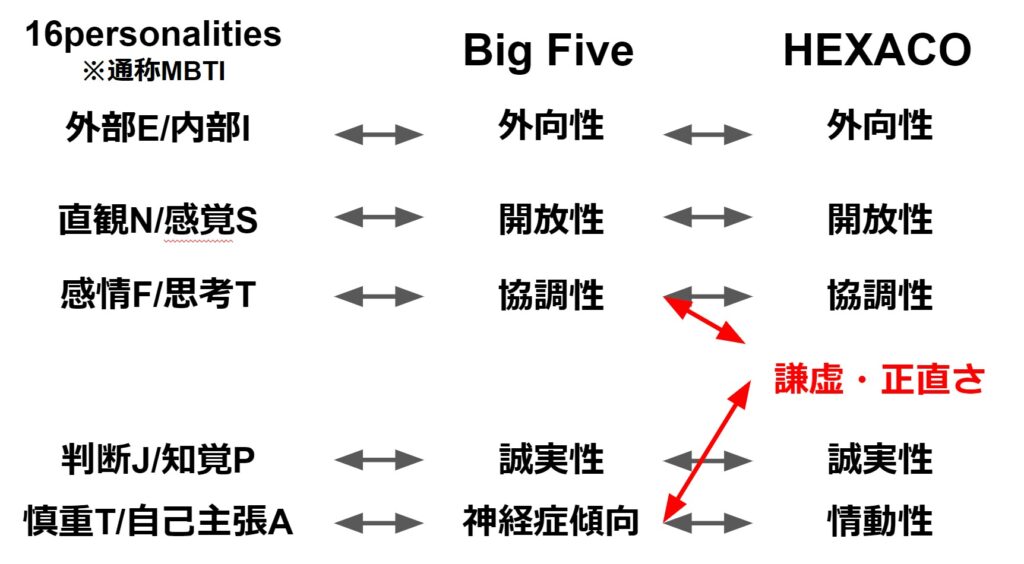
Also, in 16personalities, which was created with reference to MBTI and Big Five, the Big Five’s neuroticism is called “Identity,” and it classifies whether one is Assertive or Turbulent.
On the far right is “HEXACO,” a relatively new personality assessment. It has been improved by adding one indicator “Honesty-Humility” to the Big Five.
This article will provide a detailed explanation of 16personalities personality types based on these correlational relationships.
Since these are originally Big Five and HEXACO studies, if you want to know your personality more scientifically than MBTI or 16personalities, please try this HEXACO personality test.
What is INTP-T (Logician・Turbulent Type)?
INTP-T is a type with low Extraversion (I), high Openness (N), low Agreeableness (T), low Conscientiousness (P), and high Neuroticism (T) in the Big Five. Characteristics:
- High intellectual curiosity and analytical ability
- Self-doubt and perfectionism
- Creative and innovative thinking
- Anxiety about social interactions
- Strong desire for continuous self-improvement
They enjoy solving complex problems but tend to underestimate their own abilities. While they explore new ideas, they may also hesitate to put them into action.
In interpersonal relationships, they seek deep intellectual connections but tend to feel stressed in social situations. They have a tendency to fear failure, but this also becomes a driving force for their growth.
Scientific Explanation of INTP-T (The Logician – Turbulent Type)
Tend to get along well with people who have both N and T traits
INTP-T individuals tend to have high affinity with people who also possess N and T characteristics. This is because they share the traits of high openness (N) and low agreeableness (T) in the Big Five model. Since INTP-Ts are interested in new ideas and concepts and prefer logical thinking, they tend to connect well with people who have similar thought patterns.
However, this doesn’t mean they can’t get along with other types. Rather, valuing interactions with different types as opportunities to learn diverse perspectives leads to growth.
For more details, please see this article.
Slightly more likely to have high IQ, even more likely when neuroticism is reduced
INTP-T individuals, due to their high openness (N) in the Big Five model, tend to have strong intellectual curiosity and excel at abstract thinking. This can sometimes lead to high IQ scores.
However, the “-T” in INTP-T indicates high neuroticism, which may potentially hinder the expression of intellectual abilities. Reducing neuroticism might have the potential to further enhance IQ.
However, IQ doesn’t determine an individual’s worth. It’s important to aim for balanced growth while leveraging the strengths of INTP-T.
For more details, please see this article.
Psychotherapy may increase extraversion and reduce neuroticism
INTP-T individuals have introverted (I) and high neuroticism (-T) characteristics. This can sometimes lead to anxiety in social situations or excessive self-criticism.
Through psychotherapy, INTP-T individuals may deepen their self-understanding and improve their communication skills. This could potentially increase their extraversion and make it easier to build connections with others.
Additionally, reduced neuroticism may lead to improved stress management and increased confidence. However, the goal is not to fundamentally change one’s personality, but to support healthier self-expression.
For more details, please see this article.
INTP-T individuals, due to their high openness (N) characteristic in the Big Five model, have strong interest in new information and knowledge. This trait may lead to active information-gathering behavior through social media.
INTP-T individuals prefer pursuing deep discussions on various topics and the latest discoveries. Social media can serve as a rich source of information that satisfies such intellectual curiosity.
However, it’s also important to verify the reliability of information and avoid excessive use of social media. It’s crucial to leverage the analytical thinking of INTP-T to critically evaluate information.
For more details, please see this article.
The introverted (I) nature of INTP-T may work favorably in practicing social distancing for infection control. This is because they tend not to feel much distress about maintaining physical distance from others.
Additionally, the logical thinking (T) of INTP-T leads to understanding and implementing the importance of infection control measures. They tend to prefer taking actions based on scientific evidence, so they’re likely to follow expert advice.
However, it’s important to avoid complete isolation and maintain connections with society through online means and other methods. INTP-T individuals should also remember that moderate social interaction is important for mental health.
For more details, please see this article.
High learning goal orientation (setting goals and learning in work)
INTP-T tends to have high learning goal orientation due to their high openness (N) and low agreeableness (T) characteristics in the Big Five. This means they have an attitude of setting specific goals in work and personal growth and proceeding with learning toward those goals.
INTP-T people have a strong interest in acquiring new knowledge and skills, and are enthusiastic about self-improvement. In work as well, they tend to not just complete assigned tasks, but set learning goals for themselves and work toward them.
While this trait can work favorably for career development and improving expertise, it’s important to be careful as it can sometimes lead to perfectionism. It’s important to maintain balanced goal setting and a flexible learning approach.
Please see this article for more details.
Common in writers/editors, artists/creators, counselors/therapists
INTP-T’s introverted (I) nature is well-suited for creative work that requires concentration. As writers and editors, they can utilize their deep thinking and analytical abilities to produce high-quality writing.
As artists and creators, INTP-T’s high openness (N) serves as a source of original ideas, allowing them to discover unique methods of expression.
As counselors and therapists, INTP-T’s logical thinking (T) and introspective nature help them objectively analyze clients’ problems and propose effective solutions.
However, these professions are not suitable for all INTP-T individuals. It’s important to choose careers based on individual interests, values, and skill sets.
Please see this article for more details.
In children, there is a possibility of being gifted
INTP-T children may be gifted due to their high openness (N) characteristic in the Big Five. These children may show excellent abilities in abstract thinking and complex problem-solving.
INTP-T gifted children tend to have deep intellectual curiosity, ask questions inappropriate for their age, or understand advanced concepts. They are also characterized by having original ideas and insight.
However, being gifted does not necessarily guarantee success in academics or social life. It’s important to pay attention to the emotional needs of INTP-T children and support their balanced development.
Additionally, gifted diagnosis should be conducted by professionals, and one cannot judge giftedness based solely on INTP-T traits.
Please see this article for more details.
Common in ADHD
INTP-T traits, particularly P (flexibility) and -T (high neuroticism), partially overlap with ADHD symptoms. For example, attention deficits and difficulties with planning and organization.
However, being an INTP-T type does not directly mean having ADHD. ADHD is a neurodevelopmental disorder that requires diagnosis by medical professionals, not merely a personality trait.
If INTP-T individuals are troubled by ADHD symptoms that interfere with daily life, we recommend consulting with a specialist. Through proper diagnosis and support, they can find ways to cope with difficulties while maximizing their strengths such as creativity and analytical abilities.
Please see this article for more details.
Common in HSP
INTP-T traits, particularly N (high openness) and -T (high neuroticism), overlap with characteristics of HSP (Highly Sensitive Person). HSPs are sensitive to environmental stimuli and tend to process them deeply.
INTP-T individuals may have delicate senses and deep introspection due to their high openness. Additionally, high neuroticism may lead to sensitive reactions to subtle environmental changes.
However, not all INTP-T individuals are HSP. HSP is an innate temperament, while INTP-T is a personality type.
INTP-T individuals with HSP characteristics should deepen their self-understanding and find appropriate self-care methods. By learning to utilize their sensitivity as a strength while protecting themselves from excessive stimulation, they can lead richer lives.
Please see this article for more details.
Prone to Fatigue
INTP-T individuals tend to become easily fatigued in specific situations due to their introverted (I) nature, flexibility (P), and high neuroticism (-T).
Their introverted nature means they are likely to drain energy in social situations or during prolonged interpersonal interactions. Additionally, their high flexibility may cause stress in unstructured environments or with sudden schedule changes.
Furthermore, high neuroticism makes them prone to stress and anxiety, which can lead to physical fatigue. The analytical thinking of INTP-T individuals can also cause mental exhaustion by overthinking problems.
Understanding these characteristics and practicing proper rest and stress management is important. By respecting their own pace and consciously setting aside time to recover energy, INTP-T individuals can live more healthily.
Please see this article for more details.
Prone to Burnout
The characteristics of INTP-T, particularly introversion (I), flexibility (P), and high neuroticism (-T), may increase the risk of burnout syndrome under certain circumstances.
INTP-T individuals tend to become absorbed in work or studies due to their analytical thinking and perfectionist tendencies. However, their introverted nature makes them easily tired by frequent social interactions, and their high flexibility can cause stress in deadline-driven or structured environments.
Furthermore, high neuroticism amplifies stress and anxiety, making them prone to accumulating mental fatigue. When these factors combine, the risk of burnout increases.
For INTP-T individuals, it’s important to increase self-awareness and learn stress management techniques. By ensuring adequate rest, securing time for hobbies, and seeking help when necessary, they can prevent burnout and maintain a healthy life balance.
Please see this article for more details.
Concern-Prone Perfectionism
The characteristics of INTP-T, particularly introversion (I), thinking type (T), flexibility (P), and high neuroticism (-T), may lead to concern-prone perfectionism.
The analytical thinking of INTP-T creates a tendency to think through problems down to the smallest details. This can sometimes lead to excessive worry and concern. They also display perfectionist tendencies, setting high standards and striving to reach them.
High neuroticism may further amplify these concerns and perfectionism. As a result, behavioral patterns may emerge where they cannot be satisfied with their achievements and constantly seek something better.
For INTP-T individuals, it’s important to use this perfectionism constructively. It’s crucial to maintain high standards while balancing to avoid becoming overly self-critical. Accepting the concept of “good enough” and recognizing and celebrating small successes is also effective.
Moderate perfectionism can be a driving force for growth, but when excessive, it becomes a mental burden. By increasing self-acceptance and flexibility, INTP-T individuals can lead healthier and more productive lives.
Please see this article for more details.
Preference for Salty, Sour, and Fatty Foods Due to Stress
The “-T” in INTP-T indicates high neuroticism, which is also related to high sensitivity to stress. Under stress, many people tend to seek comfort food, and INTP-T individuals are no exception.
In particular, salty, sour, and fatty foods tend to be preferred during stressful times because they have the effect of temporarily improving mood. These foods stimulate the brain’s reward system, providing temporary comfort and satisfaction.
However, when such eating habits become long-term, they may lead to health risks. It’s important for INTP-T individuals to find healthy ways to manage stress. For example, finding alternative stress-relief methods such as exercise, mindfulness, or hobby time can be effective.
Additionally, maintaining a balanced diet and making plans in advance to make healthy choices even during stressful times would also be effective.
Please see this article for more details.
Poor Sleep Quality
The characteristics of INTP-T, particularly introversion (I), flexibility (P), and high neuroticism (-T), may affect sleep quality.
Their introverted nature leads to a tendency to deeply introspect on the day’s events and thoughts, which can make their minds restless at bedtime. High flexibility may make it difficult to maintain regular sleep habits.
Furthermore, high neuroticism makes them prone to anxiety and stress, which can be major factors that interfere with sleep. The analytical thinking of INTP-T individuals may also create a tendency to continue thinking about problems during nighttime.
For quality sleep, establishing a bedtime routine and learning relaxation techniques can be effective. For example, meditation, deep breathing, or light reading might be helpful. It’s also important to pay attention to sleep hygiene by organizing the sleep environment and avoiding caffeine and blue light intake.
Seeking expert advice as needed is also an effective way to improve sleep quality.
For more details, please see this article.
Prone to gambling
The characteristics of INTP-T, particularly flexibility (P) and high neuroticism (-T), may lead to gambling behavior under certain circumstances.
High flexibility is associated with a tendency to seek new experiences and stimulation, which can be one factor contributing to the appeal of gambling. Additionally, the analytical thinking of INTP-T may spark interest in understanding gambling systems and probabilities.
On the other hand, high neuroticism creates a state where stress and anxiety are easily felt, and there’s a possibility of turning to gambling as a means to escape from these emotions.
However, not all INTP-Ts develop gambling addiction. It’s important to increase self-awareness and find healthy stress relief methods. Even when interested in gambling, it’s crucial to approach it with a responsible attitude and set limits.
If gambling behavior becomes problematic, we recommend seeking professional support. Utilizing the logical thinking of INTP-T to objectively analyze the risks and realities of gambling may also be effective.
For more details, please see this article.
Prone to alcohol addiction, nicotine addiction, cannabis addiction, and gambling addiction
The characteristics of INTP-T may increase the risk of addiction under certain circumstances. Introversion (I), flexibility (P), and especially high neuroticism (-T) are related to this risk.
INTP-T individuals are prone to feeling stress and anxiety, and may turn to substances or gambling as a means to escape from these emotions. Additionally, openness to new experiences and the tendency to analyze things deeply may sometimes lead to experimental use out of curiosity.
However, this doesn’t mean that all INTP-T individuals become addicted. Many INTP-Ts can utilize their analytical thinking to understand the risks of addiction and develop healthy coping mechanisms.
For addiction prevention, it’s important to learn healthy stress management techniques and increase self-awareness. It’s also important not to hesitate to seek help during difficult times.
If signs of addiction are observed, we recommend receiving professional support early. The logical thinking ability of INTP-T can become a strength that can be effectively utilized in the treatment process.
For more details, please see this article.
Prone to internet addiction
The characteristics of INTP-T, particularly flexibility (P) and high neuroticism (-T), may increase the risk of internet addiction under certain circumstances.
INTP-T individuals have a strong curiosity for new information and knowledge, and the internet becomes an inexhaustible source to satisfy that desire. Additionally, due to their introverted nature (I), they may prefer online communication.
High neuroticism creates a state where stress and anxiety are easily felt, and there’s a possibility of relying on the internet as a means to escape from these emotions. Furthermore, high flexibility can sometimes lead to difficulties in time management, potentially resulting in longer internet usage times.
However, not all INTP-Ts become internet addicted. For healthy internet use, it’s important to increase self-awareness and consciously manage usage time. By also valuing offline activities and real human relationships, a balanced lifestyle can be maintained.
If you feel that internet use has become problematic, we recommend seeking professional support. The analytical thinking ability of INTP-T will be helpful in objectively evaluating one’s own internet usage patterns and finding improvement strategies.
For more details, please see this article.
In the case of males, prone to becoming husbands who are cheated on
INTP-T males tend to have a higher possibility of being cheated on under certain circumstances due to their characteristics. Particularly, high neuroticism (-T) may influence this tendency.
The introverted nature (I) of INTP-T can sometimes make emotional expression and intimacy expression difficult. Additionally, analytical thinking (T) may tend to overlook their partner’s emotional needs.
High neuroticism can cause anxiety and self-doubt, which may affect relationships. Furthermore, flexibility (P) sometimes appears as indecisiveness, potentially making partners feel instability.
However, this doesn’t mean that all INTP-T males are destined to be cheated on. By increasing self-awareness and improving communication skills, healthier relationships can be built. It’s important to pay attention to emotional needs and actively strengthen bonds with partners.
Also, infidelity is a complex issue that isn’t determined by one person’s personality type alone. Building mutual understanding and trust is key to healthy relationships.
For more details, please see this article.
Common among criminals
INTP-T traits, particularly the thinking type (T), flexibility (P), and high neuroticism (-T), may increase the risk of criminal behavior under certain circumstances. However, this does not mean that INTP-T individuals inevitably become criminals.
INTP-T’s analytical thinking may sometimes question existing rules and social norms. High flexibility means the ability to change behavior according to situations, but when directed inappropriately, it can lead to problems.
High neuroticism creates a state prone to stress and anxiety, and these emotions can potentially trigger inappropriate behavior.
However, the vast majority of INTP-Ts abide by the law and act ethically. Rather, they can find ways to contribute to society by leveraging their analytical abilities and creativity.
What’s important is to increase self-awareness, acquire healthy stress management techniques, and understand the impact of one’s actions on others and society. Seeking professional support when necessary is also effective.
Please see this article for more details.
Common among mental illness patients
INTP-T traits, particularly introversion (I), flexibility (P), and high neuroticism (-T), may increase the risk of certain mental illnesses. However, this does not mean that all INTP-Ts will develop mental illness.
INTP-T’s introverted nature may sometimes lead to social isolation, which can be a risk factor for some mental illnesses. Additionally, high flexibility may sometimes make it difficult to maintain a structured daily life.
Particularly, high neuroticism may increase the risk of mood disorders such as anxiety disorders and depression. INTP-T’s analytical thinking may sometimes lead to excessive worry and rumination.
However, INTP-T traits can also be strengths. For example, their analytical ability may help with problem-solving and self-understanding.
To maintain mental health, it is important to increase self-awareness and acquire healthy stress management techniques. Maintaining a healthy lifestyle, including regular exercise, adequate sleep, and a balanced diet, is also crucial.
If you are experiencing mental distress, we recommend seeking professional support without hesitation. Early intervention is effective for preventing and managing many mental illnesses.
Please see this article for more details.
Prone to early death
INTP-T traits, particularly flexibility (P) and high neuroticism (-T), may lead to specific lifestyle habits and behavioral patterns that could increase health risks. However, this does not mean that INTP-T individuals inevitably die early.
High flexibility may sometimes make it difficult to maintain regular lifestyle habits. For example, it may become difficult to develop habits of healthy eating and regular exercise.
High neuroticism may cause chronic stress and anxiety, which can have long-term negative effects on health. There may also be a tendency to rely on unhealthy behaviors (overeating, smoking, excessive drinking, etc.) to relieve stress.
However, INTP-T’s analytical thinking may help understand health-related information and develop appropriate countermeasures. By increasing self-awareness and understanding the importance of a healthy lifestyle, these risks can be significantly reduced.
Regular sleep, balanced diet, regular exercise, and acquiring stress management techniques are important. It is also crucial to have regular health checkups and seek advice from medical professionals when necessary.
By leveraging INTP-T’s creativity and problem-solving abilities, you can build a healthy lifestyle that suits you.
Please see this article for more details.
Prone to hoarding behavior
INTP-T traits, particularly high openness (N) and high neuroticism (-T), may lead to hoarding behavior under certain circumstances.
High openness means a strong interest in new information and knowledge, which may lead to actively collecting information about crisis situations. INTP-T’s analytical thinking might create a tendency to anticipate worst-case scenarios and try to prepare for them.
High neuroticism creates a state prone to anxiety and stress, which may lead to overreaction in crisis situations. Anxiety about uncertainty may lead to excessive stockpiling.
However, INTP-T’s logical thinking ability can also serve as a force to suppress this behavior. Through objective fact analysis and calm judgment, they can understand the irrationality of excessive hoarding.
To avoid hoarding behavior, it is important to obtain accurate information from reliable sources, focus on logical judgment rather than emotional reactions, and seek others’ opinions when necessary.
Additionally, while moderate stockpiling is beneficial, it’s also important to consider the supply and demand balance of society as a whole. By leveraging INTP-T’s analytical abilities, it’s possible to balance personal preparation with social responsibility.
For more details, please see this article.
Tends to hold Social Dominance Orientation (SDO) ideology
The thinking (T) trait of INTP-T can sometimes connect with Social Dominance Orientation (SDO) ideology. SDO refers to the tendency to accept and support hierarchies and inequality in society.
INTP-T’s analytical thinking tends to objectively observe social systems and hierarchical structures, emphasizing their efficiency and functionality. This can sometimes lead to viewing existing social hierarchies as rational.
However, INTP-T’s openness (N) also simultaneously shows interest in diverse perspectives and new ideas. This holds the potential to question existing social structures and explore more equitable social systems.
Additionally, high neuroticism (-T) may create a tendency to seek stable social structures due to anxiety about uncertainty.
What’s important is recognizing and critically examining one’s own thinking patterns and biases. By leveraging INTP-T’s logical thinking abilities and analyzing social issues from diverse perspectives, one can cultivate a more comprehensive and fair viewpoint.
Actively gathering information about social justice and equality, and broadening one’s perspective through interaction with people from diverse backgrounds is also effective.
For more details, please see this article.
Common among cyberbullying perpetrators
INTP-T traits, particularly thinking (T) and flexibility (P), may increase the risk of cyberbullying perpetration under certain circumstances. However, this doesn’t mean all INTP-Ts become cyberbullying perpetrators.
INTP-T’s analytical thinking can sometimes lead to a tendency to prioritize logic and facts over consideration for others’ emotions.
Online, it’s more difficult to read others’ emotions compared to face-to-face communication, and this tendency may become more pronounced.
Additionally, high neuroticism (-T) creates a state of being prone to stress and anxiety, and there’s a possibility of inappropriately expressing these emotions online.
For more details, please see this article.
Common among monster employees
INTP-T traits, particularly thinking (T), flexibility (P), and high neuroticism (-T), may lead to behaviors called “monster employees” under certain workplace environments. However, this doesn’t mean all INTP-Ts become monster employees.
INTP-T’s analytical thinking can lead to a tendency to question existing systems and methods, seeking improvements.
While this can sometimes be beneficial to organizations, it may also create friction with supervisors and colleagues.
For more details, please see this article.
Practicing mindfulness reduces neuroticism
While INTP-T’s high neuroticism (-T) creates a state prone to anxiety and stress, practicing mindfulness can be an effective method to reduce this tendency.
Mindfulness is a practice that cultivates a mental state of focusing awareness on the present moment and accepting it without judgment. This helps balance INTP-T’s analytical and sometimes overly thinking tendencies.
For INTP-T individuals, mindfulness offers the following benefits:
- Reduction of stress from excessive analysis and worry
- Improved emotional recognition and management abilities
- Enhanced concentration and productivity
- Promotion of creativity
- Facilitation of more objective self-observation
Mindfulness practice methods include meditation, yoga, and conscious breathing techniques. INTP-T individuals might be interested in the scientific basis of these techniques.
Through regular mindfulness practice, INTP-T individuals may be able to reduce neurotic tendencies and maintain more stable emotional states. This would lead not only to personal growth but also to improved interpersonal relationships and workplace performance.
However, if there are serious anxiety or depressive symptoms, seeking professional support is recommended. While mindfulness is effective as a complementary approach, it’s important to combine it with other treatments as needed.
For more details, please see this article.
Engaging in Emotion-Focused Coping
The traits of INTP-T, particularly the high neuroticism (-T), may lead to a tendency to engage in emotion-focused coping when facing stress or emotional difficulties.
Emotion-focused coping refers to a coping method where, in response to stressful situations, one tries to manage the emotions arising from the situation rather than attempting to solve the problem itself. INTP-T individuals may tend to use the following emotion-focused coping strategies:
- Introspection and self-analysis
- Verbalizing emotions and journal writing
- Emotional expression through creative activities (art, music, etc.)
- Meditation and mindfulness practice
- Seeking social support (dialogue with trusted individuals)
These strategies are well-suited to the analytical thinking and introverted nature of INTP-T.
However, constantly relying on emotion-focused coping may lead to postponing fundamental problem resolution. It’s important to leverage INTP-T’s logical thinking abilities and maintain balance with problem-focused coping (an approach aimed at solving the problem itself).
Also, care must be taken to ensure that excessive introspection doesn’t lead to self-criticism or ruminating thoughts. Seeking professional support when necessary is also effective.
INTP-T individuals can objectively analyze their own coping strategies and find the most effective methods. By developing a balanced approach suited to the individual, stress management abilities can be improved.
Taking High Risks, Having Risk Bias Due to High Neuroticism
The traits of INTP-T, particularly high openness (N), flexibility (P), and high neuroticism (-T), may have complex effects on risk-taking behavior and risk perception.
High openness and flexibility generate curiosity toward new experiences and possibilities, which can sometimes lead to high-risk choices.
The analytical thinking of INTP-T provides the ability to carefully calculate risks and rewards, but it may also lead to overconfidence.
On the other hand, high neuroticism creates a state of being prone to anxiety and stress. This may have two conflicting influences:
- Risk avoidance: tendency to overestimate risks due to anxiety about uncertainty and prefer safe choices
- Risk compensation: tendency to engage in high-risk behaviors to escape anxiety and stress
When these factors combine, INTP-T individuals may sometimes have biased attitudes toward risk. For example, imbalances may occur where they take excessive risks in certain areas while being overly cautious in others.
For more details, please refer to this article.
Common in Japan’s Tohoku, Hokuriku, and Chugoku Regions
The traits of INTP-T, particularly introversion (I), thinking type (T), flexibility (P), and high neuroticism (-T), may have high affinity with the culture and environment of Japan’s Tohoku, Hokuriku, and Chugoku regions. However, it should be noted that this is a statistical tendency and individual differences are significant.
These regions are traditionally characterized by the following features:
- Introverted and modest culture: matches INTP-T’s introversion
- Emphasis on practical and logical thinking: matches INTP-T’s thinking type
- Adaptability to natural environment: matches INTP-T’s flexibility
- Cautious and meticulous personality: partially matches INTP-T’s high neuroticism
The environment and culture of these regions may foster INTP-T-like characteristics. For example:
- Harsh natural environments promote introspective and analytical thinking
- Agricultural and industrial traditions demand practical and logical problem-solving abilities
- Adaptation to seasonal changes fosters flexibility
- Social norms and expectations shape cautious personalities
For more details, please refer to this article.
Preference for Simple or Practical Clothing
The traits of INTP-T, particularly introversion (I) and intuition (N), may lead to a preference for simple and practical clothing.
However, these are general tendencies and may vary greatly depending on individual preferences and environment. Also, interest in fashion and methods of expressing creativity vary from person to person.
INTP-T individuals can find their own unique fashion approach that aligns with their values and lifestyle. While keeping simplicity and practicality as the foundation, they can achieve a balance between self-expression and functionality by incorporating distinctive elements.
For more details, please see this article.
In Conclusion
INTP-T individuals are skilled at thinking through various ideas in their minds and enjoy analyzing things logically. However, they also have aspects where they sometimes feel anxious or are prone to stress.
People with this personality type love learning new things and have high problem-solving abilities. However, they may struggle with emotional responses or tend to seek perfection excessively.
What’s important is to leverage your strengths while gradually improving areas where you struggle. For example, it would be good to find stress relief methods or practice understanding other people’s feelings.
The tendencies introduced are originally based on Big Five and HEXACO research, so if you want to understand your personality more scientifically than MBTI or 16personalities, please try this HEXACO personality test.

Writer & Supervisor: Eisuke Tokiwa
Personality Psychology Researcher / CEO, SUNBLAZE Inc.
As a child he experienced poverty, domestic abuse, bullying, truancy and dropping out of school — first-hand exposure to a range of social problems. He spent 10 years researching these issues and published Encyclopedia of Villains through Jiyukokuminsha. Since then he has independently researched the determinants of social problems and antisocial behavior (work, education, health, personality, genetics, region, etc.) and has published 2 peer-reviewed journal articles (Frontiers in Psychology, IEEE Access). His goal is to predict the occurrence of social problems. Spiky profile (WAIS-IV).
Expertise: Personality Psychology / Big Five / HEXACO / MBTI / Prediction of Social Problems
Researcher profiles: ORCID / Google Scholar / ResearchGate
Social & Books: X (@etokiwa999) / note / Amazon Author Page