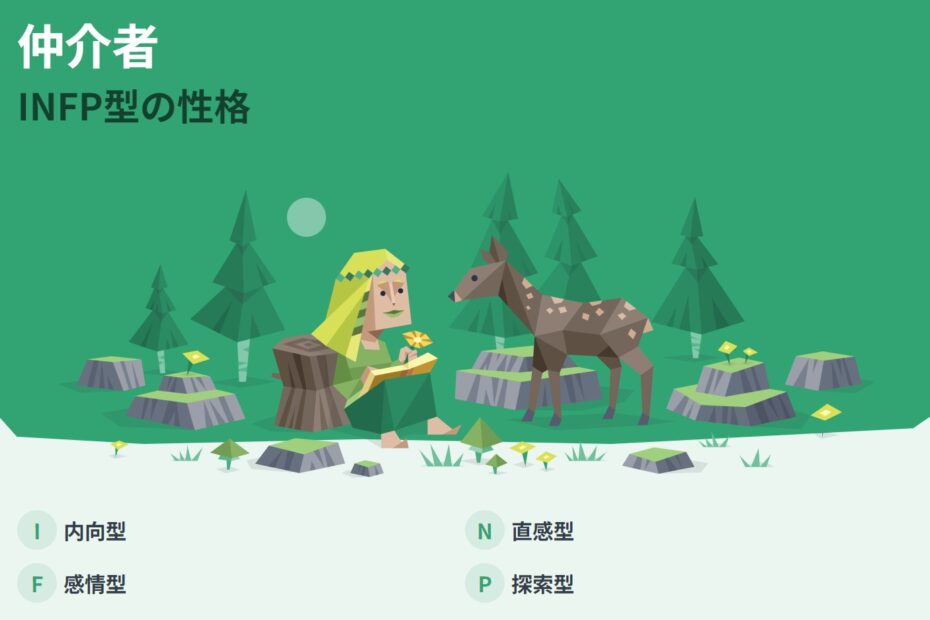
Do you know about the INFP-A type?
This is one of the indicators that represents personality, and it greatly influences our behavior and way of thinking.
In this article, we will explain in detail what characteristics INFP-A people have, including aspects of health, work, and interpersonal relationships.
Getting to know your own and others’ personalities well may lead to better communication and self-understanding.
Please read this while comparing it with your own and your friends’ personalities.
Once again, personality researcher and author of Villain Encyclopedia, Tokiwa (@etokiwa999), will provide the explanation.
※We have developed the HEXACO-JP Personality Assessment! It has more scientific basis than MBTI. Tap below for details.

目次
- 1 Scientific Background of INFP-A (Mediator・Assertive Type)
- 2 Scientific Analysis of INFP-A (Mediator – Assertive Type)
- 2.1 Tends to get along well with people who have both N and F traits
- 2.2 Most likely to have high IQ
- 2.3 Spirituality
- 2.4 When using social media, communicates through likes and encouraging comments
- 2.5 May actively gather information through social media
- 2.6 Properly maintains social distancing for infection control
- 2.7 Common among writers/editors, artists/creators, and counselors/therapists
- 2.8 In children, there is a possibility of being gifted
- 2.9 Avoid sweet drinks
- 2.10 Take high risks, unlikely to regret even if they fail
- 2.11 Common in Japan’s Kyushu region
- 2.12 Schwartz’s Values: Universalism, Benevolence
- 2.13 Preference for simple or practical clothing
- 3 Finally
Scientific Background of INFP-A (Mediator・Assertive Type)
Overview of MBTI
MBTI is a psychological theory that classifies personality into 16 types.
In the first place, MBTI is an abbreviation for Myers-Briggs Type Indicator.
MBTI classifies personality into 16 types by combining the following four indicators.
In other words, MBTI expresses one’s personality tendencies with four letters such as “ISTJ” or “ENFP”. There is the very famous 16personalities which is similar, but this is different from MBTI.
Overview of Big Five
One of the most influential trait theories in personality psychology is the “Big Five.”
The Big Five measures five traits: openness, conscientiousness, extraversion, agreeableness, and neuroticism.
Also, while 16personalities and MBTI use type classification (e.g., either extraverted or introverted), the Big Five evaluates traits with continuous numerical values (e.g., extraversion 3.5), which is also a major difference.
Furthermore, it has been studied for a long time with many research papers, and extensive research has been conducted in other fields such as academic ability, income, brain, and genetics. It can be said that the Big Five has relatively stronger scientific backing.
Correlation Between MBTI, Big Five, and HEXACO
There is a correlation between the four MBTI indicators and the five Big Five factors.
A representative study showing this correlation is the paper “The relationship between the revised NEO-Personality Inventory and the Myers-Briggs Type Indicator.”
According to this paper, the correlation between MBTI and Big Five is as follows.
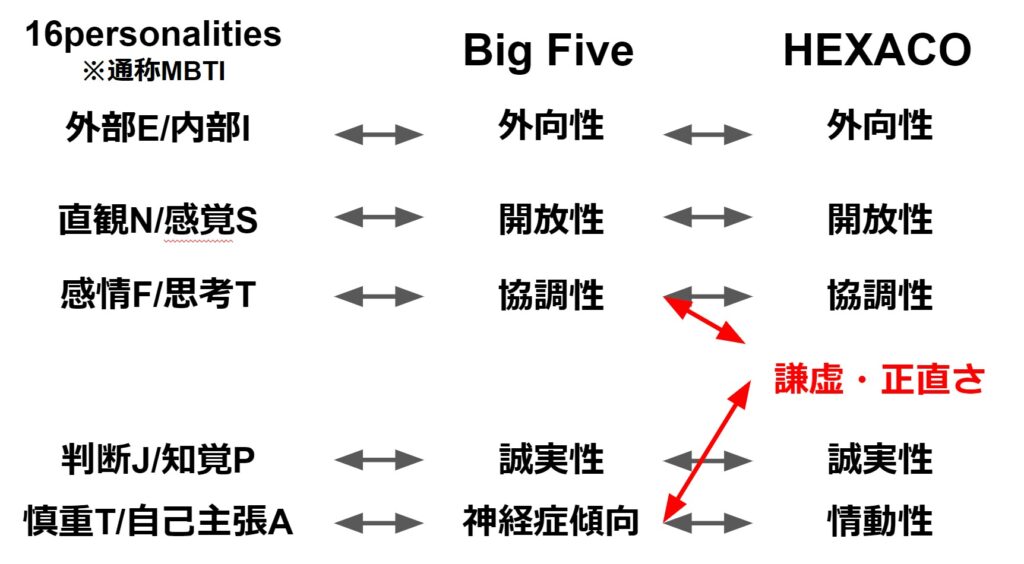
Also, in 16personalities, which was created based on MBTI and Big Five, the neuroticism of Big Five is called “Identity” and is classified as either Assertive or Turbulent.
On the far right is “HEXACO“, a relatively new personality assessment. It has been improved by adding one indicator “Honesty-Humility” to the Big Five.
Based on this correlation, this article will provide a detailed explanation of 16personalities personality types.
Since these are originally Big Five and HEXACO research, if you want to know your personality more scientifically than MBTI or 16personalities, please try this HEXACO personality test.
What is INFP-A (Mediator・Assertive Type)?
INFP-A is a type with low extraversion (I), high openness (N), high agreeableness (F), low conscientiousness (P), and low neuroticism (A) in the Big Five.
- Strong idealism and creativity
- Deep empathy for others
- Emphasis on internal values
- Adaptability and flexibility
- Confident independence
They possess rich imagination and deep sensitivity, and act based on their own values. They find joy in understanding and supporting others’ emotions.
In interpersonal relationships, they seek sincere and meaningful connections. They are open to change and new experiences, and value self-expression. With high stress tolerance and strong self-efficacy, they can cope with difficult situations without losing their authenticity.
Scientific Analysis of INFP-A (Mediator – Assertive Type)
Tends to get along well with people who have both N and F traits
INFP-A individuals tend to build intimate relationships easily with people who have intuitive (N) and feeling (F) characteristics. This indicates high openness and high agreeableness in Big Five terms. INFP-A can understand others’ emotions and enjoy deep conversations, making it easy for them to empathize with people who have similar traits.
They are imaginative and sensitive to others’ feelings. This allows them to easily find common interests and values with NF-type people, enabling them to build lasting friendships.
For more details, please see this article.
Most likely to have high IQ
INFP-A tends to have high intelligence quotient (IQ) due to their introverted (I) and intuitive (N) characteristics, combined with low neuroticism (-A). This is related to high openness and low neuroticism in Big Five terms.
INFP-A excels at abstract thinking and understanding complex concepts, and also has high creative problem-solving abilities. They are open to new ideas and have the ability to analyze things from unique perspectives.
Additionally, their introverted nature leads them to prefer deep thinking and introspective activities, which can contribute to the improvement of their intellectual abilities.
For more details, please see this article.
Spirituality
INFP-A tends to have strong spiritual tendencies due to their intuitive (N) and feeling (F) characteristics. This is related to high openness and agreeableness in Big Five terms.
INFP-A has a strong interest in exploring the meaning and purpose of life, and tends to seek connection with transcendent things. They value harmony with their inner self and the universe, and place importance on spiritual growth and self-realization.
Additionally, INFP-A has characteristics that make them easily feel a sense of unity with nature and deep spiritual connections with others. Due to these traits, they often have interest in practices such as meditation and yoga.
For more details, please see this article.
INFP-A tends to engage in compassionate communication when using social media due to their feeling (F) characteristics. This is related to high agreeableness in Big Five terms.
INFP-A is sensitive to others’ emotions and finds joy in encouraging and supporting others. Therefore, they often give “likes” on social media and comment with warm words.
They value creating positive connections with people even online and contribute to building a constructive and caring atmosphere. However, due to their introverted side, they tend not to post too frequently.
For more details, please see this article.
INFP-A may actively utilize social media as a means of information gathering due to their intuitive (N) characteristics. This is related to high openness in Big Five terms.
INFP-A has strong curiosity about new ideas and concepts, and tends to have interests in a wide range of fields. Therefore, they would enjoy collecting information about various topics through social media and deepening their knowledge and understanding.
They actively seek information that aligns with their values and interests, and are also enthusiastic about gaining creative inspiration. However, they don’t forget critical thinking to discern the truth of information.
For more details, please see this article.
INFP-A tends to properly maintain social distancing as an infection control measure due to their introverted (I) characteristics. This is related to low extraversion in Big Five terms.
INFP-A generally has little resistance to maintaining physical distance from others and rather values personal space. Therefore, they tend to naturally practice social distancing required as infection control measures.
Additionally, because they have strong compassion for others, they understand the importance of such measures to protect their own and others’ health, and act responsibly. However, they will try to maintain bonds with important people while communicating in safe ways.
For more details, please see this article.
Common among writers/editors, artists/creators, and counselors/therapists
INFP-A has introverted (I) characteristics and high creativity and sensitivity, so they are commonly found in professions such as writers/editors, artists/creators, and counselors/therapists. This is related to low extroversion and high openness and agreeableness in the Big Five.
INFP-A has rich imagination and a deep inner world, and excels at expressing it. Therefore, they are skilled at self-expression through writing and artistic works.
Also, because they have a high ability to understand and empathize with others’ emotions, they also excel in counseling and therapy fields. These professions align well with INFP-A’s introspective nature, creativity, and desire to help people.
For more details, please see this article.
In children, there is a possibility of being gifted
INFP-A children, having intuitive (N) characteristics, may be gifted (children with special talents). This is related to high openness in the Big Five.
INFP-A children often excel in abstract thinking and understanding complex concepts. They are imaginative and have the ability to generate original ideas. They are also characterized by high sensitivity and deep insight.
Due to these characteristics, INFP-A children may demonstrate special talents not only academically but also in artistic and creative fields. However, determining whether a child is gifted requires appropriate evaluation by experts.
For more details, please see this article.
Avoid sweet drinks
INFP-A, having feeling (F) characteristics, may be sensitive to health and physical condition management and tend to avoid sweet drinks. This is indirectly related to high agreeableness in the Big Five.
INFP-A has high concern for their own and others’ well-being and understands the importance of healthy lifestyle habits. They may recognize the impact of sweet drinks on health and try to make healthier choices.
Also, because they are sensitive to their own emotions and physical state, they may easily perceive the effects of excessive sweet drink consumption on mood and concentration. However, this also varies depending on individual preferences and lifestyle habits.
For more details, please see this article.
Take high risks, unlikely to regret even if they fail
INFP-A, having intuitive (N) and perceiving (P) characteristics, tends to take high risks and is unlikely to regret even when they fail. This is related to high openness and low conscientiousness in the Big Five.
INFP-A is open to new experiences and possibilities, and sometimes doesn’t hesitate to jump into unfamiliar situations. They tend to view failure as a learning opportunity and accept it as part of the growth process.
Also, INFP-A has high flexibility and easily adapts to unexpected results, so they may have less fear of taking risks. However, this also varies depending on individual experience and values.
For more details, please see this article.
Common in Japan’s Kyushu region
INFP-A, having intuitive (N) and feeling (F) characteristics, may tend to be commonly found in Japan’s Kyushu region. This is related to high openness and agreeableness in the Big Five.
The Kyushu region is known for its rich nature, traditional culture, and warm human connections. These environmental factors may harmonize with INFP-A’s imaginative and highly sensitive nature.
Also, people from Kyushu are generally considered gentle and warm-hearted, which may resonate with INFP-A’s compassionate nature. However, it should be noted that such tendencies are statistical observations and individual differences exist.
For more details, please see this article.
Schwartz’s Values: Universalism, Benevolence
INFP-A, having intuitive (N) and feeling (F) traits, tends to value “universalism” and “benevolence” in Schwartz’s theory of values. This is related to high openness and agreeableness in the Big Five.
INFP-A tends to value equality for all people and social justice, and also has an interest in environmental protection. This is reflected in the value of “universalism.”
Additionally, the “benevolence” value, which involves caring about others’ well-being and valuing compassion and tolerance, also aligns with INFP-A characteristics. They desire harmony with people and world peace, and find joy in helping others.
Please see this article for more details.
Preference for simple or practical clothing
INFP-A, having introverted (IN) traits, tends to prefer simple and practical clothing. This is related to low extraversion and high openness in the Big Five.
INFP-A values self-expression, but not necessarily through flashy clothing. Rather, they often choose simple clothing that reflects their inner values and personality, emphasizing comfort and functionality.
Also, since INFP-A tends to value harmony with nature, they may be interested in environmentally friendly materials and sustainable fashion. However, this also varies depending on individual preferences and lifestyle.
Please see this article for more details.
Finally
INFP-A people are characterized by being imaginative, highly sensitive, and good at understanding others’ feelings.
They prefer new ideas and deep thinking, and are suited for creative work and professions that help people.
On social media, they engage in compassionate communication and are enthusiastic about gathering information.
They also have high interest in health and environmental issues, and tend to prefer a simple and practical lifestyle.
INFP-A people value their own values and beliefs while also valuing harmony with those around them.
Sometimes they take high risks, but they don’t fear failure and rather see it as a learning opportunity.
The tendencies introduced are originally from Big Five and HEXACO research, so if you want to know your personality more scientifically than MBTI or 16personalities, please try this HEXACO personality test.

Writer & Supervisor: Eisuke Tokiwa
Personality Psychology Researcher / CEO, SUNBLAZE Inc.
As a child he experienced poverty, domestic abuse, bullying, truancy and dropping out of school — first-hand exposure to a range of social problems. He spent 10 years researching these issues and published Encyclopedia of Villains through Jiyukokuminsha. Since then he has independently researched the determinants of social problems and antisocial behavior (work, education, health, personality, genetics, region, etc.) and has published 2 peer-reviewed journal articles (Frontiers in Psychology, IEEE Access). His goal is to predict the occurrence of social problems. Spiky profile (WAIS-IV).
Expertise: Personality Psychology / Big Five / HEXACO / MBTI / Prediction of Social Problems
Researcher profiles: ORCID / Google Scholar / ResearchGate
Social & Books: X (@etokiwa999) / note / Amazon Author Page