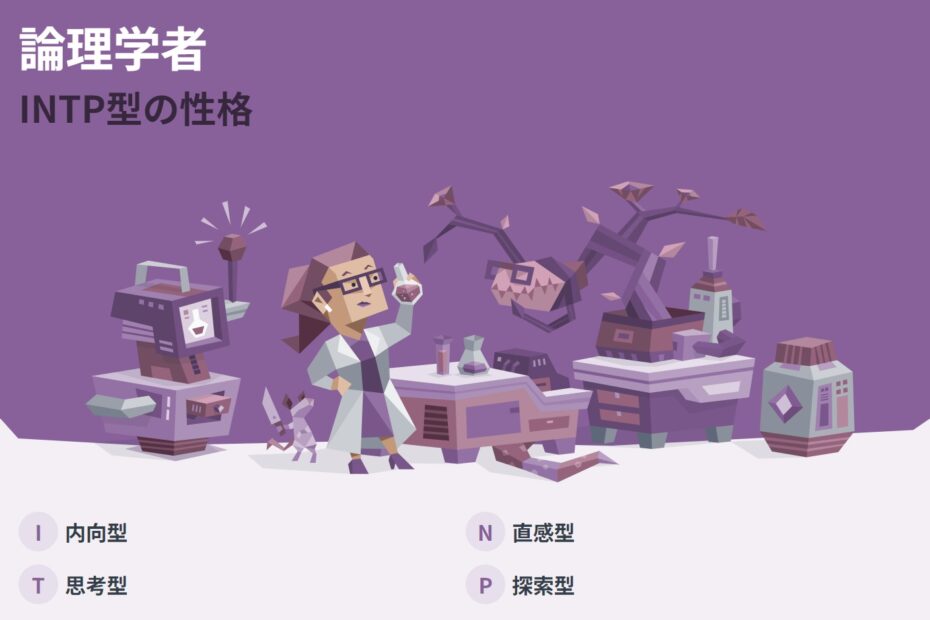
Do you know the INTP-A type?
This is one of the indicators that represents personality, and it has a major influence on our behavior and way of thinking.
In this article, we will explain in detail what characteristics INTP-A people have, including aspects of health, work, and interpersonal relationships.
By better understanding your own personality and that of those around you, it may lead to better communication and self-understanding.
Please try reading while comparing it with your own personality and that of your friends.
Once again, personality researcher and author of Villain Encyclopedia, Tokiwa (@etokiwa999), will provide the explanation.
※We have developed the HEXACO-JP Personality Assessment! It has more scientific basis than MBTI. Tap below for details.

目次
- 1 Scientific Background of INTP-A (The Logician – Assertive Type)
- 2 Scientific Explanation of INTP-A (Logician・Assertive Type)
- 2.1 Likely to get along well with people who have both N and T traits
- 2.2 Most likely to have high IQ
- 2.3 Possibility of actively gathering information on SNS
- 2.4 Properly maintain social distance for infection control
- 2.5 High learning goal orientation (setting goals and learning at work)
- 2.6 Many work as writers/editors, artists/creators, counselors/therapists
- 2.7 In the case of children, there is a possibility of being gifted
- 2.8 Prone to having Social Dominance Orientation (SDO) ideology
- 2.9 Common among cyberbullying perpetrators
- 2.10 Possibility of Machiavellianism or psychopathy
- 2.11 Common among monster employees
- 2.12 Take high risks, less likely to regret even when failing
- 2.13 Common in Japan’s Hokuriku Region
- 2.14 Preference for Simple or Practical Clothing
- 3 In Conclusion
Scientific Background of INTP-A (The Logician – Assertive Type)
Overview of MBTI
MBTI is a psychological theory that classifies personality into 16 types.
In the first place, MBTI is an abbreviation for Myers-Briggs Type Indicator.
MBTI classifies personality into 16 types by combining the following four indicators.
In other words, MBTI expresses personality tendencies with four letters such as “ISTJ” or “ENFP”. A similar and very famous one is 16personalities, but this is different from MBTI.
Overview of the Big Five
One of the most influential trait theories in personality psychology is the “Big Five”.
The Big Five measures five traits: Openness, Conscientiousness, Extraversion, Agreeableness, and Neuroticism.
Also, while 16personalities and MBTI use type classification (e.g., either extroverted or introverted), a major difference is that the Big Five evaluates traits with continuous numerical values (e.g., extraversion 3.5).
Furthermore, it has been studied for a long time with many published papers, and extensive research has been conducted in other fields including academic performance, income, brain, and genetics. It can be said that the Big Five has relatively stronger scientific backing.
Correlation Between MBTI, Big Five, and HEXACO
There are correlations between the four MBTI indicators and the five Big Five factors.
A representative study showing this correlation is the paper “The relationship between the revised NEO-Personality Inventory and the Myers-Briggs Type Indicator“.
According to this paper, the correlations between MBTI and the Big Five are as follows.
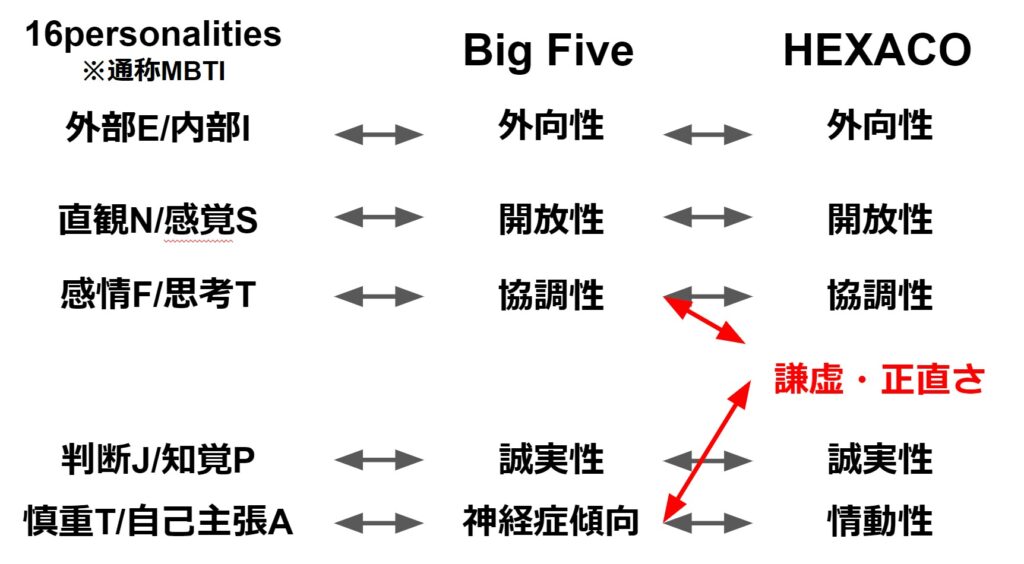
Also, in 16personalities, which was created with reference to MBTI and the Big Five, Neuroticism from the Big Five is called “Identity” and is classified as either Assertive or Turbulent.
On the far right is the relatively new personality assessment called “HEXACO“. It has been improved by adding one indicator, “Honesty-Humility”, to the Big Five.
This article will provide detailed explanations of 16personalities personality types based on these correlations.
Since these are originally Big Five and HEXACO research, if you want to know your personality more scientifically than MBTI or 16personalities, please try this HEXACO personality test.
What is INTP-A (The Logician – Assertive Type)?
INTP-A is a type with low Extraversion (I), high Openness (N), low Agreeableness (T), low Conscientiousness (P), and low Neuroticism (A) in the Big Five. Characteristics:
- Creative thinking and problem-solving abilities
- High flexibility and adaptability
- Values logical analysis
- Curious with strong inquisitiveness
- Confident independence
They excel at understanding complex concepts and generating new ideas. They are resilient to stress and constructively accept criticism. They are not bound by social norms and value free thinking. In interpersonal relationships, they seek intellectual stimulation and prefer deep discussions. They welcome change and constantly explore new possibilities.
Scientific Explanation of INTP-A (Logician・Assertive Type)
Likely to get along well with people who have both N and T traits
INTP-A type people have high affinity with others who similarly possess N and T characteristics. This reflects the tendency of high openness (N) and low agreeableness (T) in the Big Five model.
Since INTP-A individuals value logical thinking and are interested in new ideas and concepts, they easily connect with people who have similar thought patterns.
Such relationships become good opportunities to mutually stimulate each other’s intellectual curiosity.
Please see this article for more details.
Most likely to have high IQ
INTP-A types generally tend to have high intelligence quotient (IQ). This is related to high openness (N) in the Big Five.
INTP-A individuals prefer solving complex problems and excel at abstract thinking. Additionally, their introverted (I) characteristics allow them to spend time on deep thinking and analysis.
However, please remember that IQ is only one aspect of individual ability, and other factors are also important.
Please see this article for more details.
Possibility of actively gathering information on SNS
INTP-A type people tend to actively gather information through SNS.
This reflects high openness (N) in the Big Five. For them, who seek new knowledge and perspectives, SNS becomes a rich source of information.
Since INTP-A individuals prefer to dig deep into various topics, they often chase after specialized information and the latest trends through SNS.
Please see this article for more details.
INTP-A type people tend to properly maintain social distance as an infection control measure. This is related to introversion (I) in the Big Five.
Since INTP-A individuals originally tend not to prefer crowds or excessive social interaction, practicing social distancing is relatively easy.
Additionally, through logical thinking (T), they can understand the importance of infection prevention and take appropriate actions.
Please see this article for more details.
High learning goal orientation (setting goals and learning at work)
INTP-A type people tend to have high learning goal orientation. This is related to high openness (N) and low agreeableness (T) in the Big Five.
INTP-A individuals have strong interest in acquiring new knowledge and skills, and they set clear goals and proceed with learning even at work.
They value self-improvement and professional development, preferring to grow through continuous learning.
Please see this article for more details.
Many work as writers/editors, artists/creators, counselors/therapists
INTP-A type people tend to work in professions such as writers/editors, artists/creators, and counselors/therapists.
This reflects introversion (I) and high openness (N) in the Big Five.
People with INTP-A personalities possess original thinking and deep analytical abilities, allowing them to demonstrate the creativity and insight required in these professions. Additionally, since they prefer to work alone with concentration, they are well-suited to these types of careers.
Please see this article for more details.
In the case of children, there is a possibility of being gifted
Children with INTP-A type may be gifted (intellectually talented children). This is related to high openness (N) in the Big Five.
INTP-A children may show abstract thinking and complex problem-solving abilities from an early age.
They have strong curiosity and tend to feel unsatisfied with normal learning speeds. However, determining giftedness requires comprehensive evaluation by experts.
Please see this article for more details.
Prone to having Social Dominance Orientation (SDO) ideology
People with INTP-A type tend to have Social Dominance Orientation (SDO) ideology. This is related to low agreeableness (T) in the Big Five.
INTP-A people value logical thinking and tend to view social hierarchical structures and competition as natural.
However, this tendency can vary greatly depending on individual values and experiences. SDO is a concept with social implications that requires careful consideration.
Please see this article for more details.
Common among cyberbullying perpetrators
People with INTP-A type are reported to have a tendency to become cyberbullying perpetrators.
This may be related to low agreeableness (T) and low conscientiousness (P) in the Big Five.
INTP-A people sometimes disregard others’ emotions and may engage in aggressive behavior online in their pursuit of logical correctness. However, this tendency varies greatly depending on individual ethics and maturity.
Please see this article for more details.
Possibility of Machiavellianism or psychopathy
People with INTP-A type are reported to potentially show tendencies of Machiavellianism or psychopathy.
This may be related to low agreeableness (T) and low neuroticism (A) in the Big Five.
INTP-A people prioritize logic over emotion and may sometimes engage in behavior that appears cold. However, these tendencies vary greatly among individuals and require proper diagnosis by experts.
Please see this article for more details.
Common among monster employees
People with INTP-A type are reported to have a tendency to become so-called “monster employees.”
This may be related to low agreeableness (T) and low conscientiousness (P) in the Big Five.
INTP-A people have their own logic and values, and may struggle to follow organizational rules and customs. However, this tendency varies greatly depending on individual maturity and workplace environment.
Please see this article for more details.
Take high risks, less likely to regret even when failing
People with INTP-A type tend to take high risks and are characterized by being less likely to regret even when they fail. This is related to high openness (N) and low conscientiousness (P) in the Big Five.
INTP-A people prefer new experiences and challenges, and tend to view failures as learning opportunities.
They often analyze situations logically and act after calculating risks, which allows them to take a calm attitude toward results.
Please see this article for more details.
Common in Japan’s Hokuriku Region
There are reports that INTP-A type people are commonly found in Japan’s Hokuriku region. This may be related to low agreeableness (T) in the Big Five personality traits.
The culture and environment of the Hokuriku region may have high compatibility with INTP-A characteristics.
However, this tendency may be influenced by multiple factors including regional history and socioeconomic factors, and further research is needed.
Please see this article for more details.
Preference for Simple or Practical Clothing
INTP-A type people tend to prefer simple and practical clothing. This is related to introversion (I) and high openness (N) in the Big Five personality traits.
INTP-A people tend to value inner qualities and functionality over appearance. They don’t like to spend excessive time or energy on clothing, and would rather focus on intellectual activities and creative thinking.
Simple clothing reflects their utilitarian values.
Please see this article for more details.
In Conclusion
INTP-A type people are somewhat eccentric genius types whose minds are filled with ideas. They love learning new things and are good at solving difficult problems.
However, they struggle with social relationships and prefer to think alone.
They choose simple and practical clothing and actively gather information on social media.
At work, they are suited for creative professions such as writers, artists, and counselors.
However, they sometimes forget to consider other people’s feelings, so caution is needed.
While they have the courage to take on challenges without fearing risk, they may also struggle with following rules.
The tendencies introduced are originally based on Big Five and HEXACO research, so if you want to understand your personality more scientifically than MBTI or 16personalities, please try this HEXACO personality test.

Writer & Supervisor: Eisuke Tokiwa
Personality Psychology Researcher / CEO, SUNBLAZE Inc.
As a child he experienced poverty, domestic abuse, bullying, truancy and dropping out of school — first-hand exposure to a range of social problems. He spent 10 years researching these issues and published Encyclopedia of Villains through Jiyukokuminsha. Since then he has independently researched the determinants of social problems and antisocial behavior (work, education, health, personality, genetics, region, etc.) and has published 2 peer-reviewed journal articles (Frontiers in Psychology, IEEE Access). His goal is to predict the occurrence of social problems. Spiky profile (WAIS-IV).
Expertise: Personality Psychology / Big Five / HEXACO / MBTI / Prediction of Social Problems
Researcher profiles: ORCID / Google Scholar / ResearchGate
Social & Books: X (@etokiwa999) / note / Amazon Author Page