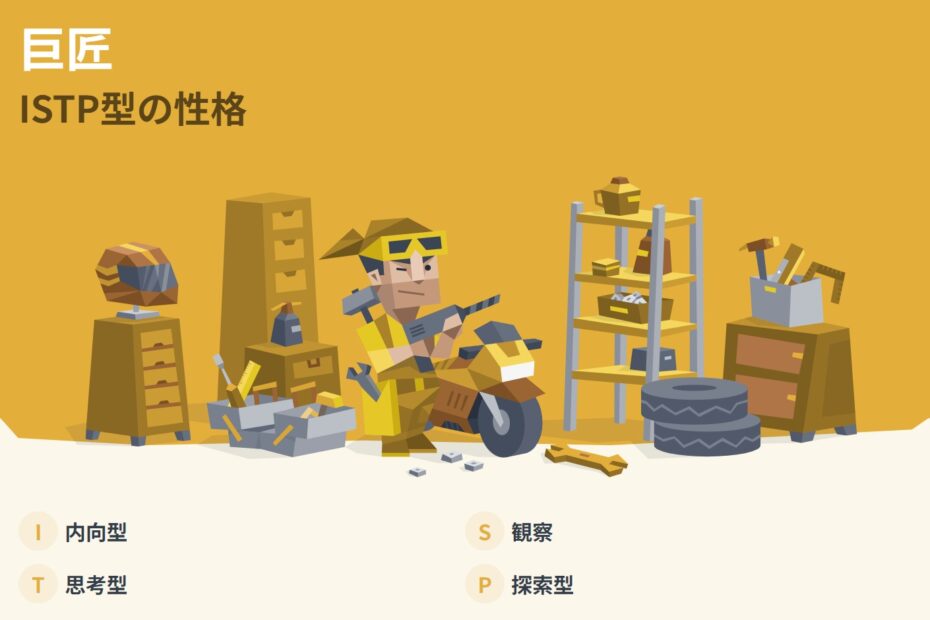
ISTP (The Virtuoso) is known as one of the most practical and independent personality types in 16personalities (16-type personality test).
They analyze things logically and excel at problem-solving.
Additionally, they tend to be curious and find joy in learning new things.
Utilizing their manual dexterity to create something is also a characteristic feature of ISTP (The Virtuoso) that brings them fulfillment.
On the other hand, ISTP (The Virtuoso) also has difficulty with emotional expression.
Understanding the characteristics and tendencies of ISTP (The Virtuoso) is important both for knowing yourself and for considering how to relate to others.
In this article, we will provide detailed explanations of various aspects of ISTP (The Virtuoso), including strengths and weaknesses, romantic relationships and friendships, parenting and career.
Come, let’s explore the world of ISTP (The Virtuoso) together!
※This article is based on translations from the English pages of the official 16personalities website.
Once again, personality researcher and author of Villain Encyclopedia, Tokiwa (@etokiwa999), will provide the explanation.
※We have developed the HEXACO-JP Personality Assessment! It has more scientific basis than MBTI. Tap below for details.

The video version of this article is available here!
目次
- 1 Strengths and Weaknesses of ISTP (The Virtuoso)
- 2 ISTP (The Virtuoso) A and T Types
- 3 ISTP (The Virtuoso) Romantic Relationship Tendencies and Improvement Strategies
- 4 ISTP (The Virtuoso) Friendship Tendencies and Improvement Strategies
- 5 ISTP (The Craftsman) Parenting Tendencies and Improvement Strategies
- 6 ISTP (The Craftsman) Career Tendencies and Improvement Strategies
- 7 ISTP (Virtuoso) Work Tendencies and Improvement Strategies
- 8 ISTP (Virtuoso) Compatible Types
- 9 ISTP (Virtuoso) Summary
- 10 Supplement
- 10.1 The Problem with 16personalities: “Weak Scientific Foundation”
- 10.2 The Good Points of 16personalities: “Large Amount of Response Data and Fame”
- 10.3 Differences Between 16personalities and Other Personality Tests: “MBTI”
- 10.4 Differences Between 16personalities and Other Personality Tests: “Big Five”
- 10.5 Differences Between 16personalities and Other Personality Tests: “HEXACO”
Strengths and Weaknesses of ISTP (The Virtuoso)
Strengths of ISTP (The Virtuoso)
This type has the strengths of being practical and independent.
They analyze things logically and excel at problem-solving.
Additionally, they are curious and enjoy learning new things.
ISTP (The Virtuoso) has the following strengths:
- Practical and rational
- Highly independent and self-reliant
- Flexible with high adaptability
- Calm and composed with high stress tolerance
- Excellent mechanical abilities
Additionally, ISTP (The Virtuoso) has drive and excels at putting ideas into action.
They demonstrate realistic problem-solving abilities and can handle difficult situations well.
They also possess the courage to take on new challenges without fearing risks.
ISTP (The Virtuoso) can excel in various fields through their practical abilities and independence.
By leveraging their strengths, they can be said to carve out their own authentic life path.
Weaknesses of ISTP (The Virtuoso)
ISTP (The Virtuoso) has weaknesses of being poor at emotional expression and lacking sociability.
They tend to avoid expressing their emotions outwardly and find it difficult to understand others’ emotions.
Additionally, they may have strong attention to detail and lack flexibility.
ISTP (The Virtuoso) has the following weaknesses:
- Poor at emotional expression and may appear cold
- Not sociable and poor at interpersonal relationships
- Strong attention to detail and lacks flexibility
- Poor planning abilities and cannot foresee ahead
- Dislikes routine work
Furthermore, ISTP (The Virtuoso) may be indifferent to things that don’t interest them and may not listen to others’ opinions.
They tend to immerse themselves in their own world and may lack cooperation with their surroundings.
Additionally, they are poor at making long-term plans and tend to be caught up in immediate matters.
It’s important for ISTP (The Virtuoso) to understand their weaknesses and work on improving them.
By growing emotionally and deepening understanding of others, they should be able to build better relationships.
ISTP (The Virtuoso) A and T Types
ISTP-A (Assertive Type)
A versatile craftsman. Confidently tackles complex problems and finds practical solutions. Calm and composed, able to respond coolly even in crisis situations.
Curious and interested in understanding how things work. Highly independent and values freedom. Flexible and quickly adapts according to situations.
Unafraid of risks and enjoys new experiences. Values efficiency and dislikes waste. Solves problems by combining logical thinking with practical skills.
Prefers direct communication and is the type who shows through actions rather than words. Focuses on the present and emphasizes immediate results over long-term planning.
Please see this article for more details.
ISTP-T (Turbulent Type)
A versatile craftsman but tends to be prone to self-doubt. Has the ability to tackle complex problems but may doubt the effectiveness of their own solutions.
Calm and composed but may feel weak under pressure. Curious but may find it difficult to continue focusing on one thing.
While they have strong independence, they can also be easily influenced by others’ opinions. Although they have flexibility, they sometimes worry about whether they can adapt to change.
They may hesitate to take risks and fear failure. While they value efficiency, their pursuit of perfection can sometimes slow down progress.
ISTP (The Virtuoso) Romantic Relationship Tendencies and Improvement Strategies
Romantic Tendencies
ISTP (The Virtuoso) tends to have strong independence in romance and dislikes being constrained.
They tend to prioritize their own freedom over their relationship with their partner.
Additionally, they struggle with emotional expression, making it difficult to convey love through words.
The following characteristics can be identified as features of ISTP (The Virtuoso) romance:
- Strong independence and dislike of being constrained
- Poor emotional expression, making it difficult to convey love through words
- Takes a realistic and rational approach
- Tends to prioritize their own freedom over their relationship with their partner
- Dislikes routines and seeks stimulating relationships
Additionally, ISTP (The Virtuoso) tends to focus on problem-solving even in romance and rarely takes an emotional approach.
They tend to view their relationship with their partner in a practical way and may struggle to create romantic atmospheres.
Also, because they dislike monotony, it can sometimes be difficult to maintain long-term relationships.
It’s important for ISTP (The Virtuoso) to respect their independence in romance while deepening their bond with their partner.
By learning methods of emotional expression and empathizing with their partner’s feelings, they should be able to build better relationships.
When Problems Arise in Romance and Improvement Strategies
ISTP (The Virtuoso) can sometimes create gaps with their partner due to their difficulty with emotional expression in romance.
They find it difficult to understand their partner’s emotions and tend to be seen as lacking empathy.
Also, due to their strong independence, they may sometimes undervalue their relationship with their partner.
The following problems that ISTP (The Virtuoso) faces in romance can be identified:
- Poor emotional expression creates gaps with their partner
- Excessive independence leads to undervaluing the relationship with their partner
- Dislike of routines prevents building stable relationships
- Too realistic an approach, lacking in romance
- Indifference to things that don’t interest them, unable to find common ground with their partner
To improve these problems, it’s essential for ISTP (The Virtuoso) to achieve emotional growth.
It’s important to practice verbalizing their own emotions and make efforts to understand their partner’s feelings.
It’s also important to value communication with their partner and deepen mutual understanding.
Furthermore, they should aim to build stable relationships without being mutually constraining.
By overcoming their shortcomings and deepening their bond with their partner, ISTP (The Virtuoso) should be able to achieve more fulfilling romance.
Overcoming their difficulty with emotional expression and continuing to make efforts to empathize with their partner will be the key to building good relationships.
ISTP (The Virtuoso) Friendship Tendencies and Improvement Strategies
Friendship Tendencies
ISTP (The Virtuoso) has strong independence in friendships and tends to dislike being constrained.
They prefer friends who respect their freedom and don’t seek deep involvement.
They also tend to avoid emotional topics and prefer superficial relationships.
The following characteristics of ISTP (The Virtuoso) friendships can be identified:
- Strong independence and dislike of being constrained
- Avoids emotional topics and prefers superficial relationships
- Deepens friendships through practical activities
- Finds friends with the same hobbies in areas of their own interest
- Not sociable but becomes a reliable presence when needed
Furthermore, ISTP (The Virtuoso) tends to prefer one-on-one relationships over group activities.
They view their connections with friends practically and avoid getting too deeply involved unnecessarily.
They also prefer to find friends who share the same hobbies in areas of their interest.
It’s important for ISTP (The Virtuoso) to respect their independence in friendships while building appropriate bonds.
By deepening their emotional understanding and improving their cooperativeness with friends, they should be able to build better relationships.
When Problems Arise in Friendships and Improvement Strategies
ISTP (The Craftsman) tends to avoid emotional exchanges in friendships, which can lead to superficial relationships.
They find it difficult to understand friends’ emotions and are often perceived as lacking empathy.
Additionally, due to their strong independence, they may sometimes disregard commitments with friends.
The following are problems that ISTP (The Craftsman) may face in friendships:
- Ending up with superficial relationships due to avoiding emotional exchanges
- Disregarding commitments with friends due to excessive independence
- Difficulty making new friends due to low sociability
- Being indifferent to things that don’t interest them, unable to find common ground with friends
- Being poor at understanding people’s feelings, leading to frequent conflicts with friends
To improve these problems, it’s important for ISTP (The Craftsman) to deepen their emotional understanding.
It’s essential to have opportunities to engage in emotional topics during conversations with friends.
It’s also important to respect commitments with friends and build trust.
Furthermore, make an effort to show interest in areas that don’t naturally interest you and find common ground with friends.
By overcoming their weaknesses and deepening bonds with friends, ISTP (The Craftsman) should be able to achieve more fulfilling friendships.
Deepening emotional understanding and continuing to make efforts to empathize with friends will be the key to building good relationships.
ISTP (The Craftsman) Parenting Tendencies and Improvement Strategies
Parenting Tendencies
ISTP (The Craftsman) tends to take a practical approach to parenting.
They respect their children’s independence and avoid excessive interference.
They also prefer flexible responses according to situations rather than rigid rules and regulations.
The following characteristics describe ISTP (The Craftsman) parenting:
- Takes a practical approach and respects children’s independence
- Prefers flexible responses according to situations rather than rules and regulations
- Deepens bonds through activities with children
- Poor at emotional exchanges but becomes supportive when necessary
- Provides learning opportunities according to children’s interests
Furthermore, ISTP (The Craftsman) prefers to deepen bonds through activities with their children.
They feel connected to their children by creating things together or engaging in physical activities.
They also value providing learning opportunities according to their children’s interests.
It’s important for ISTP (The Craftsman) to leverage their strengths in parenting while deepening their emotional understanding.
By empathizing with their children’s feelings and providing appropriate support, they should be able to build better parent-child relationships.
When Problems Arise in Parenting and Improvement Strategies
ISTP (The Craftsman) may experience a lack of emotional connection with their children due to their tendency to avoid emotional exchanges in parenting.
They find it difficult to understand their children’s emotions and are often perceived as lacking empathy.
Additionally, due to their strong independence, they may sometimes disregard their children’s feelings.
The following are problems that ISTP (The Craftsman) may face in parenting:
- Lack of emotional connection with children due to avoiding emotional exchanges
- Disregarding children’s feelings due to excessive independence
- Inconsistent parenting due to not being bound by rules and regulations
- Poor at understanding children’s emotions, unable to provide appropriate support
- Being indifferent to things that don’t interest them, unable to find common topics with children
To improve these problems, it’s essential for ISTP (The Craftsman) to deepen their emotional understanding.
It’s important to have opportunities to engage in emotional topics during conversations with children.
It’s also important to respect children’s feelings and maintain an empathetic attitude.
Furthermore, be conscious of establishing certain rules while taking flexible approaches according to situations.
By overcoming their weaknesses and deepening bonds with their children, ISTP (The Craftsman) should be able to achieve more fulfilling parenting.
ISTP (The Craftsman) Career Tendencies and Improvement Strategies
Career Tendencies
ISTP (The Craftsman) has practical and strongly independent tendencies in their career.
They find fulfillment in creating something with their own hands and prefer environments where they can work freely.
They also tend to prefer jobs with variety rather than routine work.
The following characteristics describe ISTP (The Craftsman) careers:
- Prefers practical work that utilizes manual dexterity
- Prefers environments where they can work freely
- Prefers jobs with variety rather than routine work
- Prefer to work independently and proceed with work at their own pace
- Excel in work that utilizes problem-solving abilities
Furthermore, ISTP (Virtuoso) prefers to work independently and values proceeding with work at their own pace.
They prefer work where they can demonstrate individual strength rather than teamwork.
They can also fully demonstrate their abilities in work that utilizes problem-solving skills.
For ISTP (Virtuoso), it’s important to leverage their strengths in their career while improving their planning abilities.
By maintaining a long-term perspective and steadily improving their skills, they should be able to build a more fulfilling career.
Career Problems and Improvement Strategies
ISTP (Virtuoso) may lose sight of long-term goals in their career due to poor planning abilities.
They may find it difficult to envision the future as they focus too much on immediate problem-solving.
Additionally, their strong independent orientation may cause them to undervalue teamwork.
The following problems that ISTP (Virtuoso) faces in their career include:
- Losing sight of long-term goals due to poor planning abilities
- Undervaluing teamwork due to overly strong independent orientation
- Unable to build a stable career due to dislike of routine work
- Missing skill development opportunities due to indifference toward areas outside their interests
- Neglecting theoretical learning due to being overly practical
To improve these problems, it’s important for ISTP (Virtuoso) to enhance their planning abilities and maintain a long-term perspective.
It will be crucial to clarify their career vision and steadily acquire the necessary skills for it.
They also need to understand the importance of teamwork and improve their cooperative spirit.
Furthermore, they should make an effort to take interest in areas outside their preferences and acquire broad knowledge.
By overcoming their weaknesses and acquiring a balanced skill set, ISTP (Virtuoso) should be able to achieve a more fulfilling career.
Improving planning abilities and maintaining an attitude that values teamwork will be the key to career advancement.
ISTP (Virtuoso) Work Tendencies and Improvement Strategies
Work Tendencies
ISTP (Virtuoso) tends to take a practical and efficient approach to work.
They excel at problem-solving and demonstrate quick action abilities.
They also prefer environments where they can proceed with work at their own pace and favor work styles with high degrees of freedom.
The characteristics of ISTP (Virtuoso)’s work include the following:
- Take a practical and efficient approach
- Excel at problem-solving and demonstrate quick action abilities
- Prefer environments where they can proceed with work at their own pace
- Favor work styles with high degrees of freedom
- Excel in work that utilizes manual dexterity
Furthermore, ISTP (Virtuoso) can fully demonstrate their abilities in work that utilizes manual dexterity.
They feel joy in creating or repairing things.
They also prefer directly tackling problem-solving on-site and tend to prefer practical work over desk work.
For ISTP (Virtuoso), it’s important to leverage their strengths at work while improving their communication abilities.
By fulfilling their role as a team member and building cooperative relationships with others, they should be able to create a better work environment.
Work Problems and Improvement Strategies
ISTP (Virtuoso) may experience teamwork difficulties at work due to poor communication abilities.
They have strong independent orientation and may lack cooperative spirit with others.
Additionally, their dislike of routine work may make it difficult for them to engage in continuous work.
The problems that ISTP (Virtuoso) faces at work include the following:
- Teamwork difficulties due to poor communication abilities
- Lack of cooperative spirit with others due to overly strong independent orientation
- Difficulty engaging in continuous work due to dislike of routine work
- Workplace relationships becoming thin due to avoiding emotional interpersonal relationships
- Lack of motivation and indifference toward work outside their interests
To improve these problems, it’s essential for ISTP (Virtuoso) to enhance their communication abilities and understand the importance of teamwork.
It will be important to not only express their own opinions but also maintain an attitude of listening to others’ opinions.
They also need to accept that routine work is part of the job and make continuous efforts.
Furthermore, they should value workplace relationships and actively participate in emotional exchanges.
By overcoming their weaknesses and improving cooperative spirit, ISTP (Virtuoso) should be able to achieve a more fulfilling work environment.
ISTP (Virtuoso) Compatible Types
Compatible Types: People with S in Their Type
ISTP (Virtuoso) has good compatibility with types that also contain S, meaning people with strong sensing tendencies.
S stands for Sensing, which represents a preference for realistic and practical information processing.
S types that are compatible with ISTP (Virtuoso) include the following:
- ESTP (Entrepreneur): Action-oriented and highly flexible
- ESFP (Entertainer): Bright, sociable, and loves fun things
- ISFP (Adventurer): Free-spirited and rich in sensitivity
- ISTJ (Logistician): Steady and highly responsible
These types, like ISTP (Virtuoso), prefer realistic and practical approaches and are good at hands-on work.
They can deepen their bonds by creating things together or engaging in physical activities.
They can also build relationships that respect each other’s pace.
ISTP (Virtuoso) should be able to express their true self and spend fulfilling time when together with these S types.
Compatible Types: People with T in Their Type
ISTP (Virtuoso) also has good compatibility with types that contain T, meaning people who value thinking.
T stands for Thinking, which represents a preference for logical and objective judgment. T types that are compatible with ISTP (Virtuoso) include the following:
- INTJ (Architect): Excels in strategic thinking and has strong independence
- ENTJ (Commander): Has leadership and values efficiency
- INTP (Logician): Excellent analytical skills and generates new ideas
- ESTJ (Executive): Has organizational skills and excels in practical abilities
These types, like ISTP (Virtuoso), value logical thinking and have characteristics of not being easily swayed by emotions. They can build stimulating relationships by working together on problem-solving and sharing ideas.
They can also build relationships that respect each other’s logical thinking. ISTP (Virtuoso) should be able to sharpen their thinking skills and spend fulfilling time when together with these T types.
ISTP (Virtuoso) Summary
ISTP (Virtuoso) is a practical and independent personality type.
They excel at problem-solving and are skilled at hands-on work.
They also prefer environments with high degrees of freedom and value progressing at their own pace.
On the other hand, they struggle with emotional expression and tend to avoid deep involvement with others.
In romantic relationships and friendships, it’s important to respect independence while building moderate bonds.
Deepening emotional understanding and continuing efforts to empathize with others will be key to building good relationships.
In parenting, career, and work, they are required to leverage their strengths while overcoming their weaknesses.
By improving planning skills and enhancing communication abilities, they should be able to lead a more fulfilling life.
ISTP (Virtuoso) can be said to have good compatibility with S types and P types.
They should have excellent compatibility with S types who prefer realistic and practical approaches, and P types who value flexibility and possibilities.
By understanding their individuality and developing their strengths while overcoming their weaknesses, ISTP (Virtuoso) should be able to lead a more fulfilling life.
Valuing their authenticity while achieving harmony with their surroundings will be the key to improving their quality of life.
Supplement
The Problem with 16personalities: “Weak Scientific Foundation”
16personalities (16-type personality test) can be said to have challenges in terms of scientific evidence.
First, the number of peer-reviewed papers is small, and academic support is insufficient.
Questions also remain about the statistical processing methods.
The point of classifying traits into types rather than continuous numerical values is also problematic from the perspective of scientific validity.
Furthermore, the current situation is that sufficient evidence has not been presented regarding the relationship between personality and academic performance, income, brain function, genetic factors, and other aspects.
The Good Points of 16personalities: “Large Amount of Response Data and Fame”
On the other hand, 16personalities (16-type personality test) also has significant advantages.
The first is that it has accumulated vast response data. Since many people participate in the 16personalities assessment, the reliability of the data might possibly be high.
Additionally, it has penetrated quite well among the general public, with Korean idols answering and spreading it, and gaining attention in dating matching apps.
This point can be said to be an advantageous aspect of the 16personalities personality test compared to other personality assessments.
Differences Between 16personalities and Other Personality Tests: “MBTI”
16personalities (16-type personality test) is created based on MBTI (Myers-Briggs Type Indicator) and Big Five.
Strictly speaking, 16personalities and MBTI are separate entities.
MBTI is a personality assessment tool developed based on Jung’s psychological typology.
16personalities adopts MBTI’s four indicators (E Extroversion-I Introversion, S Sensing-N Intuition, T Thinking-F Feeling, J Judging-P Perceiving) while adding the indicator of Identity (A and T) and establishing unique question items and evaluation criteria.
However, it has the same weak scientific backing as 16personalities, including the lack of solid foundation for the dichotomous approach.
Differences Between 16personalities and Other Personality Tests: “Big Five”
Big Five is one of the most prominent trait theories in personality psychology.
Big Five measures five traits: openness, conscientiousness, extroversion, agreeableness, and neuroticism.
Additionally, while Big Five evaluates traits with continuous numerical values (e.g., extroversion 3.5), 16personalities and MBTI use type classification (e.g., either extroverted or introverted), which is also a major difference.
Furthermore, it has been researched for a long time, has many papers, and extensive research has been conducted in other fields such as academic ability, income, brain, and genetics. Big Five can be said to have relatively stronger scientific backing.
As a reference, there is also a paper showing the correlation between four elements of Big Five and MBTI.
Differences Between 16personalities and Other Personality Tests: “HEXACO”
HEXACO (HEXACO Personality Inventory) is a six-dimensional personality model that extends Big Five.
HEXACO measures six traits: honesty-humility, emotionality, extroversion, agreeableness, conscientiousness, and openness.
By adding the dimension of honesty-humility to Big Five, it attempts to capture a broader range of personality traits, such as dark (and bright) aspects of personality.
Like Big Five, this also has relatively stronger scientific backing compared to 16personalities and MBTI, with a larger number of papers.