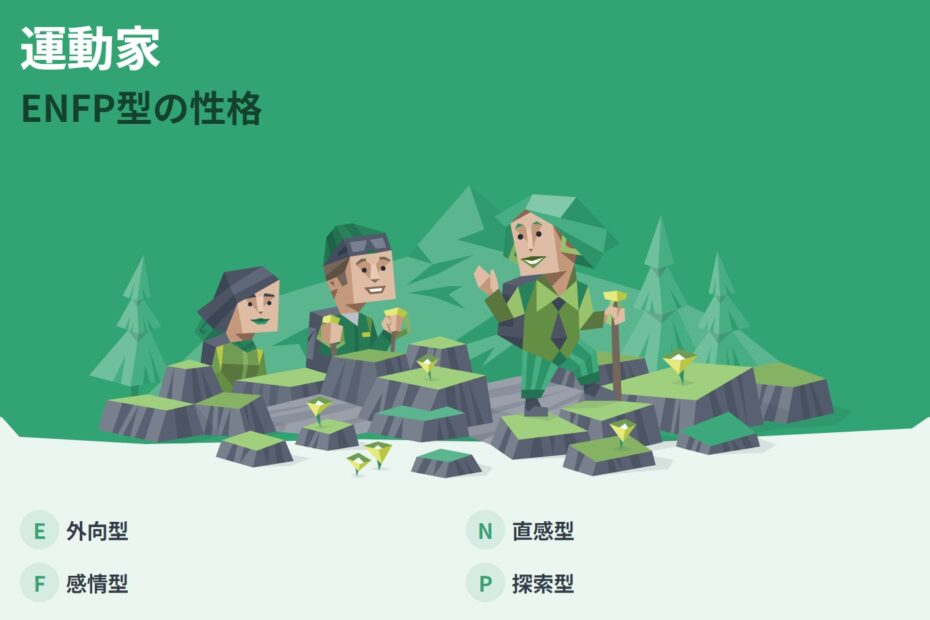
ENFP (The Campaigner) is one of the 16personalities (16 personality types) and represents a bright and creative personality type.
They have free thinking and passion, continuously generating new ideas.
They love interacting with people and are skilled at involving others to work together on projects.
ENFPs are highly sensitive and empathetic, allowing them to understand others’ feelings and interact with thoughtfulness and compassion.
ENFPs are curious and interested in various things.
They enjoy new experiences and encounters, getting excited about expanding their possibilities.
However, ENFPs also have challenges they need to overcome.
This article provides a detailed explanation of ENFP personality characteristics, strengths and weaknesses, and tendencies in romance and work.
We will also introduce key points for ENFP growth and other types they are compatible with.
You should gain insights to understand yourself or ENFPs around you, leveraging their strengths while overcoming challenges.
Please read to the end to explore the charm and potential of ENFPs.
Once again, personality researcher and author of Villain Encyclopedia, Tokiwa (@etokiwa999), will provide the explanation.
※We have developed the HEXACO-JP Personality Assessment! It has more scientific basis than MBTI. Tap below for details.

※This article is based on a translation of the 16personalities official English site page.
The video version of this article is available here!
目次
- 1 ENFP (The Campaigner) Strengths and Weaknesses
- 2 ENFP (The Campaigner) A and T Types
- 3 ENFP (Campaigner) Romantic Relationship Tendencies and Improvement Strategies
- 4 ENFP (Campaigner) Friendship Tendencies and Improvement Strategies
- 5 ENFP (Campaigner) Parenting Tendencies and Improvement Strategies
- 6 ENFP (Campaigner) Career Tendencies and Improvement Strategies
- 7 ENFP (Campaigner) Work Tendencies and Improvement Strategies
- 8 ENFP (Campaigner) Compatible Types
- 9 ENFP (Campaigner) Summary
- 10 Supplement
- 10.1 The downside of 16personalities “Weak scientific backing”
- 10.2 The good points of 16personalities “Large amount of response data and famous”
- 10.3 Differences between 16personalities and other personality tests “MBTI”
- 10.4 Differences between 16personalities and other personality tests: “Big Five”
- 10.5 Differences between 16personalities and other personality tests: “HEXACO”
ENFP (The Campaigner) Strengths and Weaknesses
ENFP (The Campaigner) Strengths
This type is rich in creativity and flexibility.
They have compassion and understanding, respecting others’ perspectives.
They also have a passionate and energetic personality with charisma that attracts people.
Specific strengths include the following:
- Rich creativity and imagination
- Flexible with high adaptability
- Empathetic and able to understand people’s feelings
- Communication skills that attract people
- Full of enthusiasm and energy
ENFPs energize those around them and expand possibilities.
They value teamwork and respect member diversity.
In problem-solving, they propose innovative ideas and approach with a positive attitude.
ENFP creativity and passion hold the potential to greatly impact organizations and society.
ENFP (The Campaigner) Weaknesses
This type’s weaknesses are lack of concentration and emotional instability.
They tend to jump on new ideas and often lose sight of goals.
They are oversensitive to criticism and struggle with emotional control.
Other weaknesses include the following:
- Poor realistic judgment
- Lack planning skills and consistency
- Struggle with keeping deadlines and promises
- Tendency to become overly emotional
- Low stress tolerance
Due to their free-spirited nature, ENFPs may face challenges with responsibility and patience.
They also tend to ignore realistic constraints or overlook details, making them prone to getting into trouble.
For ENFPs to grow, it’s important to improve self-management skills and control emotional fluctuations.
Recognizing their weaknesses and continuing efforts to overcome them will be key to maximizing ENFP potential.
ENFP (The Campaigner) A and T Types
ENFP-A (Assertive)
Passionate idealist. Confidently generates new ideas and inspires others. Curious and enjoys exploring various possibilities.
Values relationships and is skilled at building deep bonds. Creative and good at finding original solutions. Flexible and quickly adapts to change.
Energetic and can work on many projects simultaneously. Open-minded and welcomes new experiences.
Highly sensitive and deeply understands others’ emotions. Loves freedom and prefers an unconventional lifestyle.
For more details, please see this article.
ENFP-T (Turbulent)
Passionate idealist but tends to have self-doubt. Good at generating new ideas but may question the value of those ideas.
Curious but may find it difficult to stay focused on one thing for long.
Values relationships but may be overly concerned about others’ evaluations. Creative but may lack confidence in their abilities.
Flexible but may take time to make decisions. Energetic but may feel stressed from taking on too many things. Highly sensitive but easily swayed by emotions.
ENFP (Campaigner) Romantic Relationship Tendencies and Improvement Strategies
Romantic Tendencies
ENFPs tend to seek passionate and romantic love.
They value deep bonds with their partners and strive to understand their partner’s emotions.
They also like to express creativity and bring freshness to relationships.
The characteristics of ENFP romance are as follows:
- Express affection passionately
- Value emotional connection with their partner
- Seek stimulating and varied relationships
- Respect their partner’s individuality and freedom
- Tend to dream of ideal romance
On the other hand, ENFPs also have a tendency to become easily disillusioned when faced with realistic problems.
They may struggle with differences in values with their partner or daily obligations.
For ENFPs to build fulfilling romantic relationships, flexibility to accept reality and consideration for their partner are essential.
Balancing ideals with reality can be said to be a challenge in ENFP romance.
When Romance Becomes Problematic and Improvement Strategies
While ENFPs are rich in emotional expression, they can be moody.
This may lead to conflicts with their partner.
Also, due to their nature of seeking freedom, they dislike being constrained.
The following problems tend to arise:
- Intense emotional fluctuations, tending to be unstable
- Tendency to avoid realistic responsibilities
- Acting without considering their partner’s feelings
- Feeling dissatisfied when their freedom is restricted
- Disliking routine work and becoming lazy
To improve these problems, it’s important for ENFPs to first understand their own characteristics.
They should develop skills to control their emotions and refrain from impulsive actions.
It’s also important to value communication with their partner and develop the habit of thinking from their partner’s perspective.
Taking balance to respect each other’s freedom while fulfilling appropriate responsibilities will lead to solving challenges in ENFP romance.
ENFP (Campaigner) Friendship Tendencies and Improvement Strategies
Friendship Tendencies
ENFPs are sociable and tend to build wide-ranging friendships.
They enjoy meeting people and accept diverse values.
They value deep bonds with friends and try to empathize with their emotions.
The characteristics of ENFP friendships are as follows:
- Have a bright and friendly atmosphere
- Respect and try to understand their friends’ individuality
- Provide generous emotional support
- Enjoy stimulating conversations and activities
- Are relied upon and admired by their friends
On the other hand, ENFPs also tend toward superficial relationships in friendships.
Having many friends may sometimes prevent them from deepening individual relationships.
Also, because they are easily swayed by their own emotions, they may fail to keep promises with friends or lack consistency.
For ENFPs to build fulfilling friendships, they need to value bonds with each individual and make efforts to build trust.
When Friendships Become Problematic and Improvement Strategies
ENFPs tend to have excessive expectations of their friends.
When the other person cannot meet those expectations, they may feel disappointed or dissatisfied.
Also, by prioritizing their own emotions, they may act without considering their friends’ feelings.
The following problems tend to arise:
- Adapting too much to friends and losing themselves
- Forgetting promises or being unable to keep time
- Getting too involved in friends’ troubles
- Being unable to control their own emotions
- Over-idealizing relationships with friends
To improve these problems, it is important for ENFPs to first face their own emotions.
Let’s develop the skill to objectively examine and control your feelings.
It is also important to face each friend individually and respect their feelings.
Avoiding excessive expectations and building relationships where you can recognize each other’s individuality will lead to solving the challenges in ENFP friendships.
ENFP (Campaigner) Parenting Tendencies and Improvement Strategies
Parenting Tendencies
ENFPs strive for parenting that respects children’s individuality and nurtures creativity.
They value approaching with flexibility and being empathetic to children’s emotions.
They provide a free environment and support children by believing in their potential.
The characteristics of ENFP parenting are as follows:
- Drawing out children’s interests and talents
- Valuing emotional expression and empathizing
- Respecting free curiosity
- Encouraging creative activities
- Emphasizing emotional connection with children
On the other hand, ENFPs also have weaknesses in establishing consistent discipline and rules.
They may become too lenient with children or too emotional.
Also, because it’s difficult for them to set realistic limits, it may take time for children to develop self-control.
For ENFPs to practice effective parenting, it’s important to balance flexibility with rules.
When Parenting Becomes Problematic and Improvement Strategies
ENFPs sometimes neglect necessary discipline in their effort to respect children’s freedom.
They may also become too emotional to provide appropriate guidance to children.
By adapting too much to children’s interests, basic learning habits may not develop.
The following problems are likely to occur:
- Unable to provide consistent discipline
- Being too swayed by children’s emotions
- Unable to set realistic limits
- Cannot foster children’s self-control
- Cannot help children develop basic learning habits
To improve these problems, it’s important for ENFPs to control their emotions and face children calmly.
While respecting children’s freedom, establish necessary rules.
It’s also important to empathize with children’s emotions while providing appropriate guidance.
ENFPs understanding their own characteristics and practicing balanced parenting will lead to children’s healthy growth.
ENFP (Campaigner) Career Tendencies and Improvement Strategies
Career Tendencies
ENFPs are suited for jobs where they can utilize creativity and human relationships.
They excel at generating new ideas with free thinking and engaging others.
Because they respect others’ individuality and value teamwork, they demonstrate their abilities in workplaces that require cooperation.
The characteristics of careers suitable for ENFPs are as follows:
- Jobs involving creative planning and development
- Customer service industries with many opportunities to interact with people
- Project-based work that requires flexibility
- Jobs with high freedom where unique ideas can be utilized
- Work at non-profit organizations with high social contribution
On the other hand, ENFPs also have weaknesses with routine work and detailed tasks.
Also, due to their free-spirited nature, they may feel constrained working as part of an organization.
For ENFPs to build careers, it’s important to develop skills that utilize their strengths while compensating for their weaknesses.
When Career Becomes Problematic and Improvement Strategies
ENFPs tend to choose jobs based on their interests.
Therefore, they are poor at making long-term career plans and may lack stability.
Also, their concentration doesn’t last for routine work or detailed tasks, which may lower work quality.
The following problems are likely to occur:
- Cannot create realistic career plans
- Get bored easily with one job and change quickly
- Poor at following deadlines and rules
- Lack of attention to detail
- Unable to find their place within an organization
To improve these issues, it’s important for ENFPs to clarify their career vision.
Understand your strengths and weaknesses, and set long-term goals.
It’s also important to develop the patience to steadily handle tasks you’re not good at.
Within an organization, you need to find your role and maintain an attitude of cooperation with others.
ENFPs understanding their characteristics and systematically improving their skills will be the key to career development.
ENFP (Campaigner) Work Tendencies and Improvement Strategies
Work Tendencies
ENFPs are suited for jobs where they can utilize their creativity and communication skills.
They have the ability to generate new ideas and get others involved.
They value relationships with people and tend to emphasize teamwork.
ENFP work characteristics are as follows:
- Good at brainstorming and planning
- Excel in people-oriented work
- Flexible and able to adapt to situations
- Approach problem-solving with unique perspectives
- Unite teams and boost morale
On the other hand, ENFPs also have weaknesses with routine work and detailed tasks.
Also, due to their free-spirited nature, they may find it difficult to follow rules and deadlines.
For ENFPs to excel at work, they need to leverage their strengths while making efforts to overcome their weaknesses.
When Work Becomes Problematic and Improvement Strategies
ENFPs tend to proceed with work following their interests. Therefore, they struggle with prioritizing and may miss deadlines.
Also, they may lack attention to detail, leading to quality deterioration. The following problems are likely to occur:
- Lack planning skills and struggle with schedule management
- Poor realistic judgment
- Easily swayed by their emotions
- Overreact to criticism
- Get bored easily with routine work
To improve these issues, it’s important for ENFPs to enhance their self-management abilities. Clarify priorities and develop the habit of proceeding with work systematically.
It’s also important to maintain an objective perspective and cultivate realistic judgment.
Controlling emotions and accepting constructive criticism will also be necessary. ENFPs understanding their characteristics and continuing efforts to overcome their weaknesses leads to success at work.
Establishing a balanced work style while expressing their individuality can be said to be both a challenge and goal for ENFPs.
ENFP (Campaigner) Compatible Types
Compatible Types: People with N Included
ENFPs are most compatible with people who have strong intuitive (N) tendencies.
They prefer exploring abstract concepts and possibilities, so they have similar sensibilities to ENFPs. They can stimulate each other’s creativity and enjoy deep discussions.
Particularly, compatibility is good with the following types:
- INFJ (Advocate)
- INTJ (Architect)
- ENFJ (Protagonist)
- ENTP (Debater)
These types, like ENFPs, have intuition (N) as their dominant function. They prefer abstract thinking and find joy in generating new ideas.
By working together with ENFPs on creative projects and sharing deep insights, they can promote each other’s growth.
Compatible types, people who include F
ENFP is most compatible with people who have a strong Feeling (F) tendency.
They share common ground with ENFPs in valuing emotions and prioritizing human relationships.
They can understand each other’s feelings and build deep bonds.
Particularly, compatibility is good with the following types:
- INFJ (Advocate)
- ENFJ (Protagonist)
- INFP (Mediator)
- ISFP (Adventurer)
These types, like ENFPs, have Feeling (F) as their dominant function.
They value people’s emotions and values, and prioritize building harmonious relationships.
Together with ENFPs, they can enjoy emotionally expressive communication and accomplish things for others, fulfilling each other’s hearts.
Due to their high emotional empathy, they can understand and support ENFP’s emotional fluctuations.
They can also accept ENFP’s creativity and passion, providing an environment that nurtures it.
On the other hand, ENFPs can also empathize with their partner’s emotions and interact with compassion.
ENFP (Campaigner) Summary
ENFP (Campaigner) is an attractive personality type that engages with the world through creativity and passion.
With their unique imagination and flexibility as weapons, they have the power to generate new ideas and get others involved.
Their attitude of valuing human relationships and respecting others’ individuality is essential for promoting teamwork.
If ENFPs leverage their strengths, they can excel in various fields.
However, ENFPs also have challenges to overcome. Emotional control, realistic judgment, and self-management abilities can be considered growth points.
Understanding their own characteristics and acquiring skills to compensate for weaknesses is the key to maximizing ENFP’s potential.
In romance, friendships, and child-rearing, ENFPs demonstrate their unique charm. They have the ability to empathize with others’ feelings and deepen relationships through creative ideas.
However, since they may get too carried away by emotions or fail to set realistic limits, maintaining balance is important.
In careers and work, ENFP’s creativity and communication skills become strengths.
The ability to generate new ideas through free thinking and get others involved is a skill sought after in various professions.
Making the most of their unique charm while maintaining harmony with others and pursuing their own potential can be said to be ENFP’s mission.
Supplement
The downside of 16personalities “Weak scientific backing”
16personalities (16-type personality test) can be said to have challenges in terms of scientific evidence.
First, there are few peer-reviewed papers, and academic backing is insufficient.
Also, questions remain about statistical processing methods.
The point of classifying traits into types rather than continuous numerical values is also problematic from the perspective of scientific validity.
Furthermore, the current situation is that sufficient evidence has not been presented regarding the relationship between personality and academic ability, income, brain function, genetic factors, etc.
The good points of 16personalities “Large amount of response data and famous”
On the other hand, 16personalities (16-type personality test) also has major advantages.
The first is that it has accumulated vast response data. Since many people participate in 16personalities diagnostics, the reliability of the data might possibly be high.
Also, it has considerably penetrated among general people, such as Korean idols answering and spreading it, and being featured in dating matching apps.
This point can be said to be an advantageous aspect of 16personalities personality testing compared to other personality tests.
Differences between 16personalities and other personality tests “MBTI”
16personalities (16-type personality test) is created based on MBTI (Myers-Briggs Type Indicator) and Big Five.
Strictly speaking, 16personalities and MBTI are different things.
MBTI is a personality assessment tool developed based on Jung’s psychological typology.
16personalities adopts the four MBTI indicators (E Extroversion-I Introversion, S Sensing-N Intuition, T Thinking-F Feeling, J Judging-P Perceiving) while adding the Identity (A and T) indicator and establishing its own unique question items and evaluation criteria.
However, it has the same weak scientific backing as 16personalities, including the lack of solid foundation for the dichotomous approach.
Differences between 16personalities and other personality tests: “Big Five”
The Big Five is one of the most influential trait theories in personality psychology.
The Big Five measures five traits: openness, conscientiousness, extroversion, agreeableness, and neuroticism.
Additionally, a major difference is that while the Big Five evaluates traits with continuous numerical values (e.g., extroversion 3.5), 16personalities and MBTI use type classification (e.g., either extroverted or introverted).
Furthermore, it has been studied for a long time, has many published papers, and extensive research has been conducted in other fields such as academic ability, income, brain, and genetics. It can be said that the Big Five has relatively stronger scientific backing.
As a reference, there is also a paper showing the correlation between the four elements of the Big Five and MBTI.
Differences between 16personalities and other personality tests: “HEXACO”
HEXACO (HEXACO Personality Inventory) is a six-dimensional personality model that extends the Big Five.
HEXACO measures six traits: honesty-humility, emotionality, extroversion, agreeableness, conscientiousness, and openness.
By adding the honesty-humility dimension to the Big Five, it aims to capture a broader range of personality traits, including dark (and light) aspects of personality.
Like the Big Five, this model also has relatively stronger scientific backing compared to 16personalities and MBTI, with a greater number of published papers.

Writer & Supervisor: Eisuke Tokiwa
Personality Psychology Researcher / CEO, SUNBLAZE Inc.
As a child he experienced poverty, domestic abuse, bullying, truancy and dropping out of school — first-hand exposure to a range of social problems. He spent 10 years researching these issues and published Encyclopedia of Villains through Jiyukokuminsha. Since then he has independently researched the determinants of social problems and antisocial behavior (work, education, health, personality, genetics, region, etc.) and has published 2 peer-reviewed journal articles (Frontiers in Psychology, IEEE Access). His goal is to predict the occurrence of social problems. Spiky profile (WAIS-IV).
Expertise: Personality Psychology / Big Five / HEXACO / MBTI / Prediction of Social Problems
Researcher profiles: ORCID / Google Scholar / ResearchGate
Social & Books: X (@etokiwa999) / note / Amazon Author Page