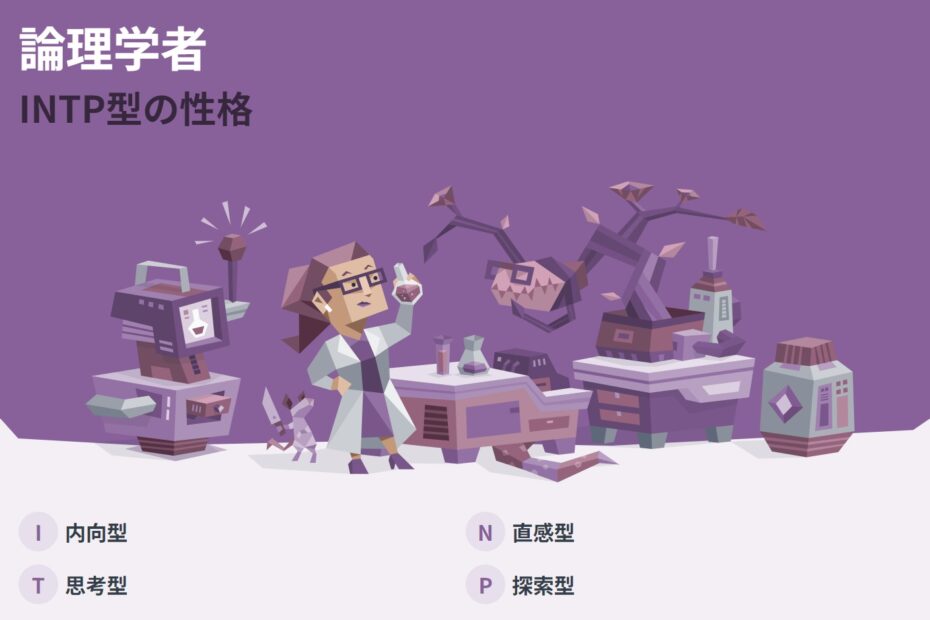
INTP (The Logician) is one of the 16 types classified by the 16personalities (16-type personality test) personality assessment test.
INTPs are said to make up about 3% of the total population, making them a rare type.
The characteristics of this type include having both original creativity and logical thinking abilities.
Their strengths include insight to see through to the essence of things and creativity unbound by conventional thinking.
On the other hand, their weakness is struggling with emotional skills.
They tend to lack emotional support in areas such as romance, friendships, and parenting.
Additionally, low communication skills can become a challenge in career and work situations.
For INTPs to live a better life, it’s important to improve emotional skills, polish communication abilities, and develop practical skills.
This article will explain the characteristics and tendencies of INTPs in detail, and propose improvement strategies to overcome weaknesses.
This content is useful not only for people who think they are INTPs, but also for those who have INTP family members, friends, or romantic partners.
Once again, personality researcher and author of Villain Encyclopedia, Tokiwa (@etokiwa999), will provide the explanation.
※We have developed the HEXACO-JP Personality Assessment! It has more scientific basis than MBTI. Tap below for details.

※This article is written based on translations from the 16personalities official English website.
Watch the video version of this article here!
目次
- 1 Strengths and Weaknesses of INTP (The Logician)
- 2 INTP (The Logician) A and T Types
- 3 INTP (Logician) Romantic Relationship Tendencies and Improvement Strategies
- 4 INTP (Logician) Friendship Tendencies and Improvement Strategies
- 5 INTP (Logician) Parenting Tendencies and Improvement Strategies
- 6 INTP (Logician) Career Tendencies and Improvement Strategies
- 7 INTP (Logician) Work Tendencies and Improvement Strategies
- 8 INTP (Logician) Compatible Types
- 9 INTP (Logician) Summary
- 10 Supplement
- 10.1 The bad aspects of 16personalities: “Weak scientific backing”
- 10.2 The good aspects of 16personalities: “Large number of responses (data) and well-known”
- 10.3 Differences between 16personalities and other personality tests: “MBTI”
- 10.4 Differences Between 16personalities and Other Personality Tests: “Big Five”
- 10.5 Differences Between 16personalities and Other Personality Tests: “HEXACO”
Strengths and Weaknesses of INTP (The Logician)
Strengths of INTP (The Logician)
The greatest strengths of this type are analytical and creative abilities.
They excel at seeing through to the essence of things.
Even with complex problems, they analyze logically and derive solutions.
They also possess creativity to generate innovative ideas.
INTPs have the following characteristics.
- Flexible thinking that views things from multiple perspectives
- Original creativity unbound by conventional thinking
- Curiosity that boldly challenges unknown fields
Furthermore, INTPs have honest and sincere personalities.
They dislike lying and maintain an attitude of pursuing truth.
They act based on their own beliefs and are not swayed by others.
INTP strengths are useful for problem-solving and innovative initiatives.
They can contribute to society by utilizing their analytical and creative abilities.
Weaknesses of INTP (The Logician)
INTP weaknesses include low communication skills.
They are introverted and tend to struggle with interpersonal relationships.
They find it difficult to put their thoughts into words, which can lead to misunderstandings.
Also, because they struggle with emotional expression, they may give off a cold impression.
INTPs have the following characteristics.
- Tendency to avoid social events
- Difficulty understanding others’ emotions
- Struggle with expressing their own emotions in words
Additionally, INTPs have weak practical skills as a weakness.
Concrete action is essential to realize ideas.
However, they tend to struggle with taking action.
Sometimes they fall into perfectionism and find it difficult to move forward.
To overcome INTP weaknesses, it’s important to improve communication skills.
By acquiring emotional expression and interpersonal relationship skills and developing practical abilities, they can proceed with things more smoothly.
INTP (The Logician) A and T Types
INTP-A (Assertive Type)
Logical and creative thinkers. They confidently explore complex theories and generate new ideas. They prefer objective analysis and are not afraid to question existing concepts.
They have strong independence and value free thinking. They prioritize logical consistency over social norms. They are curious and have interests in a wide range of fields.
They enjoy problem-solving and take original approaches. They prefer theoretical discussions but may struggle with practical follow-up.
Please see this article for details.
INTP-T (Turbulent Type)
Logical and creative thinkers, but with a tendency toward self-doubt. They enjoy exploring complex theories but may question the value of their own ideas.
They value objective analysis but may postpone decisions due to seeking perfection. They have strong independence and value free thinking, but can sometimes be easily influenced by others’ opinions.
They are curious and have interests in a wide range of fields, but may find it difficult to continue focusing on one thing. They enjoy problem-solving but may hesitate to take action due to fear of failure.
INTP (Logician) Romantic Relationship Tendencies and Improvement Strategies
Romantic Tendencies
INTPs tend to seek intellectual stimulation in romantic relationships.
They cannot be satisfied with mere appearance or physical attraction alone.
They value spiritual connections through deep discussions and exchanges of opinions with their partners.
Additionally, INTPs have a strong sense of independence and dislike being constrained.
They cherish free time and space, wanting to act at their own pace.
INTP romantic tendencies have the following characteristics:
- Attracted to intelligence and creativity
- Struggle with emotional expression and find it difficult to convey affection
- Value alone time
On the other hand, INTPs tend to be passive in romantic relationships.
They struggle with taking the initiative in approaching others and often wait for the other person to make the first move.
Also, because they struggle with emotional expression, they may find communication with partners difficult.
For INTPs to build romantic relationships, they need to practice facing and expressing their emotions.
By making an effort to understand their partner’s feelings, they can form deeper bonds.
When Problems Arise in Romance and Improvement Strategies
When INTPs encounter problems in romance, it’s often due to insufficient communication.
Because they struggle with emotional expression, communication with partners doesn’t go smoothly.
They may push their logic without trying to understand their partner’s feelings.
Additionally, INTPs may neglect time with their partners because they value alone time so much.
Causes of problems in romantic relationships include:
- Unable to put their own emotions into words
- Acting without considering their partner’s feelings
- Spending little time together
To improve these problems, it’s important to develop communication skills.
Practice putting your emotions into words repeatedly.
Also, making an effort to understand your partner’s feelings is necessary.
Cherish time with your partner and try to find ways to enjoy time together.
For INTPs to improve romantic relationships, upgrading emotional skills is essential.
By valuing communication and deepening bonds with partners, better relationships can be built.
INTP (Logician) Friendship Tendencies and Improvement Strategies
Friendship Tendencies
INTPs tend to seek intellectual stimulation in friendships.
Rather than mere playmates, they prefer partners with whom they can have deep discussions.
INTPs are stimulated by interacting with friends who have rich knowledge and original ideas.
Also, they tend to prefer small group interactions over social events.
Because they get tired in large crowds, they value quiet time with compatible friends.
INTP friendship characteristics include:
- Seek friends with strong intellectual curiosity
- Prefer one-on-one interactions
- Struggle with social events
On the other hand, INTPs tend to be passive in friendships.
They rarely take the initiative to invite friends and often wait for others to reach out.
Also, because they struggle with emotional expression, they may find communication with friends difficult.
For INTPs to build good friendships, it’s important to take proactive action.
By developing emotional expression skills and deepening bonds with friends, more fulfilling interactions become possible.
When Problems Arise in Friendships and Improvement Strategies
When INTPs encounter problems in friendships, it’s often due to insufficient communication.
Because they struggle with emotional expression, communication with friends doesn’t go smoothly.
They may push their own thoughts without considering their friend’s feelings.
Additionally, INTPs may neglect interactions with friends because they value alone time so much.
Causes of problems in friendships include:
- Unable to convey their own emotions
- Not trying to understand their friend’s feelings
- Spending little time with friends
To improve these problems, it’s important to develop communication skills.
Practice putting your emotions into words repeatedly.
Also, making an effort to understand your friend’s feelings is necessary.
Cherish time with friends and try to find ways to enjoy time together.
For INTPs to improve friendships, upgrading emotional skills is essential.
By valuing communication and deepening bonds with friends, better relationships can be built.
INTP (Logician) Parenting Tendencies and Improvement Strategies
Parenting Tendencies
INTPs tend to respect their children’s autonomy in parenting.
They value their children’s interests and encourage free exploration.
They also strive to create an environment that stimulates intellectual curiosity.
INTPs prefer to explain things logically to their children.
They value calmly reasoning with children rather than emotional encouragement or scolding.
INTP parenting characteristics include the following:
- Respecting children’s autonomy
- Creating an environment that stimulates intellectual curiosity
- Explaining things logically
On the other hand, INTPs tend to struggle with emotional support in parenting.
They find it difficult to understand their children’s feelings and often lack emotional support.
They may also stick to their own methods without being bound by social rules or customs regarding parenting.
For INTPs to achieve good parenting, they need to improve their emotional skills.
It’s important to empathize with children’s feelings and provide emotional support.
When Problems Arise in Parenting and Improvement Strategies
INTPs face parenting problems primarily due to insufficient emotional support.
They struggle to understand their children’s feelings and don’t provide adequate emotional care.
They may also clash with others by maintaining their unique parenting approach without being bound by social rules or customs.
Causes of parenting problems include the following:
- Not trying to understand children’s emotions
- Insufficient emotional support
- Ignoring social rules and customs
To improve these problems, developing emotional skills is essential.
Try to empathize with your children’s feelings and show understanding.
It’s also important to respect social rules and customs.
When necessary, incorporate opinions from those around you.
For INTPs to improve parenting problems, it’s important to enhance their emotional support abilities.
By understanding children’s feelings and providing emotional care, they can achieve better parenting.
INTP (Logician) Career Tendencies and Improvement Strategies
Career Tendencies
INTPs tend to prefer careers where they can utilize their original ideas.
They excel at demonstrating unconventional creativity and engaging in innovative endeavors.
They also find joy in deeply pursuing specialized knowledge and skills.
INTPs prefer work environments with high degrees of freedom.
They value being able to work at their own pace and dislike detailed instructions or management.
INTP career characteristics include the following:
- Preferring work that utilizes original ideas
- Pursuing specialized knowledge and skills
- Preferring work environments with high degrees of freedom
On the other hand, INTPs may face challenges in their careers due to poor communication skills.
They struggle to convey their thoughts and have difficulty communicating with others.
Weak practical skills can also be considered a weakness.
They may take time to put their ideas into action.
For INTPs to succeed in their careers, it’s important to improve their communication skills.
By practicing how to convey their thoughts clearly, they can build cooperative relationships with those around them.
When Problems Arise in Career and Improvement Strategies
INTPs often face career problems due to poor communication skills.
They find it difficult to convey their thoughts accurately and struggle with communication with others.
Due to weak practical skills, they may also take time to put their ideas into action.
Causes of career problems include the following:
- Unable to convey their thoughts clearly
- Struggling to build cooperative relationships with others
- Taking time to put ideas into action
To improve these problems, it is important to enhance communication skills.
Practice organizing your thoughts logically and conveying them in an easy-to-understand manner.
Also, it is important to listen to the opinions of others and build cooperative relationships.
When implementing ideas, make sure to create concrete plans.
For INTPs to improve career problems, improving communication skills is essential.
By accurately conveying your thoughts and working collaboratively with others, you will be able to build a more fulfilling career.
INTP (Logician) Work Tendencies and Improvement Strategies
Work Tendencies
INTPs excel at generating original ideas in their work.
They can demonstrate unconventional thinking and engage in innovative initiatives. They also find joy in pursuing specialized knowledge and skills in depth.
INTPs tend to prefer highly autonomous work environments. They value being able to work at their own pace and dislike detailed instructions or micromanagement.
INTP work characteristics include the following:
- Excellent at generating original ideas
- Pursue specialized knowledge and skills
- Prefer highly autonomous work environments
On the other hand, poor communication skills can become a challenge for INTPs in the workplace. They struggle with expressing their thoughts and find it difficult to communicate effectively with colleagues.
Weak practical implementation skills can also be considered a weakness. They may take time to put ideas into action.
For INTPs to achieve results at work, it is important to improve communication skills.
By practicing how to convey their thoughts in an understandable way, they can build cooperative relationships with colleagues.
When Problems Arise at Work and Improvement Strategies
When INTPs encounter problems at work, it is often due to poor communication skills.
They find it difficult to accurately convey their thoughts, leading to poor communication with colleagues.
Additionally, due to weak practical implementation skills, it may take time to put ideas into action. Causes of workplace problems include the following:
- Unable to convey thoughts in an understandable way
- Poor at building cooperative relationships with colleagues
- Takes time to put ideas into action
To improve these problems, it is important to enhance communication skills.
Practice organizing your thoughts logically and conveying them in an understandable manner.
Also, it is important to listen to colleagues’ opinions and build cooperative relationships. When implementing ideas, make sure to create concrete plans.
For INTPs to improve workplace problems, improving communication skills is essential.
By accurately conveying their thoughts and working collaboratively with colleagues, they can achieve higher results.
INTP (Logician) Compatible Types
Compatible Types, People with N
INTPs are most compatible with people who have intuition (N).
Intuition refers to the ability to intuitively understand the essence of things.
Since INTPs excel at logical thinking, partnering with people who have intuition allows them to approach matters from multiple perspectives.
Specifically, they are compatible with the following types of people:
- ENTP (Debater)
- INFJ (Advocate)
- INTJ (Architect)
ENTPs excel in creativity and flexibility, and can work with INTPs to generate innovative ideas. INFJs possess insight and empathy, and can provide emotional support for INTPs.
INTJs excel at strategic thinking and can translate INTP ideas into realistic plans.
The combination with people who have intuition will allow INTPs to maximize their strengths.
Compatible types, people who include T
INTPs are compatible with people who have logical thinking (T).
Logical thinking refers to the ability to objectively analyze things and derive rational conclusions. INTPs are good at generating original ideas, but tend to struggle with putting those ideas into action.
By teaming up with people who have logical thinking, they can turn ideas into realistic forms. Specifically, they are compatible with the following types of people.
- ENTJ (Commander)
- ESTJ (Executive)
- ISTJ (Logistician)
ENTJs excel in strategic thinking and execution ability, and can create plans to realize INTP ideas.
ESTJs are skilled in organization and efficiency, and can translate INTP’s innovative ideas into realistic projects.
ISTJs excel in accuracy and reliability, and can steadily give form to INTP ideas. Combinations with people who have logical thinking will be a force to help realize INTP ideas.
INTP (Logician) Summary
INTPs are unique types who combine original imagination with logical thinking ability.
Their strengths are their insight to see through the essence of things and their creativity that is not bound by common sense.
On the other hand, their weakness is that they struggle with emotional skills. They tend to lack emotional support in areas such as romance, friendships, and parenting.
Additionally, poor communication skills can become challenges in career and work. For INTPs to live better lives, it’s important to be conscious of the following points.
- Improve emotional skills
- Polish communication abilities
- Develop practical skills
To improve emotional skills, start by facing your own emotions.
By practicing putting emotions into words, you will gradually become better at emotional expression. To polish communication abilities, practicing logically organizing your thoughts and conveying them in an understandable way is effective.
Also, it’s important to listen to others’ opinions and build cooperative relationships. To develop practical skills, make an effort to create concrete plans when putting ideas into action.
By leveraging their strengths while overcoming their weaknesses, INTPs can live more fulfilling lives.
Supplement
The bad aspects of 16personalities: “Weak scientific backing”
16personalities (16-type personality test) can be said to have issues in terms of scientific evidence.
First, there are few peer-reviewed papers, and academic backing is insufficient.
Also, questions remain about the statistical processing methods.
The point of classifying traits into types rather than as continuous numerical values is also problematic from the perspective of scientific validity.
Furthermore, the current situation is that sufficient evidence has not been presented regarding relationships between personality and academic ability, income, brain function, genetic factors, etc.
The good aspects of 16personalities: “Large number of responses (data) and well-known”
On the other hand, 16personalities (16-type personality test) also has major advantages.
The first is that it has accumulated vast response data. Because many people have participated in the 16personalities diagnosis, the reliability of the data might possibly be high.
Also, it has penetrated quite extensively among the general public, with Korean idols answering and spreading it, and it gaining attention in dating matching apps as well.
This point can be said to be an advantage that the 16personalities personality test has over other personality tests.
Differences between 16personalities and other personality tests: “MBTI”
16personalities (16-type personality test) is created based on MBTI (Myers-Briggs Type Indicator) and Big Five.
Strictly speaking, 16personalities and MBTI are separate things.
MBTI is a personality assessment tool developed based on Jung’s psychological typology theory.
16personalities adopts the four MBTI indicators (E Extroversion-I Introversion, S Sensing-N Intuition, T Thinking-F Feeling, J Judging-P Perceiving) while adding the Identity (A and T) indicator and establishing its own unique questionnaire items and evaluation criteria.
However, it suffers from the same weak scientific backing as 16personalities, including the lack of basis for dichotomy.
Differences Between 16personalities and Other Personality Tests: “Big Five”
The Big Five is one of the most prominent trait theories in personality psychology.
The Big Five measures five traits: openness, conscientiousness, extroversion, agreeableness, and neuroticism.
Additionally, a major difference is that while the Big Five evaluates traits on a continuous numerical scale (e.g., extroversion 3.5), 16personalities and MBTI use type classifications (e.g., either extroverted or introverted).
Furthermore, it has been studied for a long time with many research papers, and extensive research has been conducted in other fields including academic performance, income, brain studies, and genetics. The Big Five can be said to have relatively stronger scientific backing.
As reference, there are also papers showing the correlation between the four elements of the Big Five and MBTI.
Differences Between 16personalities and Other Personality Tests: “HEXACO”
HEXACO (HEXACO Personality Inventory) is a six-dimensional personality model that extends the Big Five.
HEXACO measures six traits: honesty-humility, emotionality, extroversion, agreeableness, conscientiousness, and openness.
By adding the honesty-humility dimension to the Big Five, it aims to capture a broader range of personality traits, including dark (and bright) aspects of personality.
Like the Big Five, this can also be said to have relatively stronger scientific backing compared to 16personalities and MBTI, with more research papers available.

Writer & Supervisor: Eisuke Tokiwa
Personality Psychology Researcher / CEO, SUNBLAZE Inc.
As a child he experienced poverty, domestic abuse, bullying, truancy and dropping out of school — first-hand exposure to a range of social problems. He spent 10 years researching these issues and published Encyclopedia of Villains through Jiyukokuminsha. Since then he has independently researched the determinants of social problems and antisocial behavior (work, education, health, personality, genetics, region, etc.) and has published 2 peer-reviewed journal articles (Frontiers in Psychology, IEEE Access). His goal is to predict the occurrence of social problems. Spiky profile (WAIS-IV).
Expertise: Personality Psychology / Big Five / HEXACO / MBTI / Prediction of Social Problems
Researcher profiles: ORCID / Google Scholar / ResearchGate
Social & Books: X (@etokiwa999) / note / Amazon Author Page