
Do you know about the “Big Five”?
Personality has a significant impact on our thoughts, behaviors, and emotions.
Understanding your own personality is important for deepening self-understanding and building better relationships with others.
So today, I will introduce the “Big Five personality traits” that are widely used in the field of personality psychology.
The Big Five is a model that classifies human personality into five basic traits, and unlike MBTI or 16personalities, it has been supported by many years of research.
In this article, I will explain the Big Five in an easy-to-understand manner.
Knowing your personality is the first step to finding a way to live that is true to yourself.
Once again, personality researcher and author of Villain Encyclopedia, Tokiwa (@etokiwa999), will provide the explanation.
※We have developed the HEXACO-JP Personality Assessment! It has more scientific basis than MBTI. Tap below for details.

目次
- 1 What are the Big Five Personality Traits
- 2 The Five Personality Traits of the Big Five
- 2.1 Definition and Characteristics of Openness
- 2.2 Comparison of High Openness and Low Openness
- 2.3 The Relationship Between Openness and Creativity
- 2.4 Definition and Characteristics of Conscientiousness
- 2.5 Comparison of High Conscientiousness and Low Conscientiousness
- 2.6 The Relationship Between Conscientiousness and Goal Achievement
- 2.7 Definition and Characteristics of Extraversion
- 2.8 Comparison of High Extraversion and Low Extraversion (Introversion)
- 2.9 The Relationship Between Extraversion and Leadership
- 2.10 Definition and Characteristics of Agreeableness
- 2.11 Comparison Between High and Low Agreeableness
- 2.12 The Relationship Between Agreeableness and Teamwork
- 2.13 Definition and Characteristics of Neuroticism
- 2.14 Comparison of High and Low Neuroticism
- 2.15 The Relationship Between Neuroticism and Stress Coping
- 3 Self-Understanding Through the Big Five
- 4 Utilizing the Big Five for Interpersonal Relationships
- 5 Big Five and Job Suitability
- 6 In Conclusion
What are the Big Five Personality Traits
Overview of the Five Personality Traits
The Big Five personality traits is a model that classifies personality into five dimensions.
This is a powerful framework for understanding personality that is supported by many researchers.
The five personality traits of the Big Five are as follows:
- Openness: Related to intellectual curiosity, creativity, artistic sensitivity, etc.
- Conscientiousness: Related to discipline, reliability, diligence, etc.
- Extraversion: Related to sociability, assertiveness, liveliness, etc.
- Agreeableness: Related to empathy, kindness, cooperative attitude, etc.
- Neuroticism: Related to emotional instability, stress tolerance, anxiety tendencies, etc.
*Also called “OCEAN” using the first letters.
These traits are considered to be formed through the influence of both genetics and environment.
Additionally, each trait forms a continuum, and large individual differences are characteristic.
The Big Five provides a basic framework for personality and can be used for self-understanding and understanding others.
*HEXACO was created by adding one more trait: “Honesty-Humility.”
Origins and History of the Big Five
The origins of the Big Five personality traits date back to the 1930s. At that time, psychologists Allport and Odbert extracted and classified terms describing personality from dictionaries.
Subsequently, the development of the Big Five involved contributions from researchers such as:
- Raymond Cattell: Proposed 16 personality factors
- Hans Eysenck: Proposed a two-factor model of extraversion and neuroticism
- Warren Norman: Conducted research that became a precursor to the five-factor model
- Lewis Goldberg: Proposed the name “Big Five”
- Costa and McCrae: Developed the NEO personality inventory and popularized the Big Five
Through these studies, the five-factor model was gradually established.
Since the 1980s, the Big Five has become widely recognized as a major theory in personality psychology.
Currently, it is used as a basic framework for personality in many research and application settings.
Methods for Measuring the Big Five
The representative method for measuring Big Five personality traits is the questionnaire method.
In the questionnaire method, scores for each trait are calculated when subjects answer self-report questions.
Main questionnaires for the Big Five include:
- NEO Personality Inventory (NEO-PI-R): 240-item questionnaire that also measures six sub-scales for each trait
- Big Five Inventory (BFI): 44-item shortened questionnaire
- Ten Item Personality Inventory (TIPI): 10-item ultra-short questionnaire
In these questionnaires, for example, for a question like “I enjoy socializing with people,” you rate on a 5-point scale how much it applies to you.
By compiling the responses, scores for each trait are calculated.
In addition to questionnaire methods, other methods such as other-ratings and behavioral observation are also sometimes used.
Measurement of the Big Five has become an essential method for understanding and researching personality.
*Other personality assessments can be found here
Correlation with MBTI’s 4 Indicators
There are research papers suggesting correlations between the academically trusted Big Five and MBTI, which classifies personality into 16 types. The main correlations are as follows:
| Correlation Table | E | I | N | S | F | T | J | P |
| Extraversion | Strong Positive | Strong Negative | Positive | Negative | ||||
| Openness | Positive | Negative | Strong Positive | Strong Negative | Negative | Positive | ||
| Agreeableness | Positive | Strong Negative | ||||||
| Conscientiousness | Negative | Positive | Strong Positive | Strong Negative | ||||
| Neuroticism | Negative | Positive | Negative | Positive | Positive | Negative |
As can be seen from this, each indicator of the Big Five may be related to each indicator of MBTI.
Also, parts of the Big Five’s Agreeableness and Neuroticism are related to “Honesty-Humility” in HEXACO. When summarized in a diagram, it looks like the following:
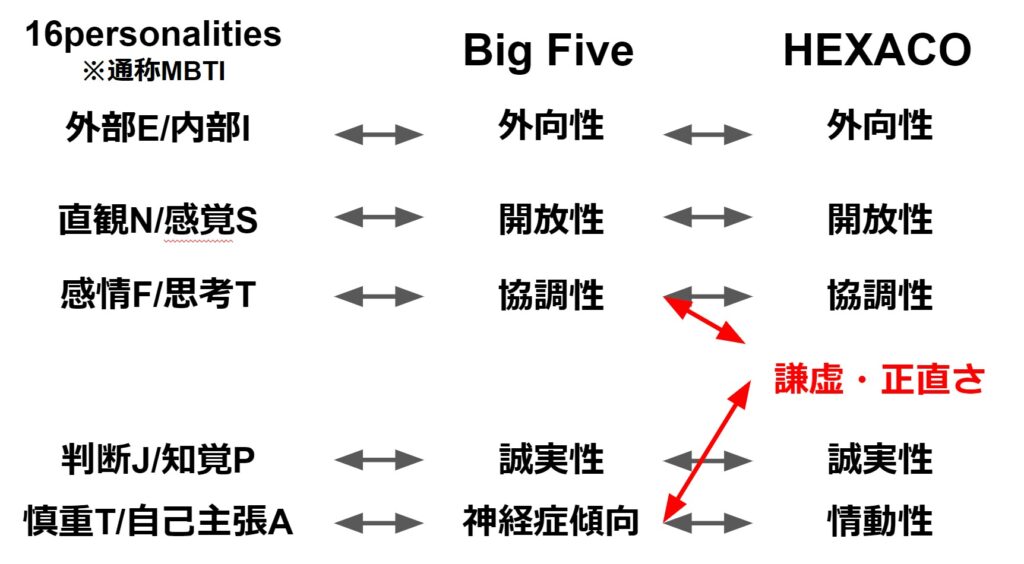
The Five Personality Traits of the Big Five
Definition and Characteristics of Openness
This is a trait that represents the degree of interest and curiosity toward new experiences and knowledge. People with high openness have the following characteristics:
- Have strong intellectual curiosity and show interest in new ideas and concepts
- Are rich in creativity and imagination, capable of original thinking
- Have high sensitivity to art and aesthetic sense
- Have flexibility to accept diverse values without being bound by conventions
On the other hand, people with low openness tend to have the following characteristics:
- Are approachable, practical, and realistic
- Prefer traditional values and customs
- Prefer concrete and practical things
- Have reserved emotional expression and limited artistic sensibility
Openness is an important trait that influences learning motivation, adaptability, and creativity. It is also said to be closely related to career choices and the direction of interests. By knowing your degree of openness, you can explore ways of living that make the most of your strengths.
Comparison of High Openness and Low Openness
People with high openness and those with low openness show significant differences in personality traits and behavioral patterns. The following table compares the characteristics of both types.
| High Openness | Low Openness |
|---|---|
| Seeks novelty | Prefers familiarity |
| Prefers abstract thinking | Prefers concrete thinking |
| Creative and original | Practical and realistic |
| Rich emotional expression | Reserved emotional expression |
| Flexible and highly adaptable | Values tradition and customs |
People with high openness enjoy diving into unknown territories and find joy in generating new ideas.
On the other hand, people with low openness value familiarity and stability, and excel at practical problem-solving.
Both traits can be strengths depending on the situation. By knowing your level of openness, you can choose environments and jobs that suit you.
The Relationship Between Openness and Creativity
Openness is a trait closely related to creativity.
Many studies have revealed that people with higher openness tend to show more creative thinking and behavior.
The following mechanisms are considered to explain why openness promotes creativity:
- High curiosity and sensitivity toward new ideas and experiences
- Ability to think flexibly without being bound by existing frameworks
- Ability to combine various information to generate unique ideas
- Ability to take on new challenges without fear of failure
Creativity is an ability required not only in artistic fields but also in various situations such as science and business activities. By enhancing openness, you may be able to generate creative problem-solving and innovative ideas.
However, creativity also involves other factors such as knowledge, skills, and motivation. Openness can be said to be one of the important foundations that support creativity.
Definition and Characteristics of Conscientiousness
Conscientiousness represents the personality trait of making steady efforts toward goals. People with high conscientiousness have the following characteristics:
- Have high self-discipline and proceed with things in a planned manner
- Are diligent and can persistently continue efforts
- Are reliable and keep promises
- Are good at organizing and act efficiently
Conversely, people with low conscientiousness tend to have the following characteristics:
- Are impulsive and lack planning
- Are lazy and tend to procrastinate
- Are careless and make many mistakes
- Are sloppy and live in messy environments
Conscientiousness is an important trait that affects outcomes in various situations such as academics, work, and lifestyle habits.
Additionally, high conscientiousness helps in building good interpersonal relationships.
By knowing your degree of conscientiousness, you can reflect on your behavior and make improvements toward achieving your goals.
Comparison of High Conscientiousness and Low Conscientiousness
People with high conscientiousness and those with low conscientiousness show significant differences in their approach to things and lifestyle. The following table compares the characteristics of both types.
| High Conscientiousness | Low Conscientiousness |
|---|---|
| Planned and organized | Impulsive and disorganized |
| Diligent and persistent | Lazy and prone to procrastination |
| Disciplined with self-control | Irregular and lacking self-control |
| Highly reliable | Low reliability |
| Steadily achieves goals | Unstable goal achievement |
People with high conscientiousness are strict with themselves and steadily achieve results through consistent effort.
On the other hand, people with low conscientiousness tend to act on spur-of-the-moment thoughts, making their path to goal achievement unstable.
However, depending on the situation, people with low conscientiousness may have advantages in terms of flexibility and adaptability.
It’s important to understand your own level of conscientiousness and work to leverage your strengths while compensating for your weaknesses.
The Relationship Between Conscientiousness and Goal Achievement
Conscientiousness is a personality trait strongly linked to goal achievement. Numerous studies have shown that people with higher conscientiousness achieve superior results in academics, work, health management, and other areas.
The following mechanisms are considered reasons why conscientiousness promotes goal achievement:
- Ability to make plans and execute them steadily
- Ability to persist and continue efforts even in difficult situations
- Ability to resist temptation and demonstrate self-control
- Ability to prevent mistakes and proceed efficiently
Goal achievement requires a clear vision, specific action plans, and the willpower to execute them.
Conscientiousness can be said to be a personality trait that encompasses these elements.
Of course, goal achievement also involves other factors such as ability and environment.
However, by enhancing conscientiousness, you can steadily progress toward your goals.
Definition and Characteristics of Extraversion
Extraversion is a personality trait that represents high levels of sociability and activity. People with high extraversion have the following characteristics:
- Enjoy interacting with people and like parties and social gatherings
- Active and eager to jump into new environments
- Strong in self-assertion and likely to demonstrate leadership
- Positive and often behave cheerfully
On the other hand, people with low extraversion (introverted people) tend to have the following characteristics:
- Prefer alone time and quiet environments
- Cautious and need time to adjust to new challenges
- Reserved and tend to avoid standing out
- Prefer deep thinking and are introspective
Extraversion is a trait that significantly influences interpersonal relationships and social adaptation.
It’s also said to be closely related to career choices and how one spends leisure time.
By knowing your own level of extraversion, you can find communication styles and environments that suit you.
Comparison of High Extraversion and Low Extraversion (Introversion)
People with high extraversion and those with low extraversion (introversion) show significant differences in where they direct their energy and their social behavior. The following table compares the characteristics of both types:
| High Extraversion | Low Extraversion (Introversion) |
|---|---|
| Sociable and externally oriented | Introspective and internally oriented |
| Active and action-oriented | Cautious and reserved |
| Seeks stimulation | Prefers quiet environments |
| Strong in self-assertion | Reserved and modest |
| Demonstrates leadership | Prefers thinking alone |
People with high extraversion focus their attention on the outside world and actively interact with others. On the other hand, people with low extraversion (introversion) focus their attention on their inner world and prefer to think deeply alone.
Both traits can be strengths depending on the situation.
By knowing your own level of extraversion, you can choose communication styles and environments that suit you.
The Relationship Between Extraversion and Leadership
Extraversion is a personality trait that is closely related to leadership. Many studies have shown that people with high extraversion are more likely to demonstrate leadership abilities and effectiveness.
The following mechanisms are considered to explain why extraversion promotes leadership:
- Ability to speak confidently in front of others
- Ability to involve others and guide teams
- Actively gathering information and making decisions
- Ability to approach difficult situations positively
Leadership requires the ability to show vision, motivate others, and make appropriate decisions. Extraversion can be said to be a personality trait that encompasses these elements.
However, leadership also involves other factors such as knowledge, experience, and situational judgment. Extraversion can be considered one of the important foundations for demonstrating leadership.
Definition and Characteristics of Agreeableness
Agreeableness is a personality trait that represents empathy and cooperative attitudes toward others. People with high agreeableness have the following characteristics:
- Compassionate and sensitive to others’ emotions
- Kind and willing to help others
- Cooperative and values teamwork
- Tolerant and receptive to others’ opinions
Conversely, people with low agreeableness tend to have the following characteristics:
- Self-centered with little interest in others
- Highly competitive and prioritizes their own interests
- Critical and not afraid of conflicts with others
- Skeptical and finds it difficult to trust people
Agreeableness is a trait that significantly affects the quality of interpersonal relationships and social adaptation.
Additionally, high agreeableness is a quality required in various situations such as teamwork and customer service.
By knowing the degree of your agreeableness, you can reflect on your behavior and improve how you interact with others.
Comparison Between High and Low Agreeableness
People with high agreeableness and those with low agreeableness have significant differences in their interpersonal relationship styles and values. The following table compares the characteristics of both:
| High Agreeableness | Low Agreeableness |
|---|---|
| High empathy | Self-centered |
| Kind and compassionate | Cold and indifferent |
| Cooperative and values teamwork | Competitive and prioritizes own interests |
| Tolerant and accepting | Critical and skeptical |
| Values harmony | Not afraid of confrontation |
People with high agreeableness build good interpersonal relationships by understanding others’ feelings and cooperating. On the other hand, people with low agreeableness pursue their own interests and are not afraid of competition with others.
However, depending on the situation, people with low agreeableness may have advantages in terms of firm attitude and objective judgment.
It is important to understand your level of agreeableness and compensate for weaknesses while leveraging strengths.
The Relationship Between Agreeableness and Teamwork
Agreeableness is a personality trait that is strongly linked to teamwork.
Numerous studies have shown that people with high agreeableness are more likely to fulfill their role as team members and achieve good results.
The following mechanisms are considered to explain why agreeableness promotes teamwork:
- Respecting others’ opinions and engaging in constructive discussions
- Understanding one’s role and fulfilling responsibilities
- Avoiding conflicts and maintaining team harmony
- Supporting others and creating a cooperative atmosphere
Teamwork requires various skills such as communication abilities, flexibility, and sense of responsibility. Agreeableness can be said to be a personality trait that encompasses these elements.
Of course, teamwork also involves other factors such as shared goals and mutual understanding.
However, by enhancing agreeableness, you can function more effectively as a team member.
Definition and Characteristics of Neuroticism
Neuroticism is a personality trait that represents a tendency to experience negative emotions. People high in neuroticism have the following characteristics:
- Prone to anxiety and stress
- Experience intense mood swings and emotional instability
- Lack confidence and tend to have negative views
- Worry about small details and tend to ruminate
On the other hand, people low in neuroticism (high in emotional stability) tend to have the following characteristics:
- Calm and resilient to stress
- Maintain stable moods and can control emotions
- Confident and optimistic
- Don’t worry about small details and can respond flexibly
Neuroticism is a trait that greatly influences stress coping abilities and mental health.
Additionally, high levels of neuroticism are closely related to psychological problems such as anxiety disorders and depressive tendencies.
By understanding your level of neuroticism, you can better understand your emotional characteristics and use this knowledge for stress management.
Comparison of High and Low Neuroticism
People with high neuroticism and those with low neuroticism show significant differences in emotional reactivity and stress tolerance. The following table compares the characteristics of both types:
| High Neuroticism | Low Neuroticism |
|---|---|
| Vulnerable to anxiety and stress | Calm and resilient to stress |
| Emotionally unstable with intense mood swings | Emotionally stable with good emotional control |
| Lacks confidence and is negative | Confident and optimistic |
| Worries about details and tends to ruminate | Can respond flexibly |
| Susceptible to physical effects of stress | High stress tolerance |
People with high neuroticism are sensitive to stress and tend to experience negative emotions.
In contrast, people with low neuroticism are resilient to stress and can maintain stable emotions.
However, depending on the situation, people with high neuroticism may have advantages in terms of sensitivity and perceptiveness.
It’s important to understand your level of neuroticism and work to leverage your strengths while addressing your weaknesses.
The Relationship Between Neuroticism and Stress Coping
Neuroticism is a personality trait closely related to stress coping abilities. Many studies have revealed that people higher in neuroticism tend to be more vulnerable to stress and less likely to engage in adaptive coping behaviors.
The following mechanisms are considered reasons why neuroticism impairs stress coping:
- Tendency to overestimate stressors
- Being overwhelmed by negative emotions, preventing calm judgment
- Prone to avoidant coping behaviors
- Lack of confidence and low problem-solving abilities
Effective stress coping requires appropriate evaluation of stressors and proactive engagement with problems.
Neuroticism can be considered a personality trait that hinders these elements.
However, stress coping also involves other factors such as utilizing social support and self-efficacy.
By reducing neuroticism and acquiring stress coping skills, you can face difficult situations more adaptively.
Self-Understanding Through the Big Five
Understanding Your Personality Traits Through the Big Five
Understanding your personality traits is important for deepening self-awareness and performing appropriate self-management.
By using the Big Five framework, you can objectively understand your personality tendencies.
To understand your personality traits, you can use the following methods:
- Take reliable personality assessments
- Observe your behavior and emotions on a daily basis
- Seek feedback from others
- Reflect on past experiences and identify patterns
While personality traits can change depending on situations and time, they show relatively stable tendencies.
By understanding your personality tendencies, you can comprehend the characteristics of your behavior and emotions, enabling you to make better choices.
However, personality traits are merely one aspect, and other factors such as abilities, values, and environment must also be considered.
It is important to deepen self-understanding flexibly while using personality traits as a guide.
Understanding Strengths and Weaknesses Through the Big Five
By understanding your personality traits, you can comprehend your strengths and weaknesses.
Each trait of the Big Five has both adaptive and maladaptive aspects.
For example, the following strengths and weaknesses can be considered:
- High openness can lead to strengths in creativity and flexibility, while also potentially becoming a weakness in making realistic judgments
- High conscientiousness can lead to strengths in steady goal achievement, while also potentially becoming a weakness in perfectionism
- High extroversion can lead to strengths in leadership and sociability, while also potentially becoming a weakness in impulsivity
- High agreeableness can lead to strengths in building interpersonal relationships, while also potentially becoming a weakness in self-assertion
- Low neuroticism can lead to strengths in stress tolerance, while also potentially becoming a weakness in lack of crisis awareness
By leveraging your strengths and compensating for your weaknesses, you can cope with the environment more adaptively.
However, strengths and weaknesses vary depending on the situation and are not absolute. It is important to deepen self-understanding flexibly and adjust behavior according to the situation.
Personality traits can be utilized as one guide for self-understanding.
Utilizing the Big Five for Career Choices
Understanding your personality traits is helpful when considering career choices and occupational suitability.
Each trait of the Big Five has been shown to relate to occupational preferences and success.
For example, the following relationships can be considered:
- People high in openness tend to be suited for research positions or art-related occupations
- People high in conscientiousness are likely to excel in occupations that require discipline
- People high in extroversion are suited for occupations where interpersonal relationships are important, such as sales or customer service
- People high in agreeableness are likely to demonstrate their abilities in occupations that require teamwork
- People low in neuroticism are likely to produce stable results even in high-stress occupations
By understanding your personality traits, you can choose occupations and working styles that suit you.
However, personality traits are merely one factor, and abilities, interests, and values must also be considered.
Additionally, certain occupations may require specific personality traits.
It is important to deepen self-understanding from multiple perspectives while using personality traits as a guide, and make appropriate career choices.
Utilizing the Big Five for Interpersonal Relationships
Understanding Communication Styles
Understanding your personality traits is helpful for effective communication. Each trait of the Big Five is closely related to communication styles.
For example, the following characteristics can be considered:
- People high in openness tend to prefer new ideas and enjoy abstract discussions
- People high in conscientiousness tend to prefer logical and systematic communication
- People high in extroversion tend to speak actively and prefer social communication
- People high in agreeableness tend to respect others’ opinions and strive for harmonious communication
- People high in neuroticism tend to use more negative expressions and take cautious approaches to communication
By understanding your communication style, you can take approaches that match your counterpart.
You can also become aware of biases caused by your personality traits.
It is important to flexibly change your style according to the purpose and situation of communication.
However, personality traits vary greatly among individuals, and communication styles cannot be determined categorically.
It is important to consider the other person’s personality traits as well and continue trial and error.
Improving Empathy and Understanding of Others
Understanding others’ personality traits helps increase empathy and build smooth interpersonal relationships.
By using the Big Five framework, you can infer the personality tendencies behind others’ behaviors and emotions.
To deepen empathy and understanding of others, consider the following points:
- Get clues about personality traits from the other person’s words and actions
- Adjust your communication style to match the other person’s personality traits
- Recognize the other person’s strengths and provide support to complement their weaknesses
- Accept differences in personality traits and respect diversity
By understanding others’ personality traits, you can think and act from their perspective.
Additionally, you can prevent misunderstandings and conflicts arising from differences in personality traits.
However, it’s important to remember that personality traits are general tendencies, and there are significant individual and situational differences. Rather than uniform understanding, it’s crucial to maintain a flexible perspective.
Personality traits can be used as one clue for understanding others.
Improving Teamwork
Understanding team members’ personality traits leads to improved teamwork.
By using the Big Five framework, you can grasp the behavioral and cognitive characteristics of members and achieve better team building.
For improving teamwork, consider the following points:
- Understand members’ personality traits and assign roles that leverage their strengths
- Respect diversity in personality traits and incorporate opinions from different perspectives
- Consider combinations of personality traits and create mutually complementary team compositions
- Understand differences in personality traits among members and resolve conflicts constructively
By understanding members’ personality traits, you can maximize individual potential and enhance team performance. Additionally, you can deepen mutual understanding among members and promote smooth communication.
However, personality traits are just one aspect, and abilities, experience, and motivation must also be considered.
It’s important to understand members’ characteristics from multiple angles using personality traits as a guide and manage teams flexibly.
Big Five and Job Suitability
Relationship Between Job Types and Personality Traits
Big Five personality traits serve as important indicators when considering compatibility with job types.
Each job type has required personality traits, and people with those traits are more likely to excel in those positions.
For example, the following relationships can be considered:
- Sales positions: High extraversion and agreeableness are required
- Research positions: High openness and conscientiousness are required
- Administrative positions: High conscientiousness and low neuroticism are required
- Healthcare/welfare positions: High agreeableness and conscientiousness are required
- Artistic/creative positions: High openness is required
By understanding your personality traits and considering compatibility with job types, you can choose a career that suits you. Organizations can also achieve optimal personnel placement.
However, personality traits are just one factor, and abilities, experience, and interests must also be considered.
Additionally, some job types may require multiple personality traits.
It’s important to judge compatibility with job types from multiple angles while using personality traits as a reference.
Leadership and the Big Five
Big Five personality traits are related to leadership style and effectiveness.
In particular, high extraversion, conscientiousness, and emotional stability are considered important for demonstrating leadership.
The relationship between leadership and the Big Five has the following characteristics:
- Leaders with high extraversion tend to actively communicate and lead teams
- Leaders with high conscientiousness tend to have strong responsibility and unite teams by setting an example
- Leaders with high emotional stability tend to make calm judgments under stress and stabilize teams
- Leaders with high openness tend to incorporate new ideas and drive transformation
- Leaders with high agreeableness tend to respect members’ opinions and prioritize team harmony
Leadership requires different styles depending on the situation and objectives. It is important to understand your personality traits and demonstrate leadership that matches the situation.
Additionally, leadership development that leverages the strengths of personality traits while compensating for weaknesses is also necessary.
The Big Five framework can be utilized as a tool for self-understanding and understanding others in leadership development.
Diversity of Personality Traits in the Workplace
The workplace brings together people with diverse personality traits.
Understanding and leveraging the diversity of personality traits leads to improved organizational performance.
The effects brought about by diversity in personality traits include the following:
- Ideas from different perspectives are generated, promoting innovation
- Problem-solving ability is enhanced by combining diverse abilities and skills
- Mutual understanding among members deepens, making communication smoother
- Team productivity improves through role division that leverages individual strengths
On the other hand, diversity in personality traits can also be a source of conflict.
Value conflicts arising from differences in personality traits and communication misunderstandings are more likely to occur.
To leverage diversity, it is important to understand and respect each other’s personality traits.
Additionally, leadership that unites the team toward common goals beyond differences in personality traits is also necessary.
Deepening understanding of personality trait diversity through the Big Five framework is the first step toward strengthening organizational capabilities.
In Conclusion
How was it? Were you able to deepen your understanding of Big Five personality traits?
The Big Five is a useful framework that helps with self-understanding and understanding others by classifying human personality into five basic traits.
By knowing your personality traits, you can leverage your strengths and compensate for your weaknesses.
Additionally, by understanding others’ personality traits, you can smooth communication and build better relationships.
However, the Big Five is merely a model that captures one aspect of personality and cannot completely explain individual diversity.
We must avoid overgeneralizing or stereotyping personality traits.
Furthermore, information about personality traits is sensitive information related to individual privacy and must be handled carefully.
When utilizing the Big Five, it is important to understand its limitations and precautions and apply it flexibly.
Let’s skillfully utilize the Big Five as a tool for self-understanding and self-growth, and as a lubricant for understanding others and communication.
Personality is an important element that shapes our individuality. By knowing your personality through the Big Five, you should be able to walk a more fulfilling life while cherishing your uniqueness.
I hope that everyone will continue their journey of self-exploration with this Big Five map in hand.

Writer & Supervisor: Eisuke Tokiwa
Personality Psychology Researcher / CEO, SUNBLAZE Inc.
As a child he experienced poverty, domestic abuse, bullying, truancy and dropping out of school — first-hand exposure to a range of social problems. He spent 10 years researching these issues and published Encyclopedia of Villains through Jiyukokuminsha. Since then he has independently researched the determinants of social problems and antisocial behavior (work, education, health, personality, genetics, region, etc.) and has published 2 peer-reviewed journal articles (Frontiers in Psychology, IEEE Access). His goal is to predict the occurrence of social problems. Spiky profile (WAIS-IV).
Expertise: Personality Psychology / Big Five / HEXACO / MBTI / Prediction of Social Problems
Researcher profiles: ORCID / Google Scholar / ResearchGate
Social & Books: X (@etokiwa999) / note / Amazon Author Page