Do you know about the ISFP-T type?
This is one of the indicators that represents personality, and it has a major influence on our behavior and way of thinking.
In this article, we will explain in detail what characteristics ISFP-T people have, including health aspects, work, and interpersonal relationships.
Getting to know your own and others’ personalities well may lead to better communication and self-understanding.
Please read while comparing with your own and your friends’ personalities.
Once again, personality researcher and author of Villain Encyclopedia, Tokiwa (@etokiwa999), will provide the explanation.
※We have developed the HEXACO-JP Personality Assessment! It has more scientific basis than MBTI. Tap below for details.

目次
- 1 Scientific Background of ISFP-T (Adventurer・Turbulent)
- 2 Scientific Explanation of ISFP-T (Adventurer, Cautious Type)
- 2.1 Tends to get along well with people who have both S and F traits
- 2.2 Psychotherapy may increase extraversion and reduce neuroticism
- 2.3 When using social media, they communicate through likes and encouraging comments
- 2.4 Properly maintains social distancing for infection control
- 2.5 Common among writers/editors, artists/creators, and counselors/therapists
- 2.6 Easily Fatigued
- 2.7 Preference for Salty, Sour, and Greasy Foods When Stressed
- 2.8 Limiting Sweet Drinks
- 2.9 Poor Sleep Quality
- 2.10 Prone to Gambling
- 2.11 Prone to Internet Addiction
- 2.12 In the case of men, tend to become husbands who get cheated on
- 2.13 Common among mental illness patients
- 2.14 Prone to early death
- 2.15 Tend to hold right-wing authoritarian (RWA) ideology
- 2.16 Practicing Mindfulness Reduces Neuroticism
- 2.17 Engaging in Emotion-Focused Coping
- 2.18 High Neuroticism Creates Bias Toward Risk
- 2.19 Common in Japan’s Tohoku and Chugoku Regions
- 2.20 Schwartz’s Values: Benevolence, Tradition
- 3 In Conclusion
Scientific Background of ISFP-T (Adventurer・Turbulent)
Overview of MBTI
MBTI is a psychological theory that classifies personality into 16 types.
MBTI stands for Myers-Briggs Type Indicator.
MBTI classifies personality into 16 types by combining the following four indicators.
In other words, MBTI expresses your personality tendencies with four letters such as “ISTJ” or “ENFP”. There is a very famous similar system called 16personalities, but this is different from MBTI.
Overview of Big Five
One of the most influential trait theories in personality psychology is the “Big Five”.
Big Five measures five traits: Openness, Conscientiousness, Extraversion, Agreeableness, and Neuroticism.
Also, while 16personalities and MBTI use type classification (e.g., either extraverted or introverted), Big Five evaluates traits as continuous numerical values (e.g., extraversion 3.5), which is a major difference.
Furthermore, it has been studied for a long time, has many research papers, and extensive research has been conducted in other fields such as academic ability, income, brain, and genetics. It can be said that Big Five has relatively stronger scientific backing.
Correlation Between MBTI, Big Five, and HEXACO
There is a correlation between the four MBTI indicators and the five Big Five factors.
A representative study showing this correlation is the paper “The relationship between the revised NEO-Personality Inventory and the Myers-Briggs Type Indicator“.
According to this paper, the correlation between MBTI and Big Five is as follows.
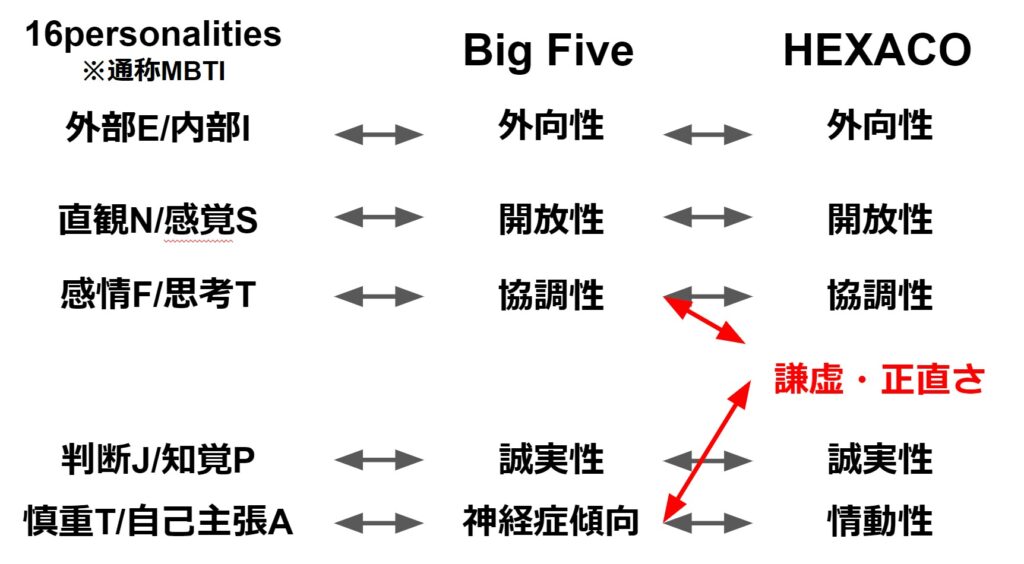
Also, in 16personalities, which was created with reference to MBTI and Big Five, the Big Five neuroticism is called “Identity” and is classified as either Assertive or Turbulent.
On the far right is “HEXACO“, a relatively new personality assessment. It has been improved by adding one indicator “Honesty-Humility” to Big Five.
This article will explain 16personalities personality types in detail based on this correlation.
Since these are originally Big Five and HEXACO research, if you want to know your personality more scientifically than MBTI or 16personalities, please try this HEXACO personality assessment.
What is ISFP-T (Adventurer・Turbulent)?
ISFP-T is a type with low extraversion (I), low openness (S), high agreeableness (F), low conscientiousness (P), and high neuroticism (T) in Big Five. Characteristics:
- High sensitivity and creativity
- Self-doubt and perfectionism
- Deep empathy for others
- Sensitivity to social evaluation
- Internal conflict and self-exploration
They have rich sensitivity and creativity and value the present moment, but they may also feel anxious about their abilities and decisions.
They learn through practical experience, but may hesitate to express themselves due to fear of failure. In interpersonal relationships, they seek deep empathy and harmony, but are sensitive to criticism and rejection from others.
They are open to change and new experiences, but tend to feel stress when faced with uncertainty. This internal conflict becomes the driving force for continuous self-understanding and growth.
Scientific Explanation of ISFP-T (Adventurer, Cautious Type)
Tends to get along well with people who have both S and F traits
ISFP-T individuals tend to have low openness and high agreeableness in the Big Five personality traits. Therefore, they are likely to build intimate relationships with people who are realistic and considerate. ISFP-Ts value sensory information while being sensitive to others’ emotions.
They are compatible with both “S” type people who similarly value concrete facts and “F” type people who prioritize emotions. ISFP-Ts tend to prefer interactions that are both practical and warm.
This trait allows them to build good relationships with diverse people, but sometimes it can make it difficult for them to assert their own opinions.
Please see this article for more details.
Psychotherapy may increase extraversion and reduce neuroticism
The “I” in ISFP-T indicates introversion, and the “-T” indicates high neuroticism. These traits correspond to low extraversion and high neuroticism in the Big Five.
By receiving psychotherapy, ISFP-T individuals may deepen their self-understanding and improve their social skills. This may lead to increased extraversion. At the same time, learning coping strategies for anxiety and stress may also reduce neuroticism.
For ISFP-T individuals, psychotherapy may be a good opportunity for self-growth. However, it should be noted that there are large individual differences, so the effectiveness varies from person to person.
Please see this article for more details.
The “F” in ISFP-T represents emotion-focused thinking, which corresponds to high agreeableness in the Big Five. This trait also influences their communication style on social media.
When ISFP-T individuals use social media, they often “like” others’ posts or write encouraging comments. This is because they are sensitive to others’ emotions and have a strong desire to support them.
This warm communication style helps deepen relationships online. However, it can sometimes make it difficult for them to express their true feelings, so caution is needed.
Please see this article for more details.
The “I” in ISFP-T represents introversion, which corresponds to low extraversion in the Big Five. This trait also influences their maintenance of social distancing in infection control measures.
ISFP-T individuals tend to have little resistance to maintaining physical distance from others. Therefore, they can relatively easily practice social distancing as an infection control measure.
They value personal space and tend to avoid excessive contact with others. While this trait is helpful for preventing infections, it’s important to maintain balance as they may become isolated more than necessary.
Please see this article for more details.
Common among writers/editors, artists/creators, and counselors/therapists
The “I” in ISFP-T represents introversion, “S” represents sensing, and “F” represents feeling. These traits tend to be compatible with specific occupations.
ISFP-T individuals may demonstrate excellent abilities as writers or editors. Their introverted nature and sensory observation skills are suitable for writing and editing work.
They are also likely to excel as artists or creators. Those who emphasize sensing and feeling are often skilled at artistic expression.
Furthermore, they have aptitude as counselors or therapists. Being sensitive to others’ emotions and having high empathy makes them suitable for providing psychological support to people.
Please see this article for more details.
Easily Fatigued
The “I” in ISFP-T represents introversion, “P” represents flexibility, and “-T” represents high neuroticism. These characteristics correspond to low extraversion, low conscientiousness, and high neuroticism in the Big Five, which affect susceptibility to fatigue.
ISFP-T individuals tend to consume a lot of energy in social situations. Due to their introverted nature, they are likely to feel fatigued from prolonged interaction with others.
Additionally, their high flexibility means they become tired from constantly trying to adapt to changing situations. Furthermore, their high neuroticism makes them prone to stress and anxiety, which also contributes to fatigue.
Adequate rest and self-care are important. It’s essential to value your own pace and ensure time for relaxation.
Please see this article for more details.
Preference for Salty, Sour, and Greasy Foods When Stressed
The “-T” in ISFP-T represents high neuroticism, which also indicates high neuroticism in the Big Five. This characteristic can influence eating behavior during stress.
ISFP-T individuals may tend to prefer salty, sour, and greasy foods when feeling stressed. These foods provide temporary pleasure and may be used as a means of stress relief.
Salt provides a sense of security, sourness offers mood change, and greasy foods bring satisfaction, making them likely to be chosen during stressful times. However, excessive consumption of these foods can lead to health problems.
It’s important to find healthy ways to manage stress. Exploring alternative stress relief methods such as exercise or meditation would also be beneficial.
Please see this article for more details.
Limiting Sweet Drinks
The “F” in ISFP-T represents emotion-focused decision making, corresponding to high agreeableness in the Big Five. This characteristic may also influence awareness of healthy lifestyle habits.
ISFP-T individuals are sensitive to their own and others’ emotions and tend to have high health consciousness. Therefore, they may tend to limit their consumption of sweet drinks.
They understand the health effects of sweet drinks and may try to make healthier choices. They would likely tend to choose drinks with less sugar content, such as water or tea.
However, this is a general tendency, and it’s important to note that individual differences exist. The choice of healthy drinks also varies depending on personal preferences and lifestyle.
Please see this article for more details.
Poor Sleep Quality
The “I” in ISFP-T represents introversion, “P” represents flexibility, and “-T” represents high neuroticism. These characteristics correspond to low extraversion, low conscientiousness, and high neuroticism in the Big Five, and may affect sleep quality.
ISFP-T individuals, due to their introverted nature, tend to focus on their inner world, and their thoughts may become active at bedtime. This can sometimes cause difficulty falling asleep.
Additionally, their high flexibility may make it difficult to maintain regular sleep habits. Furthermore, their high neuroticism means anxiety and stress may interfere with sleep.
For quality sleep, it’s important to establish relaxation habits before bedtime and a regular sleep schedule. Consulting with specialists when necessary would also be beneficial.
Please see this article for more details.
Prone to Gambling
The “P” in ISFP-T represents flexibility, and “-T” represents high neuroticism. These characteristics correspond to low conscientiousness and high neuroticism in the Big Five, and may influence gambling behavior.
ISFP-T individuals, due to their high flexibility, tend to seek new experiences and stimulation. This may lead to interest in gambling.
Additionally, their high neuroticism makes them prone to stress and anxiety, and they may use gambling as a temporary mood change or escape mechanism.
However, this is a general tendency, and not all ISFP-T individuals become addicted to gambling. Personal values and environment also have significant influence.
It’s important to recognize the dangers of gambling and find healthy forms of entertainment and mood change methods.
Please see this article for more details.
Prone to Internet Addiction
The “P” in ISFP-T represents flexibility, and “-T” indicates high neuroticism. These traits correspond to low conscientiousness and high neuroticism in the Big Five, which may influence the risk of internet addiction.
ISFP-T individuals, due to their high flexibility, may be easily interested in diverse online content and tend to become immersed in the internet, losing track of time.
Additionally, due to their high neuroticism, they may use the internet as a means of escape when feeling stressed or anxious.
However, this is a general tendency, and not all ISFP-T individuals become internet addicted. Individual self-control and environment also have significant influences.
For healthy internet use, it’s important to manage usage time and balance offline activities.
Please see this article for more details.
In the case of men, tend to become husbands who get cheated on
The “-T” in ISFP-T represents high neuroticism, which also indicates high neuroticism in the Big Five. This trait can affect interpersonal relationships, particularly partnerships.
ISFP-T men, due to their high neuroticism, may be prone to feelings of anxiety and lack of confidence. This can affect their relationship with their partner, potentially increasing the risk of being cheated on.
However, this is a general tendency, and not all ISFP-T men become husbands who get cheated on. The quality of relationships depends on many factors such as communication, trust, and mutual understanding.
To build healthy relationships, it’s important to deepen self-understanding and maintain open communication with your partner. Seeking professional support such as counseling when necessary is also beneficial.
Please see this article for more details.
Common among mental illness patients
The “I” in ISFP-T represents introversion, “P” represents flexibility, and “-T” represents high neuroticism. These traits correspond to low extraversion, low conscientiousness, and high neuroticism in the Big Five, which may influence the risk of mental illness.
ISFP-T individuals, due to their introverted nature, tend to be self-reflective and may sometimes focus excessively on their inner world. Additionally, due to their high flexibility, they may struggle to adapt to stressful situations. Furthermore, due to their high neuroticism, they tend to be prone to anxiety and stress.
The combination of these traits may increase the risk of mental illnesses such as depression and anxiety disorders. However, this is a general tendency, and not all ISFP-T individuals develop mental illness.
To maintain mental health, it’s important to deepen self-understanding and learn stress management techniques. Seeking professional support when necessary is also crucial.
Please see this article for more details.
Prone to early death
The “P” in ISFP-T represents flexibility, and “-T” represents high neuroticism. These traits correspond to low conscientiousness and high neuroticism in the Big Five, which may affect lifespan.
ISFP-T individuals, due to their high flexibility, may find it difficult to maintain regular lifestyle habits. This can potentially lead to unhealthy lifestyle habits.
Additionally, due to their high neuroticism, they are prone to experiencing chronic stress and anxiety, which may have long-term negative effects on health.
However, this is a statistical tendency and varies greatly depending on individual lifestyle habits and environment. Maintaining healthy lifestyle habits, regular health checkups, and appropriate stress management are important.
Early health management and preventive approaches may contribute to extending healthy lifespan.
Please see this article for more details.
The “S” in ISFP-T represents sensing preference, which corresponds to low openness in the Big Five. This trait may influence political beliefs and worldviews.
ISFP-T individuals tend to value concrete and realistic information. This trait may lead to a tendency to support traditional values and existing social order.
Right-wing authoritarianism (RWA) refers to political attitudes that emphasize traditional values and existing authority. ISFP-T individuals may be more likely to sympathize with such ideologies due to their sensing-focused characteristics.
However, this is a general tendency and varies greatly depending on individual experiences, education, environment, and other factors. Political beliefs are complex and multifaceted, and are not determined by a single personality trait alone.
It is important to understand diverse perspectives and cultivate critical thinking.
For more details, please see this article.
Practicing Mindfulness Reduces Neuroticism
The “-T” in ISFP-T represents high neuroticism, which also indicates high neuroticism in the Big Five. This trait leads to a tendency to feel stress and anxiety more easily, but it may be improved through mindfulness practice.
Mindfulness refers to a mental state of focusing consciousness on the present moment and accepting it without judgment. For ISFP-T individuals, this practice may be particularly effective.
Regular mindfulness practice can improve the ability to cope with stress and anxiety, potentially resulting in reduced neuroticism. It also cultivates deeper self-understanding and the ability to observe emotions more objectively.
However, effects vary among individuals, and continuous practice is important. Starting with guidance from a specialist is also a good approach.
For more details, please see this article.
Engaging in Emotion-Focused Coping
The “-T” in ISFP-T represents high neuroticism, which also indicates high neuroticism in the Big Five. This trait may influence the choice of stress coping strategies.
ISFP-T individuals may tend to choose emotion-focused coping when experiencing stress. Emotion-focused coping is a method of dealing with the emotions arising from stress rather than the cause of stress itself.
For example, this includes seeking diversion in stressful situations or expressing emotions to friends. While this approach may be effective in the short term, it may not lead to fundamental problem resolution in the long term.
It is important to develop balanced stress coping methods. It is desirable to appropriately incorporate problem-solving approaches as well, and to become able to select appropriate coping methods according to the situation.
High Neuroticism Creates Bias Toward Risk
The “-T” in ISFP-T represents high neuroticism, which also indicates high neuroticism in the Big Five. This trait may influence risk perception and decision-making.
ISFP-T individuals may tend to overestimate risks due to their high neuroticism. In other words, they may have a bias toward perceiving situations as worse than the actual risks.
This bias can cause them to avoid new challenges or become overly cautious. On the other hand, it can also be helpful for detecting potential dangers early and taking preventive measures.
To balance risk perception, objective information gathering and calm analysis are important. Also, by reflecting on past experiences and comparing actual outcomes with expected outcomes, they may become able to make more realistic risk assessments.
For more details, please see this article.
Common in Japan’s Tohoku and Chugoku Regions
The “I” in ISFP-T represents introversion, “P” represents flexibility, and “-T” represents high neuroticism. The combination of these traits appears to be commonly found in specific regions of Japan, particularly in the Tohoku and Chugoku regions.
The Tohoku and Chugoku regions traditionally have cultures that value a calm atmosphere and harmony with nature. The environments and cultures of these regions may have high compatibility with ISFP-T traits.
Introverted, highly flexible, and sensitive ISFP-T individuals may adapt easily to the peaceful lifestyle rhythms and nature-rich environments of these regions.
However, this is a general tendency, and individual differences and changes over time are also significant. Moreover, various factors influence the distribution of personality traits, so simple judgment based solely on regional characteristics is not possible.
For more details, please see this article.
Schwartz’s Values: Benevolence, Tradition
The “I” in ISFP-T represents introversion, “S” represents sensing-focus, and “F” represents feeling-focus. These traits may be related to the values of “benevolence” and “tradition” in Schwartz’s value theory.
ISFP-T individuals tend to value compassion and understanding toward others due to their feeling-focused “F” trait. This connects with the value of “benevolence.” They will have concern for others’ well-being and value mutual support.
Additionally, the sensing-focused “S” trait leads to valuing concrete and realistic experiences. This relates to the value of “tradition” and may lead to a tendency to respect existing customs and culture.
However, values are also greatly influenced by individual experiences and environment, so not all ISFP-T individuals will prioritize these values in the same way.
Understanding your own values and living based on them will lead to personal happiness and harmony with society.
For more details, please see this article.
In Conclusion
ISFP-T individuals are characterized by their rich sensitivity and ability to understand others’ feelings well. They value their inner world while also prioritizing harmony with those around them. However, they tend to feel stress and anxiety easily, so self-care is important.
People with this personality type are often skilled at art and creative activities, or good at listening to people’s feelings. However, they also tend to get tired easily and sometimes fall into bad habits.
What’s important is to utilize your strengths while also paying attention to your weaknesses.
The tendencies introduced are originally from Big Five and HEXACO research, so if you want to understand personality more scientifically than MBTI or 16personalities, please try this HEXACO personality test.

Writer & Supervisor: Eisuke Tokiwa
Personality Psychology Researcher / CEO, SUNBLAZE Inc.
As a child he experienced poverty, domestic abuse, bullying, truancy and dropping out of school — first-hand exposure to a range of social problems. He spent 10 years researching these issues and published Encyclopedia of Villains through Jiyukokuminsha. Since then he has independently researched the determinants of social problems and antisocial behavior (work, education, health, personality, genetics, region, etc.) and has published 2 peer-reviewed journal articles (Frontiers in Psychology, IEEE Access). His goal is to predict the occurrence of social problems. Spiky profile (WAIS-IV).
Expertise: Personality Psychology / Big Five / HEXACO / MBTI / Prediction of Social Problems
Researcher profiles: ORCID / Google Scholar / ResearchGate
Social & Books: X (@etokiwa999) / note / Amazon Author Page