Do you know the ESFJ-T type?
This is one of the indicators that represents personality, and it has a major influence on our behavior and way of thinking.
In this article, we will explain in detail what characteristics ESFJ-T people have, including their health, work, and interpersonal relationships.
Getting to know your own and others’ personalities well may lead to better communication and self-understanding.
Please read while comparing with your own and your friends’ personalities.
Once again, personality researcher and author of Villain Encyclopedia, Tokiwa (@etokiwa999), will provide the explanation.
※We have developed the HEXACO-JP Personality Assessment! It has more scientific basis than MBTI. Tap below for details.

目次
- 1 Scientific Background of ESFJ-T (Consul – Turbulent)
- 2 Scientific Explanation of ESFJ-T (Consul, Cautious Type)
- 2.1 Engaging in Health Behaviors
- 2.2 Easily Getting Along with People Who Have Both S and F Traits
- 2.3 Making New Friends
- 2.4 Relatively Tend to Have Higher Academic Performance
- 2.5 Valuing Religious Duties and Precepts
- 2.6 Possibility of Reduced Neuroticism Through Psychotherapy
- 2.7 Has many friends on social media
- 2.8 Posts updates and photos on social media, especially many emotional posts
- 2.9 When using social media, communicates through likes and encouraging comments
- 2.10 Engages in altruistic activities such as volunteering
- 2.11 Properly follows infection prevention measures such as handwashing
- 2.12 Having a certain number on the team improves team balance, even better when working with introverted people
- 2.13 Common among athletes, especially at championship level, but even more common with lower neuroticism
- 2.14 Perfectionism taken too far
- 2.15 Preference for salty, sour, and fatty foods due to stress
- 2.16 Preference for fast food, ice cream, chocolate, and cocoa
- 2.17 Health-conscious preference for vegetables, dairy products, and nuts, even more health-conscious with lower neuroticism
- 2.18 Prone to smoking
- 2.19 In men, prone to becoming cheated-on husbands
- 2.20 Prone to having right-wing authoritarian RWA ideology
- 2.21 Practicing mindfulness reduces neuroticism
- 2.22 Employs emotion-focused coping
- 2.23 Attempts relatively calm risk management, but high neuroticism creates bias toward risks
- 2.24 Schwartz’s Values: Benevolence, Harmony, Security
- 2.25 Investment Behavior: Crowd Behavior
- 3 Finally
Scientific Background of ESFJ-T (Consul – Turbulent)
Overview of MBTI
MBTI is a psychological theory that classifies personality into 16 types.
MBTI is an abbreviation for Myers-Briggs Type Indicator.
MBTI classifies personality into 16 types by combining the following 4 indicators.
In other words, MBTI expresses one’s personality tendencies with 4 letters such as “ISTJ” or “ENFP”. There is the very famous 16personalities which is similar, but this is different from MBTI.
Overview of Big Five
One of the most influential trait theories in personality psychology is the “Big Five”.
The Big Five measures five traits: Openness, Conscientiousness, Extraversion, Agreeableness, and Neuroticism.
Also, while 16personalities and MBTI use type classification (e.g., either extraverted or introverted), a major difference is that Big Five evaluates traits with continuous numerical values (e.g., extraversion 3.5).
Furthermore, it has been studied for a long time, has many research papers, and extensive research has been conducted in other fields such as academic ability, income, brain, and genetics. It can be said that Big Five has relatively stronger scientific backing.
Correlations between MBTI, Big Five, and HEXACO
There are correlations between the 4 indicators of MBTI and the 5 factors of Big Five.
A representative study showing this correlation is the paper “The relationship between the revised NEO-Personality Inventory and the Myers-Briggs Type Indicator“.
According to this paper, the correlations between MBTI and Big Five are as follows.
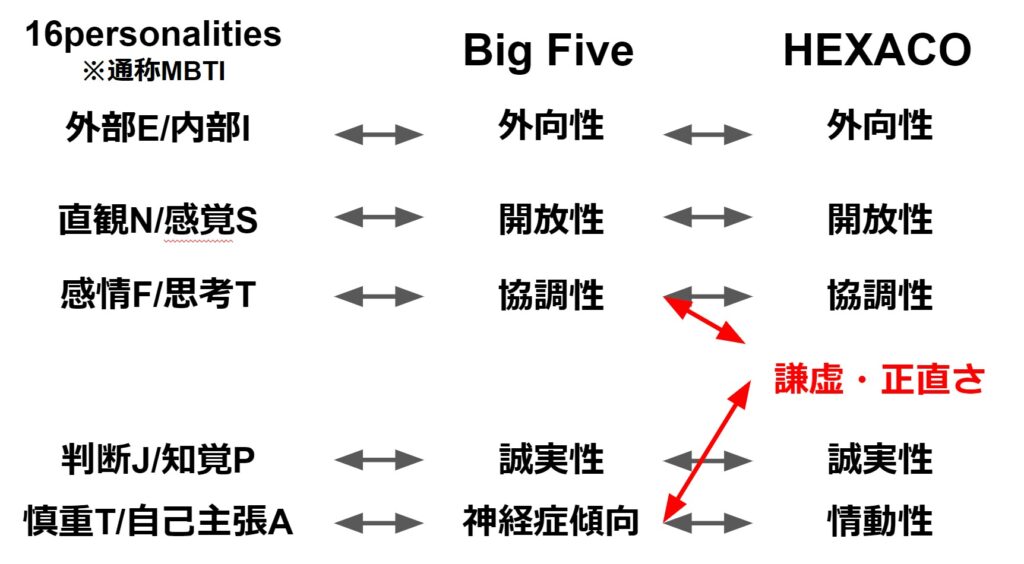
Also, in 16personalities, which was created with reference to MBTI and Big Five, the neuroticism of Big Five is called “Identity” and is classified as either Assertive or Turbulent.
On the far right is the relatively new personality assessment “HEXACO“. It has been improved by adding one indicator “Honesty-Humility” to Big Five.
Based on these correlations, this article provides detailed explanations of 16personalities personality types.
Since these are originally Big Five and HEXACO research, if you want to understand personality more scientifically than MBTI or 16personalities, please try this HEXACO personality assessment.
What is ESFJ-T (Consul – Turbulent)?
ESFJ-T is a type with high Extraversion (E), low Openness (S), high Agreeableness (F), high Conscientiousness (J), and high Neuroticism (T) in Big Five. Characteristics:
- Strong empathy and other-oriented nature
- Sensitivity to social evaluation
- Practical support skills
- Self-doubt and perfectionism
- Pursuit of harmony and stability
They are very sensitive to the needs of others and find joy in supporting the people around them. However, they often feel anxiety about their own abilities and decisions. They value social norms and harmony, but can react oversensitively to criticism or rejection from others.
In interpersonal relationships, they seek deep connections and cooperation, but also have fears about not being able to meet expectations. They tend to feel stressed by change and uncertainty, but this can also become a driving force for growth and improving their skills in supporting others.
Scientific Explanation of ESFJ-T (Consul, Cautious Type)
Engaging in Health Behaviors
ESFJ-T individuals have high health awareness and tend to actively engage in healthy behaviors. Due to their high agreeableness (F) and conscientiousness (J), they care not only about their own health but also about the health of those around them. They value habits for maintaining health such as regular lifestyle, healthy eating, and regular exercise.
However, due to their high neuroticism (-T), they may worry excessively about health-related matters. Balanced health management is important.
For more details, please see this article.
Easily Getting Along with People Who Have Both S and F Traits
ESFJ-T individuals combine both practical and sensory aspects (S) with emotional and empathetic aspects (F), making them naturally inclined to become intimate with people who have similar characteristics.
They value concrete facts and experiences while also being sensitively responsive to others’ emotions. This balanced personality allows them to build good relationships with a wide range of people.
Particularly with people who similarly possess S and F traits, they are likely to share values and interests, enabling them to cultivate deep friendships.
For more details, please see this article.
Making New Friends
The extroversion (E) of ESFJ-T is a major strength in building new relationships. They are sociable and gain energy from interacting with people.
They actively approach others and listen attentively to what others have to say. Also, due to their high agreeableness (F), they are skilled at understanding and empathizing with others’ feelings.
These traits enable ESFJ-T individuals to make friends relatively easily even in new environments. However, due to their neuroticism (-T), they may feel anxiety about new relationships.
For more details, please see this article.
Relatively Tend to Have Higher Academic Performance
ESFJ-T individuals tend to achieve excellent academic performance due to their high agreeableness (F) and conscientiousness (J). They have a strong sense of responsibility and excel at proceeding with tasks in a planned manner.
They can also build good relationships with teachers and peers, and actively participate in group learning activities. Their extroversion (E) allows them to deepen understanding through questions and exchanges of opinions.
However, due to their high neuroticism (-T), they may feel excessive pressure regarding tests and grades. Moderate relaxation is also important.
For more details, please see this article.
Valuing Religious Duties and Precepts
ESFJ-T individuals tend to value religious duties and precepts due to their practical and sensory aspects (S), emotional and empathetic aspects (F), and their preference for planning and order (J).
They respect traditions and social norms, and strongly feel their responsibility as members of a community. Through religious rituals and customs, they can gain a sense of belonging and spiritual stability.
Also, due to their high agreeableness (F), they value bonds and harmony with others through religion. However, due to their neuroticism (-T), they may feel anxiety about not being able to fulfill religious duties.
For more details, please see this article.
Possibility of Reduced Neuroticism Through Psychotherapy
The “Cautious type” (-T) of ESFJ-T indicates high neuroticism. Due to this trait, they tend to be prone to anxiety and stress.
However, by receiving psychotherapy, there is potential to reduce this neurotic tendency. therapy provides an opportunity to deepen self-understanding and learn stress coping methods.
The high agreeableness (F) of ESFJ-T helps in building good relationships with therapists. Their extroversion (E) allows them to express their emotions and thoughts frankly, which also becomes a factor that enhances the effectiveness of therapy.
Please see this article for more details.
The extroversion (E) of ESFJ-T is also demonstrated on social media. They actively like to connect with people and engage in communication.
They have little resistance to making new friends on social media and tend to expand their relationships online as well. Also, due to their high agreeableness (F), they strive for caring interactions even on social media.
However, due to their neurotic tendency (-T), there is also a possibility that they may be overly considerate of relationships on social media or worry too much about others’ reactions. It’s important to maintain an appropriate sense of distance.
Please see this article for more details.
ESFJ-T is characterized by active posting activity on social media due to their extroversion (E) and neurotic tendency (-T). They like to actively share their current situation and emotions.
In particular, they tend to make many emotional posts. They honestly express various emotions such as joy, excitement, and sometimes anxiety or sadness. They are also skilled at conveying their experiences and emotions visually through photos and videos.
This tendency can be said to be an expression of ESFJ-T’s desire to value connections with others and share emotions. However, it’s important to avoid excessive emotional posting and maintain an appropriate balance.
Please see this article for more details.
ESFJ-T tends to engage in active and warm communication on social media due to their high extroversion (E) and agreeableness (F).
They frequently give “likes” to others’ posts and send encouraging and empathetic comments. This is a manifestation of ESFJ-T’s nature of wanting to understand and support others’ feelings.
Also, they try to build and maintain good relationships online through positive feedback. However, due to their neurotic tendency (-T), they may sometimes worry excessively about whether their comments are appropriate.
Please see this article for more details.
Engages in altruistic activities such as volunteering
ESFJ-T tends to actively participate in altruistic activities such as volunteering due to their high extroversion (E) and agreeableness (F).
They find joy in helping others and contributing to society, valuing these activities as a means of self-realization. Their empathy and compassion for people become great strengths in volunteer activities.
Also, they are skilled at utilizing their extroversion (E) to interact with new people during activities and expand their relationships. However, due to their neurotic tendency (-T), they may sometimes feel anxious about whether their contribution is sufficient.
Please see this article for more details.
Properly follows infection prevention measures such as handwashing
ESFJ-T tends to seriously approach infection prevention measures due to their high conscientiousness (J). They value following rules and instructions, and properly practice basic infection prevention measures such as handwashing and wearing masks.
Also, due to their high agreeableness (F), they consider not only their own health but also the health of people around them, and strive for infection prevention. They may also utilize their extroversion (E) to call on people around them to take appropriate infection prevention measures.
However, due to their neurotic tendency (-T), there is also a possibility that they may feel excessive anxiety about infection. Moderate caution and calm judgment are important.
Please see this article for more details.
Having a certain number on the team improves team balance, even better when working with introverted people
ESFJ-T plays an important role within teams due to their high agreeableness (F) and conscientiousness (J). They value harmony among people and excel at maintaining a positive team atmosphere.
Additionally, leveraging their extraversion (E), they play a role in activating communication within the team. Especially when working with introverted people, ESFJ-T helps draw out their opinions and abilities, contributing to balancing the entire team.
However, due to their neuroticism (-T), they may excessively fear disrupting team harmony. Moderate assertiveness is also necessary.
Please see this article for more details.
Common among athletes, especially at championship level, but even more common with lower neuroticism
ESFJ-T is a personality type commonly found among athletes, particularly championship-level athletes, due to their combination of extraversion (E), agreeableness (F), and conscientiousness (J).
Their extraversion (E) helps with cooperation in team sports and interaction with audiences. Agreeableness (F) contributes to building good relationships with teammates, and conscientiousness (J) serves them well in rigorous training and discipline adherence.
However, ESFJ-T with high neuroticism (-T) may have weaknesses under pressure. The ESFJ-A type with lower neuroticism tends to be even more common among championship-level athletes.
Please see this article for more details.
Perfectionism taken too far
ESFJ-T, due to their high conscientiousness (J), tends to strive for perfect completion of tasks. They set high standards and work hard to achieve them.
While this perfectionism can lead to high achievements in work and academics, it may also cause excessive stress and anxiety. Particularly, ESFJ-T with high neuroticism (-T) tends to feel that their achievements are insufficient and may pursue perfection excessively.
Due to their high agreeableness (F), they may push themselves too hard in trying to meet others’ expectations. Moderate perfectionism is good, but maintaining balance is important.
Please see this article for more details.
Preference for salty, sour, and fatty foods due to stress
The “Turbulent” (-T) aspect of ESFJ-T shows a tendency to feel stress easily. As part of coping with this stress, they tend to prefer salty, sour, and fatty foods.
These foods have the effect of temporarily improving mood and are easily chosen as a means of stress relief. Due to their high extraversion (E), they may also seek stress relief by enjoying these meals together with friends.
However, health-conscious ESFJ-T also worry about the impact such eating habits may have on their health. It’s important to combine a balanced diet with other stress relief methods.
Please see this article for more details.
Preference for fast food, ice cream, chocolate, and cocoa
ESFJ-T, due to their extraversion (E), tends to prefer convenient and enjoyable foods. Fast food, ice cream, chocolate, and cocoa become attractive choices for them.
These foods are characterized by providing quick satisfaction and being enjoyable in social settings with friends. Also, for ESFJ-T with high neuroticism (-T), these foods sometimes serve as temporary stress relief or mood improvement methods.
However, health-conscious ESFJ-T also tends to be cautious about excessive consumption of these foods. Due to their high agreeableness (F), they often choose these as snacks to enjoy together with friends or family.
Please see this article for more details.
Health-conscious preference for vegetables, dairy products, and nuts, even more health-conscious with lower neuroticism
ESFJ-T, due to their high conscientiousness (J), tends to pay attention to healthy eating habits. They prefer to consume nutritious foods such as vegetables, dairy products, and nuts.
They have a high awareness of maintaining health and strive for balanced meals. Due to their high agreeableness (F), they also care about the health of family and friends and prefer to share healthy meals.
However, ESFJ-T with high neuroticism (-T) may feel excessive anxiety about health. ESFJ-A types with lower neuroticism tend to maintain a healthy diet with a more relaxed attitude.
Please see this article for more details.
Prone to smoking
ESFJ-T tends to be prone to smoking habits due to the combination of extroversion (E) and neuroticism (-T).
High extroversion (E) may lead to smoking in social situations or seeking connections with people through smoking. Additionally, high neuroticism (-T) can be a factor in choosing smoking as a means of stress relief.
However, ESFJ-T’s high agreeableness (F) and conscientiousness (J) can also serve as motivation to refrain from smoking or quit, considering health concerns and impact on others. There is also a trend toward reconsidering smoking habits with increasing health awareness.
Please see this article for more details.
In men, prone to becoming cheated-on husbands
ESFJ-T men tend to be prone to anxiety and concerns in their relationships with partners due to their “turbulent” (-T) characteristics. This high neuroticism can sometimes lead to excessive dependence or possessiveness.
Additionally, due to their high agreeableness (F), they may suppress their own desires in their excessive attempts to meet their partner’s demands and expectations. These factors may create relationship imbalances and potentially increase the risk of partner infidelity.
However, high extroversion (E) and conscientiousness (J) also serve as strengths in valuing communication and continuing efforts to maintain relationships. For building healthy relationships, a balance between self-assertion and consideration for one’s partner is important.
Please see this article for more details.
ESFJ-T tends to value traditional values and existing social structures due to their realistic and sensing aspects (S). This characteristic may lead to a tendency toward right-wing authoritarian (RWA) ideology.
They value order and stability and may feel anxious about rapid social changes. High agreeableness (F) strengthens the tendency to conform to the norms of the groups or society they belong to. Additionally, high conscientiousness (J) leads to an attitude of respecting rules and authority.
However, this is merely a tendency, and not all ESFJ-T individuals hold this ideology. Various factors such as individual experience, education, and environment influence the formation of political beliefs.
Please see this article for more details.
Practicing mindfulness reduces neuroticism
The “turbulent” (-T) aspect of ESFJ-T indicates high neuroticism. However, practicing mindfulness may help reduce this tendency.
Mindfulness is a technique that focuses awareness on the present moment and is effective in reducing anxiety and stress. ESFJ-T’s high agreeableness (F) will help them sincerely accept mindfulness instruction and practice it.
By utilizing their extroversion (E) to participate in group mindfulness practice, they may further enhance the effects. Regular mindfulness practice can help improve ESFJ-T’s mental health and assist them in living daily life in a calmer state.
Please see this article for more details.
Employs emotion-focused coping
ESFJ-T tends to use emotion-focused coping as a stress management method due to their high agreeableness (F) and neuroticism (-T).
Emotion-focused coping is a method of dealing with stress by regulating emotions and mood in response to stressful situations. ESFJ-T attempts to process their emotions and reduce stress through dialogue with others and emotional sharing.
High extroversion (E) leads to behaviors such as confiding emotions to friends and family or seeking support. However, since this may not directly lead to solving the problem itself, it is effective to use it in combination with problem-solving coping.
Attempts relatively calm risk management, but high neuroticism creates bias toward risks
ESFJ-T tends to attempt relatively calm risk management due to their high conscientiousness (J). They are planful and try to carefully analyze situations.
However, high neuroticism (-T) can lead to being overly sensitive to risks. This may cause overestimation of risks or excessive anxiety about uncertainty.
High agreeableness (F) helps in actively incorporating others’ opinions and advice, but it also makes one susceptible to being influenced by surrounding anxieties. For balanced risk assessment, objective information gathering and recognition of one’s emotional reactions are important.
Please see this article for more details.
Schwartz’s Values: Benevolence, Harmony, Security
ESFJ-T tends to particularly value benevolence, harmony, and security according to Schwartz’s theory of values.
The value of benevolence is related to ESFJ-T’s high agreeableness (F). They value others’ well-being and act with compassion. The value of harmony stems from their combination of extraversion (E) and agreeableness (F), emphasizing the maintenance of good relationships with people.
The value of security comes from their realistic and sensing aspects (S) and high conscientiousness (J). They seek stability and order, preferring predictable environments. However, high neuroticism (-T) may also lead to excessive attachment to security.
These values greatly influence ESFJ-T’s behavior and decisions.
Please see this article for more details.
Investment Behavior: Crowd Behavior
ESFJ-T tends to exhibit crowd behavior in investment actions due to the combination of their extraversion (E) and neuroticism (-T).
High extraversion (E) leads to characteristics of paying attention to others’ opinions and actions and being easily influenced by them. Additionally, high agreeableness (F) strengthens the tendency to conform with surrounding people.
High neuroticism (-T) increases anxiety about uncertainty and may lead to seeking comfort by imitating others’ behaviors.
Therefore, ESFJ-T tends to overreact to market trends and other investors’ actions, becoming easily swayed by crowd psychology. It’s important to maintain independent analysis and calm judgment while keeping a long-term perspective.
Please see this article for more details.
Finally
ESFJ-T type people are extraverted, highly agreeable, and have a planned personality. They value connections with people and understand others’ feelings well. They pay attention to health and have a strong sense of responsibility, so they work hard at school and work.
However, they also have a worrying side, so they may feel stress easily. In such times, it would be good to talk with friends or maintain a healthy diet.
By knowing your personality characteristics, you can utilize your strengths and improve your weaknesses.
The tendencies introduced are originally based on Big Five and HEXACO research, so if you want to understand your personality more scientifically than MBTI or 16personalities, please try this HEXACO personality test.