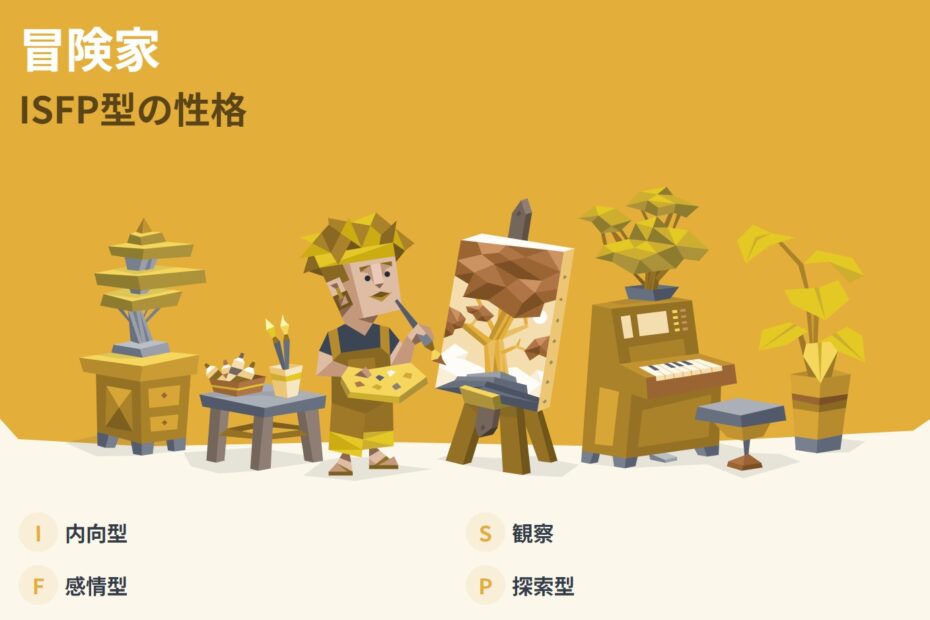
Do you know the type called ISFP (Adventurer)? It’s one of the 16personalities (16-type personality test).
ISFP is an abbreviation combining the initials of Introversion, Sensing, Feeling, and Perceiving, and is also called “Adventurer” or “Artist.”
People with the ISFP type have rich sensitivity and free-spirited personalities, and are abundant in creativity and flexibility.
Their way of life, which values relationships with people and prioritizes living in the present above all else, will attract many people.
This article will explain in detail the characteristics and tendencies of the ISFP type from the perspectives of strengths and weaknesses, romance, friendships, parenting, career, work, and more.
We will also examine compatibility with other types.
Not only those who think their own type is ISFP, but also those who have ISFP type people close to them, please read this article to deepen your understanding.
Once again, personality researcher and author of Villain Encyclopedia, Tokiwa (@etokiwa999), will provide the explanation.
※We have developed the HEXACO-JP Personality Assessment! It has more scientific basis than MBTI. Tap below for details.

※This article is written based on translations from the 16personalities official site English page.
The video version of this article is available here!
目次
- 1 Strengths and Weaknesses of ISFP (Adventurer)
- 2 ISFP (Adventurer) A and T Types
- 3 ISFP (Adventurer) Romantic Relationship Tendencies and Improvement Strategies
- 4 ISFP (Adventurer) Friendship Tendencies and Improvement Strategies
- 5 ISFP (Adventurer) Parenting Tendencies and Improvement Strategies
- 6 ISFP (Adventurer) Career Tendencies and Improvement Strategies
- 7 ISFP (Adventurer) Work Tendencies and Improvement Strategies
- 8 ISFP (Adventurer) Compatible Types
- 9 ISFP (Adventurer) Summary
- 10 Supplementary Information
- 10.1 The weakness of 16personalities: “Weak scientific backing”
- 10.2 The strengths of 16personalities: “Large number of responses (data) and fame”
- 10.3 Differences between 16personalities and other personality tests “MBTI”
- 10.4 Differences between 16personalities and other personality tests “Big Five”
- 10.5 Differences between 16personalities and other personality tests “HEXACO”
Strengths and Weaknesses of ISFP (Adventurer)
Strengths of ISFP (Adventurer)
The strengths of this type are high sensitivity, rich imagination, and strong curiosity.
They can sensitively perceive and empathize with others’ emotions.
They are also rich in creativity and have the power to generate innovative ideas.
Additionally, they have a strong curiosity about the unknown and enjoy taking on new challenges.
Other strengths include the following characteristics:
- Flexible and able to adapt according to situations
- Good with people and friendly
- Value the present and can enjoy the moment
- Have a kind heart that cares for others
- Have their own values and act according to them
In this way, ISFPs have rich sensitivity and attractive personalities.
By leveraging their strengths, they can be active in various situations.
Living authentically while involving the people around them can be said to be ISFP’s strength.
Weaknesses of ISFP (Adventurer)
The weaknesses of ISFP (Adventurer) are lack of planning ability, vulnerability to criticism, and difficulty with technical problem-solving.
They are not good at making long-term plans and tend to act based on emotions of the moment.
They also react sensitively to criticism directed at them and may be deeply hurt.
Furthermore, when facing mechanical or technical problems, they feel difficulty in dealing with them.
Other weaknesses include the following characteristics:
- Not good at meeting deadlines or following rules
- Sometimes have difficulty making realistic judgments
- Poor at self-expression and cannot show their inner self
- Tend to accumulate stress
- Lack confidence and sometimes have low self-evaluation
In this way, ISFPs have several weaknesses.
To overcome these shortcomings, they need to face themselves and grow.
It’s important to gradually improve weak areas while receiving support from those around them.
If ISFPs can understand and accept their weaknesses, they should be able to live more fulfilling lives.
ISFP (Adventurer) A and T Types
ISFP-A (Assertive Type)
Adventurous artists. They confidently express themselves and pursue beauty and harmony. They have high sensitivity and sensitively perceive the atmosphere around them and people’s emotions.
They have strong independence and value living according to their own values. They are flexible and cherish the present moment.
They are practical and demonstrate creativity through concrete methods. They are caring toward others and respect individual freedom. They love nature and art and value sensory experiences.
They are cooperative but do not compromise their beliefs. They have quiet passion and proceed with things at their own pace. They have an adventurous spirit and enjoy new experiences.
For details, please see this article.
ISFP-T (Turbulent Type)
Adventurous artists, but with a tendency to harbor self-doubt.
They have talent for self-expression, but sometimes cannot have confidence in their work or abilities.
You have high sensitivity, but tend to be swayed by emotions. You have strong independence, but can also be easily influenced by others’ opinions. While you have flexibility, it can sometimes take time to make decisions.
You are practical, but may feel difficulty in setting long-term goals. You are considerate toward others, but may sometimes struggle with self-assertion.
You are creative, but sometimes doubt the value of your own ideas.
ISFP (Adventurer) Romantic Relationship Tendencies and Improvement Strategies
Romantic Tendencies
As a romantic tendency of ISFP (Adventurer), passionate and devoted aspects strongly appear.
They have high sensitivity and keenly perceive their partner’s emotions.
And they make efforts to please their partner and act with affection.
Also, ISFPs tend to prefer free-spirited romance.
They enjoy unpredictable developments and seek stimulating experiences.
On the other hand, the following characteristics are also observed.
- Poor at expressing emotions and not revealing inner thoughts
- Excessively concerned about evaluation from partners
- Immersed in current romance without thinking about the future
- May impose their own values on others
- Dislike routine work and avoid monotony
In this way, ISFP romance can be said to have both advantages and disadvantages.
While their passionate and considerate nature is attractive, attention is needed for communication deficiencies and inability to see ahead.
By facing their own emotions and valuing dialogue with their partner, they should be able to build better relationships.
When Problems Arise in Romance and Improvement Strategies
Problems in ISFP (Adventurer) romance arise from difficulty in emotional expression and lack of long-term vision.
They are not good at putting their feelings into words, which tends to cause misunderstandings with partners.
Also, they may become so absorbed in immediate romance that they cannot make future plans.
To improve these problems, the following measures would be necessary.
- Practice verbalizing your own emotions
- Increase opportunities for dialogue with your partner
- Have long-term goals and share them
- Listen to and respect your partner’s opinions
- Understand that patience is sometimes necessary
Furthermore, since ISFPs have a weak side when it comes to criticism, constructive communication with partners is important.
When receiving negative feedback, try to first accept your partner’s words and respond calmly.
You are required to acknowledge your shortcomings and make efforts toward improvement.
In this way, by recognizing problems in romance and taking appropriate measures, ISFPs should be able to build better partnerships.
ISFP (Adventurer) Friendship Tendencies and Improvement Strategies
Friendship Tendencies
The characteristics of ISFP (Adventurer) friendships are high acceptance and free-spirited nature.
They respect their friends’ individuality and accept them as they are.
Also, they dislike restraints and tend to value each other’s freedom.
ISFPs have an easygoing and friendly personality, so they are often liked by those around them.
On the other hand, the following characteristics are also observed.
- Takes time to build deep relationships
- Poor at opening up about their inner thoughts
- Lack planning and may forget promises
- Tend to get tired easily from socializing
- Tend to dislike critical attitudes
In this way, ISFP friendships have both advantages and disadvantages coexisting.
Their tolerance and freedom are attractive, but attention is needed for the difficulty in forming deep bonds.
By expressing their emotions and building trust with friends, they should be able to build more fulfilling friendships.
When Problems Arise in Friendships and Improvement Strategies
Problems in ISFP (Adventurer) friendships arise from lack of communication and lack of planning.
They are not good at putting their thoughts into words, so communication with friends may not go well.
Also, they often act according to the flow of the moment and tend to forget promises or change plans.
To improve these problems, the following measures would be necessary.
- Make an effort to communicate your feelings
- Listen to your friends and show understanding
- Thoroughly manage your schedule
- Recognize the importance of keeping promises
- Understand that patience is sometimes necessary
Furthermore, since ISFPs dislike critical attitudes, constructive dialogue with friends is important.
When there are differences of opinion, try to put yourself in the other person’s position and discuss things calmly.
Rather than imposing your own thoughts, it’s important to respect each other’s opinions.
In this way, ISFPs can build better friendships by recognizing the issues in their friendships and taking appropriate measures.
ISFP (Adventurer) Parenting Tendencies and Improvement Strategies
Parenting Tendencies
The characteristics of ISFP (Adventurer) parenting are providing a free environment and strong emotional support.
They respect their children’s individuality and create an environment where they can grow freely.
They also excel at empathizing with and understanding their children’s emotions.
ISFPs value time with their children and strive to enjoy it together.
On the other hand, the following characteristics are also observed.
- Poor at creating consistent rules
- Unable to establish long-term educational policies
- Sometimes leave too much to the child’s autonomy
- Tendency to avoid critical feedback
- Sometimes have difficulty controlling their own emotions
In this way, ISFP parenting has both advantages and disadvantages.
Their free thinking and emotional support have a positive impact on children’s growth, but attention must be paid to the lack of consistency and planning.
By building trust with children while setting appropriate rules and goals, more effective parenting should be possible.
When Parenting Becomes Problematic and Improvement Strategies
The problems in ISFP (Adventurer) parenting are lack of consistency and insufficient long-term vision.
They often interact with children based on momentary emotions, making it difficult to maintain consistent discipline and educational policies.
Also, they may prioritize immediate enjoyment and be unable to make plans considering their children’s future.
To improve these problems, the following measures are necessary.
- Clarify parenting principles and follow them
- Set goals considering the child’s future
- Take a firm attitude when necessary
- Respect the child’s autonomy while providing appropriate intervention
- Learn methods to control your own emotions
Furthermore, since ISFPs tend to avoid critical feedback, constructive communication with children is important.
When children’s words or actions are problematic, try to explain reasons and encourage appropriate behavior rather than being negative.
It’s important to accept children’s feelings while providing necessary guidance.
In this way, ISFPs can build better parent-child relationships by recognizing problems in parenting and taking appropriate measures.
ISFP (Adventurer) Career Tendencies and Improvement Strategies
Career Tendencies
The characteristics of ISFP (Adventurer) careers are preferring occupations where they can utilize creativity and flexibility.
They seek environments where they can reflect free thinking and ideas in their work.
Their flexibility to respond appropriately to situations is also a strength.
ISFPs value relationships with people, so they are also suited for jobs that utilize interpersonal skills.
On the other hand, the following characteristics are also observed.
- Unable to create long-term career plans
- Dislike routine tasks and being bound by deadlines
- Easily influenced by their own emotions
- Weak against critical feedback
- Poor at self-promotion and unable to demonstrate abilities
In this way, ISFP careers have both advantages and disadvantages.
Their creativity and flexibility improve work quality, but attention must be paid to the lack of planning and stability.
By utilizing their strengths while acquiring skills to compensate for weaknesses, they should be able to build more fulfilling careers.
When Career Problems Arise and Improvement Strategies
The career problems for ISFP (Adventurer) types are difficulty in setting long-term goals and stress from tasks they’re not good at.
They often focus so much on immediate work that they can’t clearly define their future career plans.
They also struggle with routine work and deadline-driven tasks, making them prone to stress.
To improve these problems, the following approaches are necessary:
- Draw a long-term career vision
- Create and execute plans to achieve goals
- Challenge and overcome tasks they’re not good at
- Learn stress management methods
- Increase opportunities to showcase their strengths
Furthermore, since ISFPs tend to be weak against critical feedback, it’s important to accept improvement points with a constructive attitude.
View criticism from supervisors and colleagues as opportunities for personal growth.
They need to listen honestly and think positively about improvement strategies.
In this way, by recognizing career problems and taking appropriate measures, ISFPs can lead a more fulfilling work life.
ISFP (Adventurer) Work Tendencies and Improvement Strategies
Work Tendencies
The work characteristics of ISFP (Adventurer) types are practical problem-solving abilities and strong interpersonal skills.
They can quickly grasp workplace situations and respond flexibly.
They also value relationships with people and have the ability to demonstrate teamwork. ISFPs can apply creative ideas to their work, making them well-suited for innovative initiatives.
On the other hand, the following characteristics are also observed:
- Poor at making long-term plans
- Easily bored with routine tasks
- Easily swayed by their emotions
- Overly sensitive to critical opinions
- Poor at self-assertion and unable to demonstrate their presence
In this way, ISFP work performance has both merits and demerits coexisting.
Their problem-solving abilities and interpersonal skills are highly valued in the workplace, but attention is needed for issues with planning and emotional management.
By continuing to leverage their strengths while making efforts to compensate for their weaknesses, they should be able to achieve higher results.
When Work Problems Arise and Improvement Strategies
The work problems for ISFP (Adventurer) types are difficulty in long-term planning and low stress tolerance.
They focus so much on solving immediate issues that they struggle with prioritizing tasks based on future considerations. They also tend to become emotional when faced with deadline pressure or receiving critical opinions.
To improve these problems, the following approaches are necessary:
- Clarify task priorities and proceed systematically
- Find meaning in routine work and maintain motivation
- Develop self-management skills to control emotions
- View constructive criticism as opportunities for growth
- Have the courage to appropriately express their opinions
Furthermore, since ISFPs tend to be poor at self-assertion, it’s also important to demonstrate their presence. Build up achievements in their areas of expertise and promote their results at appropriate times.
By gaining trust from those around them, opportunities to be entrusted with bigger jobs should increase.
In this way, by recognizing work problems and taking appropriate measures, ISFPs can achieve growth as professionals.
ISFP (Adventurer) Compatible Types
Compatible Types, People with S Included
ISFP (Adventurer) types are compatible with reality-oriented types that also include S.
Specifically, this includes ESTP (Entrepreneur), ESFP (Entertainer), ISTJ (Logistician), ISFJ (Protector), and others.
They value the present moment and have a strong tendency to experience the world through their five senses, making it easy to share values with ISFPs.
The compatibility with ISFPs can be explained by the following characteristics.
- Skilled at realistic problem-solving
- Flexible and adaptable to change
- Enjoy sensory experiences and can have fun together
- Value human relationships and can support each other
- Can respect each other’s pace
As such, types containing S can be said to have good compatibility with ISFPs. Their strength lies in sharing common values and being able to approach problem-solving from a realistic perspective.
By acknowledging each other’s individuality and responding flexibly to one another, they should be able to build good relationships.
Compatible types, people with F included
ISFP (Adventurer) is compatible with emotion-focused types that also contain F.
Specifically, this includes ENFJ (Educator), ESFJ (Consul), INFJ (Advocate), ISFJ (Protector), and others.
They value emotions and strongly emphasize human relationships, making it easy to share values with ISFPs.
The compatibility with ISFPs can be explained by the following characteristics.
- Skilled at providing emotional support
- Excellent at understanding others’ feelings
- Highly empathetic and can build heartfelt relationships
- Value human relationships and are cooperative
- Can create a warm atmosphere
As such, types containing F can be said to have good compatibility with ISFPs.
Their strength lies in respecting each other’s emotions and building caring relationships.
By deepening emotional understanding, they should be able to build rich, heartfelt relationships.
However, it’s also important to sometimes maintain an objective perspective to avoid being overly influenced by emotions.
If ISFPs and F-type people can leverage each other’s strengths, they can build warm and fulfilling relationships.
ISFP (Adventurer) Summary
ISFP (Adventurer) is a type with rich sensitivity and a free-spirited personality.
Their creativity and flexibility are demonstrated in various situations, including the arts field.
Additionally, their attitude of valuing relationships with people and living in the present will attract many people. On the other hand, the following weaknesses are also observed.
- Lack planning ability and consistency
- Difficulty controlling emotions
- Vulnerable to criticism and poor at self-assertion
- Sometimes poor at realistic judgment
To overcome these weaknesses, they need to face themselves and continue growing. They will need to adopt an attitude of challenging themselves in areas they’re weak at and working persistently.
At the same time, it’s also important to leverage their strengths and demonstrate their abilities in their areas of expertise.
By accepting their individuality and implementing appropriate improvement measures, ISFPs should be able to live more fulfilling lives.
Moving forward step by step while receiving support from those around them will lead to their growth.
Supplementary Information
The weakness of 16personalities: “Weak scientific backing”
16personalities (16-type personality test) can be said to have challenges in terms of scientific evidence.
First, there are few peer-reviewed papers, and academic backing is insufficient.
Questions also remain about the statistical processing methods.
The point of classifying traits into types rather than continuous numerical values is also problematic from the perspective of scientific validity.
Furthermore, sufficient evidence has not been presented regarding the relationship between personality and academic performance, income, brain function, genetic factors, and other elements.
The strengths of 16personalities: “Large number of responses (data) and fame”
On the other hand, 16personalities (16-type personality test) also has significant advantages.
The first is that it has accumulated vast response data. Since many people participate in 16personalities diagnostics, the reliability of the data might possibly be high.
Additionally, it has penetrated quite deeply among the general public, with Korean idols answering and spreading it, and it being featured in dating matching apps.
This point can be said to be an advantageous aspect of the 16personalities personality test compared to other personality tests.
Differences between 16personalities and other personality tests “MBTI”
16personalities (16-type personality test) is created based on MBTI (Myers-Briggs Type Indicator) and Big Five.
Strictly speaking, 16personalities and MBTI are different things.
MBTI is a personality assessment tool developed based on Jung’s psychological typology theory.
16personalities adopts MBTI’s four indicators (E Extroversion-I Introversion, S Sensing-N Intuition, T Thinking-F Feeling, J Judging-P Perceiving) while adding the indicator of Identity (A and T) and establishing unique question items and evaluation criteria.
However, it has the same weakness in scientific backing as 16personalities, such as the lack of basis for dichotomous classification.
Differences between 16personalities and other personality tests “Big Five”
Big Five is one of the most prominent trait theories in personality psychology.
Big Five measures five traits: openness, conscientiousness, extraversion, agreeableness, and neuroticism.
Another major difference is that while Big Five evaluates traits with continuous numerical values (e.g., extraversion 3.5), 16personalities and MBTI use type classification (e.g., either extroverted or introverted).
Furthermore, it has been studied for a long time, has many research papers, and extensive research has been conducted in other fields such as academic ability, income, brain, and genetics. It can be said that Big Five has relatively stronger scientific backing.
For reference, there is also a paper showing the correlation between the four elements of Big Five and MBTI.
Differences between 16personalities and other personality tests “HEXACO”
HEXACO (HEXACO Personality Inventory) is a six-dimensional personality model that extends the Big Five.
HEXACO measures six traits: honesty-humility, emotionality, extraversion, agreeableness, conscientiousness, and openness.
By adding the dimension of honesty-humility to the Big Five, it attempts to capture a broader range of personality traits, such as personality darkness (and brightness).
Like Big Five, this also has relatively stronger scientific backing compared to 16personalities and MBTI, with a larger number of research papers.

Writer & Supervisor: Eisuke Tokiwa
Personality Psychology Researcher / CEO, SUNBLAZE Inc.
As a child he experienced poverty, domestic abuse, bullying, truancy and dropping out of school — first-hand exposure to a range of social problems. He spent 10 years researching these issues and published Encyclopedia of Villains through Jiyukokuminsha. Since then he has independently researched the determinants of social problems and antisocial behavior (work, education, health, personality, genetics, region, etc.) and has published 2 peer-reviewed journal articles (Frontiers in Psychology, IEEE Access). His goal is to predict the occurrence of social problems. Spiky profile (WAIS-IV).
Expertise: Personality Psychology / Big Five / HEXACO / MBTI / Prediction of Social Problems
Researcher profiles: ORCID / Google Scholar / ResearchGate
Social & Books: X (@etokiwa999) / note / Amazon Author Page