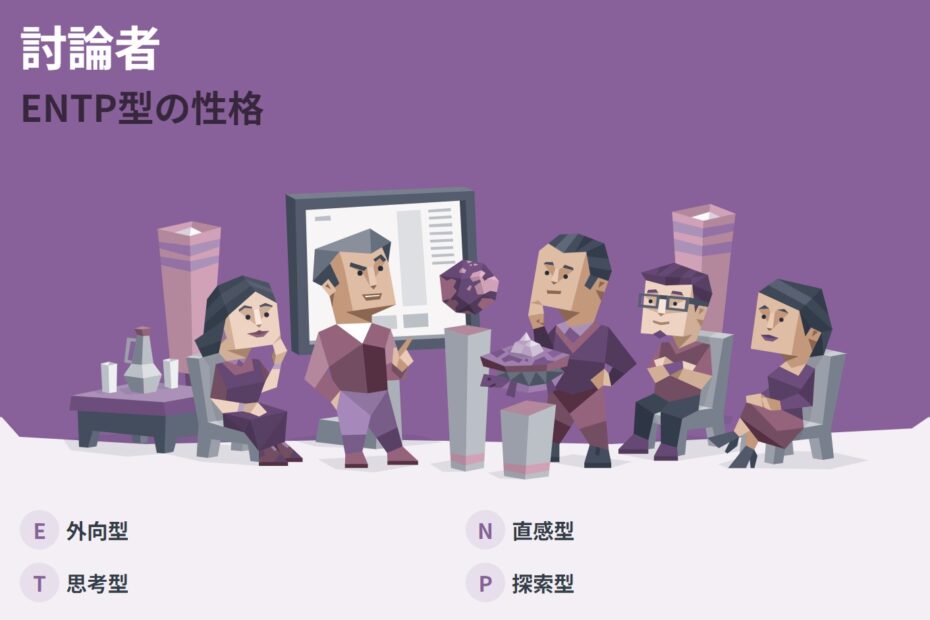
ENTP (The Debater) is one of the 16personalities (16-type personality test) types,
characterized by strong intellectual curiosity and abundant creativity.
They generate ideas one after another with free thinking and enjoy debating with people.
Their flexible thinking that is not bound by conventional wisdom is characteristic.
ENTPs are skilled at viewing things from multiple angles and analyzing them logically.
They are passionate about learning new things and want to explore unknown fields.
With their quick minds, they can tackle complex problems without hesitation.
This article introduces the characteristics, strengths and weaknesses of ENTPs, as well as their tendencies and improvement strategies in various aspects such as romance, friendships, work, and child-rearing.
We will also touch on compatibility by type and the limitations of personality diagnosis.
Please read to the end.
Once again, personality researcher and author of Villain Encyclopedia, Tokiwa (@etokiwa999), will provide the explanation.
※We have developed the HEXACO-JP Personality Assessment! It has more scientific basis than MBTI. Tap below for details.

※This article is written based on a translation of the 16personalities official English page.
The video version of this article is here!
目次
- 1 ENTP Strengths and Weaknesses
- 2 ENTP (Debater) A and T Types
- 3 ENTP Relationship Tendencies and Improvement Strategies
- 4 ENTP Friendship Tendencies and Improvement Strategies
- 5 ENTP Parenting Tendencies and Improvement Strategies
- 6 ENTP Career Tendencies and Improvement Strategies
- 7 ENTP Work Tendencies and Improvement Strategies
- 8 Types Compatible with ENTP
- 9 Summary of ENTP
- 10 Supplement
- 10.1 The bad aspect of 16personalities “weak scientific backing”
- 10.2 The good aspect of 16personalities “large number of responses (data) and famous”
- 10.3 Differences between 16personalities and other personality tests “MBTI”
- 10.4 Differences between 16personalities and other personality tests: “Big Five”
- 10.5 Differences between 16personalities and other personality tests: “HEXACO”
ENTP Strengths and Weaknesses
ENTP Strengths
The strengths of this type are their strong thirst for knowledge and high creativity.
They can also think about things logically and are skilled at debate.
The main strengths of ENTPs are as follows:
- Strong intellectual curiosity and quick at absorbing new knowledge
- Can generate ideas quickly
- Can analyze things objectively and think logically
- Skilled at debate and can flexibly respond to others’ opinions
In other words, ENTPs excel at generating ideas based on various knowledge and logically organizing and debating them.
Their strong intellectual curiosity, high creativity, and logical thinking ability can be said to be ENTPs’ great strengths.
ENTPs who view things from multiple angles and approach problem-solving with innovative ideas can be said to have personalities suited for generating revolutionary ideas.
ENTP Weaknesses
ENTPs’ weakness is that they are poor at considering emotional aspects.
Also, because they have a tendency to lose interest easily, they are not good at seeing things through to the end.
The main weaknesses of ENTPs are as follows:
- They debate without considering others’ emotions, which can complicate relationships
- Their thinking gets ahead of itself, sometimes talking about unrealistic ideas
- They lose interest easily, so they’re not good at continuing one thing for a long time
- They’re not good at working out details and make many mistakes
In other words, ENTPs, because they prefer logical debate, sometimes make statements without considering others’ emotions.
Also, while they are good at generating ideas one after another, they are not good at the steady work required to realize them.
ENTPs are required to understand and compensate for their weaknesses.
They need to make an effort to debate logically while considering emotional aspects and to give form to their ideas.
If ENTPs acquire a sense of balance, they should be able to demonstrate their abilities even more.
ENTP (Debater) A and T Types
ENTP-A
An innovative inventor. With a confident attitude, they generate new ideas one after another and challenge existing concepts. They combine logical thinking with creativity and are skilled at solving complex problems.
They are curious and interested in a wide range of fields. They enjoy debate and seek intellectual stimulation. They are flexible and adapt quickly to change.
They have a strong entrepreneurial spirit and are not afraid of risks. They are sociable and have a sense of humor. However, they may struggle with completing long-term projects. They are energetic and constantly seek new challenges.
For details, please see this article.
ENTP-T
An innovative inventor, but with a tendency to easily harbor self-doubt. While they are good at generating new ideas, they may also doubt the value of those ideas.
They have logical thinking and creativity, but may hesitate to take action due to seeking perfection. They are curious and interested in a wide range of fields, but may find it difficult to continue concentrating on one thing.
They enjoy debate but may sometimes lack confidence in their own opinions. While they are flexible, they may feel anxious about whether they can adapt to change. They are sociable but may also feel anxiety about relationships.
ENTP Relationship Tendencies and Improvement Strategies
Romantic Tendencies
ENTP’s romantic characteristic is their preference for intellectual conversations.
Their ideal partner would be someone who can debate with them as equals.
ENTPs listen well to their partner’s opinions and respond flexibly.
On the other hand, ENTPs also have the following romantic tendencies.
- They struggle with emotional expression, making their partner anxious
- They dislike monotony, so they seek stimulating relationships
- They seek freedom, so they dislike being constrained
In other words, while ENTPs want to build deep relationships with their partners through intellectual conversation, they struggle with emotional communication.
Also, because they have a free-spirited view of love, conflicts easily arise from differences in values with their partner.
For ENTPs to find happiness in love, they need to learn emotional expression and make an effort to understand their partner’s feelings.
Additionally, it will be important to build a stable relationship while respecting each other’s freedom.
When Problems Arise in Romance and Improvement Strategies
The problem in ENTP’s romantic relationships is that they tend to dismiss their partner’s emotions.
By prioritizing logical debate too much, they end up making statements without considering their partner’s feelings.
Additionally, the following issues are also likely to become problems.
- They get bored easily, so relationships don’t last long
- They seek too much freedom, making their partner anxious
- They seek unrealistic ideal romance
For ENTPs to build good relationships in romance, the following improvements are necessary.
- Respect and consider their partner’s emotions
- Immerse themselves in romance and cherish time with their partner
- Have a realistic view of romance and find points of compromise
In other words, ENTPs need to enhance not only logical thinking but also emotional communication skills.
Try to think from your partner’s perspective and be mindful of thoughtful words and actions.
Also, by immersing yourself in romance, you can deepen the bond with your partner.
If ENTPs learn emotional expression and develop a realistic view of romance, they should be able to build wonderful partnerships.
ENTP Friendship Tendencies and Improvement Strategies
Friendship Tendencies
ENTP’s friendship characteristic is enjoying stimulating conversations with like-minded companions.
They prefer relationships where they respect each other’s freedom and don’t interfere too much.
ENTPs deepen their bonds by engaging in intellectual discussions with friends.
However, ENTPs also have the following friendship tendencies.
- They seek people they can speak honestly with, so it’s difficult to develop deep relationships
- They try to push their own opinions through, so conflicts easily arise
- They tend to prioritize their own interests over relationships
In other words, while ENTPs seek friends with whom they can spend stimulating time, they struggle with deep relationships.
Also, because they persist in pushing their own opinions, they may clash with friends.
For ENTPs to build good friendships, it’s important to respect their friends’ feelings and maintain appropriate distance.
Additionally, they need an attitude that values time with friends, not just their own interests.
When Problems Arise in Friendships and Improvement Strategies
The problem in ENTP’s friendships is making statements without considering their friend’s emotions.
By getting too absorbed in debates, they end up with words and actions that hurt their friends.
Additionally, the following issues are also likely to become problems.
- They don’t keep promises or punctuality
- They only talk about themselves and don’t listen to others
- They can’t empathize with friends’ troubles and only give logical advice
For ENTPs to maintain good friendships, the following improvements are necessary.
- Consider their friend’s feelings and choose their words carefully
- Keep promises and punctuality, and respect others
- Not only have others listen to their stories, but also listen to others’ stories
- When someone confides their worries to you, make an effort to show empathy
In other words, ENTPs need to improve their communication skills even in their relationships with friends.
Consider the other person’s feelings and strive for thoughtful words and actions.
Also, by keeping promises and listening to what the other person has to say, you can build trust.
If ENTPs adopt an attitude of cherishing their friends, they should be blessed with companions they can call lifelong friends.
ENTP Parenting Tendencies and Improvement Strategies
Parenting Tendencies
The characteristic of ENTP parenting is respecting children’s autonomy.
They tend to value children’s interests and concerns, allowing them to explore freely.
ENTPs enjoy intellectual conversations with children and try to develop their potential.
However, ENTPs also have the following parenting tendencies.
- Difficulty empathizing with children’s emotions
- Expecting logical thinking from children too much
- Getting bored with parenting easily and lacking consistency
In other words, while ENTPs respect children’s autonomy, they struggle with emotional support.
Also, because they have excessively high expectations for children, they may put pressure on them.
For ENTPs to become good parents, it’s important to empathize with children’s emotions and interact with them appropriately for their age.
They also need to face parenting without getting bored and strive for consistent discipline.
When Problems Arise in Parenting and Improvement Strategies
The problem with ENTP parenting is neglecting children’s emotions.
They hurt children with logical words and actions, or suppress emotional expression.
Also, the following are likely to become problems.
- Respecting children’s freedom too much and not teaching rules
- Getting bored with parenting and becoming neglectful
- Becoming uninterested when children’s interests don’t match their own
For ENTPs to improve parenting problems, the following are necessary.
- Accept and empathize with children’s emotions
- Set rules appropriate for children’s developmental stage and enforce them
- Be aware of parenting responsibilities and face them to the end
- Respect children’s interests while providing diverse experiences
In other words, ENTPs need to learn to empathize with children’s emotions.
An attitude of understanding and accepting children’s feelings is required.
Also, while giving children freedom, appropriate discipline is necessary to help them develop social skills.
If ENTPs recognize the importance of parenting and take responsibility, they should be able to maximize their children’s potential.
ENTP Career Tendencies and Improvement Strategies
Career Tendencies
The characteristic of ENTP careers is being suited for jobs that generate new ideas.
They have a high ability to promote innovative projects by leveraging their original thinking.
ENTPs are types who constantly explore new possibilities and enjoy challenges.
Jobs suitable for ENTPs include the following.
- Research and development positions
- Consultant
- Marketing positions
- Entrepreneur
In other words, ENTPs are suited for jobs where they generate original ideas and work to realize them.
They can constantly take on new challenges and approach problem-solving with free thinking.
They also have high ability to analyze complex problems and formulate strategies.
ENTPs should be able to build their careers smoothly by choosing jobs that leverage their strengths.
When Problems Arise in Career and Improvement Strategies
The problem with ENTP careers is their inability to continue working due to their easily bored personality.
While their interest in new things is endless, they are poor at steady work, so they end up giving up halfway through.
Additionally, the following issues are also likely to become problematic.
- Trying to push through their own opinions and clashing with others
- Lacking a big picture view and being unable to prioritize
- Disregarding human relationships and disrupting teamwork
For ENTPs to improve their career problems, the following is necessary.
- Having a sense of responsibility to see work through to completion
- Listening to others’ opinions and developing flexibility to coordinate
- Cultivating the ability to grasp the overall picture and prioritize
- Recognizing the importance of human relationships and enhancing communication skills
In other words, ENTPs need to overcome their easily bored personality and develop a sense of responsibility toward work.
Additionally, not only pushing through their own opinions but also having a cooperative attitude with others is important.
ENTPs should be able to solve career problems by having a perspective that looks at the whole picture and valuing human relationships.
Not neglecting efforts to leverage their strengths while compensating for weaknesses will be the key to ENTP career development.
ENTP Work Tendencies and Improvement Strategies
Work Tendencies
ENTP’s work characteristic is generating new ideas with free thinking.
They stimulate their team with innovative proposals that don’t adhere to conventional methods.
ENTPs can logically analyze and find solutions even when facing complex problems at work.
However, ENTPs also have the following work tendencies.
- Unable to meet deadlines and work tends to be delayed
- Poor at detailed work and prone to making mistakes
- Trying to push through their own opinions and getting into trouble with colleagues
In other words, while ENTPs demonstrate creativity at work, they have shortcomings in practical abilities. Also, because they are too attached to their own opinions, they may face opposition from others.
For ENTPs to perform well at work, they need execution power to turn ideas into reality and an attitude of cooperation with others. They are required to improve schedule management and work accuracy, and polish their communication skills.
When Problems Arise at Work and Improvement Strategies
The problem with ENTP’s work is their weakness in realistic judgment. They try to push through ideas that are too innovative without considering feasibility.
Additionally, the following issues are also likely to become problematic.
- Disliking routine work and skipping it
- Focusing only on their own work and becoming unable to see their surroundings
- Not listening to others and trying to push through their own theories
For ENTPs to improve work problems, the following is necessary.
- Examining the feasibility of ideas and making realistic proposals
- Recognizing that routine work is also important and working through it steadily
- Understanding surrounding situations and comprehending the relationship with their own work
- Having an attitude of listening to others’ opinions and responding flexibly
In other words, ENTPs need to develop realistic judgment while demonstrating originality. They are also required to recognize that steady work is important and approach it with a sense of responsibility.
If ENTPs communicate with others and have awareness as team members, work problems should be solvable. Developing the ability to turn innovative ideas into realistic forms will be the key to ENTP’s work success.
Types Compatible with ENTP
Compatible Types, People Who Include N
The types compatible with ENTP are the four types that include N: “INFJ,” “ENFJ,” “INTJ,” and “ENTJ.”
N represents “intuition” and tends to prefer abstract thinking. Since ENTPs are also N-types, they can enjoy deep discussions with these types.
Among these, the following types are said to have particularly good compatibility with ENTP.
- “INFJ” is emotionally rich and highly empathetic, so they can accept ENTP’s theoretical discussions
- “INTJ” thinks about things logically, so they can enjoy intellectual debates with ENTP
In other words, ENTP can get excited about abstract topics with N types, and can build a deeply understanding relationship especially with “INFJ” and “INTJ”.
There is good compatibility where they can leverage each other’s strengths and compensate for each other’s weaknesses. By actively interacting with N types, ENTP may be able to expand their potential.
Compatible types, people with T included
ENTP is compatible with the 4 types that include T: “INTJ”, “ENTJ”, “INTP”, and “ESTP”.
T represents “thinking” and tends to be logical with high analytical ability.
Since ENTP is also a T type, they can enjoy intellectual debates with these types.
Among these, the following types are said to have particularly good compatibility with ENTP.
- “ENTJ” excels at strategic thinking and has action-taking ability, so they can guide ENTP’s ideas to realization
- “INTP” excels at logical thinking and has strong intellectual curiosity, so they can have stimulating debates with ENTP
In other words, ENTP can enjoy logical dialogue with T types, and can especially enjoy intellectual activities with “ENTJ” and “INTP”.
Within rational relationships, there is good compatibility where they can enhance each other’s thinking.
By spending time with T types, ENTP may gain new insights.
Summary of ENTP
This type has strong intellectual curiosity and excels in creativity and logical thinking.
They generate ideas with free thinking and enjoy debating. In romance, they seek stimulating partners, and in friendships, they prefer intellectual conversations.
At work, they make innovative proposals but have challenges with execution and cooperation. In child-rearing, they respect autonomy but are weak at emotional support.
They have good compatibility with N types and P types and can enjoy creative activities. ENTP is a versatile personality, but it’s important to deepen self-understanding and overcome weaknesses.
Supplement
The bad aspect of 16personalities “weak scientific backing”
16personalities (16-type personality test) can be said to have issues in terms of scientific evidence.
First, there are few peer-reviewed papers, and academic backing is insufficient.
Also, questions remain about the statistical processing methods.
The point of classifying traits into types rather than continuous numerical values is also problematic from the perspective of scientific validity.
Furthermore, regarding the relationship between personality and academic ability, income, brain function, genetic factors, etc., sufficient evidence has not been presented at present.
The good aspect of 16personalities “large number of responses (data) and famous”
On the other hand, 16personalities (16-type personality test) also has significant advantages.
The first is that it accumulates vast response data. Since many people participate in 16personalities testing, the reliability of the data might possibly be high.
Also, Korean idols have answered and spread it, and it’s getting attention in dating matching apps, so it has penetrated quite well among ordinary people.
This point can be said to be an advantageous aspect of 16personalities personality testing compared to other personality tests.
Differences between 16personalities and other personality tests “MBTI”
16personalities (16-type personality test) is created based on MBTI (Myers-Briggs Type Indicator) and Big Five.
Strictly speaking, 16personalities and MBTI are different things.
MBTI is a personality assessment tool developed based on Jung’s psychological type theory.
16personalities adopts MBTI’s four indicators (E Extroversion-I Introversion, S Sensing-N Intuition, T Thinking-F Feeling, J Judging-P Perceiving) while adding the Identity (A and T) indicator and establishing its own unique question items and evaluation criteria.
However, it faces the same weakness in scientific backing as 16personalities, such as the lack of solid foundation for dichotomous approaches.
Differences between 16personalities and other personality tests: “Big Five”
The Big Five is one of the most prominent trait theories in personality psychology.
The Big Five measures five traits: openness, conscientiousness, extroversion, agreeableness, and neuroticism.
Another major difference is that while the Big Five evaluates traits with continuous numerical values (e.g., extroversion 3.5), 16personalities and MBTI use type classification (e.g., either extroverted or introverted).
Furthermore, it has been researched for a long time with numerous papers, and extensive research has been conducted in other fields including academic performance, income, brain studies, and genetics. The Big Five can be said to have relatively stronger scientific backing.
For reference, there is also a paper showing the correlation between the four elements of the Big Five and MBTI.
Differences between 16personalities and other personality tests: “HEXACO”
HEXACO (HEXACO Personality Inventory) is a six-dimensional personality model that extends the Big Five.
HEXACO measures six traits: honesty-humility, emotionality, extroversion, agreeableness, conscientiousness, and openness.
By adding the dimension of honesty-humility to the Big Five, it aims to capture a broader range of personality traits, such as dark (and light) aspects of personality.
Like the Big Five, this can also be said to have relatively stronger scientific backing compared to 16personalities and MBTI, with a greater number of research papers.

Writer & Supervisor: Eisuke Tokiwa
Personality Psychology Researcher / CEO, SUNBLAZE Inc.
As a child he experienced poverty, domestic abuse, bullying, truancy and dropping out of school — first-hand exposure to a range of social problems. He spent 10 years researching these issues and published Encyclopedia of Villains through Jiyukokuminsha. Since then he has independently researched the determinants of social problems and antisocial behavior (work, education, health, personality, genetics, region, etc.) and has published 2 peer-reviewed journal articles (Frontiers in Psychology, IEEE Access). His goal is to predict the occurrence of social problems. Spiky profile (WAIS-IV).
Expertise: Personality Psychology / Big Five / HEXACO / MBTI / Prediction of Social Problems
Researcher profiles: ORCID / Google Scholar / ResearchGate
Social & Books: X (@etokiwa999) / note / Amazon Author Page