Do you know about the ISFP-A type?
This is one of the indicators that represents personality, and it has a major influence on our behavior and way of thinking.
In this article, we will provide a detailed explanation of the characteristics that ISFP-A people have, including aspects of health, work, and relationships.
By getting to know your own personality and that of those around you well, it may lead to better communication and self-understanding.
Please read this while comparing it with your own personality and that of your friends.
Once again, personality researcher and author of Villain Encyclopedia, Tokiwa (@etokiwa999), will provide the explanation.
※We have developed the HEXACO-JP Personality Assessment! It has more scientific basis than MBTI. Tap below for details.

目次
- 1 Scientific Background of ISFP-A (Adventurer – Assertive)
- 2 A Scientific Explanation of ISFP-A (Adventurer – Assertive Type)
- 2.1 Easily Bonds with People Who Have Both S and F Traits
- 2.2 When Using Social Media, They Communicate Through Likes and Encouraging Comments
- 2.3 Properly Maintains Social Distance for Infection Prevention
- 2.4 Common Among Writers/Editors, Artists/Creators, and Counselors/Therapists
- 2.5 Less Prone to Perfectionism, Can Think and Act Flexibly
- 2.6 Limiting Sweet Drinks
- 2.7 Tend to Hold Right-Wing Authoritarian (RWA) Ideology
- 2.8 Schwartz’s Values: Benevolence, Tradition
- 3 In Conclusion
Scientific Background of ISFP-A (Adventurer – Assertive)
Overview of MBTI
MBTI is a psychological theory that classifies personality into 16 types.
MBTI is an abbreviation for Myers-Briggs Type Indicator.
MBTI classifies personality into 16 types by combining the following four indicators:
In other words, MBTI expresses personality tendencies in four letters such as “ISTJ” or “ENFP”. There is the very famous 16personalities which is similar, but this is different from MBTI.
Overview of Big Five
One of the most prominent trait theories in personality psychology is the “Big Five.”
Big Five measures five traits: Openness, Conscientiousness, Extraversion, Agreeableness, and Neuroticism.
Also, while 16personalities and MBTI use type classification (e.g., either extroverted or introverted), Big Five evaluates traits on a continuous numerical scale (e.g., extraversion 3.5), which is a major difference.
Furthermore, it has been studied for a long time, has many published papers, and extensive research has been conducted in other fields including academic ability, income, brain, and genetics. Big Five can be said to have relatively stronger scientific backing.
Correlation between MBTI, Big Five, and HEXACO
There is a correlation between the four MBTI indicators and the five Big Five factors.
A representative study showing this correlation is the paper “The relationship between the revised NEO-Personality Inventory and the Myers-Briggs Type Indicator“.
According to this paper, the correlation between MBTI and Big Five is as follows:
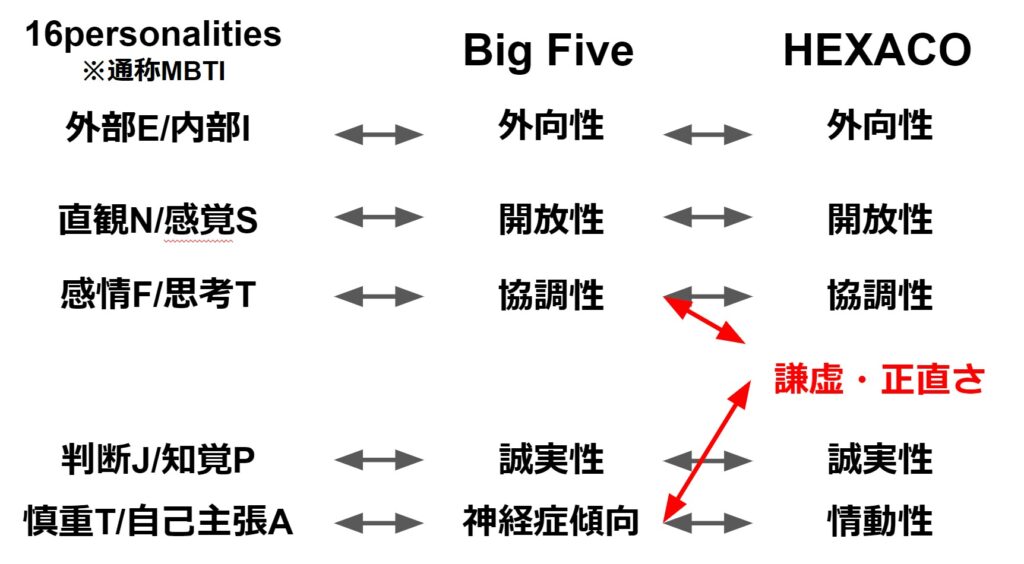
Also, in 16personalities, which was created with reference to MBTI and Big Five, the neuroticism of Big Five is called “Identity” and is classified as either Assertive or Turbulent.
On the far right is “HEXACO“, a relatively new personality assessment. It has been improved by adding one indicator “Honesty-Humility” to Big Five.
This article will provide detailed explanations of 16personalities personality types based on this correlation.
Since this is originally research from Big Five and HEXACO, if you want to know your personality more scientifically than MBTI or 16personalities, please try this HEXACO personality assessment.
What is ISFP-A (Adventurer – Assertive)?
ISFP-A is a type with low extraversion (I), low openness (S), high agreeableness (F), low conscientiousness (P), and low neuroticism (A) in Big Five terms. Characteristics:
- Strong sensitivity and aesthetic sense
- Present-oriented flexibility
- Deep empathy for others
- Confident self-expression
- Values harmony and individuality
They possess rich sensitivity and creativity, and value the present moment. They learn through practical experience and express themselves in a natural way.
In interpersonal relationships, they value compassion and sincerity, and respect the individuality of others. They are open to change and new experiences, and have high stress tolerance, maintaining their authenticity even in difficult situations. They have a strong sense of self-efficacy and act based on their own values.
A Scientific Explanation of ISFP-A (Adventurer – Assertive Type)
Easily Bonds with People Who Have Both S and F Traits
ISFP-A type individuals have both sensing (S) and feeling (F) characteristics. Therefore, they tend to value realistic and concrete information while also cherishing human relationships and emotional aspects. In the Big Five, this indicates low openness and high agreeableness.
ISFP-A individuals easily empathize with people who similarly have S and F traits, making it easier to build intimate relationships. They can enjoy realistic conversations while being considerate of each other’s emotions, allowing them to build balanced and friendly relationships.
Please see this article for more details.
When Using Social Media, They Communicate Through Likes and Encouraging Comments
ISFP-A type individuals have feeling (F) characteristics, so they prefer warm communication methods even on social media. In the Big Five, this indicates high agreeableness, which is also reflected in their social media usage.
ISFP-A individuals value connections with others by liking others’ posts and leaving encouraging comments. They prefer to avoid conflicts and create a positive atmosphere.
Even on social media, ISFP-A individuals tend to communicate by expressing their own emotions while being considerate of others’ emotions.
Please see this article for more details.
Properly Maintains Social Distance for Infection Prevention
ISFP-A type individuals have introverted (I) characteristics, so they tend to have less resistance to maintaining physical distance from others. In the Big Five, this indicates low extraversion, which also affects infection prevention measures.
ISFP-A individuals tend to value their own and others’ health, making it easier for them to understand the importance of social distancing. They can observe their surroundings and maintain appropriate distance.
Also, due to their introverted nature, they can naturally engage in avoiding crowds and refraining from unnecessarily close contact.
Please see this article for more details.
Common Among Writers/Editors, Artists/Creators, and Counselors/Therapists
ISFP-A type individuals have introverted (I), sensing (S), and feeling (F) characteristics. These traits are compatible with creative professions that value human relationships.
ISFP-A individuals are skilled at expressing their inner feelings and emotions, making them likely to excel as writers or artists who express these through words or artistic works. They can also understand and empathize with others’ emotions, making them suitable as counselors or therapists.
In these professions, ISFP-A individuals’ emotionally rich personality and realistic observational skills are utilized.
Please see this article for more details.
Less Prone to Perfectionism, Can Think and Act Flexibly
ISFP-A type individuals have perceiving (P) characteristics, so they tend to be highly flexible and able to respond according to situations. In the Big Five, this indicates low conscientiousness, which leads to an attitude different from perfectionism.
ISFP-A individuals can respond flexibly to situations without being overly bound by strict rules or plans. Rather than seeking perfection, they prefer to enjoy the process and find creative solutions.
This trait allows ISFP-A individuals to reduce stress and approach problems with more free thinking.
Please see this article for more details.
Limiting Sweet Drinks
People with the ISFP-A type have emotional (F) characteristics, but are also sensing (S), so they tend to have a high awareness of their body and health.
ISFP-A people are sensitive to their emotions and physical state, and tend to be conscious of a healthy lifestyle. They understand the effects that sweet drinks have on the body and may tend to limit them.
They have high self-management abilities and try to maintain mental and physical balance by making healthy choices. However, they may sometimes seek sweet things due to their emotional side.
Please see this article for more details.
Tend to Hold Right-Wing Authoritarian (RWA) Ideology
People with the ISFP-A type have sensing (S) characteristics, so they tend to value traditional values and existing order. In the Big Five, this indicates low openness, which tends to connect with conservative ideology.
ISFP-A people tend to seek stability and order, and may easily empathize with right-wing authoritarian thinking. However, because they also have an emotional (F) side, they also value compassion for others and individual freedom.
This trait may influence their views on society and politics, but individual differences are also significant.
Please see this article for more details.
Schwartz’s Values: Benevolence, Tradition
People with the ISFP-A type have introverted (I), sensing (S), and feeling (F) characteristics. These traits are related to the values of “benevolence” and “tradition” in Schwartz’s theory of values.
ISFP-A people are likely to hold the value of “benevolence,” which emphasizes compassion and kindness toward others. At the same time, due to their sensing aspect, they also tend to value the “tradition” value, which respects familiar things and traditional values.
These values influence the actions and decisions of ISFP-A people and will also be reflected in their relationships and interactions with society.
Please see this article for more details.
In Conclusion
People with the ISFP-A type have very unique and attractive characteristics. There may be people of this type among you as well.
ISFP-A people can understand the feelings of those around them well and interact with them kindly. They are also characterized by their ability to think flexibly and act while valuing realistic and concrete things.
Making warm comments on social media and being health-conscious can also be said to be characteristic of this type of person.
They are suited for creative work and work helping people, and they also value traditional values. However, they don’t seek perfection too much, so they are less likely to accumulate stress, which is also a good point.
The tendencies introduced are originally from Big Five and HEXACO research, so if you want to know your personality more scientifically than MBTI or 16personalities, please try this HEXACO personality test.

Writer & Supervisor: Eisuke Tokiwa
Personality Psychology Researcher / CEO, SUNBLAZE Inc.
As a child he experienced poverty, domestic abuse, bullying, truancy and dropping out of school — first-hand exposure to a range of social problems. He spent 10 years researching these issues and published Encyclopedia of Villains through Jiyukokuminsha. Since then he has independently researched the determinants of social problems and antisocial behavior (work, education, health, personality, genetics, region, etc.) and has published 2 peer-reviewed journal articles (Frontiers in Psychology, IEEE Access). His goal is to predict the occurrence of social problems. Spiky profile (WAIS-IV).
Expertise: Personality Psychology / Big Five / HEXACO / MBTI / Prediction of Social Problems
Researcher profiles: ORCID / Google Scholar / ResearchGate
Social & Books: X (@etokiwa999) / note / Amazon Author Page