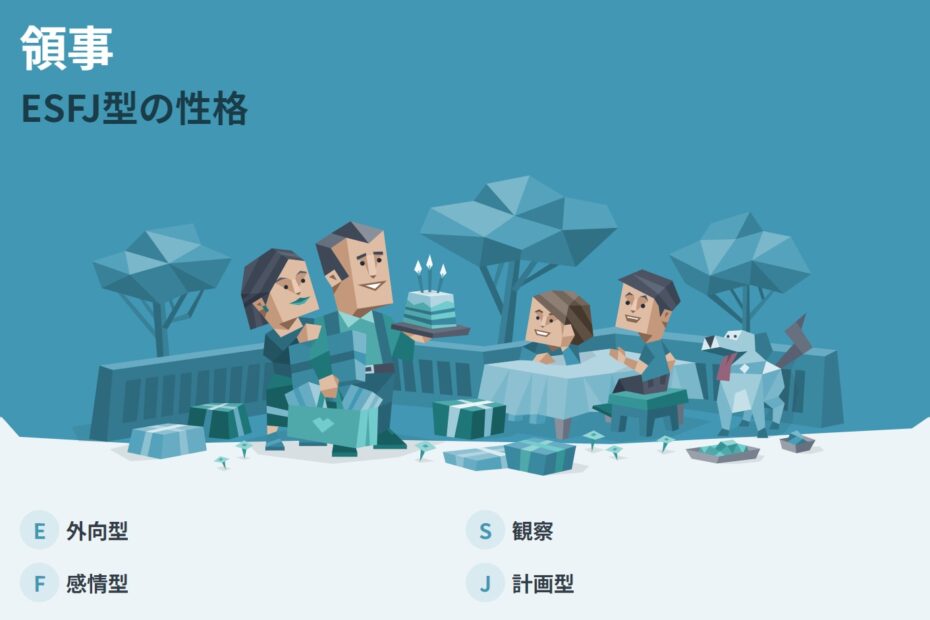
Have you ever heard the term ESFJ (The Consul)?
This is one of the 16personalities (16-type personality test) types, characterized by being devoted and caring.
ESFJ people find joy in helping those around them and tend to value harmony.
They prioritize maintaining good relationships above all else and are often sociable and approachable individuals.
So today, we will explain the characteristics and tendencies of ESFJs in detail.
We’ll analyze them from various angles including strengths and weaknesses, romance and friendships, parenting and career, so please use this as reference.
Whether you think you’re an ESFJ type or not, you’re sure to make new discoveries.
Once again, personality researcher and author of Villain Encyclopedia, Tokiwa (@etokiwa999), will provide the explanation.
※We have developed the HEXACO-JP Personality Assessment! It has more scientific basis than MBTI. Tap below for details.

※This article is written based on translations from the 16personalities official English page.
The video version of this article is available here!
目次
- 1 Strengths and Weaknesses of ESFJ (The Consul)
- 2 ESFJ (The Consul) A and T Types
- 3 ESFJ (The Consul) Romance Relationship Tendencies and Improvement Strategies
- 4 ESFJ (Consul) Friendship Tendencies and Solutions
- 5 ESFJ (Consul) Parenting Tendencies and Improvement Strategies
- 6 ESFJ (Consul) Career Tendencies and Improvement Strategies
- 7 ESFJ (Consul) Work Tendencies and Improvement Strategies
- 8 ESFJ (Consul) Compatible Types
- 9 ESFJ (Consul) Summary
- 10 Supplement
- 10.1 The Weak Point of 16personalities: “Weak Scientific Foundation”
- 10.2 The Good Point of 16personalities: “Large Number of Responses (Data) and Fame”
- 10.3 Difference Between 16personalities and Other Personality Tests: “MBTI”
- 10.4 Difference Between 16personalities and Other Personality Tests: “Big Five”
- 10.5 Differences between 16personalities and other personality assessments: “HEXACO”
Strengths and Weaknesses of ESFJ (The Consul)
Strengths of ESFJ (The Consul)
This type’s greatest strength is valuing harmony with people and supporting those around them.
ESFJs have the following strengths:
- High realistic and practical skills
- Strong sense of duty and emphasis on fulfilling responsibilities
- Seeks stability and security, very loyal personality
- Sensitive to people’s emotions, with compassion and warmth
- Good at connecting with people and sociable
In other words, ESFJs are skilled at relating to people and excel at supporting and bringing together those around them.
They find joy in creating stable environments and value being useful to people above all else.
They are loyal and have a strong sense of responsibility, so they can be said to have personalities that always follow through on what they say.
Weaknesses of ESFJ (The Consul)
This type’s weaknesses are being too concerned about social status and lacking flexibility.
ESFJs have the following weaknesses:
- Excessively concerned about social status and influence
- Dislike change and tend to stick to conventional methods
- Vulnerable to criticism and quickly become defensive
- Strong need for approval and excessive desire for praise
- Too self-sacrificing and tend to ignore their own needs
ESFJs sometimes lose creativity and flexibility due to their emphasis on social recognition.
Also, because they extremely dislike being criticized, they have difficulty accepting others’ opinions.
ESFJs can be said to tend to resist changing their values or habits.
ESFJ (The Consul) A and T Types
ESFJ-A (Assertive Type)
A caring supporter. Confidently responds to others’ needs and creates harmonious environments. Sociable and has the ability to bring people together.
Has a strong sense of responsibility and always keeps promises. Respects traditional values and emphasizes stability. Solves problems with practical approaches and supports others through concrete methods.
Can provide detailed care and is sensitive to people’s emotions. Has organizational skills and is good at planning and executing events. Values cooperation and teamwork.
Patient and skilled at building long-term relationships. Although they tend to seek approval from others, they act according to their own values.
For details, please see this article.
ESFJ-T (Turbulent Type)
A caring supporter but tends to have self-doubt. Has the ability to respond to others’ needs but constantly feels anxious about whether their efforts are sufficient.
Sociable but sometimes feels anxious about relationships. Has a strong sense of responsibility but may feel overwhelmed by pressure.
Respects traditional values but worries about whether they can adapt to change. Takes practical approaches but sometimes lacks confidence in their own judgment.
Can provide detailed care but worries about not being able to meet others’ expectations. Has organizational skills but sometimes feels anxious about taking leadership.
ESFJ (The Consul) Romance Relationship Tendencies and Improvement Strategies
Romantic Tendencies
For ESFJs, romance holds great meaning in life and is something special.
This type’s romantic relationships have the following characteristics:
- They prefer serious relationships with marriage in mind rather than temporary relationships
- They respect each other’s opinions and try to build deep understanding relationships
- They gain happiness by being loved and needed by their partner
- They are very sensitive to criticism from their partner and are easily deeply hurt
- There is a risk of losing sight of their own values and becoming dependent on their partner
ESFJs tend to desire stable relationships with their partners above all else.
Feeling loved by their partner greatly affects ESFJs’ self-esteem.
On the other hand, they have no tolerance for criticism and may be deeply hurt by trivial matters.
When Romance Becomes Problematic and Solutions
ESFJs face problems in romance when they lose sight of themselves.
Specifically, the following situations can be considered:
- They compromise their own values for approval from their partner
- They become too dependent on their partner and lose their independence
- ESFJs’ devoted expressions of love may feel burdensome to their partner
To improve these problems, the following things are important:
- Cherish your own values and dreams, and don’t lose sight of them
- Strive to build a healthy relationship with your partner
- Make an effort to listen to your partner’s opinions and accept them flexibly
In other words, for ESFJs to have happy romantic relationships, it’s important to maintain their individuality while being considerate of their partner.
While respecting their partner’s opinions, they should aim for a relationship where both parties’ individuality is cherished.
It’s important for ESFJs to express their devoted love in a way that takes into account their partner’s needs.
ESFJ (Consul) Friendship Tendencies and Solutions
Friendship Tendencies
ESFJs have sociable personalities and tend to value their friends.
This type’s friendships show the following characteristics:
- They build broad social networks and actively try to engage with people
- They find joy in helping and supporting their friends
- They spend a lot of time and energy maintaining friendships
- They prefer friends who share their values
- They greatly fear being betrayed and don’t trust people easily
ESFJs value keeping promises with friends above all else.
If there are friends in trouble, they will immediately offer a helping hand.
On the other hand, they also tend to distance themselves from people who don’t share their values.
When Friendships Become Problematic and Solutions
ESFJs may face problems by excessively defending their friends.
Specifically, the following situations can be considered:
- They unconditionally justify their friends’ actions
- They extremely fear being criticized by friends and avoid conflicts of opinion
- They struggle to accept others’ perspectives and tend toward biased views
To improve these problems, the following things are important:
- Look at friends’ actions objectively and don’t be afraid to voice opinions when necessary
- Strive to communicate your own opinions to build healthy relationships with friends
- Make an effort to listen to others’ perspectives and accept diverse opinions
In other words, for ESFJs to build fulfilling friendships, it’s important to care for friends while maintaining appropriate distance.
Sometimes, it’s necessary to question friends’ words and actions.
By developing the flexibility to accept diverse values and opinions, ESFJs should be able to build better friendships.
ESFJ (Consul) Parenting Tendencies and Improvement Strategies
Parenting Tendencies
ESFJs are devoted parents who tend to wish for their children’s happiness above all else.
This type’s parenting has the following characteristics:
- They strive to provide their children with security and satisfaction
- They provide detailed support and management of their children’s daily lives
- They are passionate about protecting their children, sometimes tending to be overprotective
- They tend to prioritize parental authority over their children’s opinions
- They have difficulty respecting their children’s independence
ESFJs spare no effort in supporting their children in every aspect to make their daily lives comfortable.
On the other hand, because it’s difficult for them to respect their children’s autonomy, there’s also the danger of becoming overinvolved.
When Problems Arise in Parenting and Improvement Strategies
ESFJs encounter problems in parenting when they cannot accept their children’s independence.
Specifically, the following situations can be considered:
- Not respecting children’s autonomy and imposing parental opinions
- Being unable to accept children’s growth and trying to maintain excessive dependency relationships
- Fearing children’s challenges and depriving them of opportunities to experience failure
To improve these problems, the following things are important:
- Make an effort to listen to children’s opinions and respect their autonomy
- Rejoice in children’s growth and understand the importance of fostering independence
- View failure as an opportunity for growth and support children’s challenges
In other words, for ESFJs to be good parents, it’s important to encourage their children’s independence.
It’s necessary to respect children’s opinions and sometimes allow them to experience failure.
If they can rejoice in their children’s growth and watch over them, ESFJs should be able to become wonderful parents.
ESFJ (Consul) Career Tendencies and Improvement Strategies
Career Tendencies
ESFJs are suited for professions where they can utilize their high interpersonal skills and practical abilities.
This type’s career has the following characteristics:
- They excel at maintaining harmony and order within organizations
- They steadily handle routine work and show stable work performance
- They find fulfillment in helping people and have a strong spirit of service
- They feel unsatisfied with simple tasks alone and seek human interaction
- Being appreciated and recognized by others increases their motivation
ESFJs find joy in cooperating with people to accomplish things.
They are suited for jobs such as management positions or interpersonal support roles where they bring people together or provide support.
Having their work performance recognized becomes the driving force for ESFJs.
When Problems Arise in Career and Improvement Strategies
ESFJs encounter career problems when they lose sight of their own value.
Specifically, the following situations can be considered:
- Compromising their own opinions in order to gain approval from others
- Neglecting their own skill development while focusing too much on serving others
- Fearing new challenges and settling for the status quo in pursuit of stability
To improve these problems, the following things are important:
- Value your own values and goals, and don’t fear conflicts with others
- Having opportunities to acquire new skills for personal growth
- Having the courage to sometimes abandon stability and take on new challenges
In other words, for ESFJs to build a fulfilling career, it’s important to maintain an attitude of continuous growth while cherishing their true selves.
They need to move forward toward their goals without being swayed by evaluations from others.
If ESFJs can fully utilize their interpersonal skills and practical abilities, they should surely be able to build wonderful careers.
ESFJ (Consul) Work Tendencies and Improvement Strategies
Work Tendencies
ESFJs value interpersonal relationships and excel at maintaining organizational harmony.
Their work style exhibits the following characteristics:
- Respecting social order and hierarchical relationships, placing importance on following rules
- Preferring to collaborate with people and valuing teamwork
- Finding joy in supporting others and working devotedly
- Fearing criticism and being prone to stress
- Tending to be concerned with status and position, having strong approval needs
ESFJs focus on maintaining harmony as members of an organization.
They value following their supervisor’s instructions and working cooperatively with colleagues above all else.
On the other hand, they tend to accumulate stress due to being overly concerned about their own evaluation.
When Problems Arise at Work and Improvement Strategies
ESFJs encounter problems at work when they become too fixated on their roles.
Specifically, the following situations can be considered:
- Blindly following supervisor’s instructions to the point of being unable to express their own opinions
- Prioritizing relationships with colleagues to the extent that work efficiency decreases
- Being so fixated on their role that they become unable to respond flexibly
To improve these problems, the following things are important:
- Expressing their own opinions when necessary, even regarding supervisor’s instructions
- Valuing human relationships while not losing sight of work priorities
- Responding flexibly according to situations and challenging new roles
In other words, for ESFJs to demonstrate their abilities, a flexible attitude that sometimes breaks free from conventional frameworks while maintaining harmony is important.
They will be required to skillfully communicate their opinions and respond adaptably according to situations.
If ESFJs can develop flexibility while leveraging their interpersonal skills, they should surely be able to show wonderful work performance.
ESFJ (Consul) Compatible Types
Compatible Types with S (Sensing)
ESFJs are compatible with people who have strong sensing tendencies (S). Specifically, the following types can be mentioned:
- Realistic and practical ISFJ (Protector)
- Sociable and cheerful ESFP (Entertainer)
- Tolerant and highly cooperative ISFP (Adventurer)
ESFJs tend to prefer realistic and practical approaches. Therefore, they can be said to be compatible with sensing types (S) who are similarly concrete and realistic. They can easily share each other’s values and are considered likely to build stable relationships.
Compatible Types with F (Feeling)
ESFJs are compatible with people who have strong feeling tendencies (F). Specifically, the following types can be mentioned:
- Thoughtful and devoted INFP (Mediator)
- Passionate and inspiring ENFJ (Protagonist)
- Kind and cooperative ISFJ (Protector)
ESFJ tends to place importance on emotions and human relationships. Therefore, it can be said that they are compatible with feeling types (F) who similarly value emotions. They can easily understand each other’s feelings and are thought to build deep bonds easily.
People with feeling type (F) highly value ESFJ’s thoughtfulness and consideration. At the same time, ESFJs also tend to open their hearts easily to the warmth and empathy of feeling types. They will find joy in cooperating together to support people around them.
ESFJ (Consul) Summary
ESFJ is a personality type that values social harmony and finds joy in serving others.
They excel in interpersonal skills and tend to easily gain trust from those around them through their dedicated attitude.
On the other hand, they may also be too self-sacrificing or vulnerable to criticism.
For ESFJs to live a happy life, it will be important to cherish their own authenticity while building healthy relationships with others.
Sometimes, they also need the courage to assert their own opinions or challenge new things.
If ESFJs can utilize their strengths while overcoming their weaknesses, they should surely be able to live a fulfilling life.
Supplement
The Weak Point of 16personalities: “Weak Scientific Foundation”
16personalities (16-type personality test) can be said to have challenges in terms of scientific evidence.
First, there are few peer-reviewed papers, and academic support is insufficient.
Also, questions remain about statistical processing methods.
The point of classifying traits into types rather than continuous numerical values is also problematic from the perspective of scientific validity.
Furthermore, regarding the relationship between personality and academic performance, income, brain function, genetic factors, etc., sufficient evidence has not been presented at present.
The Good Point of 16personalities: “Large Number of Responses (Data) and Fame”
On the other hand, 16personalities (16-type personality test) also has major advantages.
The first is that it accumulates vast response data. Since many people participate in 16personalities diagnostics, the reliability of the data might possibly be high.
Also, it has penetrated quite widely among the general public, with Korean idols answering and spreading it, and it being featured in dating matching apps.
This point can be said to be an advantage that the 16personalities personality test has over other personality tests.
Difference Between 16personalities and Other Personality Tests: “MBTI”
16personalities (16-type personality test) is created based on MBTI (Myers-Briggs Type Indicator) and Big Five.
Strictly speaking, 16personalities and MBTI are different things.
MBTI is a personality assessment tool developed based on Jung’s psychological typology theory.
16personalities adopts MBTI’s four indicators (E Extraversion-I Introversion, S Sensing-N Intuition, T Thinking-F Feeling, J Judging-P Perceiving) while adding the Identity (A and T) indicator and establishing unique question items and evaluation criteria.
However, it has the same weakness of poor scientific foundation as 16personalities, such as the lack of basis for the dichotomous approach.
Difference Between 16personalities and Other Personality Tests: “Big Five”
Big Five is one of the most influential trait theories in personality psychology.
Big Five measures five traits: openness, conscientiousness, extraversion, agreeableness, and neuroticism.
Also, a major difference is that while Big Five evaluates traits with continuous numerical values (e.g., extraversion 3.5), 16personalities and MBTI use type classification (e.g., either extraverted or introverted).
Furthermore, it has been studied for a long time, has many papers, and much research has been conducted in other fields such as academic performance, income, brain, and genetics. It can be said that Big Five has relatively stronger scientific foundation.
For reference, there is also a paper showing the correlation between Big Five’s four elements and MBTI.
Differences between 16personalities and other personality assessments: “HEXACO”
HEXACO (HEXACO Personality Inventory) is a 6-dimensional personality model that extends the Big Five.
HEXACO measures six traits: Honesty-Humility, Emotionality, Extraversion, Agreeableness, Conscientiousness, and Openness.
By adding the dimension of Honesty-Humility to the Big Five, it attempts to capture a broader range of personality traits, such as personality darkness (and brightness).
Like the Big Five, this model can be said to have relatively strong scientific backing, with a larger number of research papers compared to 16personalities and MBTI.