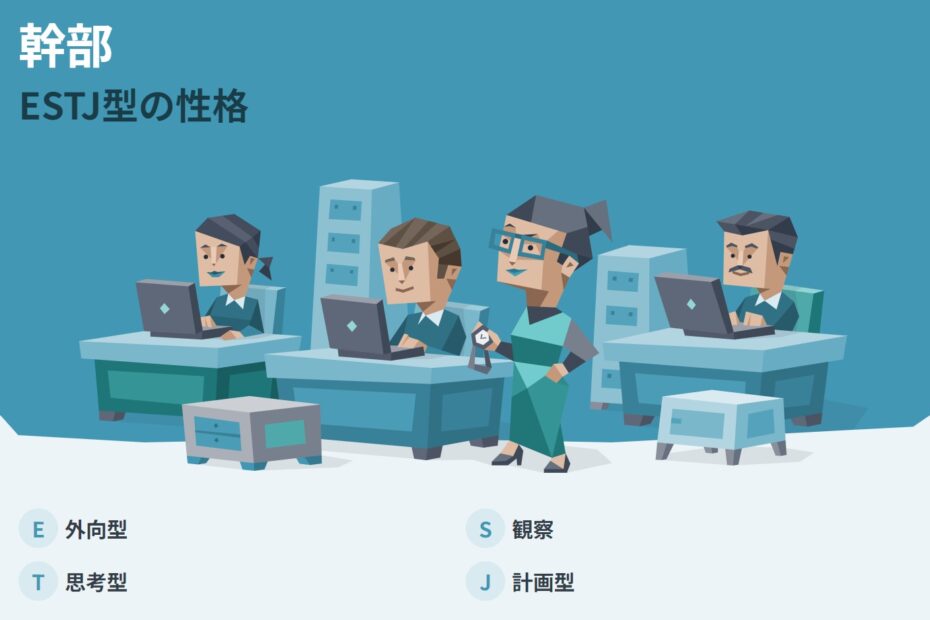
ESTJ (The Executive) is one of the 16personalities (16-type personality test) types, characterized by strong responsibility, realistic and practical personality traits.
In school terms, this type is suited for roles that demonstrate leadership, such as student council president or committee chair.
They tend to steadily advance things and value rules and procedures.
They are also skilled at thinking logically and achieving results efficiently.
On the other hand, challenges include lacking flexibility and not respecting others’ opinions.
Being poor at emotional consideration could also be said to be one of ESTJ’s characteristics.
However, if they can understand such weaknesses and respond appropriately, ESTJs should be able to become someone others rely on.
This article will provide detailed explanations of ESTJ personality characteristics and tendencies and improvement strategies in various situations such as romance, friendships, and work.
High school students who want to better understand their own or others’ personalities and get along well with ESTJs should definitely use this as a reference.
Once again, personality researcher and author of Villain Encyclopedia, Tokiwa (@etokiwa999), will provide the explanation.
※We have developed the HEXACO-JP Personality Assessment! It has more scientific basis than MBTI. Tap below for details.

※This article is written based on translations from the 16personalities official English site.
The video version of this article is available here!
目次
- 1 ESTJ (The Executive) Strengths and Weaknesses
- 2 ESTJ (The Executive) A and T Types
- 3 ESTJ (Executive) Romantic Relationship Tendencies and Improvement Strategies
- 4 ESTJ (Executive) Friendship Tendencies and Improvement Strategies
- 5 ESTJ (Executive) Parenting Tendencies and Improvement Strategies
- 6 ESTJ (Executive) Career Tendencies and Improvement Strategies
- 7 ESTJ (Executive) Work Tendencies and Improvement Strategies
- 8 ESTJ (Executive) Compatible Types
- 9 ESTJ (Executive) Summary
- 10 Supplement
- 10.1 Bad Points of 16personalities: “Weak Scientific Basis”
- 10.2 Good Points of 16personalities: “Large Amount of Response Data and Fame”
- 10.3 Differences Between 16personalities and Other Personality Tests: “MBTI”
- 10.4 Differences between 16personalities and other personality tests: “Big Five”
- 10.5 Differences between 16personalities and other personality tests: “HEXACO”
ESTJ (The Executive) Strengths and Weaknesses
ESTJ (The Executive) Strengths
This type’s greatest strength is their strong sense of responsibility and dedication to seeing things through to the end.
They are also realistic with strong execution abilities and excel at organizing things.
Specific strengths are as follows:
- Dedicated and sees things through to completion
- Realistic with strong execution abilities
- Excellent at organizing things
- Efficient and doesn’t waste time
- Follows rules and values tradition
- Demonstrates leadership and is skilled at bringing things together
Additionally, ESTJs are efficient and don’t waste time.
They also tend to follow rules and value tradition.
Demonstrating leadership and being skilled at bringing things together are also characteristics.
By leveraging these strengths, ESTJs can play important roles in work and community.
Responsibility, execution ability, and organizational skills can be called ESTJ’s three major strengths.
ESTJ (The Executive) Weaknesses
ESTJ (The Executive)’s greatest weakness is being inflexible and stubborn.
They also tend to dislike change and can be too harsh in their judgments.
Specific weaknesses are as follows:
- Inflexible and stubborn
- Dislikes change and struggles to accept new ideas
- Judgments can be too harsh, sometimes hurting others
- Too concerned with social status
- Poor at relaxing
- Poor at emotional expression and tends to appear cold
Furthermore, ESTJs tend to be too concerned with social status.
Being poor at relaxing is also a characteristic.
Being poor at emotional expression and tending to appear cold can also be considered weaknesses.
To overcome these weaknesses, it’s important to develop flexibility and maintain an attitude of listening to others’ opinions.
Inflexibility, stubbornness, and harsh judgment can be called ESTJ’s three major weaknesses.
ESTJ (The Executive) A and T Types
ESTJ-A (Assertive)
Efficient administrator. Demonstrates leadership with confidence and operates organizations efficiently. Solves problems with logical and practical approaches.
Has strong responsibility and always keeps promises. Values traditional values and puts effort into maintaining order. Has decision-making ability and takes swift action.
Excels at organization and is skilled at managing complex projects. Prefers direct communication and gives clear instructions. Works persistently toward goal achievement.
Values discipline and sets high standards. Is realistic and emphasizes concrete results.
For details, please see this article.
ESTJ-T (Turbulent)
Has the qualities of an efficient administrator but also has self-critical aspects. Has the ability to demonstrate leadership but may also feel anxious about their own judgment.
Takes a logical and practical approach, but may hesitate to make decisions in pursuit of perfection. Has a strong sense of responsibility, but sometimes feels overwhelmed by pressure.
Values traditional values, but worries about being able to adapt to change. Has decision-making ability, but constantly questions whether those decisions are correct.
Excels in organizational skills, but worries about not being able to meet others’ expectations.
ESTJ (Executive) Romantic Relationship Tendencies and Improvement Strategies
Romantic Tendencies
The greatest characteristic of ESTJ (Executive) romance is their sincere and devoted nature.
They also cherish their partners and make efforts to maintain long-lasting relationships.
Specific romantic tendencies are as follows:
- Sincere and devoted
- Cherishes their partner
- Makes efforts to maintain long-lasting relationships
- Sociable and enjoys dating
- Struggles with emotional expression
- Tends to be nagging and preachy
Additionally, ESTJs tend to be sociable and enjoy dating.
On the other hand, struggling with emotional expression is also a characteristic.
Being nagging and preachy can also be considered a problem.
Understanding these tendencies and responding appropriately is important.
The characteristics of ESTJ romance can be said to be sincerity, devotion, and efforts toward long-lasting relationships.
When Problems Arise in Romance and Improvement Strategies
The most problematic aspect of ESTJ (Executive) romance is their lack of understanding on the emotional level.
Additionally, being inflexible and stubborn also tends to cause problems.
Specific problems and improvement strategies are as follows:
- Lack of understanding on the emotional level → Listen to partner’s feelings
- Inflexible and stubborn → Develop flexibility
- Tends to be nagging and preachy → Trust partner and delegate to them
- Struggles with emotional expression → Make efforts to verbalize and communicate emotions
In other words, it’s important for ESTJs to listen to their partner’s feelings and develop flexibility.
Rather than being nagging and preachy, it’s also important to trust their partner and delegate to them.
The struggle with emotional expression can be improved by making efforts to verbalize and communicate emotions.
By practicing these improvement strategies, ESTJs should be able to make their relationships with partners better.
To avoid causing problems in romance, emotional understanding, flexibility, and trust are key.
ESTJ (Executive) Friendship Tendencies and Improvement Strategies
Friendship Tendencies
The greatest characteristic of ESTJ (Executive) friendships is their sincere and devoted nature.
They also tend to be sociable and cherish their friends.
Specific friendship tendencies are as follows:
- Sincere and devoted
- Cherishes friends
- Sociable and enjoys friendships
- Builds stable friendships
- Prefers friends who share traditional values
- Tends to clash with friends who disagree with their opinions
Furthermore, ESTJs tend to build stable friendships.
Preferring friends who share traditional values is also a characteristic.
On the other hand, tending to clash with friends who disagree with their opinions can also be considered a problem.
Understanding these tendencies and responding appropriately is important.
The characteristics of ESTJ friendships can be said to be sincerity, devotion, and stable relationships.
When Problems Arise in Friendships and Improvement Strategies
The most problematic aspect of ESTJ (Executive) friendships is dealing with disagreements.
Additionally, lacking flexibility and being stubborn also tends to cause problems.
Specific problems and improvement strategies are as follows:
- Dealing with disagreements → Respect others’ opinions and strive for constructive discussion
- Lacking flexibility and being stubborn → Recognize others’ values and develop a flexible attitude
- Imposing one’s values → Recognize and respect the diversity of friends
- Disliking new experiences → Challenge new things and broaden perspectives
In other words, it’s important for ESTJs to respect others’ opinions and develop a flexible attitude.
Rather than imposing their own values, it’s also important to recognize and respect the diversity of friends.
The tendency to dislike new experiences can be improved by challenging new things and broadening perspectives.
By practicing these improvement strategies, ESTJs should be able to make their relationships with friends better.
To avoid causing problems in friendships, flexibility, respect for diversity, and challenging new experiences are key.
ESTJ (Executive) Parenting Tendencies and Improvement Strategies
Parenting Tendencies
The greatest characteristic of ESTJ (Executive) parenting is having a strong sense of responsibility and valuing discipline.
They also prioritize promoting children’s growth and fostering independence.
Specific parenting tendencies are as follows:
- Strong sense of responsibility and valuing discipline
- Prioritizing promoting children’s growth and fostering independence
- Teaching traditional values
- Tendency to give one-sided instructions without listening to children’s opinions
- Poor at providing emotional support
- Tendency to restrict children’s free thinking
Additionally, ESTJs tend to teach traditional values.
On the other hand, their tendency to give one-sided instructions without listening to children’s opinions is also a problem.
Being poor at providing emotional support can also be said to be a characteristic.
Their tendency to restrict children’s free thinking is also one of the challenges.
It’s important to understand these tendencies and respond appropriately.
The characteristics of ESTJ parenting can be said to be strong responsibility, emphasis on discipline, and fostering independence.
When Parenting Becomes Problematic and Improvement Strategies
The most problematic aspect of ESTJ (Executive) parenting is not respecting children’s opinions.
Being poor at providing emotional support can also be said to be a challenge.
Specific problems and improvement strategies are as follows:
- Not respecting children’s opinions → Listen to children and incorporate their opinions
- Poor at emotional support → Accept children’s feelings and empathize with them
- Tendency to give one-sided instructions → Respect children’s autonomy and provide choices
- Tendency to restrict free thinking → Recognize and nurture children’s creativity
In other words, it’s important for ESTJs to listen to children and incorporate their opinions.
It’s also important to accept children’s feelings and empathize with them.
Rather than giving one-sided instructions, respecting children’s autonomy and providing choices is required.
Rather than restricting free thinking, it’s also important to recognize and nurture children’s creativity.
By practicing these improvement strategies, ESTJs should be able to make their relationship with children better.
To avoid causing problems in parenting, respecting children’s opinions, providing emotional support, and fostering autonomy and creativity are key.
ESTJ (Executive) Career Tendencies and Improvement Strategies
Career Tendencies
The greatest characteristic of ESTJ (Executive) careers is having a strong sense of responsibility and sparing no effort toward achieving goals.
They are also skilled at maintaining order within organizations and demonstrating leadership.
Specific career tendencies are as follows:
- Strong sense of responsibility and sparing no effort toward achieving goals
- Skilled at maintaining order within organizations and demonstrating leadership
- Value traditional values and aspire to stable careers
- Dislike change and are poor at accepting new ideas
- Tendency to push through their own ideas without listening to others’ opinions
- Lack emotional consideration
Furthermore, ESTJs tend to value traditional values and aspire to stable careers.
On the other hand, disliking change and being poor at accepting new ideas is also a characteristic.
Their tendency to push through their own ideas without listening to others’ opinions can also be said to be a problem.
Lacking emotional consideration is also one of the challenges.
It’s important to understand these tendencies and respond appropriately.
The characteristics of ESTJ careers can be said to be strong responsibility, effort toward goal achievement, and demonstrating leadership.
Career Problems and Improvement Strategies
The biggest problem in ESTJ (Executive) careers is the lack of adaptability to change.
Additionally, not respecting others’ opinions and pushing through one’s own ideas can also be considered a challenge.
The specific problems and improvement strategies are as follows.
- Lack of adaptability to change → Develop flexibility and incorporate new ideas
- Not respecting others’ opinions → Listen to diverse opinions and enhance cooperation
- Pushing through one’s own ideas → Emphasize teamwork and build consensus
- Lacking emotional consideration → Understand subordinates’ feelings and provide appropriate support
In other words, it’s important for ESTJs to develop flexibility and incorporate new ideas.
Listening to diverse opinions and enhancing cooperation is also crucial.
Rather than pushing through their own ideas, they are required to emphasize teamwork and build consensus.
The lack of emotional consideration can be improved by understanding subordinates’ feelings and providing appropriate support.
By implementing these improvement strategies, ESTJs should be able to make their careers better.
To avoid causing problems in their careers, adaptability to change, cooperation, emphasis on teamwork, and emotional consideration are key.
ESTJ (Executive) Work Tendencies and Improvement Strategies
Work Tendencies
The greatest characteristic of ESTJ (Executive) work is having a strong sense of responsibility and efficiently advancing things.
They also emphasize rules and procedures and are skilled at steadily achieving results. The specific work tendencies are as follows.
- Have a strong sense of responsibility and efficiently advance things
- Emphasize rules and procedures and are skilled at steadily achieving results
- Maintain order within organizations and aim for stable operations
- Dislike change and tend to stick to existing methods
- Tend not to listen to others’ opinions and push through their own ideas
- Lack emotional consideration
Furthermore, ESTJs tend to maintain order within organizations and aim for stable operations. On the other hand, they also characteristically dislike change and tend to stick to existing methods.
Tending not to listen to others’ opinions and pushing through their own ideas can also be considered a problem. Lacking emotional consideration is also one of the challenges. It’s important to understand these tendencies and respond appropriately.
The characteristics of ESTJ work can be said to be strong sense of responsibility, pursuit of efficiency, and emphasis on rules and procedures.
Work Problems and Improvement Strategies
The biggest problem in ESTJ (Executive) work is lacking flexibility.
Additionally, not respecting others’ opinions and pushing through their own ideas can also be considered a challenge. The specific problems and improvement strategies are as follows.
- Lacking flexibility → Respond flexibly according to situations and incorporate new ideas
- Not respecting others’ opinions → Listen to diverse opinions and enhance cooperation
- Pushing through one’s own ideas → Emphasize teamwork and build consensus
- Lacking emotional consideration → Understand colleagues’ feelings and provide appropriate support
In other words, it’s important for ESTJs to respond flexibly according to situations and incorporate new ideas. Listening to diverse opinions and enhancing cooperation is also crucial.
Rather than pushing through their own ideas, they are required to emphasize teamwork and build consensus.
The lack of emotional consideration can be improved by understanding colleagues’ feelings and providing appropriate support.
By implementing these improvement strategies, ESTJs should be able to make their work better.
To avoid causing problems at work, flexibility, cooperation, emphasis on teamwork, and emotional consideration are key.
ESTJ (Executive) Compatible Types
Compatible Types, People with S Included
ESTJ (Executive) is compatible with realistic and practical types that include S. Specifically, the following types can be mentioned.
- ISTJ (Logistician)
- ESFJ (Consul)
- ISFJ (Defender)
- ESTP (Entrepreneur)
- ISTP (Virtuoso)
These types have realistic and practical tendencies like ESTJs. They excel at steadily advancing things and emphasize stability, making them compatible with ESTJs.
They also share the trait of valuing rules and procedures. They should be able to cooperate with ESTJs to advance things efficiently.
Types that contain S can be said to easily share the same values as ESTJs.
Compatible Types: People with T
ESTJ (Executive) is compatible with logical and analytical types that contain T.
Specific types include the following:
- ENTJ (Commander)
- INTJ (Architect)
- ISTP (Virtuoso)
- INTP (Logician)
These types value logical thinking like ESTJs.
They are compatible with ESTJs in objectively analyzing things and efficiently solving problems.
They also share the tendency to prioritize facts over emotions.
They should be able to cooperate with ESTJs to achieve goals logically and effectively.
However, care is needed as there may be insufficient consideration for emotional aspects.
Types that contain T can be said to easily share the same thinking tendencies as ESTJs.
By utilizing this compatibility and complementing each other’s strengths, better relationships can be built.
ESTJ (Executive) Summary
ESTJ (Executive) is a type with strong sense of responsibility, realistic and practical.
They tend to steadily advance things and emphasize stability. They also value rules and procedures and excel at efficiently achieving results.
On the other hand, their challenges include lack of flexibility and not respecting others’ opinions. Lack of consideration for emotional aspects is also one of their problem points.
Understanding these characteristics and responding appropriately is important. Compatible types are realistic and practical types that contain S, and planned and decisive types that contain J.
ESTJs should be able to live better lives by utilizing their strengths while compensating for their weaknesses.
They are expected to fulfill responsible roles in society and become trusted figures among those around them.
Supplement
Bad Points of 16personalities: “Weak Scientific Basis”
16personalities (16 Type Personality Test) can be said to have challenges in terms of scientific evidence.
First, there are few peer-reviewed papers, lacking academic backing.
Also, questions remain about statistical processing methods.
The point of classifying traits into types rather than continuous numerical values is also criticized from the perspective of scientific validity.
Furthermore, the current situation is that sufficient evidence has not been presented regarding relationships between personality and academic ability, income, brain function, genetic factors, etc.
Good Points of 16personalities: “Large Amount of Response Data and Fame”
On the other hand, 16personalities (16 Type Personality Test) also has major advantages.
First is the point of accumulating vast response data. Because many people participate in 16personalities diagnosis, the reliability of the data might possibly be high.
Also, it has penetrated considerably among the general public, such as Korean idols answering and spreading it, and being noticed in romantic matching apps.
This point can be said to be an advantage of 16personalities personality diagnosis compared to other personality tests.
Differences Between 16personalities and Other Personality Tests: “MBTI”
16personalities (16 Type Personality Test) is created based on MBTI (Myers-Briggs Type Indicator) and Big Five.
Strictly speaking, 16personalities and MBTI are different things.
MBTI is a personality diagnosis tool developed based on Jung’s psychological typology.
16personalities adopts MBTI’s four indicators (E Extraversion-I Introversion, S Sensing-N Intuition, T Thinking-F Feeling, J Judging-P Perceiving) while adding the Identity (A and T) indicator and establishing its own question items and evaluation criteria.
However, it faces the same weakness in scientific backing as 16personalities, including the lack of solid foundation for the dichotomous approach.
Differences between 16personalities and other personality tests: “Big Five”
The Big Five is one of the most influential trait theories in personality psychology.
The Big Five measures five traits: openness, conscientiousness, extraversion, agreeableness, and neuroticism.
Another major difference is that while the Big Five evaluates traits on a continuous numerical scale (e.g., extraversion 3.5), 16personalities and MBTI use type classification (e.g., either extraverted or introverted).
Furthermore, it has been studied for a long time, has many research papers, and extensive research has been conducted in other fields such as academic achievement, income, brain, and genetics. The Big Five can be said to have relatively stronger scientific backing.
For reference, there is also a paper showing the correlation between the four elements of the Big Five and MBTI.
Differences between 16personalities and other personality tests: “HEXACO”
HEXACO (HEXACO Personality Inventory) is a six-dimensional personality model that extends the Big Five.
HEXACO measures six traits: honesty-humility, emotionality, extraversion, agreeableness, conscientiousness, and openness.
By adding the honesty-humility dimension to the Big Five, it aims to capture a broader range of personality traits, including personality darkness (and brightness).
Like the Big Five, this model also has relatively stronger scientific backing compared to 16personalities and MBTI, with a larger number of research papers.