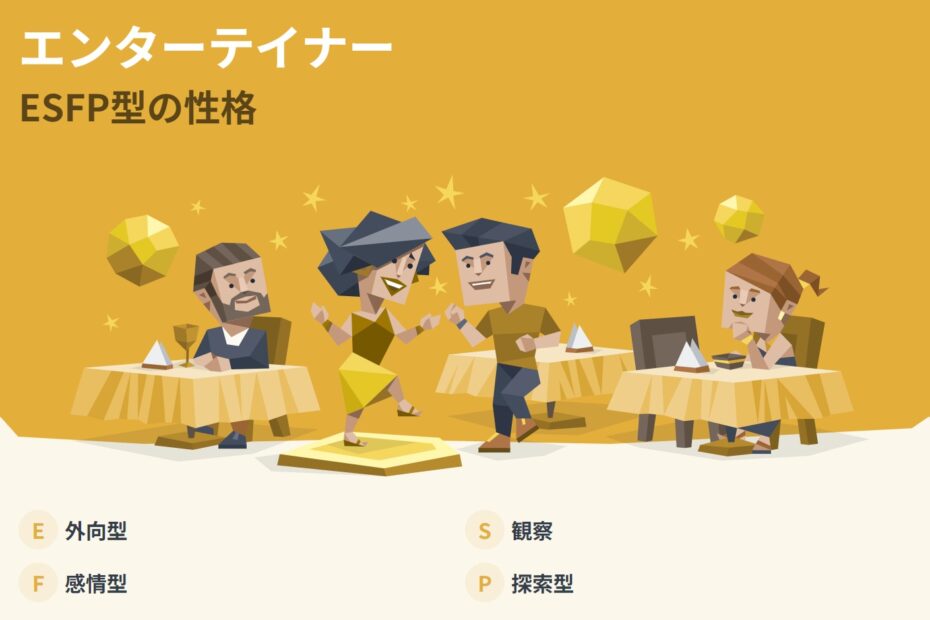
ESFP (The Entertainer) is one of the 16personalities (16-type personality test) types with a bright and sociable personality.
They love interacting with people and are always the center of attention at parties and gatherings.
ESFPs are a type that values “enjoying this very moment” above all else and prefer to live freely and spontaneously.
They are also emotionally rich and have excellent abilities to sensitively perceive people’s feelings.
ESFPs often excel in professions with many opportunities to interact with people, such as the entertainment industry or hospitality sector.
This time, we will explain in detail the characteristics, strengths, weaknesses, romantic tendencies, and job suitability of ESFPs.
Whether you think you are an ESFP type or not, please use this as a reference.
Once again, personality researcher and author of Villain Encyclopedia, Tokiwa (@etokiwa999), will provide the explanation.
※We have developed the HEXACO-JP Personality Assessment! It has more scientific basis than MBTI. Tap below for details.

※This article is written based on a translation of the English page of the official 16personalities site.
The video version of this article is available here!
目次
- 1 Strengths and Weaknesses of ESFP (The Entertainer)
- 2 ESFP (The Entertainer) A and T Types
- 3 ESFP (Entertainer) Romantic Relationship Tendencies and Improvement Strategies
- 4 ESFP (Entertainer) Friendship Tendencies and Improvement Strategies
- 5 ESFP (Entertainer) Parenting Tendencies and Improvement Strategies
- 6 ESFP (Entertainer) Career Tendencies and Improvement Strategies
- 7 ESFP (Entertainer) Work Tendencies and Improvement Strategies
- 8 Compatible Types with ESFP (Entertainer)
- 9 ESFP (Entertainer) Summary
- 10 Supplement
- 10.1 The downside of 16personalities: “Weak scientific foundation”
- 10.2 The good points of 16personalities: “Large number of responses (data) and famous”
- 10.3 Differences between 16personalities and other personality tests: “MBTI”
- 10.4 Differences between 16personalities and other personality tests: “Big Five”
- 10.5 Differences between 16personalities and other personality tests: “HEXACO”
Strengths and Weaknesses of ESFP (The Entertainer)
Strengths of ESFP (The Entertainer)
The greatest strength of this type is their bright and optimistic personality.
They are sociable and enjoy interacting with people.
They also value the present moment and tend to actively seek new experiences.
ESFP (The Entertainer) has the following strengths:
- Enjoys interacting with people and is sociable
- Bright and positive personality
- Values the present moment
- Enjoys taking on new challenges
- Good at reading people’s emotions
Additionally, ESFP (The Entertainer) is highly sensitive and acutely perceives others’ emotions.
Therefore, they can empathize with people’s feelings and become good listeners.
They are also creatively rich and excel at generating ideas one after another.
By leveraging these strengths, ESFP (The Entertainer) can become someone loved by many people.
Let’s live authentically while cherishing your bright and positive personality and caring heart toward others.
Weaknesses of ESFP (The Entertainer)
The greatest weakness of ESFP (The Entertainer) is their lack of planning ability.
Because they value the present moment so much, they tend to struggle with thinking about the future.
They are also easily influenced by their emotions and may take impulsive actions.
ESFP (The Entertainer) has the following weaknesses:
- Lacks planning ability
- Tends to take impulsive actions
- Easily influenced by their own emotions
- Sensitive to criticism and easily hurt
- Struggles with monotonous tasks
Furthermore, ESFP (The Entertainer) is sensitive to criticism and easily hurt.
They may overreact to negative opinions from others and become depressed.
Additionally, they tend to dislike monotonous tasks, which can make achieving long-term goals difficult.
To overcome these weaknesses, they need to develop planning skills and cultivate the ability to control their emotions.
It’s also important to have the strength to withstand criticism and continue steady efforts.
Make sure to understand your weaknesses and not neglect efforts to improve them.
ESFP (The Entertainer) A and T Types
ESFP-A (Assertive Type)
A cheerful entertainer. Confidently draws people’s attention and entertains those around them. Sociable and can easily get along with people.
Values the present moment and tries to enjoy life to the fullest. Flexible and quickly adapts to change. Practical and solves problems in concrete ways.
Tolerant toward others and respects individuality. Energetic and prefers an active lifestyle. Creatively rich and generates original ideas.
Highly sensitive and acutely perceives people’s emotions. Optimistic and finds positive aspects even in difficult situations. Cooperative and values teamwork.
For details, please see this article.
ESFP-T (Turbulent Type)
Has the qualities of a cheerful entertainer but tends to have self-doubt. Has the ability to draw people’s attention but may also be overly concerned about others’ evaluations.
Sociable but sometimes feels anxious about relationships. Tries to enjoy the present moment but may be troubled by anxiety about the future.
While flexible, they may struggle with making important decisions. They are practical, but may find it difficult to set long-term goals.
They are tolerant of others, but may sometimes struggle with self-assertion. They are energetic, but can sometimes become too emotional. They are creative, but may sometimes lack confidence in their own ideas.
ESFP (Entertainer) Romantic Relationship Tendencies and Improvement Strategies
Romantic Tendencies
ESFP (Entertainers) tend to prefer passionate and exciting romance.
They value excitement and elation in romantic relationships.
They also enjoy accumulating new experiences together with their partners.
The characteristics of ESFP (Entertainer) romance include the following:
- Seek passionate and exciting romance
- Like to try new things together with their partner
- Value physical attraction
- Sensitively perceive their partner’s emotions
- Good at expressing their own emotions
On the other hand, ESFP (Entertainers) also have difficulty building long-term relationships.
In their pursuit of exciting romance, they may easily become bored with relationships with one partner.
Also, being too honest with their emotions may sometimes hurt their partner.
For ESFP (Entertainers) to be happy in romance, it’s important to build stable relationships with their partners.
Rather than being swept away by temporary emotions, they should not forget to have caring feelings for their partner.
When Romance Becomes Problematic and Improvement Strategies
When ESFP (Entertainers) have problems in romance, it’s often due to impulsive behavior.
They tend to act on emotions, which can result in hurting their partner.
Also, because they struggle with building long-term relationships, their relationships with partners may not be stable.
The problems that ESFP (Entertainers) face in romance include the following:
- Hurt their partner through impulsive behavior
- Difficulty building long-term relationships
- Easily swept away by their own emotions
- Troubled by differences in values with their partner
- Difficulty understanding their partner’s feelings
To improve these problems, it’s important to first control one’s own emotions.
Try to refrain from impulsive behavior and think about your partner’s feelings before acting.
It’s also necessary to accept differences in values with your partner and respect each other.
To understand your partner’s feelings, it’s important to value communication and listen to what your partner has to say.
For ESFP (Entertainers) to be happy in romance, they need to face their own emotions and cherish their relationship with their partner.
Rather than being swept away by temporary emotions, build relationships with a long-term perspective.
ESFP (Entertainer) Friendship Tendencies and Improvement Strategies
Friendship Tendencies
ESFP (Entertainers) are sociable and good at making friends.
They have bright and positive personalities and can entertain those around them.
They also enjoy meeting new people and like to interact with various people.
The characteristics of ESFP (Entertainer) friendships include the following:
- Sociable and good at making friends
- Bright and positive personality
- Like meeting new people
- Good at entertaining those around them
- Value emotional bonds
On the other hand, ESFP (Entertainers) also have difficulty building deep relationships.
They tend to prefer superficial relationships and tend to avoid serious discussions.
Also, being too honest with their emotions may sometimes strain relationships with friends.
For ESFP (Entertainers) to build smooth friendships, it’s important to understand their friends’ feelings.
They should actively participate in serious discussions, not just superficial relationships.
When Friendships Become Problematic and Improvement Strategies
ESFPs (Entertainers) often face problems in friendships because they tend to be easily swayed by their emotions.
They can become overly emotional, causing their relationships with friends to become strained.
Additionally, since they struggle with building deep relationships, their friendships may remain superficial.
ESFPs (Entertainers) face the following problems in their friendships:
- Becoming too emotional and causing friction with friends
- Difficulty building deep relationships
- Unable to control their emotions
- Struggling with differences in values with friends
- Difficulty understanding others’ feelings
To improve these problems, it’s important to first learn to control your emotions.
Try to judge situations calmly without becoming overly emotional.
It’s also necessary to accept differences in values with friends and respect each other.
To understand others’ feelings, it’s important to value communication and listen to what others have to say.
For ESFPs (Entertainers) to build smooth friendships, they need to face their emotions and understand others’ feelings.
Let’s not just engage in superficial interactions, but actively participate in serious conversations and build deep relationships.
ESFP (Entertainer) Parenting Tendencies and Improvement Strategies
Parenting Tendencies
ESFPs (Entertainers) have bright, optimistic personalities and tend to enjoy parenting.
They enjoy playing with children and actively incorporate activities that stimulate children’s curiosity.
They can also sensitively perceive and empathize with children’s emotions.
ESFP (Entertainer) parenting characteristics include the following:
- Love playing with children
- Incorporate activities that stimulate children’s curiosity
- Sensitively perceive children’s emotions
- Create a bright and optimistic atmosphere
- Respect children’s independence
On the other hand, ESFPs (Entertainers) also struggle with consistent discipline.
They may hesitate to establish rules because they respect children’s freedom too much.
Also, since they’re easily influenced by their emotions, they may become too emotional.
For ESFPs (Entertainers) to proceed smoothly with parenting, it’s important to focus on consistent discipline.
While respecting children’s freedom, make sure to establish necessary rules.
When Problems Arise in Parenting and Improvement Strategies
ESFPs (Entertainers) often face problems in parenting because consistent discipline is difficult for them.
They hesitate to establish rules because they respect children’s freedom too much.
They may also become too emotional to provide appropriate guidance to their children.
ESFPs (Entertainers) face the following problems in parenting:
- Consistent discipline is difficult
- Respecting children’s freedom too much
- Becoming too emotional to provide appropriate guidance
- Struggling with education that considers children’s future
- Struggling with differences in values with children
To improve these problems, it’s important to first focus on consistent discipline.
While respecting children’s freedom, make sure to establish necessary rules.
It’s also important to judge situations calmly without becoming too emotional.
For education that considers children’s future, it may be effective to refer to expert advice.
For ESFPs (Entertainers) to proceed smoothly with parenting, they need to focus on consistent discipline and be careful not to become too emotional.
While respecting children’s freedom, establish necessary rules and provide education that considers children’s future.
ESFP (Entertainer) Career Tendencies and Improvement Strategies
Career Tendencies
ESFPs (Entertainers) enjoy interacting with people, so they tend to choose careers that emphasize interpersonal relationships.
They have bright, sociable personalities and are good at entertaining people.
Therefore, they often excel in customer service and the entertainment industry.
ESFP (Entertainer) career characteristics include the following:
- Choose careers that emphasize interpersonal relationships
- Often excel in customer service and the entertainment industry
- Jobs that utilize their bright and sociable personality are suitable
- Enjoy taking on new challenges
- Jobs that utilize their sensitivity are well-suited
- Likes to take on challenges
- Jobs that utilize personal sensitivity are a good fit
On the other hand, ESFP (Entertainer) also has difficulty setting long-term goals.
They may put off creating future career plans because they prioritize current enjoyment too much.
Additionally, they tend to avoid jobs with a lot of routine work or detailed tasks, as these are areas they struggle with.
For ESFP (Entertainer) to progress smoothly in their career, it’s important to set long-term goals.
While choosing jobs that utilize your strengths, make sure to consider your future career plans.
Career Problems and Improvement Strategies
Career problems for ESFP (Entertainer) are often caused by their difficulty in setting long-term goals.
They put off thinking about future career plans because they prioritize current enjoyment too much.
Additionally, their job satisfaction will be low in positions with a lot of routine work or detailed tasks, as these are areas they struggle with.
Career problems that ESFP (Entertainer) faces include the following:
- Difficulty setting long-term goals
- Prioritizing current enjoyment too much
- Struggling with routine work and detailed tasks
- Unable to find jobs that utilize their strengths
- Unable to sustain efforts for career advancement
To improve these problems, it’s first important to set long-term goals. While choosing jobs that utilize your strengths, make sure to consider your future career plans.
Also, it’s important to find creative ways to efficiently handle routine work and detailed tasks that you struggle with.
For career advancement efforts, setting small goals and steadily building upon them will be effective.
For ESFP (Entertainer) to progress smoothly in their career, they need to set long-term goals and creatively approach tasks they struggle with.
While choosing jobs that utilize your strengths, consider your future career plans and steadily build your efforts.
ESFP (Entertainer) Work Tendencies and Improvement Strategies
Work Tendencies
ESFP (Entertainer) values teamwork and excels at creating a positive atmosphere.
They have a sociable personality and tend to enjoy communicating with colleagues.
Additionally, they excel at coming up with new ideas and can enhance team creativity.
ESFP (Entertainer) work characteristics include the following:
- Values teamwork
- Excels at creating a positive atmosphere
- Enjoys communicating with colleagues
- Excels at coming up with new ideas
- Flexible and can adapt to situations
On the other hand, ESFP (Entertainer) also lacks planning skills. They may lose sight of long-term goals because they focus too much on immediate matters.
Additionally, their job satisfaction will be low in positions with a lot of routine work or detailed tasks, as these are areas they struggle with.
For ESFP (Entertainer) to work smoothly, it’s important to develop planning skills. Set long-term goals and work steadily toward them.
Work Problems and Improvement Strategies
Work problems for ESFP (Entertainer) are often caused by their lack of planning skills.
They lose sight of long-term goals because they focus too much on immediate matters.
Additionally, their job satisfaction will be low in positions with a lot of routine work or detailed tasks, as these are areas they struggle with.
Work problems that ESFP (Entertainer) faces include the following:
- Lacks planning skills
- Focuses too much on immediate matters
- Struggles with routine work and detailed tasks
- Loses sight of long-term goals
- Often chased by deadlines
To improve these problems, it is important to first develop planning skills. Set long-term goals and work steadily toward them.
Additionally, it is important to find ways to efficiently handle routine work and detailed tasks that you struggle with. It would also be effective to make an effort to start early to avoid being chased by deadlines.
For ESFP (Entertainer) to work smoothly, they are required to develop planning skills and find ways to tackle tasks they struggle with.
Set long-term goals, work steadily toward them, and make an effort to avoid being chased by deadlines.
Compatible Types with ESFP (Entertainer)
Compatible types with S included
ESFP (Entertainer) is compatible with types that also include S, such as ISFP (Adventurer) and ESFJ (Consul).
They value the present moment and tend to perceive things through their senses, so their values align well with each other.
Additionally, ISFP has an artistic sensibility and ESFJ tends to value interpersonal relationships, so they can enjoy fun times together with ESFP.
The compatibility between ESFP and types that include S can be seen in the following points.
- Share values that cherish the present moment
- Have similar tendencies to perceive things through senses
- Can enjoy fun times together
- Can understand each other’s emotions
- Can build relationships where they can be themselves naturally
Compatible types with F included
ESFP (Entertainer) is compatible with types that also include F, such as ENFJ (Protagonist) and INFJ (Advocate).
They value emotions and tend to cherish human relationships, so their values align well with ESFP.
Additionally, ENFJ has charisma and INFJ has excellent insight, so they will help ESFP grow. The compatibility between ESFP and types that include F can be seen in the following points.
- Value emotions and cherish human relationships
- Can understand each other’s feelings
- Help ESFP grow
- Can build deep bonds
- Can provide emotional support to each other
F types understand and support ESFP’s emotional aspects. ENFJ can bring out ESFP’s energetic side and enjoy fun times together.
INFJ can help ESFP’s inner growth and may be able to build deep relationships. Through relationships with F types, ESFP can understand their emotions more deeply and make their human relationships even richer.
ESFP (Entertainer) Summary
ESFP (Entertainer) has a bright and sociable personality and is a type that enjoys interacting with people.
They value the present moment and enjoy taking on new challenges.
Additionally, they are emotionally rich and can sensitively perceive people’s feelings. ESFP has the following characteristics.
- Bright and sociable personality
- Values the present moment
- Enjoys taking on new challenges
- Emotionally rich and sensitively perceives people’s feelings
- Values interpersonal relationships and cherishes teamwork
On the other hand, ESFP also has aspects that lack planning. They may lose sight of long-term goals due to focusing too much on immediate matters.
Additionally, since they struggle with routine work and detailed tasks, their satisfaction will be low in jobs that involve a lot of such work.
For ESFPs to lead a fulfilling life, the following things are important:
- Set long-term goals and develop planning skills
- Find creative ways to approach tasks they struggle with
- Choose work that leverages their strengths
- Build good relationships with compatible types
- Live flexibly while cherishing their individuality
ESFPs can lead fulfilling lives by leveraging their bright and sociable personality and engaging with people.
It’s important to make use of your strengths while finding creative approaches to areas you struggle with, and building good relationships with compatible types.
I hope that ESFPs will live flexibly while cherishing their individuality.
Supplement
The downside of 16personalities: “Weak scientific foundation”
16personalities (16-type personality test) can be said to have challenges in terms of scientific evidence.
First, there are few peer-reviewed papers, and academic support is lacking.
Also, questions remain about the statistical processing methods.
The point of classifying traits into types rather than continuous numerical values is also problematic from the perspective of scientific validity.
Furthermore, the current situation is that sufficient evidence has not been presented regarding the relationship between personality and academic ability, income, brain function, genetic factors, etc.
The good points of 16personalities: “Large number of responses (data) and famous”
On the other hand, 16personalities (16-type personality test) also has significant advantages.
The first is that it has accumulated vast response data. Since many people participate in 16personalities assessments, the reliability of the data might be high.
Also, it has penetrated quite widely among the general public, with Korean idols taking and spreading it, and dating apps also paying attention to it.
This point can be said to be an advantage that 16personalities personality assessment has over other personality assessments.
Differences between 16personalities and other personality tests: “MBTI”
16personalities (16-type personality test) is created based on MBTI (Myers-Briggs Type Indicator) and Big Five.
Strictly speaking, 16personalities and MBTI are different things.
MBTI is a personality assessment tool developed based on Jung’s psychological typology theory.
16personalities adopts MBTI’s four indicators (E Extroversion-I Introversion, S Sensing-N Intuition, T Thinking-F Feeling, J Judging-P Perceiving) while adding the Identity (A and T) indicator and establishing unique question items and evaluation criteria.
However, it has the same weakness in scientific foundation as 16personalities, such as the lack of basis for the dichotomous approach.
Differences between 16personalities and other personality tests: “Big Five”
Big Five is one of the most influential trait theories in personality psychology.
Big Five measures five traits: openness, conscientiousness, extroversion, agreeableness, and neuroticism.
Also, a major difference is that while Big Five evaluates traits with continuous numerical values (e.g., extroversion 3.5), 16personalities and MBTI use type classification (e.g., either extroverted or introverted).
Furthermore, it has been researched for a long time, has many papers, and extensive research has been conducted in other fields such as academic ability, income, brain, and genetics. It can be said that Big Five has relatively stronger scientific foundation.
For reference, there is also a paper showing the correlation between four elements of Big Five and MBTI.
Differences between 16personalities and other personality tests: “HEXACO”
HEXACO (HEXACO Personality Inventory) is a 6-dimensional personality model that extends the Big Five.
HEXACO measures six traits: Honesty-Humility, Emotionality, Extraversion, Agreeableness, Conscientiousness, and Openness.
By adding the Honesty-Humility dimension to the Big Five, it seeks to capture a broader range of personality traits, such as personality darkness (and brightness).
Like the Big Five, this model can be said to have relatively strong scientific backing, with a large number of research papers compared to 16personalities and MBTI.

Writer & Supervisor: Eisuke Tokiwa
Personality Psychology Researcher / CEO, SUNBLAZE Inc.
As a child he experienced poverty, domestic abuse, bullying, truancy and dropping out of school — first-hand exposure to a range of social problems. He spent 10 years researching these issues and published Encyclopedia of Villains through Jiyukokuminsha. Since then he has independently researched the determinants of social problems and antisocial behavior (work, education, health, personality, genetics, region, etc.) and has published 2 peer-reviewed journal articles (Frontiers in Psychology, IEEE Access). His goal is to predict the occurrence of social problems. Spiky profile (WAIS-IV).
Expertise: Personality Psychology / Big Five / HEXACO / MBTI / Prediction of Social Problems
Researcher profiles: ORCID / Google Scholar / ResearchGate
Social & Books: X (@etokiwa999) / note / Amazon Author Page