
If you’ve ever wondered what the 64 personality types test can reveal about your true character, you’re in the right place. This personality type system — known as the HEXACO model — uses 6 scientifically validated factors to map out who you really are, offering a level of depth that older frameworks simply can’t match. Whether you’re trying to understand your own behavioral patterns, improve your relationships, or simply satisfy a deep curiosity about human nature, HEXACO provides a remarkably comprehensive lens for self-discovery.
Unlike the pop-psychology quizzes you might find on social media, the HEXACO scientific personality model is grounded in cross-cultural research spanning multiple languages and decades. In this article, we’ll break down every key element of the model — what each of the 6 traits means, how they interact, how HEXACO compares to the Big Five and MBTI, and how you can use this knowledge for real personal growth.
Once again, personality researcher and author of Villain Encyclopedia, Tokiwa (@etokiwa999), will provide the explanation.
※We have developed the HEXACO-JP Personality Assessment! It has more scientific basis than MBTI. Tap below for details.

You can also watch the video version of this article here:
目次
- 1 What Is the 64 Personality Types Test? An Overview of HEXACO
- 2 How the 64 Personality Types Test Differs from Big Five and MBTI
- 3 A Deep Dive into the 6 HEXACO Factors in the 64 Personality Types Test
- 3.1 Factor 1: Honesty-Humility — The Unique Honesty-Humility Trait
- 3.2 Factor 2: Emotionality — Understanding Emotional Sensitivity
- 3.3 Factor 3: eXtraversion — Social Energy and Self-Expression
- 3.4 Factor 4: Agreeableness — Cooperation and Conflict Tolerance
- 3.5 Factor 5: Conscientiousness — Discipline, Organization, and Follow-Through
- 3.6 Factor 6: Openness to Experience — Curiosity, Creativity, and Imagination
- 4 How to Apply Your HEXACO Results for Personal Growth and Better Relationships
- 5 Frequently Asked Questions About the 64 Personality Types Test
- 5.1 Where can I take the 64 personality types test?
- 5.2 Can your results on the 64 personality types test change over time?
- 5.3 How does the HEXACO model compare to MBTI in terms of scientific accuracy?
- 5.4 Does a low score on the Honesty-Humility trait mean someone is a bad person?
- 5.5 Can the HEXACO personality type system help with career decisions?
- 5.6 Is it possible to improve your scores on any of the HEXACO dimensions?
- 5.7 Why does HEXACO use 6 factors instead of the Big Five’s 5?
- 6 Summary: What the 64 Personality Types Test Reveals About You
What Is the 64 Personality Types Test? An Overview of HEXACO
Defining the HEXACO Model
HEXACO is a scientifically developed personality type system that represents human character through 6 core factors. The name itself is an acronym — each letter stands for one of the 6 dimensions that together create a detailed portrait of an individual’s personality. Compared to the older Big Five model, HEXACO is considered a more refined and nuanced framework, largely because it introduces a sixth factor that no previous mainstream model had included.
The 6 factors of HEXACO are:
- H — Honesty-Humility: How sincere, fair, and modest a person tends to be
- E — Emotionality: How strongly a person experiences and expresses emotions
- X — eXtraversion: How sociable, energetic, and outgoing a person tends to be
- A — Agreeableness: How cooperative, patient, and empathetic a person is toward others
- C — Conscientiousness: How organized, disciplined, and goal-oriented a person tends to be
- O — Openness to Experience: How creative, curious, and open to new ideas a person tends to be
Each of these 6 dimensions exists on a continuous spectrum — nobody is purely “high” or purely “low” on any single factor. Research suggests that the combination of a person’s scores across all 6 dimensions produces a uniquely detailed character type analysis, which is why this approach is sometimes called the “64 personality types” framework. Understanding where you fall on each dimension can shed light on why you think, feel, and behave the way you do — and why others around you may see the world so differently.
The History and Background of the 64 Personality Types Test
The HEXACO model was developed in the early 2000s, primarily by Canadian researchers who were not satisfied with the explanatory power of existing personality frameworks. Their goal was to conduct large-scale vocabulary studies across multiple languages — including English, Dutch, Korean, Hungarian, and several others — to see whether the same personality dimensions emerged consistently regardless of cultural background. The answer was a resounding yes, which gave the HEXACO model a strong claim to cross-cultural universality.
The key steps in its development included:
- Multi-language lexical research: Personality-describing words were collected from multiple languages and statistically analyzed to find the underlying dimensions they cluster around
- Discovery of an unexplained factor: Existing models like the Big Five left a consistent cluster of traits — related to sincerity, fairness, and modesty — unaccounted for
- Addition of the Honesty-Humility factor: This sixth dimension was formally introduced, completing what would become the HEXACO model
Because the same 6 factors appeared consistently across languages and cultures, researchers argue that these dimensions reflect genuinely universal aspects of human personality rather than artifacts of any one culture’s values. This universality is one of the main reasons why the HEXACO scientific personality model is increasingly used not only in academic research but also in applied settings like organizational psychology, career counseling, and educational assessment. Studies indicate that HEXACO scores can predict a range of real-world outcomes — from workplace performance to ethical decision-making — with meaningful accuracy.
How the 64 Personality Types Test Differs from Big Five and MBTI
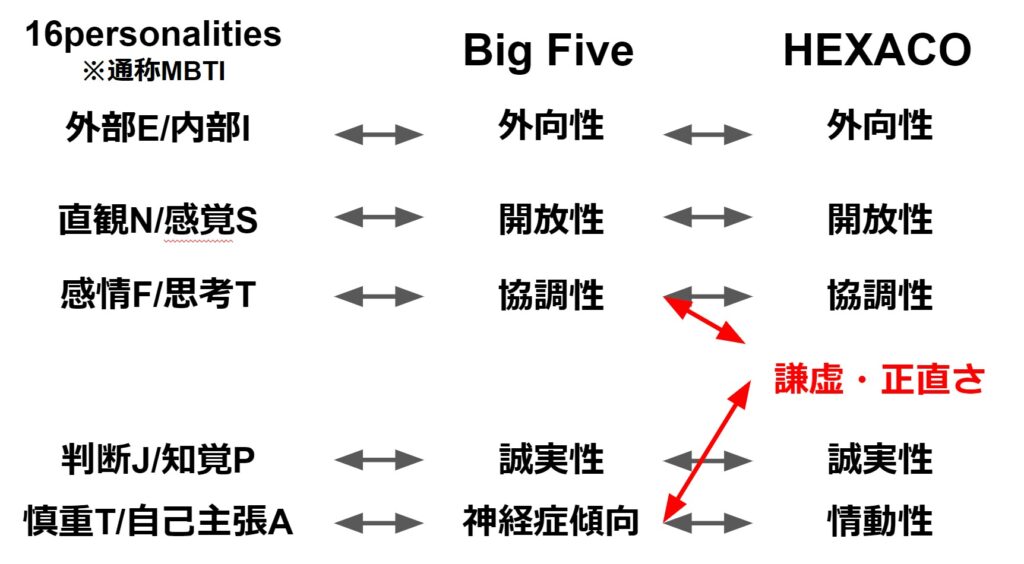
At first glance, HEXACO and the Big Five look similar — but the differences are significant enough to matter in both research and real-life application. The most obvious structural difference is the number of dimensions: the Big Five has 5 factors (Openness, Conscientiousness, Extraversion, Agreeableness, and Neuroticism), while HEXACO has 6. That sixth factor — Honesty-Humility — is not simply a renamed version of an existing Big Five trait. It represents a genuinely distinct personality dimension that captures ethical and moral tendencies in a way the Big Five cannot.
Here is a summary of the key differences between HEXACO and the Big Five:
- Addition of Honesty-Humility: This is the defining innovation of HEXACO. It measures traits like sincerity, fairness, greed avoidance, and modesty — none of which are adequately captured by Big Five Agreeableness alone
- Redefined Agreeableness: In HEXACO, Agreeableness is narrowed to focus on anger management and tolerance, while some aspects of the Big Five’s Agreeableness have been redistributed to Honesty-Humility
- Emotionality vs. Neuroticism: HEXACO’s Emotionality differs from the Big Five’s Neuroticism in that it includes attachment and dependence-related traits, while some fear-related traits have shifted to the Honesty-Humility dimension
- Extraversion, Conscientiousness, and Openness: These 3 dimensions are largely consistent between both models, though with minor adjustments in scope
As for MBTI (Myers-Briggs Type Indicator) — including the popular 16personalities version — it is important to note that while MBTI is widely used and culturally popular, its scientific validity is considerably weaker than either the Big Five or HEXACO. MBTI is loosely based on Big Five principles, and correlations between MBTI types and Big Five scores have been documented. However, the binary “type” system used by MBTI — where you are either an Introvert or an Extrovert, for example — does not reflect the reality that personality traits exist on continuous spectrums. For a more scientifically grounded personality self-assessment, HEXACO tends to be the stronger choice.
A Deep Dive into the 6 HEXACO Factors in the 64 Personality Types Test
Factor 1: Honesty-Humility — The Unique Honesty-Humility Trait
Honesty-Humility is the most distinctive element of the HEXACO model and the primary reason it is considered an advancement over earlier frameworks. This honesty-humility trait measures the degree to which a person behaves in sincere, fair, modest, and non-exploitative ways. It is essentially a window into a person’s ethical orientation — not just what they believe to be right, but how those beliefs show up in their day-to-day behavior.
People who score high on Honesty-Humility tend to show these characteristics:
- Sincerity: They avoid flattery and manipulation, tending to say what they genuinely mean
- Fairness: They are unlikely to cheat or take unfair advantage, even when they could do so without being caught
- Greed avoidance: They tend not to be motivated by wealth, luxury, or social status for its own sake
- Modesty: They do not see themselves as superior to others and are unlikely to seek special treatment
Conversely, individuals who score low on this dimension may tend toward manipulative behavior, self-promotion, and a stronger desire for material gain or social dominance. Research suggests that low Honesty-Humility scores are associated with so-called “dark triad” personality traits — narcissism, Machiavellianism, and psychopathy — making this factor particularly valuable in organizational and forensic psychology contexts.
It is worth emphasizing that no score on this scale makes someone inherently a “good” or “bad” person. A lower score may reflect a highly competitive, assertive character who thrives in environments that reward ambition. The key is understanding how this trait shapes behavior — and using that awareness constructively.
Factor 2: Emotionality — Understanding Emotional Sensitivity
Emotionality in the HEXACO model captures the richness and intensity of a person’s emotional life, including how readily they experience anxiety, fear, and emotional vulnerability. Unlike the Big Five’s Neuroticism — which leans heavily toward negative emotional states — HEXACO’s Emotionality also encompasses positive emotional connection, such as empathy and the desire for close attachments. This makes it a more balanced and nuanced dimension.
Key characteristics of high Emotionality include:
- Anxiety-proneness: Tends to worry about everyday concerns and potential future problems
- Fearfulness: More likely to feel afraid in physically or socially risky situations
- Emotional dependence: Values emotional support from others and tends to seek reassurance during stressful times
- Sentimental sensitivity: More easily moved by music, art, or the emotions of others — a trait linked to empathy
People who score low on Emotionality tend to appear calm under pressure, are less reliant on emotional support from others, and may be less affected by physical danger or uncertainty. While this profile can be a genuine asset in high-stress professions, research suggests that very low Emotionality may also be associated with reduced empathy and difficulty connecting emotionally with others.
Importantly, studies indicate that Emotionality tends to differ between genders — on average, women tend to score somewhat higher on this dimension than men. However, individual variation is enormous, and such group-level tendencies should never be used to stereotype any individual.
Factor 3: eXtraversion — Social Energy and Self-Expression
Extraversion in the HEXACO model measures how much a person draws energy from social interaction, how assertively they express themselves, and how positive their general emotional outlook tends to be. This is one of the dimensions most consistent between HEXACO and the Big Five — and also one of the most intuitive to understand, since most people have a fairly strong sense of whether they tend toward introversion or extraversion.
Hallmarks of high Extraversion include:
- Social boldness: Comfortable speaking up in groups, taking the lead in conversations, and meeting new people
- Liveliness: Tends to feel enthusiastic, energetic, and optimistic about life in general
- Self-assertiveness: Expresses opinions clearly and is comfortable in positions of visibility
- Positive emotionality: More naturally inclined toward cheerfulness and positive affect in daily life
Lower scorers on Extraversion — those who lean toward introversion — are not necessarily shy or anxious. Rather, they tend to find large social gatherings draining rather than energizing, prefer thoughtful one-on-one conversations over group settings, and often excel in roles that require focused, independent work. Research suggests that introverts tend to reflect more deeply before acting, which can be a significant advantage in roles requiring careful analysis.
Neither pole is superior — high Extraversion correlates with success in sales, leadership, and performance roles, while lower Extraversion is often associated with excellence in research, writing, technical fields, and any context that rewards sustained concentration. The most important insight from character type analysis is that career fit matters enormously, and understanding your natural energy orientation can help you make better decisions about your environment.
Factor 4: Agreeableness — Cooperation and Conflict Tolerance
In the HEXACO model, Agreeableness is defined more specifically than in the Big Five — it focuses primarily on how a person handles interpersonal conflict, frustration, and the temptation to hold grudges. While the Big Five’s Agreeableness encompasses a wide range of prosocial qualities, HEXACO separates some of those qualities (like sincerity and fairness) into the Honesty-Humility factor, leaving Agreeableness to focus on patience, forgiveness, and tolerance.
Key qualities associated with high Agreeableness in HEXACO include:
- Forgiveness: Inclined to let go of grudges and give others the benefit of the doubt
- Gentleness: Tends to avoid harsh criticism and approaches others with understanding
- Flexibility: Willing to compromise and adapt rather than insisting on their own way
- Patience: Slower to feel irritated or annoyed by the behavior of others
People who score lower on Agreeableness tend to be more critical, less inclined to forgive easily, and more willing to engage in direct confrontation when they disagree with someone. While this can make conflict more frequent, it also tends to come with a certain frankness and directness that can be highly effective in leadership, negotiation, and roles that require difficult decisions.
Research suggests that very high Agreeableness can sometimes work against a person — particularly in competitive environments where asserting one’s own needs is necessary. People who score extremely high on this dimension may find it difficult to say no, set boundaries, or advocate for themselves, which can become a source of chronic stress. A moderate level of self-assertion tends to serve most people well in the long run.
Factor 5: Conscientiousness — Discipline, Organization, and Follow-Through
Conscientiousness measures the degree to which a person is organized, goal-oriented, diligent, and careful in their approach to tasks and responsibilities. This is one of the most extensively studied personality dimensions in all of psychology, and research consistently shows it to be one of the strongest predictors of real-world outcomes — including academic achievement, job performance, and even physical health.
Characteristics of high Conscientiousness include:
- Organization: Maintains tidy workspaces and clear systems for managing tasks and information
- Diligence: Works hard and persistently, even when tasks are tedious or demanding
- Perfectionism: Sets high standards for quality and is bothered by errors or imprecision
- Prudence: Thinks carefully before acting and tends to avoid impulsive decisions
People on the lower end of this spectrum tend to be more spontaneous, flexible, and relaxed about deadlines and structure. They may thrive in creative or unpredictable environments where rigid planning would be a disadvantage. However, chronic low Conscientiousness can also lead to difficulty completing long-term projects or maintaining healthy routines.
One nuance worth noting is that very high Conscientiousness can sometimes tip into counterproductive perfectionism — where the fear of making mistakes leads to procrastination, over-checking, or difficulty delegating. Studies indicate that an optimal level of conscientiousness balances thoroughness with adaptability, allowing a person to maintain high standards without becoming paralyzed by them.
Factor 6: Openness to Experience — Curiosity, Creativity, and Imagination
Openness to Experience reflects a person’s appetite for novelty, their appreciation of art and beauty, and their comfort with abstract and unconventional thinking. High scorers on this dimension tend to be intellectually curious, creatively inclined, and drawn to exploring new ideas, places, and perspectives. This is the dimension most closely linked to what researchers call “intellectual humility” — the willingness to consider that one might be wrong and to update one’s views based on new information.
Defining qualities of high Openness include:
- Aesthetic appreciation: Strongly moved by music, visual art, literature, and other creative expressions
- Inquisitiveness: Genuinely curious about ideas across many domains, from science to philosophy to the arts
- Creativity: Tends to generate original ideas and finds unconventional approaches appealing
- Adaptability to change: Comfortable with ambiguity and relatively unbothered by uncertainty
Lower scorers on Openness tend to prefer the familiar and the concrete. They value tradition, practicality, and proven methods over experimentation. This profile is often a strength in environments that require consistency and reliability — such as manufacturing, law enforcement, or accounting — where following established procedures is essential.
Research suggests that Openness tends to be highest in young adulthood and may gradually decline with age, though this is not universal. Deliberately exposing yourself to new experiences — reading outside your usual genres, learning a musical instrument, traveling to unfamiliar places — appears to help maintain this dimension over time. For anyone using personality self-assessment as a growth tool, Openness is arguably the most “trainable” of the 6 HEXACO factors.
How to Apply Your HEXACO Results for Personal Growth and Better Relationships
Knowing your HEXACO profile is only valuable if you translate that knowledge into meaningful change — in how you work, how you relate to others, and how you manage your own wellbeing. Here is how each of the 6 dimensions can be leveraged for practical self-improvement:
Leveraging Your Strengths Across the 6 HEXACO Dimensions
- High Honesty-Humility: Your trustworthiness is a rare and valuable asset. Seek roles and relationships where integrity is rewarded — and be mindful that not everyone operates by the same ethical standards you do. Learning to set firm boundaries protects you from being taken advantage of.
- High Emotionality: Your empathy and emotional sensitivity make you an exceptional listener and friend. Channel these qualities into caregiving, counseling, creative work, or any role that benefits from genuine human connection. Practice mindfulness or journaling to prevent emotional overwhelm.
- High Extraversion: Your energy and sociability are natural leadership assets. Actively seek opportunities to network, speak, and collaborate — these environments energize you and bring out your best. Be conscious of giving quieter team members space to contribute.
- High Agreeableness: Your patience and cooperative spirit make you an excellent team player and mediator. Practice saying “no” in low-stakes situations to build the assertiveness muscle — it protects your wellbeing and earns respect.
- High Conscientiousness: Your discipline and attention to detail are enormous professional advantages. Use project management tools and clear goal-setting to channel this energy productively. Watch for perfectionist paralysis — sometimes “done” is genuinely better than “perfect.”
- High Openness: Your curiosity and creativity are engines of innovation. Seek environments that reward original thinking and give yourself permission to explore widely. Pair your ideas with a more Conscientious collaborator to bring them to completion.
Watching Out for Potential Blind Spots
Every personality profile comes with potential blind spots — not because any trait is inherently bad, but because strengths taken to an extreme can become liabilities. Research suggests these are the most common patterns to watch for:
- Low Honesty-Humility: A strong drive for status and influence can damage trust if it is not balanced with genuine consideration for others. Periodic self-reflection on your motivations can help keep this in check.
- Low Emotionality: Your calm resilience is an asset, but be aware that others may experience you as emotionally unavailable. Making deliberate efforts to express warmth and appreciation can significantly improve your relationships.
- Low Extraversion: Your need for solitude is valid and important, but be careful not to withdraw so completely that you miss valuable opportunities for connection and visibility. Scheduling social commitments in advance helps ensure balance.
- Low Agreeableness: Your directness is often refreshing, but unchecked, it can come across as dismissive or harsh. Practicing active listening — genuinely hearing others before responding — tends to make your feedback land much more effectively.
- Low Conscientiousness: Your spontaneity is creative energy, but it can undermine reliability. Small systems — even something as simple as a daily checklist — can dramatically improve your follow-through without constraining your flexibility.
- Low Openness: Your preference for the tried-and-true is grounding and reassuring to others, but in rapidly changing environments, a deliberate effort to explore new approaches — even small ones — can keep your skills relevant and your perspective fresh.
Frequently Asked Questions About the 64 Personality Types Test
Where can I take the 64 personality types test?
The official HEXACO personality self-assessment is available for free at the HEXACO research website (hexaco.org), where you can complete a validated questionnaire and receive a detailed score profile across all 6 dimensions. Several third-party personality platforms also offer HEXACO-based assessments, though the quality varies. For the most accurate and research-backed results, the official academic version is generally the best starting point.
Can your results on the 64 personality types test change over time?
Yes — while personality traits tend to be relatively stable, research suggests they do shift over a lifetime. Conscientiousness and Agreeableness tend to increase with age as people take on more responsibilities and life experience. Openness, on the other hand, may gradually decline. Major life events — such as a career change, parenthood, or therapy — can also produce meaningful shifts. Retaking the assessment every few years can offer a useful picture of how you’ve grown and changed.
How does the HEXACO model compare to MBTI in terms of scientific accuracy?
The HEXACO scientific personality model is considerably more robust than MBTI in terms of research support. HEXACO dimensions are based on factor-analytic studies conducted across multiple languages and cultures, and they show strong test-retest reliability. MBTI, while widely used and culturally popular, has been criticized by researchers for its binary categorization system and weaker predictive validity. For those seeking a scientifically grounded character type analysis, HEXACO is the stronger tool.
Does a low score on the Honesty-Humility trait mean someone is a bad person?
Not at all. A lower score on the honesty-humility trait simply means a person tends to be more competitive, status-conscious, and self-promoting — qualities that can be genuine strengths in entrepreneurial, legal, or highly competitive professional environments. Personality dimensions describe tendencies, not moral worth. The most useful way to interpret any HEXACO score is as a neutral description of your natural inclinations, not as a verdict on your character.
Can the HEXACO personality type system help with career decisions?
Research suggests that HEXACO dimensions are meaningfully correlated with occupational fit and job satisfaction. For example, high Conscientiousness is consistently associated with strong performance across a wide range of professions. High Extraversion tends to predict success in sales, management, and public-facing roles. High Openness is associated with creative and academic careers. Using your HEXACO profile as one input among many — alongside your skills, values, and practical circumstances — can make career planning more informed and self-aware.
Is it possible to improve your scores on any of the HEXACO dimensions?
Studies indicate that deliberate behavioral practice can shift personality scores, particularly over longer timeframes. Conscientiousness tends to respond well to habit-formation strategies and structured routines. Emotionality can be managed through mindfulness and cognitive-behavioral techniques. Even Openness can be actively cultivated by regularly exposing yourself to new experiences, ideas, and perspectives. While the core of your personality is relatively stable, consistent effort in targeted areas can produce real, measurable change over months and years.
Why does HEXACO use 6 factors instead of the Big Five’s 5?
The addition of the sixth factor — Honesty-Humility — emerged from cross-language vocabulary research that found a consistent cluster of personality-related words in multiple languages that did not fit neatly into any of the Big Five dimensions. This cluster, centering on sincerity, fairness, modesty, and greed avoidance, turned out to have strong predictive power for ethical behavior and dark personality traits. Adding this dimension gives the HEXACO model greater coverage of the full human personality space than the Big Five alone.
Summary: What the 64 Personality Types Test Reveals About You
The 64 personality types test — built on the HEXACO six factors — offers one of the most scientifically grounded and practically useful frameworks available for understanding yourself and the people around you. By examining your profile across Honesty-Humility, Emotionality, Extraversion, Agreeableness, Conscientiousness, and Openness, you gain a nuanced, evidence-based picture of your natural tendencies — one that can guide better career choices, healthier relationships, and more intentional personal growth. No score is inherently good or bad; each combination of traits comes with its own unique strengths and potential blind spots. The real value of this kind of personality self-assessment lies not in labeling yourself, but in using the insights to understand why you do what you do — and to make more conscious, empowered choices going forward. Explore where your own 6 HEXACO dimensions fall — and discover which aspects of your personality are quietly shaping your everyday life.