
Understanding personality test types explained clearly can be one of the most powerful steps you take toward self-discovery. Whether you stumbled across a free quiz online or heard a colleague mention their “MBTI type,” personality assessments are everywhere — yet most people don’t fully understand what separates a casual self-discovery quiz from a rigorously validated psychological personality evaluation. This guide breaks down the major types of personality tests, explains the key differences between popular tools like 16Personalities, MBTI, the Big Five, and HEXACO, and shows you how to use each one meaningfully in your daily life, career, and relationships.
Personality assessment tools range from simple online quizzes you can complete in 10 minutes to multi-scale academic instruments used by researchers worldwide. Each sits on a spectrum from “casual and entertaining” to “scientifically rigorous,” and knowing where a tool falls on that spectrum helps you interpret your results with the right level of confidence. Rather than treating any single result as a definitive label, the healthiest approach is to treat these tools as mirrors — imperfect but illuminating — that help you reflect on who you are and who you want to become.
Once again, personality researcher and author of Villain Encyclopedia, Tokiwa (@etokiwa999), will provide the explanation.
※We have developed the HEXACO-JP Personality Assessment! It has more scientific basis than MBTI. Tap below for details.

目次
- 1 What Is a Personality Test? Definitions, Goals, and the Spectrum of Tools
- 2 10 Things Personality Tests Can Actually Reveal About You
- 2.1 1. Your Strengths and Weaknesses
- 2.2 2. Your Interpersonal Style
- 2.3 3. Your Stress Triggers and Coping Patterns
- 2.4 4. Career and Work-Style Fit
- 2.5 5. Your Motivation Sources
- 2.6 6. Your Decision-Making Style
- 2.7 7. Your Emotional Patterns
- 2.8 8. Your Core Values and Beliefs
- 2.9 9. Your Growth Direction
- 2.10 10. Your Mental Health Baseline
- 3 Personality Test Types Explained: The 6 Major Assessment Frameworks
- 3.1 16Personalities — The World’s Most Popular Online Personality Quiz
- 3.2 MBTI — 4 Preference Pairs, 16 Types, and Widespread Misunderstandings
- 3.3 Big Five (OCEAN) — The Scientific Gold Standard for Psychological Personality Evaluation
- 3.4 HEXACO — The 6-Factor Model That Adds Honesty-Humility
- 3.5 Enneagram — 9 Types Rooted in Motivational Dynamics
- 3.6 Egogram — Personality Through the Lens of Transactional Analysis
- 4 Beyond Personality: Specialized Psychological Scales Worth Knowing
- 4.1 WLEIS — Measuring Emotional Intelligence Across 4 Dimensions
- 4.2 CES-D — A Screening Tool for Depressive Symptoms
- 4.3 HLS-Q12 — Measuring Mental Wellness Through Everyday Behavior
- 4.4 Rosenberg Self-Esteem Scale — Assessing How You Value Yourself
- 4.5 BIS/BAS Scale — Understanding Your Behavioral Motivation System
- 4.6 Subjective Happiness Scale — Quantifying Your Sense of Well-Being
- 5 How to Use Personality Assessment Results Wisely: Actionable Advice
- 6 Frequently Asked Questions
- 6.1 What is the most scientifically accurate personality test?
- 6.2 What is the difference between MBTI and the Big Five?
- 6.3 Can personality tests predict career success?
- 6.4 Do personality test results change over time?
- 6.5 What is the HEXACO model and how is it different from the Big Five?
- 6.6 Is 16Personalities the same as MBTI?
- 6.7 How should I choose the best personality test for my needs?
- 7 Summary: Use Personality Test Types Explained as a Map, Not a Cage
What Is a Personality Test? Definitions, Goals, and the Spectrum of Tools
Defining Personality Assessment and Its Core Purpose
A personality assessment is a structured method for analyzing an individual’s characteristic patterns of thinking, feeling, and behaving. At its core, the goal is to create a clearer, more objective picture of who you are — one that goes beyond vague self-impressions. Personality assessments are used across at least 4 broad domains: personal growth and self-awareness, career counseling and job fit, clinical and mental health contexts, and organizational team-building. Understanding which domain a specific tool was designed for is crucial, because a tool built for entertainment should not be used to make high-stakes career or clinical decisions.
Research suggests that self-knowledge — knowing your own strengths, blind spots, emotional triggers, and motivational drivers — is consistently linked to better decision-making, stronger relationships, and greater life satisfaction. Personality tests provide a structured starting point for that self-knowledge. They are not magic or infallible, but when used wisely, they can surface patterns about yourself that might take years of therapy or coaching to uncover organically.
- Self-understanding: Identify your strengths, weaknesses, and behavioral tendencies in concrete terms.
- Career guidance: Match your natural preferences with roles, environments, and working styles that suit you.
- Communication improvement: Understand how you naturally interact with others and where friction might arise.
- Team and leadership development: Help groups understand each other’s working styles to collaborate more effectively.
- Mental health screening: Some scales (like CES-D) are designed specifically to flag symptoms that warrant professional attention.
In short, a personality test is most valuable not as a verdict on who you are, but as a conversation starter — with yourself, your team, or a professional. The best personality test online is ultimately the one matched to your specific purpose.
The 5 Key Terms You Need to Know: Diagnosis, Assessment, Scale, Test, and Examination
One of the most common sources of confusion around personality tools is terminology — the words “test,” “assessment,” “scale,” and “examination” are used interchangeably in everyday conversation, but they carry meaningfully different connotations in psychology. Understanding these distinctions helps you evaluate how seriously to take a given tool’s results.
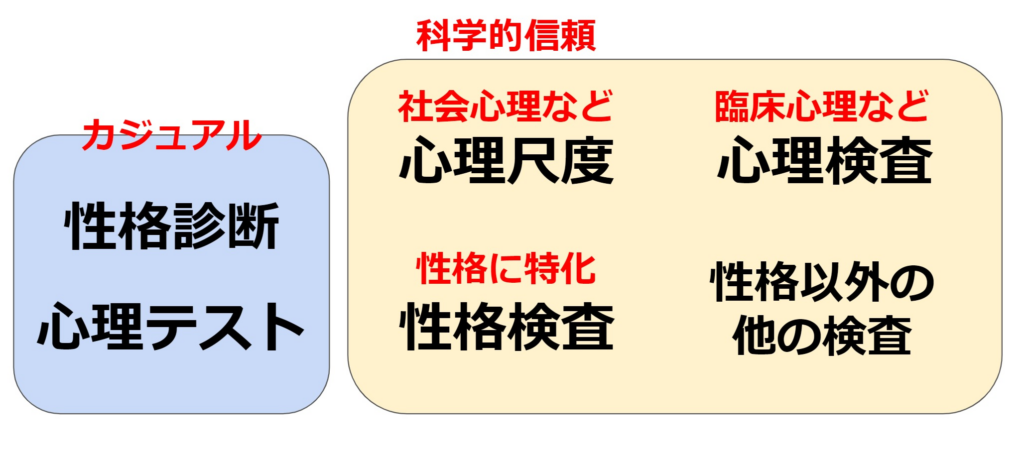
- Personality Diagnosis (性格診断): Casual, accessible tools like 16Personalities that prioritize readability and engagement over strict scientific rigor. Great as an entry point for self-reflection.
- Personality Examination (性格検査): Academically validated instruments like the Big Five questionnaires, developed and administered by specialists. Results carry more scientific weight.
- Psychological Test (心理テスト): Used almost interchangeably with “personality diagnosis” in everyday speech; often covers psychological characteristics beyond just personality (e.g., mood, cognition).
- Psychological Scale (心理尺度): A rigorously validated measurement instrument used in academic research. Statistical checks (reliability and validity) are central to its development.
- Psychological Examination (心理検査): A clinical-context tool used by licensed practitioners for psychological assessment and support — not typically self-administered.
The practical takeaway: if you’re doing a quick self-discovery quiz for fun or initial exploration, a personality diagnosis tool works perfectly well. If you need results for clinical, research, or high-stakes professional purposes, a validated psychological scale or examination administered by a specialist is the appropriate choice.
10 Things Personality Tests Can Actually Reveal About You
Many people take a personality test expecting a simple label — “you’re an introvert” or “you’re a Type A person” — but well-designed assessments can illuminate far more nuanced and actionable insights. Below are 10 dimensions that personality assessments commonly address, along with a brief explanation of why each one matters in real life.
1. Your Strengths and Weaknesses
High scores on certain dimensions tend to reflect natural strengths; low scores can indicate areas worth developing. For instance, someone who scores high on Conscientiousness in the Big Five tends to be organized and reliable — a natural asset in project management roles. Understanding this objectively (rather than emotionally) makes it easier to leverage strengths deliberately and find strategies to compensate for weaker areas without self-judgment.
2. Your Interpersonal Style
Assessments can reveal whether you tend to be direct or diplomatic, competitive or collaborative, warm or analytical in social settings. This awareness helps you anticipate where friction might arise in relationships and adapt your communication style accordingly.
3. Your Stress Triggers and Coping Patterns
Research suggests that people with high Neuroticism (one of the Big Five dimensions) tend to experience stress more intensely and may benefit from specific coping strategies like mindfulness or structured problem-solving. Identifying your stress profile allows you to build a personalized mental toolkit before a crisis hits.
4. Career and Work-Style Fit
Personality traits show meaningful correlations with job performance in specific roles. Studies indicate that high Conscientiousness tends to predict strong performance across most jobs, while high Openness to Experience is particularly relevant in creative and research fields. Knowing your profile helps you prioritize environments where you’re likely to thrive naturally.
5. Your Motivation Sources
Some people are primarily driven by external rewards (recognition, competition, achievement milestones), while others are fueled by internal satisfaction (mastery, meaning, autonomy). Personality assessments — particularly BIS/BAS scales — can help clarify which motivational system tends to dominate your decision-making.
6. Your Decision-Making Style
Do you prefer to gather large amounts of information before deciding, or do you tend to act quickly on intuition? Do you weigh logical pros and cons, or do you prioritize how a decision feels emotionally? MBTI’s Thinking/Feeling and Judging/Perceiving dimensions directly address these tendencies.
7. Your Emotional Patterns
Understanding whether you tend to internalize emotions, express them freely, or suppress them can prevent a lot of unnecessary relationship damage. Emotional Intelligence scales (like the WLEIS) add a further layer by measuring how well you recognize and use emotions — both your own and others’ — as useful information.
8. Your Core Values and Beliefs
Certain assessments, like the Honesty-Humility dimension in HEXACO, directly probe values such as fairness, sincerity, and modesty. Seeing these reflected back in a structured format can help you articulate what you truly care about — which is the foundation of meaningful goal-setting.
9. Your Growth Direction
Knowing where you sit on various dimensions points toward concrete development opportunities. Someone low in Agreeableness who wants to improve their teamwork skills has a clearer target than someone who simply feels “things aren’t going well at work.”
10. Your Mental Health Baseline
Scales like CES-D and HLS-Q12 go beyond personality to give you a snapshot of your current mental and emotional health. These are not diagnostic tools, but they can flag patterns — like chronic low mood or poor sleep — that might benefit from professional support. Think of them as an annual check-in for your mind, similar to a physical for your body.
Personality Test Types Explained: The 6 Major Assessment Frameworks
The landscape of personality assessment tools is broad, but most commonly used instruments fall into one of several major frameworks. Here is a comprehensive breakdown of each, covering what it measures, how it works, and when it is most useful.
16Personalities — The World’s Most Popular Online Personality Quiz
16Personalities is arguably the most widely recognized self-discovery quiz in the world, with hundreds of millions of completions across more than 30 languages. It blends elements of MBTI-style type theory with a fifth dimension borrowed from Big Five research, producing results that are detailed, readable, and highly shareable. The assessment consists of 92 questions and classifies respondents into 16 distinct personality profiles organized under 4 broader temperament groups: Analysts, Diplomats, Sentinels, and Explorers.
The 5 dimensions it measures are:
- Mind: Extraverted vs. Introverted — how you direct and receive energy
- Energy: Intuitive vs. Observant — how you process information and perceive the world
- Nature: Thinking vs. Feeling — how you make decisions and handle emotions
- Tactics: Judging vs. Prospecting — how you approach planning and structure
- Identity: Assertive vs. Turbulent — how confident and emotionally stable you tend to feel
16Personalities is an excellent entry point for someone new to personality assessment. Its results pages are rich with practical information about careers, relationships, and personal growth. However, it is important to treat it as a casual personality diagnosis rather than a scientifically validated instrument — its psychometric properties have not been independently peer-reviewed to the same standard as the Big Five or HEXACO. Use it as a starting conversation, not a final verdict.
MBTI — 4 Preference Pairs, 16 Types, and Widespread Misunderstandings
The Myers-Briggs Type Indicator (MBTI) is one of the most widely used personality assessment tools in corporate and educational settings, yet it is also one of the most frequently misunderstood. Developed by Isabel Briggs Myers and Katharine Cook Briggs based on Carl Jung’s theory of psychological types, MBTI classifies individuals into 1 of 16 types based on 4 binary preference pairs. Globally, approximately 2 million people take the official MBTI assessment per year for professional development purposes alone.
The 4 preference dimensions are:
- Extraversion (E) vs. Introversion (I): Where you primarily direct your attention and energy
- Sensing (S) vs. Intuition (N): How you prefer to take in information
- Thinking (T) vs. Feeling (F): How you prefer to make decisions
- Judging (J) vs. Perceiving (P): How you prefer to orient yourself to the outer world
This produces 16 possible four-letter combinations (e.g., INFJ, ENTP, ISTJ) that each come with detailed descriptions. The most common criticism of MBTI from the academic psychology community is that it forces continuous traits into binary categories, potentially producing different results if the same person retakes the test. Studies suggest that re-test consistency over short periods varies, with some research finding that roughly 50% of people receive a different type classification within 5 weeks. Despite these limitations, MBTI remains highly valuable as a framework for sparking team conversations about communication styles and work preferences, provided results are treated as tendencies rather than fixed labels.
Big Five (OCEAN) — The Scientific Gold Standard for Psychological Personality Evaluation
The Big Five personality model — also known as the Five Factor Model (FFM) — is widely regarded as the most empirically supported framework in personality psychology, and it forms the backbone of most serious psychological personality evaluation conducted in academic research today. Unlike MBTI’s categorical types, the Big Five measures 5 broad trait dimensions on continuous scales, meaning everyone has some degree of each trait rather than belonging to one box or another. This makes it more statistically robust and better suited for predicting real-world outcomes like job performance, relationship satisfaction, and health behaviors.
The 5 dimensions, often remembered by the acronym OCEAN, are:
- Openness to Experience: Curiosity, creativity, appreciation for art and ideas — high scorers tend to enjoy novelty and abstract thinking
- Conscientiousness: Organization, self-discipline, reliability — research consistently finds this to be the strongest predictor of occupational achievement
- Extraversion: Sociability, assertiveness, positive emotionality — high scorers gain energy from social interaction
- Agreeableness: Cooperativeness, empathy, trust — linked to harmony in relationships and prosocial behavior
- Neuroticism: Emotional instability, anxiety, vulnerability to stress — higher scores tend to correlate with greater susceptibility to mood fluctuations
The Big Five’s dimensional structure allows for nuanced profiles. Two people might both score moderately on Extraversion but differ sharply on Neuroticism, producing very different lived experiences of social interaction. Multiple validated free versions of Big Five questionnaires are available online, making it one of the most accessible best personality test options for anyone seeking a scientifically grounded self-assessment. When comparing MBTI vs Big Five, the key difference is this: MBTI tells you which of 16 categories you fit, while Big Five tells you where you sit on 5 continuous spectrums — a distinction that matters enormously if you want to use the results for research or high-stakes decisions.
HEXACO — The 6-Factor Model That Adds Honesty-Humility
HEXACO is a personality model developed through cross-cultural lexical research that expands the Big Five by adding a crucial 6th dimension: Honesty-Humility. This addition was motivated by findings that certain morally relevant traits — sincerity, fairness, modesty, and avoidance of greed — did not fit neatly into any of the Big Five’s 5 factors, yet consistently emerged as a coherent cluster across multiple languages and cultures. The model’s name is an acronym of its 6 dimensions.
The 6 HEXACO dimensions are:
- Honesty-Humility (H): Sincerity, fairness, modesty, and avoidance of greed — the dimension most strongly associated with ethical and prosocial behavior
- Emotionality (E): Sensitivity to emotional experiences, empathy, and anxiety — somewhat similar to Neuroticism in the Big Five but conceptually distinct
- eXtraversion (X): Social boldness, positive self-regard, and sociability — closely parallels the Big Five’s Extraversion
- Agreeableness (A): Patience, tolerance, and flexibility in interpersonal conflict — note that in HEXACO, the empathy component moves to Emotionality
- Conscientiousness (C): Organization, diligence, and perfectionism — similar to the Big Five dimension
- Openness to Experience (O): Aesthetic appreciation, inquisitiveness, and creativity — closely parallels the Big Five dimension
Research using HEXACO indicates that Honesty-Humility is a particularly strong predictor of behaviors like workplace deception, cheating, and unethical decision-making — outcomes the Big Five model tends to underpredict. For organizations interested in integrity-related hiring or leadership development, HEXACO offers measurably better predictive validity in those domains. It is also increasingly popular in academic personality research as a more comprehensive alternative to the Big Five.
Enneagram — 9 Types Rooted in Motivational Dynamics
The Enneagram is a personality system that describes 9 fundamental character types, each defined not just by behavioral traits but by the underlying fears and motivations that drive those behaviors. Unlike the Big Five or HEXACO, which emerged from statistical analysis of personality language, the Enneagram has roots in contemplative and philosophical traditions and was later adapted for psychological and organizational use. While its scientific validation is less robust than the Big Five, many practitioners find its motivational depth uniquely useful for personal and spiritual development.
The 9 Enneagram types are:
- The Perfectionist: Principled, purposeful, self-controlled; driven by a desire to be good and avoid error
- The Helper: Caring, generous, people-pleasing; driven by a need to be needed and loved
- The Achiever: Adaptable, success-oriented, driven; motivated by achievement and recognition
- The Individualist: Expressive, dramatic, self-absorbed; searching for identity and significance
- The Investigator: Perceptive, innovative, secretive; driven by a need to understand and conserve energy
- The Loyalist: Committed, security-oriented, engaging; motivated by finding safety and support
- The Enthusiast: Spontaneous, versatile, scattered; driven by a desire for stimulation and avoiding pain
- The Challenger: Self-confident, decisive, confrontational; motivated by control and self-reliance
- The Peacemaker: Receptive, agreeable, complacent; driven by a need for peace and avoiding conflict
The Enneagram’s greatest practical value tends to lie in its description of stress and growth pathways — each type has a characteristic direction it moves under stress (toward the behaviors of another type) and a direction it moves when growing. This dynamic element makes it particularly useful in coaching and therapeutic contexts where understanding patterns of change over time matters.
Egogram — Personality Through the Lens of Transactional Analysis
The Egogram is a personality assessment tool grounded in Transactional Analysis (TA) theory, a psychological framework developed by psychiatrist Eric Berne that maps personality through 5 distinct “ego states” — internal patterns of thought, feeling, and behavior that each person draws on in different situations. The Egogram visualizes the relative strength of each ego state as a bar graph, making it immediately intuitive to interpret.
The 5 ego states measured are:
- CP (Critical Parent): Tendency toward strictness, criticism, high standards, and rule-enforcement
- NP (Nurturing Parent): Warmth, care-giving, protectiveness, and supportiveness toward others
- A (Adult): Rational, objective, data-driven thinking and calm problem-solving
- FC (Free Child): Playfulness, spontaneity, creativity, and emotional expressiveness
- AC (Adapted Child): Compliance, people-pleasing, suppression of own needs in favor of others’ expectations
The Egogram is particularly popular in workplace communication training and counseling contexts in Japan and parts of Asia. Its practical value lies in helping people recognize which ego state they default to in specific situations — for example, someone whose AC is disproportionately high relative to FC may consistently suppress their authentic desires to gain approval, a pattern worth exploring in a coaching or therapeutic setting.
Beyond Personality: Specialized Psychological Scales Worth Knowing
While the major personality frameworks covered above focus on stable trait dimensions, a second category of psychological assessment tools measures more specific psychological characteristics — emotional intelligence, mental health status, self-esteem, behavioral motivation, and subjective well-being. These scales are especially useful when you want to zoom in on one particular aspect of your psychological profile rather than getting a broad personality overview.
WLEIS — Measuring Emotional Intelligence Across 4 Dimensions
The Wong and Law Emotional Intelligence Scale (WLEIS) is a compact, research-validated measure of Emotional Intelligence (EI) — the ability to perceive, understand, regulate, and use emotions effectively. It covers 4 specific capabilities: recognizing your own emotions, recognizing others’ emotions, regulating your own emotional responses, and using emotions to facilitate thinking and problem-solving. Research suggests that higher EI scores tend to correlate with better leadership effectiveness, greater relationship satisfaction, and stronger resilience under stress. The WLEIS is widely used in organizational psychology research because of its concise 16-item format and solid psychometric properties.
CES-D — A Screening Tool for Depressive Symptoms
The Center for Epidemiologic Studies Depression Scale (CES-D) is a 20-item self-report questionnaire originally developed for use in large-scale population studies, now widely used as a screening tool for depressive symptoms in both research and clinical practice. Respondents rate how frequently they experienced 20 symptoms — including low mood, loss of interest, sleep disturbance, and fatigue — during the past week on a 4-point scale. Scores at or above a threshold of 16 are commonly used as a flag for possible clinically significant depression warranting professional follow-up. It is critical to understand that the CES-D is a screening instrument, not a diagnostic tool — a high score means “consider talking to a professional,” not “you have depression.”
HLS-Q12 — Measuring Mental Wellness Through Everyday Behavior
The HLS-Q12 is a 12-item questionnaire that assesses mental health and well-being indirectly, through questions about specific day-to-day behaviors and attitudes rather than directly asking about symptoms. Its 4 underlying factors — support for others, healthy lifestyle habits, positive thinking, and self-actualization — reflect the idea that mental wellness is built through consistent behavioral patterns rather than simply the absence of illness. This makes it particularly practical for preventive mental health initiatives in schools and workplaces, where the goal is to build resilience before problems develop.
Rosenberg Self-Esteem Scale — Assessing How You Value Yourself
The Rosenberg Self-Esteem Scale (RSES) is a 10-item scale that measures global self-esteem — a person’s overall sense of their own worth and value. Developed in the 1960s, it remains one of the most widely used self-esteem measures in psychological research, with translations in over 50 languages. The scale distinguishes between high self-esteem (a stable, positive sense of self-worth) and low self-esteem (feelings of inadequacy and self-doubt). Research consistently links higher self-esteem scores to better mental health outcomes, greater academic and occupational achievement, and stronger social relationships — though the relationship is complex and context-dependent.
BIS/BAS Scale — Understanding Your Behavioral Motivation System
The Behavioral Inhibition System / Behavioral Activation System (BIS/BAS) Scale measures 2 fundamental neurobiologically-grounded motivational systems that influence how people respond to potential threats and rewards. The BIS (Behavioral Inhibition System) is activated by signals of punishment, non-reward, novelty, or conflict — it promotes caution, anxiety, and avoidance. The BAS (Behavioral Activation System) is activated by signals of reward and positive stimuli — it promotes approach behavior, drive, and positive affect. Research suggests that individuals with a dominant BIS tend to be more risk-averse and anxiety-prone, while those with a dominant BAS tend to be more reward-seeking and impulsive. Neither profile is inherently better — understanding your own balance helps you make smarter decisions about environments, roles, and risk-management strategies.
Subjective Happiness Scale — Quantifying Your Sense of Well-Being
The Subjective Happiness Scale is a brief, validated 4-item measure that captures an individual’s global sense of happiness — how happy they generally feel relative to others and relative to their own idealized self. Unlike clinical scales that focus on pathology, the Subjective Happiness Scale takes a positive psychology perspective, treating happiness as a meaningful construct in its own right. It is widely used in positive psychology research to study factors that contribute to human flourishing, including personality traits, social connections, and life circumstances. Scores on the scale tend to show moderate stability over time, suggesting they reflect something relatively stable about a person’s baseline emotional life rather than purely short-term mood fluctuations.
How to Use Personality Assessment Results Wisely: Actionable Advice
Getting a result from any personality assessment is only the beginning — the real value comes from how you engage with that result over time. Here is a practical framework for using personality test insights in a way that genuinely supports your growth rather than boxing you into a label.
1. Cross-Reference Multiple Tools for a Fuller Picture
No single personality assessment captures the full complexity of a human being. Using 2 or 3 complementary tools — for example, combining the Big Five for trait measurement with an Enneagram assessment for motivational insight and a BIS/BAS scale for behavioral tendencies — produces a significantly richer self-portrait than any single instrument alone. When patterns repeat across multiple assessments, you can be more confident they reflect something real about you. When they contradict each other, that discrepancy itself is worth reflecting on.
2. Treat Results as Tendencies, Not Destiny
Research consistently shows that personality traits are influenced by both genetic factors and environmental experiences, and that meaningful change — especially in traits like Conscientiousness and Neuroticism — is possible over the course of a lifetime. A personality assessment captures a snapshot of where you tend to be right now, not a ceiling on where you can go. This is especially important to remember when a result highlights a weakness — treat it as a growth target, not a fixed limitation. The phrase “I’m just an introvert, I can’t do public speaking” reflects a misuse of personality results; a more useful reframe is “I tend toward introversion, so I may need to prepare more deliberately for high-social-energy situations.”
3. Apply Results in Specific Contexts, Not Everywhere at Once
Different assessments are optimized for different use cases. Use the Big Five or HEXACO when evaluating career fit or working with a counselor. Use 16Personalities or MBTI as a team communication exercise. Use the CES-D or HLS-Q12 for periodic mental health check-ins. Use the Enneagram or Egogram in coaching or interpersonal development contexts. Applying the right tool to the right problem makes each one far more useful than trying to use a single assessment as a universal answer to every question about yourself.
4. Leverage Your Strengths Deliberately
Studies in positive psychology suggest that people who actively use their character strengths in daily life report higher levels of engagement, meaning, and well-being. If your Big Five profile shows high Openness and high Conscientiousness, you are likely to thrive in roles that combine creative exploration with structured execution — deliberately seeking out those conditions is not self-indulgent, it is strategically smart. The “why” here is that environments aligned with your natural strengths reduce the cognitive and emotional energy you waste fighting against your own grain.
5. Seek Professional Support When Results Raise Concerns
If a screening tool like the CES-D suggests elevated depressive symptoms, or if repeated personality assessments reveal patterns causing significant distress in your relationships or work life, that is a signal to consult a licensed mental health professional. Personality assessment tools are not substitutes for professional psychological evaluation — they are conversation starters. A trained counselor or psychologist can interpret results in the full context of your life history, current circumstances, and future goals in a way that no self-report questionnaire can replicate.
Frequently Asked Questions
What is the most scientifically accurate personality test?
The Big Five (Five Factor Model) and HEXACO are widely considered the most scientifically validated personality assessment frameworks available. Both emerged from rigorous lexical and cross-cultural research, have been replicated in hundreds of independent studies, and demonstrate strong reliability and validity for predicting real-world outcomes like job performance, relationship quality, and health behaviors. For everyday self-reflection, tools like 16Personalities are accessible and engaging, but for serious research or professional psychological evaluation, the Big Five or HEXACO are the recommended choice.
What is the difference between MBTI and the Big Five?
The core difference in the MBTI vs Big Five comparison is measurement approach. MBTI classifies people into 1 of 16 discrete types based on 4 binary preference pairs (e.g., Extraverted vs. Introverted), meaning you are assigned to one category or the other. The Big Five measures 5 personality traits on continuous scales, so everyone receives a score along a spectrum for each trait. Research suggests the Big Five’s dimensional approach better captures the reality that most personality traits exist on a continuum rather than as either/or categories, which is why it is preferred in academic psychology.
Can personality tests predict career success?
Research suggests that certain personality traits show meaningful correlations with job performance, though no personality test can definitively predict individual career success. Studies indicate that Conscientiousness is the single most consistent predictor of performance across virtually all occupations. Openness to Experience tends to be particularly predictive in creative and knowledge-work roles. Extraversion correlates with success in sales and leadership positions. However, skills, experience, work environment, and opportunity also play enormous roles — personality profiles are best treated as one useful input in career planning rather than a definitive guide.
Do personality test results change over time?
Research suggests that personality traits are moderately stable across adulthood but are not fixed. Studies tracking individuals over decades indicate that Conscientiousness and Agreeableness tend to increase with age, while Neuroticism tends to decrease — a pattern sometimes called the “maturity principle.” Short-term fluctuations in test scores can also occur due to current mood, life circumstances, or even how you interpret individual questions. This is why a single test score should be treated as a snapshot rather than a permanent label, and why retesting over time can reveal meaningful growth.
What is the HEXACO model and how is it different from the Big Five?
HEXACO is a 6-factor personality model that includes all 5 dimensions found in the Big Five — Emotionality (similar to Neuroticism), Extraversion, Agreeableness, Conscientiousness, and Openness to Experience — plus a 6th dimension called Honesty-Humility. This added dimension captures traits like sincerity, fairness, modesty, and avoidance of greed that cross-cultural research found to be consistently distinct from the other 5 factors. Research indicates that Honesty-Humility is a particularly strong predictor of ethical behavior, making HEXACO especially useful in contexts where integrity assessment matters.
Is 16Personalities the same as MBTI?
16Personalities is inspired by MBTI but is not the same instrument. It uses a similar 4-letter type system and shares the 4 core dichotomies (Mind, Energy, Nature, Tactics), but it adds a 5th dimension (Identity: Assertive vs. Turbulent) borrowed from Big Five research. It was developed independently as a free online tool rather than as a certified psychological assessment, and it has not undergone the same standardization and validity testing as the official MBTI instrument administered by certified practitioners. Both can be useful for self-reflection, but they should not be treated as interchangeable.
How should I choose the best personality test for my needs?
The best personality test is the one matched to your specific purpose. For casual self-discovery and sharing with friends or colleagues, 16Personalities or an Enneagram quiz are engaging and accessible. For career counseling or professional development, the Big Five provides the most evidence-based insights. For exploring ethical values and integrity-related dimensions, HEXACO is a strong choice. For mental health screening, validated scales like the CES-D or Rosenberg Self-Esteem Scale are more appropriate than personality tests. When in doubt, start with a free Big Five questionnaire as a scientifically grounded foundation, then supplement with other tools as needed.
Summary: Use Personality Test Types Explained as a Map, Not a Cage
Having now explored the full spectrum of personality test types explained — from casual self-discovery quizzes like 16Personalities and MBTI to scientifically rigorous psychological personality evaluation frameworks like the Big Five and HEXACO, and from motivational tools like the Enneagram and Egogram to specialized scales measuring emotional intelligence, self-esteem, and mental wellness — the most important takeaway is this: no single assessment tells the whole story of who you are, but each one can illuminate a genuinely useful corner of it. The goal is not to find the label that fits you best, but to build an increasingly detailed and compassionate understanding of your own patterns, preferences, and possibilities.
Use personality assessments as starting points for curiosity, not endpoints for judgment. Combine multiple tools. Hold results lightly. Revisit them as you grow. And when an assessment surfaces something that genuinely concerns you — a persistent pattern of low mood, a chronic stress response, a recurring relationship difficulty — let it guide you toward professional support rather than internet rabbit holes. Personality science is a lens, not an answer key. The richest insights come from using it actively and reflectively over time.
Ready to put this knowledge into practice? Explore the personality assessments covered in this guide — start with the one that matches your current goal, whether that’s career clarity, self-understanding, or relationship insight — and see which patterns across multiple tools resonate most deeply with your lived experience.

Writer & Supervisor: Eisuke Tokiwa
Personality Psychology Researcher / CEO, SUNBLAZE Inc.
As a child he experienced poverty, domestic abuse, bullying, truancy and dropping out of school — first-hand exposure to a range of social problems. He spent 10 years researching these issues and published Encyclopedia of Villains through Jiyukokuminsha. Since then he has independently researched the determinants of social problems and antisocial behavior (work, education, health, personality, genetics, region, etc.) and has published 2 peer-reviewed journal articles (Frontiers in Psychology, IEEE Access). His goal is to predict the occurrence of social problems. Spiky profile (WAIS-IV).
Expertise: Personality Psychology / Big Five / HEXACO / MBTI / Prediction of Social Problems
Researcher profiles: ORCID / Google Scholar / ResearchGate
Social & Books: X (@etokiwa999) / note / Amazon Author Page