
Aren’t you curious about the differences in personality between men and women?
When we look around us, each person has their own rich individuality in personality, but somehow we can feel that there are different tendencies between men and women.
For example, there might be an image that women have higher empathy and men have stronger adventurous spirit.
But do such personality differences between men and women really exist?
Also, are personalities determined from birth, or do they change with age?
To answer these questions, an American research team conducted a large-scale study.
The paper is titled “Age Differences in Personality Traits From 10 to 65” and analyzes data from over 1.26 million people, revealing gender differences and age-related changes in personality.
In this article, we will explore the commonalities and differences in personality between men and women based on these research findings.
Once again, personality researcher and author of Villain Encyclopedia, Tokiwa (@etokiwa999), will provide the explanation.
※We have developed the HEXACO-JP Personality Assessment! It has more scientific basis than MBTI. Tap below for details.

目次
- 1 Gender Differences in Personality and Development
- 1.1 What is the Big Five?
- 1.2 Male and Female Personality: Who is More Social?
- 1.3 Male and Female Personality: Who is More Caring Toward Others?
- 1.4 Male and Female Personality: Who are the Hard Workers – Men or Women?
- 1.5 Male and Female Personality: Differences in Response to Stress
- 1.6 Male and Female Personalities: Does Curiosity About New Things Differ Between Genders?
- 2 How Do Male and Female Personalities Change with Age?
- 2.1 Childhood (10-12 years old) Male and Female Personalities
- 2.2 Changes in Male and Female Personalities Seen During Adolescence (13-17 years old)
- 2.3 Youth (18-25 years old): The First Step Toward Independence
- 2.4 Personality Characteristics of Men and Women in Early Adulthood (26-35 years old)
- 2.5 Middle Adulthood (36-50 years): Toward a Mature Personality
- 2.6 Personality Differences Between Men and Women in Later Adulthood (51-65 years)
- 3 Age-Related Changes in Extraversion: How Does Male and Female Sociability Change?
- 4 Development of Agreeableness: Acquiring Compassion and Kindness
- 5 How is Conscientiousness Nurtured?
- 6 Gender Differences and Age Changes in Neuroticism
- 7 Age and Gender Differences in Openness
- 8 Summary: Diversity and Plasticity in Gender Personality
Gender Differences in Personality and Development
What is the Big Five?
It’s a classification method for personality traits widely used in personality psychology. Human personality is understood through the following five dimensions:
- Extraversion: Tendency to be sociable and active
- Agreeableness: Tendency to be compassionate and cooperative
- Conscientiousness: Tendency to be responsible and work hard toward goal achievement
- Neuroticism: Tendency to easily feel anxiety and stress
- Openness: Tendency to have strong curiosity toward new experiences and knowledge
The Big Five is used in a wide range of research as a framework for comprehensively evaluating personality.
These five personality traits are considered to be influenced by both genetic and environmental factors, and are said to be relatively stable.
Let’s examine the differences in personality between men and women using the Big Five framework.
Male and Female Personality: Who is More Social?
Extraversion represents personality characteristics related to interpersonal relationships, such as sociability, activeness, and assertiveness.
Generally, women are considered to be more extraverted than men.
For example, gender differences can be seen in the following points:
- Women tend to enjoy interaction with people and social activities
- Men tend to have strong independence and value alone time
- Women are emotionally expressive and actively communicate
- Men are strong in self-assertion but find it difficult to express inner emotions
Also, extraversion is known to change with age.
From childhood to adolescence, extraversion decreases, and from adulthood onward it remains relatively stable.
For both men and women, gaining social experience may gradually help them achieve a balance in extraversion.
Gender differences in extraversion are considered to be related not only to biological factors but also to social expectations and roles.
Male and Female Personality: Who is More Caring Toward Others?
Agreeableness refers to personality characteristics related to interpersonal harmony, such as compassion, kindness, and cooperative attitudes.
Many studies report that women are more agreeable than men.
Specifically, gender differences can be seen in the following points:
- Women are sensitive to others’ emotions and have high empathy
- Men tend to be competitive and assertive
- Women value harmony in relationships and are more likely to take cooperative actions
- Men have strong independence and sometimes push through with their own opinions
Also, agreeableness develops with age.
It temporarily decreases from childhood to adolescence, but gradually increases from adulthood onward.
This is thought to be because people learn the importance of cooperation with others in social life.
Gender differences in agreeableness can be said to be related to biological factors as well as social expectations and role divisions.
Male and Female Personality: Who are the Hard Workers – Men or Women?
Conscientiousness represents personality characteristics of working hard toward goals, such as diligence, steadiness, and self-control.
Research results vary regarding gender differences, but overall women are said to have higher conscientiousness.
For example, differences might be seen in the following points:
- Women tend to be organized and steadily advance things
- Men tend to be impulsive and sometimes give in to temptation
- Women strive for regular lifestyles and are good at self-management
- Men have relaxed personalities and tend to become lazy
Also, conscientiousness changes greatly with age.
It temporarily decreases from childhood to adolescence, but steadily increases from adulthood onward.
This is thought to be because people come to understand the importance of fulfilling social responsibilities and duties.
Gender differences in conscientiousness are likely more influenced by social expectations and education than by biological factors.
Male and Female Personality: Differences in Response to Stress
Neuroticism is a personality trait that represents high sensitivity to anxiety and stress.
Many studies have shown that women have higher neuroticism than men.
Specifically, gender differences can be seen in the following aspects.
- Women tend to feel anxious more easily and are more vulnerable to stress
- Men are emotionally stable and give the impression of being strong against stress
- Women tend to think about things in a negative direction and are prone to harboring worries
- Men have optimistic personalities and don’t worry much about the future
Additionally, neuroticism is known to change with age.
Particularly, neuroticism tends to increase in adolescent females, while it tends to decrease in males.
From adulthood onwards, neuroticism gradually decreases in both men and women.
This is thought to be because stress coping abilities improve and emotional control becomes better.
Biological factors such as hormonal balance may be involved in gender differences in neuroticism.
Male and Female Personalities: Does Curiosity About New Things Differ Between Genders?
Openness is a personality trait that represents high curiosity and sensitivity to new experiences and knowledge.
While consistent results have not been obtained regarding gender differences, men tend to have higher openness overall.
For example, differences might be seen in the following aspects.
- Men like to challenge new things
- Women tend to value familiar things
- Men prefer abstract thinking and are interested in philosophical questions
- Women tend to prefer concrete and realistic ways of thinking
Also, openness changes with age.
It tends to decrease from childhood to adolescence, but gradually increases from adulthood onwards.
This is thought to be because accumulating life experiences allows people to accept new values and ways of thinking.
Gender differences in openness are likely more influenced by social expectations and cultural factors than biological factors.
How Do Male and Female Personalities Change with Age?
Childhood (10-12 years old) Male and Female Personalities
Childhood is an important period when the foundation of personality is formed.
The personalities of boys and girls during this period show the following characteristics.
- Both boys and girls tend to be extroverted and active
- Girls have higher agreeableness and are more likely to show compassion for others
- Boys have strong competitive spirits and tend to be self-assertive
- No clear gender differences are seen in conscientiousness or diligence
However, these characteristics are greatly influenced by the environment.
Educational policies at home and school, and the attitudes of surrounding adults are involved in children’s personality formation.
Also, this period is when self-concept develops.
While exploring their own identity, they actively interact with same-sex friends to acquire social skills.
Childhood personality can be said to be an important period that becomes the foundation for later personality development.
It is important to promote balanced growth while developing individual characteristics.
Changes in Male and Female Personalities Seen During Adolescence (13-17 years old)
Adolescence is a period of major changes both physically and mentally, and personality also fluctuates greatly.
The personality characteristics seen in boys and girls during this period are as follows.
- Egocentric tendencies become stronger, and extroversion temporarily decreases
- Girls have increased neuroticism and tend to become emotionally unstable
- Boys may show delinquency or problem behaviors
- Conscientiousness and agreeableness temporarily decrease, and rebellious attitudes may be taken
These changes are thought to be related to hormonal balance changes and brain development stages.
Also, confusion and conflict tend to arise in the process of seeking independence from parents and establishing the ego.
At the same time, adolescence is also a period of exploring self-identity.
While pursuing their own identity, they begin to have goals and dreams for the future.
The fluctuations in adolescent personality can be viewed as a passage point for growth.
It is important for surrounding adults to watch warmly while providing appropriate advice and support.
Youth (18-25 years old): The First Step Toward Independence
Youth is a transitional period from childhood to adulthood, and a time of great growth toward independence.
The personalities of men and women during this period show the following characteristics.
- Self-awareness deepens and identity is established
- Sociability increases and interpersonal skills are acquired
- Morality and ethics develop, and social responsibility is recognized
- Conscientiousness and diligence gradually increase
Youth is also a period of standing at life’s crossroads, such as advancing to higher education, finding employment, and romance.
In the process of determining future direction based on one’s own values and goals, personality also grows significantly.
Also, this period is when psychological independence from parents is required.
While exploring the nature of parent-child relationships, they pursue their own way of life.
Personality development during youth becomes an important foundation for lifelong character formation.
It is important to establish one’s own identity while repeating trial and error.
Personality Characteristics of Men and Women in Early Adulthood (26-35 years old)
Early adulthood is a period of establishing the foundation as a member of society, and can be said to be a time when personality also stabilizes.
The personalities of men and women during this period show the following characteristics.
- Extroversion and agreeableness increase, making interpersonal relationships smoother
- Conscientiousness and diligence increase, strengthening motivation and sense of responsibility toward work
- Neuroticism gradually decreases, becoming emotionally stable
- Although openness varies greatly between individuals, people continue to maintain interest in new things
Early adulthood is also a time for establishing the foundation of work and family life.
While fulfilling roles as members of society, people also begin to focus their energy on relationships with partners and child-rearing.
Additionally, this is a time when the desire for self-actualization increases.
Many people seek to demonstrate their abilities and aim for career advancement.
The personality of early adulthood can be said to be a time of refining individuality while enhancing social adaptability.
It requires maintaining flexibility while cherishing one’s authentic self.
Middle Adulthood (36-50 years): Toward a Mature Personality
Middle adulthood is said to be the most fulfilling period in life, and personality also takes on a mature quality.
The personalities of men and women during this period show the following characteristics:
- High extraversion and agreeableness, able to maintain harmony in interpersonal relationships
- High conscientiousness and diligence, fulfilling responsibilities at work and home
- Low neuroticism tendency, with increased tolerance for stress
- Although openness varies greatly between individuals, people possess insight based on life experience
Middle adulthood is a time when work and family life stabilize, but it’s also when people face various challenges.
They take on many roles including child-rearing, caring for elderly parents, and dealing with their own health issues.
Additionally, this is a time for questioning the meaning and purpose of life.
People begin to reflect on their past experiences and consider their future life plans.
The personality of middle adulthood can be said to be a time of finding meaning in life while maintaining a sense of balance.
It requires cherishing one’s authentic self while achieving harmony with one’s surroundings.
Personality Differences Between Men and Women in Later Adulthood (51-65 years)
Later adulthood can be said to be a time for deepening one’s authentic self toward the culmination of life.
The personality differences between men and women during this period include the following points:
- Women have high agreeableness and extraversion, with strong social tendencies
- Men tend to become more introverted and face their inner selves
- Women show decreased neuroticism and are emotionally stable
- Men have high conscientiousness and diligence, with a strong sense of responsibility
Later adulthood is also a time of encountering life’s turning points, such as retirement from work and the completion of child-rearing.
It requires reflecting on one’s past life and finding new purpose in living.
Additionally, this is a time when health concerns also increase.
It becomes important to live positively while accepting physical changes.
The gender differences in personality during later adulthood are thought to reflect differences in social roles rather than biological factors.
This can be said to be a time when support from one’s surroundings is needed so that each individual can live their own authentic life.
Age-Related Changes in Extraversion: How Does Male and Female Sociability Change?
Decline in Extraversion from Childhood to Adolescence
Extraversion tends to decline from childhood to adolescence.
The following factors are thought to be related to this change:
- The heightened self-consciousness characteristic of puberty temporarily strengthens introversion
- Anxiety and conflict accompanying independence from parents reduces sociability
- Academic work and exam preparation restrict extraverted activities
- Self-assertion is suppressed to adapt to social expectations and norms
However, the decline in extraversion during this period is temporary, and it begins to rise again from adulthood onward.
Additionally, there are large individual differences, so it cannot be said that extraversion universally declines.
Rather, this period is also a time when inner growth and self-understanding deepen.
By facing one’s inner self, one can acquire a more mature form of extraversion.
The changes in extraversion from childhood to adolescence can be viewed as necessary experiences in the developmental process.
It’s important to nurture one’s own unique sociability while receiving understanding and support from one’s surroundings.
Activity and Assertiveness: Two Aspects of Extraversion
Extraversion can be understood from two aspects: activity and assertiveness.
These two aspects have the following characteristics:
- Activity is a trait related to the quantity and quality of behavior, such as energy and enthusiasm
- Assertiveness is a trait related to self-expression, such as proactivity and expressiveness
- Activity tends to decline with age, but assertiveness remains relatively stable
- Gender differences in activity are small, but women tend to have higher assertiveness
The two aspects of extraversion are known to show different developmental changes while being interrelated.
The decline in activity is thought to be related to physical changes and changes in social roles that accompany aging.
On the other hand, assertiveness reflects social skills and the power of self-expression, and can be improved through experience.
The balance between the two aspects of extraversion can be said to vary greatly among individuals.
Establishing one’s own style of extraversion will lead to improved social adaptation and quality of interpersonal relationships.
Changes in Extraversion from Adulthood Onward
Extraversion from adulthood onward is considered a relatively stable trait.
Extraversion during this period shows the following characteristics:
- From the 20s to 30s, extraversion tends to gradually increase
- From the 40s onward, it generally becomes stable
Extraversion in adulthood and beyond is closely related to social roles and interpersonal relationship skills.
Extraverted behavior is often required to fulfill responsibilities in work and family life.
Additionally, the ability to appropriately express one’s emotions and opinions is necessary to build rich human relationships.
On the other hand, physical changes that come with aging and changes in social roles may affect extraversion.
It can be said that extraversion in adulthood and beyond is important to respond flexibly while establishing one’s own style.
Development of Agreeableness: Acquiring Compassion and Kindness
Two Elements of Agreeableness: Altruism and Harmony
Agreeableness consists of two elements: altruism and harmony.
These two elements have the following characteristics.
- Altruism is a trait related to prosocial behavior, such as compassion, generosity, and consideration for others
- Harmony is a trait related to the smoothness of interpersonal relationships, such as flexibility and cooperative attitudes
- Altruism tends to increase with age, while harmony is relatively stable
- Both altruism and harmony tend to be higher in women
The two elements of agreeableness are known to show different developmental changes while being related to each other.
The improvement of altruism is thought to be related to learning the importance of compassion for others and mutual assistance through social experiences and roles.
On the other hand, harmony reflects interpersonal skills and flexibility, and can be said to be a trait with large individual differences.
The balance of the two elements of agreeableness has a significant impact on social adaptation and the quality of human relationships.
Establishing one’s own style of agreeableness will be the key to living a fulfilling life.
Changes in Agreeableness from Childhood to Adulthood
Agreeableness tends to gradually increase from childhood to adulthood.
The following factors are thought to be involved in this change.
- Compassion and consideration for others are fostered by accumulating social experiences
- Learning the importance of cooperation through group life at school and in the workplace
- Social responsibility increases by taking on roles in the family and local community
- Interpersonal skills and flexibility improve with age
However, there are also large individual differences in the development of agreeableness, and it does not necessarily increase in a straight line.
Particularly from adolescence to young adulthood, agreeableness may temporarily decrease as the establishment of ego and pursuit of uniqueness take priority.
Gender differences are also observed, with women tending to have higher agreeableness from an earlier stage.
Changes in agreeableness from childhood to adulthood are closely related to the development of sociability.
It can be said that it is important to find one’s own style of agreeableness through interactions with others.
Agreeableness in Elderly Men and Women
In old age, gender differences in agreeableness tend to become smaller.
The agreeableness of men and women during this period shows the following characteristics.
- Men’s roles in the family and local community increase, often triggered by retirement
- Women have reduced burden of housework and childcare, increasing opportunities to participate in social activities
- Both men and women deepen their compassion and consideration for others through life experiences
- However, individual differences are large, and gender differences do not necessarily become smaller
Agreeableness in old age is closely related to life experiences and changes in social roles.
Men tend to increase in agreeableness as their focus shifts from work-centered life to activities in the family and local community.
On the other hand, women have expanded opportunities to demonstrate agreeableness as their burden of housework and childcare decreases, increasing opportunities to participate in social activities.
Additionally, in old age, wisdom and values cultivated through life experiences may lead to compassion and consideration for others.
However, individual differences are large, and not all people necessarily show high agreeableness.
It can be said that agreeableness in old age is important to find one’s own way of living while reflecting on one’s life so far.
How is Conscientiousness Nurtured?
Self-control and Diligence Supporting Conscientiousness
Conscientiousness consists of two elements: self-control and diligence.
These two elements have the following characteristics.
- Self-control is the ability to control impulses and strive toward goals
- Diligence is the ability to persistently work on tasks and steadily achieve results
- Self-control tends to increase with age, while diligence is relatively stable
- Both self-control and diligence tend to be higher in women
The two elements of conscientiousness are known to show different developmental changes while being related to each other.
The improvement of self-control is thought to be related to learning the importance of fulfilling social responsibilities and obligations.
On the other hand, diligence reflects individual values and personality traits, and can be said to be a trait with large individual differences.
The balance of the two elements of conscientiousness has a significant impact on goal achievement and social adaptation.
Establishing one’s own style of conscientiousness will be the key to living a fulfilling life.
Development of Conscientiousness: Characteristics from Childhood to Adolescence
Conscientiousness undergoes major changes from childhood to adolescence.
During this period, conscientiousness exhibits the following characteristics:
- In childhood, discipline is developed by following the guidance of parents and teachers
- During adolescence, rebelliousness emerges, which may temporarily reduce conscientiousness
- In youth, autonomous conscientiousness is fostered along with the establishment of self-identity
The development of conscientiousness from childhood to adolescence is closely related to the acquisition of autonomy.
In childhood, children learn social rules and norms by following adult guidance.
During adolescence, with the awakening of self-awareness, they may question existing values and rebel against them.
In youth, they are required to establish their own values and act autonomously.
Through this process, conscientiousness becomes internalized and practiced through one’s own will.
It can be said that it is important to cultivate one’s own conscientiousness while gaining understanding and support from those around them.
Conscientiousness in Adulthood: Balancing Work and Family
Conscientiousness in adulthood greatly impacts the balance between work and family life.
During this period, conscientiousness exhibits the following characteristics:
- At work, responsibility and diligence are required
- At home, love and compassion for family become important
- Balancing work and family leads to the expression of conscientiousness
Conscientiousness in adulthood is closely related to social roles and responsibilities.
At work, one is required to steadily carry out assigned tasks and achieve results.
At home, it becomes important to protect family happiness and devote oneself to child-rearing and household tasks.
Balancing work and family involves significant burdens both in terms of time and mental energy.
However, working conscientiously in each setting leads to a sense of fulfillment in life.
Finding one’s own balance and living conscientiously can be said to be the challenge of adulthood.
Gender Differences and Age Changes in Neuroticism
Anxiety and Depression That Shape Neuroticism
Neuroticism is composed of two elements: anxiety and depression.
These two elements have the following characteristics:
- Anxiety represents emotional instability, such as vague fears and worries about the future
- Depression represents the intensity of negative emotions such as sadness and despair
- Anxiety tends to decrease with age, but depression temporarily increases during adolescence
- Both anxiety and depression tend to be higher in women
The two elements of neuroticism are known to show different developmental changes while being related to each other.
The decrease in anxiety is thought to be related to improved stress coping abilities and enhanced social adaptation skills.
On the other hand, depression is easily influenced by psychological changes specific to adolescence and social factors, and may temporarily increase.
The balance of the two elements of neuroticism greatly impacts mental health and adaptation.
Learning one’s own stress coping methods will be the key to living a healthy life.
Increased Neuroticism in Women During Adolescence
During adolescence, women’s neuroticism tends to increase.
Women’s neuroticism during this period exhibits the following characteristics:
- They are prone to feeling anxiety and confusion associated with rapid physical changes
- Interpersonal relationship troubles and anxieties about the future increase
- Emotional instability occurs due to changes in self-image
The increase in neuroticism among adolescent women is considered to be the result of complex interactions between physical, psychological, and social changes.
Rapid physical changes trigger fluctuations in self-image and anxiety.
Additionally, interpersonal relationship troubles and anxieties about the future also lead to emotional instability.
Furthermore, adaptation to social gender roles can also be a source of stress.
Neuroticism in adolescent women can be understood as a process of adaptation to physical and mental changes.
It is important to cherish one’s individuality while developing the ability to cope effectively with stress.
Decline in Neuroticism with Aging
Neuroticism tends to decrease with aging.
The following factors are thought to be related to this change.
- Stress coping abilities improve through life experiences
- Emotional stability increases, making one less likely to be swayed by anxiety and depression
- Social adaptability increases, enabling flexible responses to environmental changes
The decline in neuroticism with aging is closely related to psychological maturity and improved adaptability.
Through life experiences, people learn coping strategies for stress and become able to make calm judgments.
Additionally, as emotional stability increases, they become less likely to be swayed by anxiety and depression.
Furthermore, improved social adaptability enables flexible responses to environmental changes.
The decline in neuroticism with aging can be considered an indicator of mental health and adaptation.
It is important to improve stress coping abilities at one’s own pace.
Age and Gender Differences in Openness
Openness to Experience: Aesthetic Sensitivity and Interest in Ideas
Openness is a personality trait that represents openness to experience and has two aspects: aesthetic sensitivity and interest in ideas.
These two aspects show the following characteristics:
- Aesthetic sensitivity represents high sensitivity to art and beauty
- Interest in ideas represents high intellectual curiosity and interest in new ways of thinking
- Aesthetic sensitivity tends to be higher in women, but gender differences in interest in ideas are small
- Aesthetic sensitivity and interest in ideas do not necessarily change in the same way
The two aspects of openness to experience are known to show different developmental changes while being related to each other.
Aesthetic sensitivity is related to emotional richness and artistic sensibility, and is a trait with large individual differences.
On the other hand, interest in ideas reflects intellectual curiosity and flexible thinking ability, and can be said to be a trait easily influenced by education and experience.
The balance between the two aspects of openness to experience has a significant impact on creativity and adaptability.
Valuing one’s own sensibility while flexibly facing new ideas will lead to a rich life.
Openness Changing with Age
Openness is one of the personality traits that changes with age.
This change shows the following characteristics:
- From childhood to adolescence, openness tends to temporarily decrease
- From adulthood onwards, it tends to gradually increase
- In old age, aesthetic sensitivity tends to be maintained, but interest in ideas tends to decline
Various factors are thought to be related to age-related changes in openness.
The decline in openness from childhood to adolescence may be related to adaptation to social norms and the development of realistic thinking.
From adulthood onwards, the pattern of changes in openness differs according to individual experiences and values.
In old age, physical changes and changes in social roles may affect openness.
Openness that changes with age can be said to reflect the accumulation of life experiences and changes in values.
Valuing one’s own interests and sensibility while flexibly facing new experiences leads to lifelong growth.
Gender Differences in Openness and Their Background
Openness is known to show certain gender differences.
Specifically, the following characteristics have been reported:
- Aesthetic sensitivity, a sub-component of openness, tends to be higher in women
- Openness overall tends to be higher in men
Gender differences in openness are thought to be related to both biological and social factors.
Women’s higher aesthetic sensitivity may reflect differences in brain regions involved in emotional processing and empathy.
On the other hand, the reason why men have higher overall openness may be related to the social background where intellectual curiosity and adventurous spirit have been considered symbols of “masculinity,” and the fact that men are encouraged to take on new challenges and have more opportunities to accumulate diverse experiences.
Summary: Diversity and Plasticity in Gender Personality
Commonalities and Differences Between Genders in Personality
Understanding the commonalities and differences between genders in personality is important for respecting individual differences and recognizing diversity.
From the Big Five perspective, the following points can be identified:
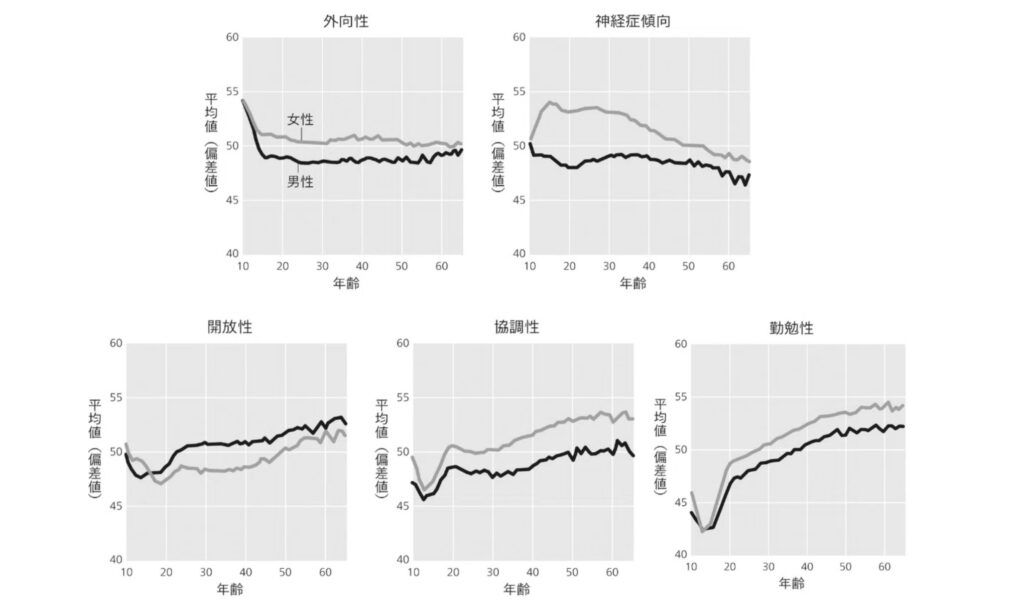
- Extraversion, agreeableness, and neuroticism tend to be higher in women
- Openness tends to be higher in men
- However, these differences are average tendencies, and individual differences are larger
Gender differences in personality are thought to reflect both biological and social factors.
Biological factors such as hormonal balance and brain structure differences will affect emotionality, empathy, and stress reactivity.
Additionally, social factors such as social gender roles and expectations, and educational differences are thought to be involved in the expression and development of personality traits.
However, these differences are merely average tendencies, and individual differences hold greater significance.
Regardless of gender, leveraging each person’s individuality and strengths while compensating for weaknesses will lead to the realization of a rich society.
Understanding the commonalities and differences between genders in personality can be said to be the first step toward overcoming uniform gender perspectives and respecting diversity.
When graphed by gender and age, it looks like the following. (From “What is Personality?” by Shinji Koshio)
The Potential for Lifelong Personality Development
Personality holds the potential to continue developing throughout one’s lifetime.
From the Big Five perspective, the following points can be made:
- Openness, agreeableness, and conscientiousness tend to increase with age
- Neuroticism tends to decrease with age
- Extraversion doesn’t change significantly
These developmental changes are thought to reflect the accumulation of social experiences, changes in values, and biological factors such as brain development and aging.
Personality may change flexibly to adapt to the roles and challenges required at each stage of life.
Furthermore, deepening self-understanding and self-acceptance, as well as improved stress coping abilities, can also be considered factors that promote personality development.
However, there are significant individual differences in personality development, and not everyone necessarily experiences the same changes.
Rather, it’s considered important for each individual to develop various aspects of their personality at their own pace.
Believing in the potential for lifelong personality development leads to maintaining hope and motivation for self-growth.
Regardless of age, the attitude of taking on new experiences and continuing to learn can be said to hold the key to a rich life.
The Importance of Individual Differences: Beyond Uniform Perspectives
When considering gender differences in personality, we must not forget the importance of individual differences.
From the Big Five perspective, the following points can be made:
- Individual experiences, values, and temperament have a greater influence on personality than gender
- Uniform views based on gender risk limiting individual potential
Gender differences in personality represent average tendencies of entire groups and do not determine individual personality.
Moreover, personality is formed not only by innate factors but is greatly influenced by environmental factors.
Experiences and learning in various settings such as home, school, and workplace create individual differences in personality.
It can be said that it’s important to focus on each person’s individuality, strengths, and interests, and to recognize diverse ways of living.
What is required of us may be an attitude that respects each individual’s personality regardless of gender and recognizes diversity.

Writer & Supervisor: Eisuke Tokiwa
Personality Psychology Researcher / CEO, SUNBLAZE Inc.
As a child he experienced poverty, domestic abuse, bullying, truancy and dropping out of school — first-hand exposure to a range of social problems. He spent 10 years researching these issues and published Encyclopedia of Villains through Jiyukokuminsha. Since then he has independently researched the determinants of social problems and antisocial behavior (work, education, health, personality, genetics, region, etc.) and has published 2 peer-reviewed journal articles (Frontiers in Psychology, IEEE Access). His goal is to predict the occurrence of social problems. Spiky profile (WAIS-IV).
Expertise: Personality Psychology / Big Five / HEXACO / MBTI / Prediction of Social Problems
Researcher profiles: ORCID / Google Scholar / ResearchGate
Social & Books: X (@etokiwa999) / note / Amazon Author Page