
Non-Cognitive Ability Test
Sunblaze Test
For Children
Now Recruiting for Trial! Offered at Special Price
Measure Mental Strength in 10 Minutes and Develop Life Skills!
Unlike other non-cognitive ability tests (such as SPI and MBTI), the Sunblaze Test is academically reliable because many research papers are attached to the test results. Also, it is based on HEXACO (explained later) rather than the Big Five, and can identify not only personality traits but also dark traits that pose risks of problematic behaviors, making it possible to prevent various problems.
What You Can Do with the Sunblaze Test

Non-Cognitive Skills Assessment
Understand which abilities in children should be developed.

Group Division
Understand compatibility to create well-balanced class divisions.

Bullying Prevention
By knowing dark traits in advance, you can address issues before they occur.

Educational Impact Assessment
You can understand how much impact homework and events have on students.

01 Quantifying and Visualizing Mental Strength and Characteristics for Personalized Optimal Learning
We present a comprehensive list of cognitive abilities like superficial academic performance and IQ, as well as non-cognitive abilities and their derived tendencies that couldn’t be understood through short interviews, along with supporting research papers.
The Sunblaze Test directly reveals six key areas: ethics and fairness, mental stability, positive emotions, altruism and empathy, self-control and perseverance, and openness to new experiences and intellectual curiosity. These correspond respectively to the six elements of HEXACO.
Furthermore, through combinations of high and low scores in these six areas, we can identify approximately 90 tendencies including non-cognitive abilities, social relationships, and stress coping methods. For example, children who are prone to anxiety should receive more frequent encouragement, while children with high self-control would benefit from being given more active responsibilities.
02 Understanding values that go beyond individual personality to achieve balanced group formation
The Sunblaze Test enables scientific evidence-based decision making by referencing research on children’s diversity and individual compatibility.
In HEXACO, honesty-humility is related to “ethical values,” openness to “novelty,” and conscientiousness to “social norms.” Compatibility can be understood to some extent by how well these values align.
Extroverted and introverted people are needed in a balanced way within groups (classes), and it’s better to have a certain number of people with relatively high agreeableness and conscientiousness in the group (class). Tendencies toward discrimination and prejudice can also be identified, and groups (classes) that value diversity would be better off without such individuals.


03 Identifying children who may engage in problematic behaviors such as bullying at enrollment or grade progression
The Sunblaze Test is based on HEXACO, which has been advancing in research in recent years, rather than the Big Five used by other companies. The honesty-humility factor in HEXACO is related to ethical values, and low scores on this factor are associated with “dark traits,” which involve various unethical behaviors and ways of thinking.
Current measures have many flaws. Bullying surveys only identify problems after harm has occurred, so countermeasures are delayed. There is no evidence that moral education reduces problem behaviors such as bullying. The clincher is that research results show that even those with dark traits can have slightly high EQ (emotional intelligence), so EQ assessment cannot provide complete countermeasures. The ideal is to identify people with potential before harm occurs. There is a clear relationship between HEXACO and children’s problem behaviors, please see these papers (①, ②).
List of Approximately 90 Tendencies
※If there are unnecessary items below, they can be deleted, and if there are items you’d like added, we can research them separately.
- Non-cognitive abilities
- Potential for high IQ・EQ, capable of critical thinking, common among hard workers, high motivation, tends to act proactively, tends to have confidence, tends to have good relationships with others, tends to feel happy, tends to feel lucky, high self-efficacy, strong positive emotions, has resilience
- Stress coping (seeking problem resolution, seeking comfort and empathy from others, engaging in distraction, reframing situations more positively, accepting situations, avoiding problems altogether, denying problems・hiding emotions, hoping for magical salvation, withdrawing, crying・throwing things・self-blame, relying on alcohol or nicotine, participating in religious activities)
- Humble and calm toward risks, less likely to regret after failure, challenges even with risks, tends to have biases
- Dark tendencies (narcissism, psychopathy, Machiavellianism), engages in social loafing, susceptible to conformity pressure
- Perception・Values
- Seeks meaning in life and transcendent matters, tends to blame negative things on the environment
- Schwartz Theory of Basic Values (managing people and resources and seeking money, seeking socially recognized success, seeking pleasure, seeking stimulating experiences, seeking independence of thought and action, seeking equality・social justice・environmental protection, seeking prosperity and happiness of surrounding people, controlling one’s own impulses to meet others’ expectations, preserving tradition, seeking safety and security for self・family・nation)
- Politically prefers left-wing parties・right-wing parties, interested in environmental protection, right-wing authoritarianism (tends to attack those who deviate from norms), social dominance orientation (tends to have discrimination and prejudice)
- Compatible people: xNxx-xL (high openness and honesty-humility), xNxx-xD (high openness, low honesty-humility), xSxx-xL (low openness, high honesty-humility), xSxx-xD (low openness and honesty-humility)
- Academic ability・(Future) work
- Tends to achieve high academic performance, good at online learning, can learn deeply and adapt, sometimes engages in superficial learning and perspectives・responses
- Tend to have higher income, tend to have higher job performance, tend to have successful careers, become good team members, tend to voluntarily quit, get tired easily, prone to burnout
- Tend to produce results in remote work, tend to have high work engagement, have a sense of belonging and attachment to the organization, actively perform work outside the scope of duties
- Voluntarily help colleagues and other individuals, voluntarily act for the benefit of the entire organization, aim to improve and transform organizational and business processes, work across group and job boundaries, good at interpersonal tasks, coaching tends to be effective
- Good at new business and entrepreneurship, tend to become good supervisors, transformational leadership, laissez-faire leadership, destructive leadership
- Like visionary leaders, like friendly leaders, like realistic leaders
All test results come with peer-reviewed papers attached
- Other companies’ non-cognitive ability tests lack scientific evidence because they are independently developed. Having numerical data does not necessarily mean it is objective.
- The Sunblaze Test has been developed through academic processes, and correlation analysis with other psychological scales, as well as validity and reliability analysis have been conducted.
- Additionally, peer-reviewed papers are attached regarding various soft skills that have a high possibility of correlating with test results. While we have not conducted direct correlation analysis with our Sunblaze Test, similar analyses have been performed, making them sufficiently valuable for reference.
- Having scientific evidence is extremely important for accountability when evaluating and judging an individual.
Non-cognitive ability test based on HEXACO
- In personality psychology, a psychological scale called HEXACO has been gaining attention since the 2000s. While the Big Five, which other companies reference in their independent development, expresses personality with 5 factors, HEXACO uses 6 factors, enabling more detailed analysis. Details are here.
- In particular, Honesty-Humility, one of the 6 factors of HEXACO, is related to ethics, and its low levels can determine the Dark Triad (Narcissism, Machiavellianism, Psychopathy). Details are here.
- Research on the Dark Triad has been actively conducted in recent years, and it has been found to be related to not only bullying and academic misconduct, but also harassment, workplace misconduct, criminal behavior, sexual harassment, and other unethical behaviors. International comparisons have also shown that Japanese people have higher levels of Machiavellianism and Psychopathy.
Target Individuals Who Especially Need SunBlaze Testing

Introverted Children
Since they express themselves less, it’s difficult to understand what kind of personality they have.

Children with Only Low Academic Performance
Even with good natural intelligence, low self-control makes it difficult to achieve high academic performance.

Children Who Appear to Be Model Students
Even if there are no problems in front of the teacher, there may be cases where they cause problems behind the scenes.
Actual Usage Flow

①Contact us and verify educational credentials
Please contact us from here. Proof of educational credentials is required.

②Students or children under support respond
Email address required for invitation. Can be answered on smartphone/PC/tablet.

③We submit response results in CSV format
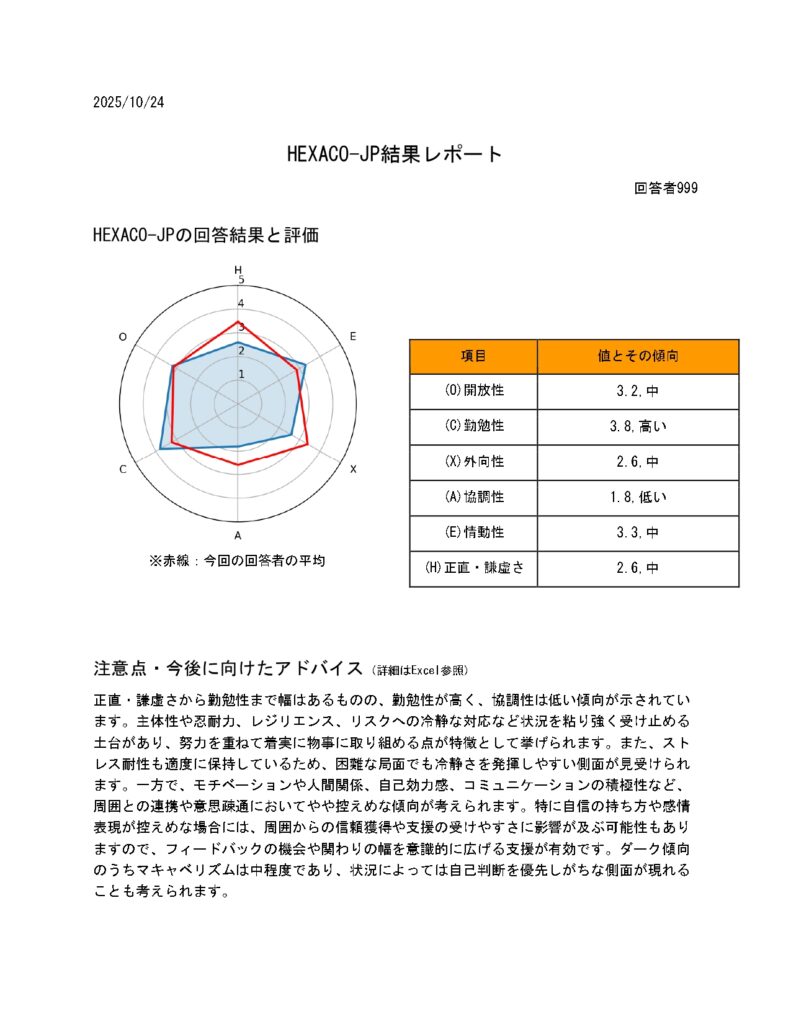
Results data and presence/absence of characteristics are output in a list format. You can analyze freely.
※Separately, we can also provide feedback reports as shown below.
Pricing
6.5 USD per person + 10% tax
*Please check here for Japanese yen conversion at current exchange rates.
*Currently offered at a special price during the trial period.
*Free members can initially invite 1 person, paid members (500 yen per month) can invite up to 5 people.
*There are no initial fees or other costs. Therefore, volume discounts are not offered.
*For wholesale pricing inquiries, please contact us separately through our contact form.
Bonus “Soft Skills Handbook”
Explaining further details of your test results! We present the “Soft Skills Handbook” (partial excerpt below). You can view it from each invitation screen of the invitation function.
HEXACO-JP API
You can embed our personality assessment into your company’s web/app services and retrieve data. It can be used at a lower cost than the invitation function. Like the invitation function, it can be used from “Business Use“. Details are below.
代表の紹介
株式会社SUNBLAZE 代表取締役 常盤瑛祐(ときわえいすけ)。幼少期より家庭や学校にてダーク特性のある人たちから様々な被害に遭い、不登校・うつ・中退を経験。その原体験から、2010年から政策提言やアート活動、ソーシャルビジネスなど様々な社会活動を行い、2021年「悪者図鑑」を出版。さらに学術的な知見をためるため、2024-25年は論文5本を執筆し、うち3本は海外のジャーナルに掲載。HEXACOベースのサンブレイズテストの開発者。博士号取得を目指している。心の強さ、非認知能力、ソフトスキルに強い関心がある。
FAQ
- How long does the Sunblaze Test take?
- The 24-question version takes 2-3 minutes, the 60-question version takes 5-6 minutes, and the 100-question version takes 10 minutes.
- Is it possible to try the Sunblaze Test as a trial?
- What is the difference between the individual version (HEXACO-JP) and the Sunblaze Test (for corporations)?
- The corporate version allows you to “view other people’s responses in a CSV list format.”
- When using our system, you need to enter an email address.
- If it is difficult to use our system due to personal information concerns, responses via Excel files are also possible, though this would require a separate quote.
- The paid version of HEXACO-JP for individuals allows you to learn about an even wider range of categories (such as health and romance) than the Sunblaze Test.
- The corporate version allows you to “view other people’s responses in a CSV list format.”
- Are volume discounts available?
- There is no initial fee, and we offer special trial pricing at very affordable rates, so we currently do not offer volume discounts.
- Do other companies’ aptitude tests and personality tests lack scientific evidence?
- Scientific evidence here refers to whether the personality tests (psychological scales) used have been subjected to correlation analysis with psychological scales in existing peer-reviewed papers, validity and reliability analysis of questionnaire items, and correlation analysis between test results and actual behavior.
- For example, even if results evaluate someone as work-focused or private life-focused, it cannot be trusted without evidence of what constitutes work-focused or private life-focused.
- How does the Sunblaze Test handle false responses?
- If an account is created, the number of responses and response time are measured, so the possibility of countermeasures can be excluded.
- Each question is not designed to make it easy to predict the HEXACO 6 factors, and statistical processing reveals the consistency of responses.
- While there are good and bad aspects to soft skills, please communicate to subjects that this is simply “understanding personality traits.”
- Why do the results of the Sunblaze Test differ from MBTI/16personalities results?
- Since personality is influenced by genetics and environment, responses change when the environment changes (e.g., emotionality changes when tired). For more details on genetics, see here.
- Personality changes with age and life events. Response variations depend on age. For more details, see here.
- Type classification is based on whether each value is 3 or above, or below 3, so values close to 3 are more likely to change depending on how questions are asked or the environment at the time. Please look at the numerical values rather than the type.
- The extent of statistical processing in the question design stage for MBTI (original) and 16personalities (commonly called MBTI diagnosis) is unclear as no relevant papers can be found. On the other hand, such papers for Big Five and HEXACO are easily found, and this HEXACO-JP diagnosis has gone through an academic development process and is published as a paper.
- While MBTI and 16personalities have relatively few research papers comparing them with everyday behaviors (academic ability, income, etc.) or brain/genetic factors, Big Five and HEXACO have numerous studies.
- HEXACO is essentially a variation of Big Five elements, so they are similar but different. HEXACO’s Honesty-Humility is extracted from Big Five’s Agreeableness and Neuroticism. For details, see here.
- Are test results absolutely correct?
- Personality is influenced by both genetics and environment. Due to genetic influence, there is a certain range of variation, but results can fluctuate to some extent depending on environmental factors.
- Also, while research papers on Big Five and HEXACO conduct correlation analysis with academic ability, income, etc., the correlation coefficients are not as large as those in natural science experiments. Correlation coefficients range from a minimum of -1 to a maximum of 1, but most are around -0.4 to 0.4. Of course, some are higher, but they’re not 0.8 or 0.9 – they’re relatively low compared to those.
- However, since various studies do exist, please think of it as “more than fortune-telling, less than natural science.” I’m not 100% denying psychology or fortune-telling.