
If you’ve ever wondered whether a personality disorder or any other psychological trait might be influencing your daily life, standardized psychological measurement tools — known as psychometric scales — can offer surprisingly clear insights. These are not casual online quizzes. They are rigorously designed, scientifically validated instruments used by researchers and clinicians to measure invisible aspects of the mind, from emotional states and cognitive patterns to interpersonal tendencies and mental health. This article breaks down exactly what these tools are, how they differ from everyday personality tests, and how you can use them to better understand yourself.
The results of any psychological assessment should never be treated as a final verdict. Research consistently suggests that our psychological characteristics are dynamic — shaped by context, experience, and growth. Think of these tools as a mirror: they reflect tendencies worth exploring, not fixed labels to be accepted without question. Let’s explore what psychometric scales can reveal and why they matter.
Once again, personality researcher and author of Villain Encyclopedia, Tokiwa (@etokiwa999), will provide the explanation.
※We have developed the HEXACO-JP Personality Assessment! It has more scientific basis than MBTI. Tap below for details.

目次
- 1 What Is a Psychometric Scale? A Clear Definition
- 2 Psychometric Scales vs. Personality Tests vs. Psychological Assessments: Key Differences
- 3 What Psychometric Scales Can Reveal About You
- 4 Major Categories of Standardized Psychological Tests
- 5 How to Use Psychometric Scales Wisely: Actionable Guidance
- 6 Frequently Asked Questions
- 6.1 What is the difference between a psychometric scale and a regular personality test?
- 6.2 Can a psychometric scale diagnose a personality disorder?
- 6.3 What does “reliability” mean when talking about psychological assessment tools?
- 6.4 Are Big Five personality scales useful for understanding personality disorder traits?
- 6.5 How is the PANAS different from a general wellbeing questionnaire?
- 6.6 What is the Sense of Coherence (SOC) scale and why does it matter?
- 6.7 Can psychometric scale results change over time?
- 7 Summary: Using Psychological Measurement to Know Yourself Better
What Is a Psychometric Scale? A Clear Definition
Defining Psychological Measurement Tools
A psychometric scale is a structured questionnaire or test designed to convert psychological characteristics — such as personality traits, emotional states, thinking patterns, and behavioral tendencies — into numerical scores. This quantification allows researchers and practitioners to study and compare mental phenomena in an objective, repeatable way.
In most psychometric scales, respondents rate how strongly each statement applies to them, typically on a 4- or 7-point scale (for example, from “not at all like me” to “very much like me”). Their responses are then tallied to produce a score that reflects their standing on a particular psychological dimension.
Importantly, a well-constructed psychometric scale satisfies 2 core statistical requirements:
- Reliability — the scale produces consistent results under similar conditions
- Validity — the scale genuinely measures what it claims to measure
Without these properties, a scale’s results cannot be trusted. This is what separates scientifically developed psychometric tools from informal personality quizzes found on social media.
Why Are Psychological Measurement Tools Valuable?
The primary purpose of a psychometric scale is to make the invisible visible — to give measurable form to inner experiences that are otherwise difficult to observe or compare. These tools serve both research and real-world practice.
In research settings, scales are used to investigate relationships between psychological variables (for example, how perfectionism relates to procrastination), to evaluate the effectiveness of therapy programs, and to track changes in mental health over time. In clinical and counseling settings, they help practitioners understand an individual’s baseline, monitor progress, and tailor interventions.
Concretely, psychological measurement tools can help with:
- Identifying individual personality tendencies and behavioral patterns
- Quantifying emotional states and how they shift over time
- Revealing cognitive biases or distorted thinking habits
- Measuring mental health and overall psychological adjustment
- Exploring the roots of interpersonal challenges
In short, psychometric scales transform subjective experience into data — making self-understanding both deeper and more precise.
Psychometric Scales vs. Personality Tests vs. Psychological Assessments: Key Differences
Many people use terms like “personality test,” “psychological test,” and “psychological assessment” interchangeably, but they actually refer to distinct concepts. Understanding these differences helps you choose the right tool for the right purpose.
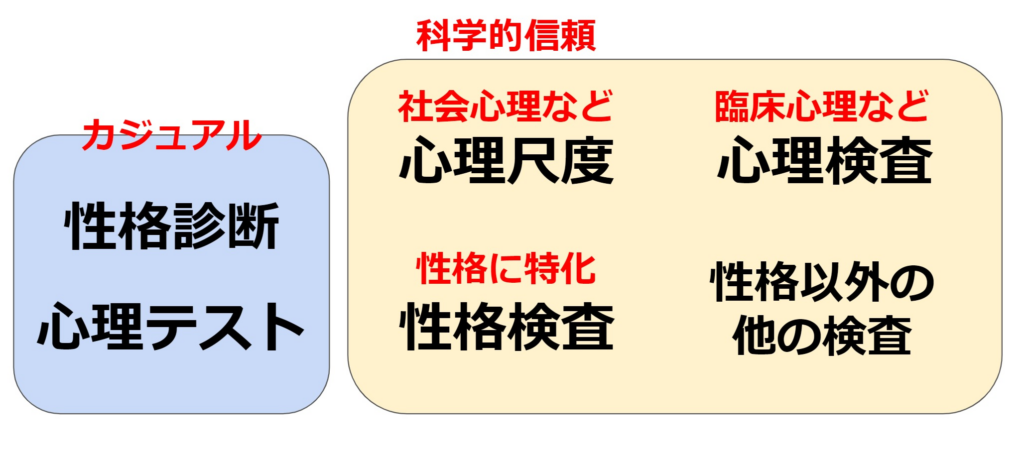
Personality Diagnosis vs. Personality Assessment
A personality diagnosis (性格診断 in Japanese) refers to casual, accessible tools like 16Personalities — fun, quick, and easy to complete, but not necessarily designed to meet academic or clinical standards. In contrast, a personality assessment (性格検査) refers to tools grounded in scientific theory, such as the Big Five personality inventories, that are developed or administered by professionals and statistically validated.
Casual personality diagnoses are a great starting point for self-exploration, but if you want more accurate, reliable insights — especially related to concerns like a personality disorder or emotional regulation difficulties — a formal personality assessment tends to offer far more depth and rigor.
Personality Diagnosis vs. Psychological Test
In everyday casual usage, “personality diagnosis” and “psychological test” are often treated as the same thing — both describe accessible, informal self-assessment tools. However, a psychological test is technically the broader category: it can measure not just personality, but any psychological characteristic, including emotional regulation, cognitive style, or stress resilience.
Think of personality diagnosis as a subset of psychological tests — one that focuses specifically on character and temperament. When someone says “I took a psychological test,” they might mean anything from a quick online quiz to a professionally administered inventory.
Psychological Test vs. Psychometric Scale
The critical distinction here is scientific rigor: casual diagnostic tools are called psychological tests, while academically and scientifically validated measurement instruments are called psychometric scales (心理尺度).
Psychometric scales are developed through extensive research, factor analysis, and cross-validation with large samples. Their reliability and validity are statistically verified — typically through peer-reviewed publication. Because of this, psychometric scales are primarily used in academic research and require some specialist knowledge to interpret correctly.
In other words, every psychometric scale could loosely be called a psychological test, but not every psychological test qualifies as a psychometric scale.
Psychological Examination vs. Psychometric Scale
A psychological examination (心理検査) is used in clinical psychology and mental health support — it is a practical measurement tool deployed in therapeutic or diagnostic contexts, including the assessment of a potential personality disorder. A psychometric scale (心理尺度), by contrast, is the broader academic term used primarily in basic research fields such as personality psychology and social psychology.
Practically speaking: if a licensed psychologist administers a structured test in a clinic to help determine whether a patient meets criteria for a clinical condition, that is a psychological examination. If a researcher uses a validated questionnaire in a study to measure narcissistic tendencies across a university sample, that is a psychometric scale. The tools can overlap significantly — but context and purpose distinguish them.
Personality Assessment vs. Psychometric Scale
A personality assessment is a specific type of psychometric scale — one that focuses exclusively on measuring personality traits. Psychometric scales, however, cover a far wider range of constructs: intelligence, values, emotional regulation, stress resilience, cognitive distortions, and more.
So while all personality assessments are psychometric scales, not all psychometric scales are personality assessments. Whenever you hear about a tool used to screen for a personality disorder or measure conscientiousness, you are dealing with a psychometric scale that happens to focus on personality.
What Psychometric Scales Can Reveal About You
Understanding Your Personality and Behavioral Tendencies
One of the most powerful uses of psychometric scales is gaining an objective understanding of your own personality and habitual behaviors. Rather than relying on gut feeling or others’ opinions, you can see where you stand on well-researched psychological dimensions.
Personality and temperament scales can illuminate traits such as:
- Degree of extraversion or introversion
- Emotional stability or neuroticism
- Agreeableness versus antagonism
- Conscientiousness versus impulsiveness
- Openness to new experiences
Cognitive tendency scales add another layer. Research shows that scales measuring perfectionism — for example, the multidimensional perfectionism cognition scale — can reveal whether your drive for high standards is adaptive (motivating you to grow) or maladaptive (leading to anxiety and procrastination). Studies indicate that procrastination behavior correlates significantly with both perfectionism and anxiety levels, making these scales useful diagnostic complements.
Behavioral scales, such as the Japanese version of the General Procrastination Scale, help you see your action patterns with fresh objectivity — a valuable step toward meaningful behavioral change.
Mapping Your Emotional Landscape
Emotions are notoriously difficult to describe precisely, but standardized emotional assessment tools give you a structured vocabulary for what you’re feeling — and how intensely you’re feeling it.
Representative emotional measurement tools include:
- PANAS (Positive and Negative Affect Schedule) — measures the strength of positive versus negative emotions separately, revealing your overall emotional balance
- State Self-Esteem Scale — captures momentary fluctuations in self-worth, rather than fixed trait-level self-esteem
- Depression Checklist (revised Japanese version) — assesses the presence and severity of depressive mood
A particularly interesting research finding is that variability in self-esteem — how much your sense of self-worth fluctuates day to day — tends to be associated with psychological maladjustment, even when average self-esteem is relatively high. Diary-method studies using repeated emotional measurement have illuminated this pattern. This suggests that emotional stability, not just emotional positivity, matters for wellbeing.
By tracking emotional states over time with validated tools, you can identify patterns you might otherwise miss — such as predictable mood dips linked to certain situations or relationships.
Identifying Cognitive Biases and Distorted Thinking
Many of our everyday struggles — from persistent worry to relationship friction — stem not from external circumstances but from predictable, measurable patterns in our thinking. Psychometric scales designed to assess cognitive distortions can pinpoint these patterns with precision.
Tools in this category include:
- Irrational Beliefs Measurement Scale — identifies rigid, unrealistic expectations that tend to fuel emotional distress
- ATQ-R (Automatic Thoughts Questionnaire — Revised) — measures the frequency of positive automatic thoughts and their role in psychological resilience
- Paranoia Checklist (Japanese version) — evaluates the frequency, conviction, and distress associated with suspicious or persecutory thinking
- Multidimensional Perfectionism Cognition Scale — breaks perfectionism into distinct sub-types with different implications for mental health
These scales are especially relevant in cognitive behavioral therapy (CBT) contexts, where identifying specific cognitive distortions is the first step toward challenging and restructuring them. Research suggests that high scores on paranoia or irrational belief scales are meaningfully associated with clinical-level distress — making these tools useful not just for research but for shaping individualized therapeutic approaches.
Assessing Interpersonal Patterns and Relationship Tendencies
How we connect with others — or struggle to connect — is one of the richest areas that psychometric scales can illuminate, with direct relevance to understanding conditions like personality disorder traits.
Key interpersonal scales include:
- ECR-GO (Experiences in Close Relationships — General Objects) — measures adult attachment style along 2 dimensions: fear of abandonment and avoidance of intimacy
- Interpersonal Fear and Narcissistic Tendency 2D Model Scale — captures the interplay between social anxiety and self-centered patterns
- Intolerance of Ambiguity in Social Situations Scale (Revised) — assesses discomfort with unclear social signals, which tends to predict social withdrawal
- Motivation for Friendship Relationships Scale — reveals whether friendships are motivated by genuine connection, approval-seeking, or fear of isolation
Research suggests, for example, that high interpersonal fear tends to co-occur with narcissistic vulnerability and lower self-esteem — a pattern relevant to understanding certain personality disorder presentations. Meanwhile, the type of motivation driving friendships has been shown to predict both relationship quality and overall life satisfaction in meaningful ways.
Discovering Your Strengths, Aptitudes, and Blind Spots
Psychometric tools are not only useful for identifying problems — they are equally valuable for discovering what you are genuinely good at and where you naturally thrive.
Aptitude-related scales include vocational interest inventories (such as the VPI, which measures strength of interest across 6 domains: realistic, investigative, artistic, social, enterprising, and conventional) and career self-efficacy scales that assess confidence in making educational and occupational decisions.
Strength-and-weakness scales include:
- General Self-Efficacy Scale — how confident you are in your ability to handle challenges across different areas of life
- Narcissistic Personality Inventory (NPI-35) — measures grandiosity, need for admiration, and sense of superiority, which in moderate doses can drive leadership but in excess may indicate maladaptive patterns
Understanding your aptitudes and blind spots through validated measurement helps you make more intentional choices — in careers, relationships, and personal growth — rather than stumbling through trial and error.
Major Categories of Standardized Psychological Tests
Personality and Temperament Scales
Personality measurement tools are among the most widely used and thoroughly researched psychometric scales in existence. The most influential include:
- NEO-PI-R — measures the Big Five personality traits (Neuroticism, Extraversion, Openness, Agreeableness, Conscientiousness) across 30 facets, providing an extraordinarily detailed personality profile
- HEXACO Personality Inventory — extends the Big Five by adding a 6th dimension: Honesty-Humility, which research suggests is especially relevant to ethical behavior and workplace integrity
Both tools are theoretically grounded, standardized on large samples, and supported by decades of accumulated research findings. They can be used to understand everyday personality variation, but also to identify patterns consistent with personality disorder traits when administered in clinical contexts.
Mood and Emotional State Scales
Unlike personality traits (which tend to be relatively stable across time), mood and emotion fluctuate — and specialized scales are designed to capture this moment-to-moment variation.
Leading emotional assessment tools include:
- POMS (Profile of Mood States) — assesses 6 distinct mood dimensions: Tension-Anxiety, Depression-Dejection, Anger-Hostility, Vigor, Fatigue, and Confusion
- PANAS (Positive and Negative Affect Schedule) — separately measures positive affect (energy, enthusiasm) and negative affect (distress, hostility), enabling a nuanced emotional balance assessment
- GHQ (General Health Questionnaire) — screens for psychological distress across 4 domains: somatic symptoms, anxiety and insomnia, social dysfunction, and severe depression
- SDS (Self-Rating Depression Scale) — a 20-item self-report inventory widely used to assess depressive symptom severity
The POMS is particularly popular in sports psychology and wellness research because it can be administered quickly (approximately 5 minutes) and provides an at-a-glance snapshot of an individual’s current emotional profile. Research shows that the PANAS’s 2-dimensional structure — measuring positive and negative affect as largely independent axes rather than opposites — has important implications: you can simultaneously feel both energized and anxious, which a single-axis scale would miss entirely.
Mental Health, Adjustment, and Resilience Scales
Beyond measuring symptoms, psychological measurement tools can also assess how well a person is coping with life’s demands — capturing psychological strengths and adaptive resources, not just vulnerabilities.
Key tools in this category include:
- GHQ (General Health Questionnaire) — widely used for broad mental health screening in both clinical and community settings
- CMI (Cornell Medical Index) — a comprehensive health questionnaire covering approximately 195 items across physical and psychiatric domains
- Sense of Coherence Scale (SOC) — measures stress-coping capacity through 3 sub-dimensions: Comprehensibility (the world makes sense), Manageability (you have the resources to cope), and Meaningfulness (life feels worth engaging with)
The SOC scale is rooted in the “salutogenic” (health-building) model of psychology — it asks not “what makes people sick?” but “what keeps people healthy despite stress?” Research indicates that individuals with high SOC scores tend to show better physical health outcomes, lower levels of burnout, and greater life satisfaction, even under objectively demanding conditions.
Newly Developed and Specialized Scales
The field of psychological measurement is continuously evolving, with 3 notable development trends: shorter forms, culturally adapted versions, and tools tailored to specific populations.
Shortened scales reduce respondent burden while preserving the essential measurement properties of the original. For example, the Ten Item Personality Inventory (TIPI) — with only 10 items — captures all 5 Big Five personality dimensions in roughly 2 minutes, making it ideal for large-scale surveys where time is limited.
Culturally adapted (Japanese-language) versions of international scales are particularly important when the source culture’s assumptions may not apply universally. For instance, the Japanese version of the PANAS, the Japanese Paranoia Checklist, and the Japanese Adult Effortful Control Scale have all been validated specifically with Japanese samples — ensuring their scores are interpretable within that cultural context.
Population-specific scales focus on groups with unique measurement needs:
- Problem Behavior Scale for Preschoolers (caregiver-rated) — designed for young children who cannot self-report
- Self-Image Instability Scale for upper elementary and middle school students — captures identity turbulence during early adolescence
- Gender Identity Scale — measures the strength of identification with specific gender categories
- Humor Coping with Interpersonal Stress Scale (HCISS) — assesses how individuals use humor as a stress management strategy in social situations
These specialized tools reflect a recognition that psychological measurement must be sensitive to context — what works for an adult in one culture may be entirely inappropriate for a child in another.
How to Use Psychometric Scales Wisely: Actionable Guidance
Choose a Scale That Fits Your Actual Goal
The most important practical step is matching the scale to your specific purpose — not simply choosing whatever tool appears first in a search result.
Before selecting a scale, ask yourself these 5 questions:
- Does this scale measure what I actually want to understand (personality, emotion, behavior, relationships)?
- Is it appropriate for my age group, cultural background, and situation?
- Is the time required to complete it realistic for my context?
- Has its reliability and validity been verified in peer-reviewed research?
- Are there reference data or norms available so I can interpret my scores meaningfully?
For example, if you want to understand your general personality, a Big Five-based scale like the NEO-PI-R or TIPI is a strong starting point. If you are experiencing relationship difficulties that might relate to a personality disorder pattern — such as intense fear of abandonment or chronic emptiness — an attachment style scale like the ECR-GO combined with clinical consultation would be more appropriate. In clinical settings, prioritize scales that are sensitive to symptom severity and capable of tracking changes across treatment sessions. For general wellness contexts, a resilience-focused tool like the SOC scale might be most illuminating.
Practical tips for finding the right fit: research the tool’s background before using it, compare 2 or 3 candidate scales side-by-side, consult a psychology professional if the purpose is clinical, and when possible, try a practice run to assess whether the items feel comprehensible and relevant.
Interpret Results with Nuance, Not Rigidity
A psychometric score is a starting point for reflection, not a conclusion — and interpreting results well requires considering the full picture rather than fixating on a single number.
Effective interpretation involves:
- Understanding what the scale actually measures and what its scores represent
- Situating your individual score relative to population norms (are you in the top 20%? The average range?)
- Exploring the life experiences or situational factors that might be driving a particular result
- Cross-referencing scale results with other sources of information — such as self-reflection, trusted feedback from others, or clinical observation
- Recognizing the limitations of self-report: people sometimes answer based on how they wish to appear rather than how they actually tend to behave
For example, if a depression scale returns a high score, the appropriate response is not to immediately conclude “I am depressed” — but to ask: What has been happening in my life recently? Have I been sleeping poorly? Are these feelings new, or have they persisted for weeks? Situational distress and clinical depression can produce similar scores on a screening tool, but they have very different implications for action. Always consider the human context behind the numbers.
Furthermore, research consistently suggests that psychological traits are not fixed — they can change meaningfully across years and decades, particularly in response to deliberate practice, therapy, and life experience. A high neuroticism score today is a useful data point, not a life sentence.
Frequently Asked Questions
What is the difference between a psychometric scale and a regular personality test?
A psychometric scale is a scientifically developed measurement tool whose reliability (consistency) and validity (accuracy) have been verified through peer-reviewed statistical research. A regular personality test — such as those found on social media or entertainment websites — is typically designed for accessibility and engagement rather than scientific precision. Psychometric scales are used in academic research and clinical practice; casual personality tests are useful for entertainment or initial self-exploration but should not be used for clinical conclusions.
Can a psychometric scale diagnose a personality disorder?
No — a psychometric scale alone cannot diagnose a personality disorder. Formal diagnosis requires a comprehensive evaluation by a licensed mental health professional, typically involving structured clinical interviews, behavioral history, and collateral information. However, certain standardized psychological tests — such as personality inventories and attachment style scales — can provide clinically meaningful data that supports a professional’s assessment process. Think of psychometric scales as valuable screening and measurement tools, not diagnostic instruments in isolation.
What does “reliability” mean when talking about psychological assessment tools?
In the context of psychometric scales, reliability refers to the consistency of the tool’s results. A reliable scale produces similar scores when administered to the same person under similar conditions — it doesn’t fluctuate wildly based on minor changes in wording or testing environment. The most common reliability measure is Cronbach’s alpha, where values above approximately 0.70 are generally considered acceptable for research purposes. High reliability is a necessary (though not sufficient) condition for a scale to be scientifically useful.
Are Big Five personality scales useful for understanding personality disorder traits?
Research suggests that the Big Five framework — particularly the dimension of Neuroticism — shows meaningful overlap with several personality disorder patterns. For example, extremely high Neuroticism combined with very low Agreeableness tends to appear more frequently in individuals with borderline or antisocial personality disorder traits. However, the Big Five captures personality as dimensional variation across the general population, whereas personality disorder criteria involve clinically significant impairment. The two frameworks are complementary rather than interchangeable, and Big Five scales work best as one part of a broader assessment approach.
How is the PANAS different from a general wellbeing questionnaire?
The PANAS (Positive and Negative Affect Schedule) measures 2 independent emotional dimensions — positive affect and negative affect — rather than wellbeing as a single continuous scale. This distinction matters: research shows you can simultaneously score high on both (feeling excited but also irritable) or low on both (feeling calm but also slightly down). General wellbeing questionnaires often collapse these into one score, missing this complexity. The PANAS is especially valued in emotion research and short-term mood tracking for this reason.
What is the Sense of Coherence (SOC) scale and why does it matter?
The Sense of Coherence (SOC) scale measures an individual’s capacity to cope with stress — not by assessing how much stress they face, but by evaluating 3 internal resources: the ability to understand their situation (Comprehensibility), the confidence that they can manage it (Manageability), and the sense that it is worth engaging with (Meaningfulness). High SOC scores are associated with better physical health, lower burnout rates, and greater life satisfaction. It is a notable example of a “salutogenic” scale — one designed to measure what promotes health rather than what causes illness.
Can psychometric scale results change over time?
Yes. While some psychological traits — particularly broad personality dimensions — tend to be relatively stable across years, research consistently shows they are not fixed. Studies tracking individuals across decades find gradual but meaningful changes, particularly in Neuroticism (which tends to decrease with age) and Conscientiousness (which tends to increase). Emotional state scales, by design, capture fluctuation across hours or days. Even trait-level scales can shift in response to significant life events, therapy, and deliberate behavioral change. This is why psychometric results should be viewed as a current snapshot rather than a permanent identity.
Summary: Using Psychological Measurement to Know Yourself Better
Psychometric scales and standardized psychological tests represent some of the most powerful evidence-based tools available for understanding the human mind — from Big Five personality measurement and emotional assessment tools to cognitive distortion inventories and interpersonal attachment scales. They can reveal patterns linked to a personality disorder, expose hidden emotional tendencies, map behavioral habits, and illuminate relationship dynamics that might otherwise remain invisible. The key is to approach them with both curiosity and appropriate caution: use results as a lens for deeper self-understanding rather than a definitive label, choose tools that match your actual goals, and seek professional guidance when results raise clinical concerns.
If what you’ve read has sparked curiosity about your own psychological profile, the next step is exploring which specific dimensions resonate with your current questions — whether that’s personality traits, emotional balance, stress resilience, or interpersonal patterns. Browse the validated assessments available on sunblaze.jp and begin mapping the psychological landscape that is uniquely yours.

Writer & Supervisor: Eisuke Tokiwa
Personality Psychology Researcher / CEO, SUNBLAZE Inc.
As a child he experienced poverty, domestic abuse, bullying, truancy and dropping out of school — first-hand exposure to a range of social problems. He spent 10 years researching these issues and published Encyclopedia of Villains through Jiyukokuminsha. Since then he has independently researched the determinants of social problems and antisocial behavior (work, education, health, personality, genetics, region, etc.) and has published 2 peer-reviewed journal articles (Frontiers in Psychology, IEEE Access). His goal is to predict the occurrence of social problems. Spiky profile (WAIS-IV).
Expertise: Personality Psychology / Big Five / HEXACO / MBTI / Prediction of Social Problems
Researcher profiles: ORCID / Google Scholar / ResearchGate
Social & Books: X (@etokiwa999) / note / Amazon Author Page