
The preschool education long-term effects revealed by decades of scientific research are far more profound than most parents and policymakers realize. Quality early childhood education does not simply prepare children to sit quietly in a kindergarten classroom — it shapes their cognitive abilities, social skills, employment prospects, and even their likelihood of avoiding criminal behavior well into adulthood. The evidence is compelling enough that understanding it could meaningfully change how families, schools, and governments prioritize the earliest years of a child’s life.
One of the most powerful sources of that evidence is the HighScope Perry Preschool Program, a landmark American study that ran from 1962 to 1967 and tracked participants all the way to age 40. In this article, we will explore what that program found, why high-quality preschool works, and what its findings mean for children, families, and society at large.
Once again, personality researcher and author of Villain Encyclopedia, Tokiwa (@etokiwa999), will provide the explanation.
※We have developed the HEXACO-JP Personality Assessment! It has more scientific basis than MBTI. Tap below for details.

目次
- 1 What Is Preschool Education and Why Does It Matter?
- 2 Short-Term Gains: What Children Develop in the Preschool Years
- 3 The HighScope Perry Preschool Program: A Landmark Study on Preschool Education Long-Term Effects
- 4 Preschool Education Long-Term Effects: What the Data Revealed at Age 40
- 5 Actionable Insights: Applying the Research to Real-World Preschool Decisions
- 6 Frequently Asked Questions
- 6.1 At what age do the benefits of preschool education start to appear?
- 6.2 How long do the effects of preschool education actually last?
- 6.3 What are the key features of a high-quality preschool program?
- 6.4 What is the return on investment for society when it funds quality preschool?
- 6.5 Do disadvantaged children benefit more from preschool than children from wealthier backgrounds?
- 6.6 Is the Perry Preschool research still relevant today, given how old the study is?
- 6.7 How does preschool education affect children’s social and emotional development specifically?
- 7 Summary: What Decades of Research Tell Us About Investing in Early Childhood
What Is Preschool Education and Why Does It Matter?
Defining Preschool Education
Preschool education refers to any organized learning program designed for children before they enter compulsory primary school, typically targeting ages 3 to 5. It encompasses a wide range of settings — kindergartens, daycare centers, nursery schools, and structured play-based programs — but all share the central goal of supporting children’s intellectual, social, emotional, and physical development during one of the most sensitive periods of human growth.
During these early years, the brain develops at a rate that will never be matched again. Research in developmental neuroscience suggests that more than 1 million new neural connections form every second in a young child’s brain. This biological reality makes the preschool years an extraordinary window of opportunity: the right experiences can build cognitive and emotional foundations that support learning and well-being for decades to come.
Preschool education tends to focus on school readiness benefits such as early literacy, numeracy, and the ability to follow instructions. However, its most enduring contributions may actually lie in less visible areas — how a child regulates emotions, collaborates with peers, handles frustration, and sustains curiosity. These non-cognitive skills, sometimes called “soft skills” or social-emotional competencies, are increasingly recognized by researchers as powerful predictors of life outcomes.
What Makes Preschool Education “High Quality”?
Not all preschool programs produce the same outcomes — the quality of the program is the decisive factor. Research on early childhood education consistently identifies several hallmarks of effective programs, and understanding these characteristics can help parents and policymakers distinguish truly beneficial environments from those that offer little more than supervised play.
The first hallmark is a developmentally appropriate environment. This means the physical space, materials, and activities are designed to match where children are in their developmental journey, not where adults wish they were. Key elements include:
- Safe, hygienic, and stimulating facilities — clean spaces that invite exploration without unnecessary hazards
- Engaging, age-appropriate materials — toys, books, and art supplies that spark curiosity rather than passive consumption
- Structured but flexible daily routines — enough predictability to build security, with room for child-initiated discovery
The second hallmark is the quality of the educator. Skilled preschool teachers do far more than supervise — they observe each child closely, ask open-ended questions, scaffold problem-solving, and provide individualized encouragement. Studies indicate that teacher responsiveness may be one of the single strongest predictors of a preschool program’s effectiveness.
Third, meaningful parental involvement amplifies results. When teachers and families communicate regularly, align their approaches, and share observations about a child’s progress, the child benefits from consistent support across home and school environments. High-quality preschool education is therefore not a replacement for parenting — it is a powerful complement to it.
Short-Term Gains: What Children Develop in the Preschool Years
Children who participate in quality early childhood education programs tend to show measurable improvements across cognitive, social, and emotional domains within a relatively short time. These near-term gains are important in their own right, but they also serve as the building blocks for the longer-term outcomes that have attracted so much attention from researchers and policymakers.
On the cognitive side, preschool-educated children commonly develop stronger language skills, broader vocabulary, and an earlier grasp of basic mathematical concepts. Early intervention programs like Head Start in the United States have reported improvements in pre-reading skills and receptive vocabulary after just one year of participation. These gains translate into greater readiness for the formal academic demands of elementary school.
Socially, preschool environments expose children to peer interaction in ways that home settings rarely replicate. Navigating disagreements over toys, learning to take turns, and cooperating on group projects all build the social competencies that become invaluable in school and beyond. Research suggests that children who enter primary school with stronger social skills tend to form better relationships with both teachers and classmates, which in turn supports continued academic motivation.
Emotionally, structured preschool programs appear to strengthen children’s self-regulation — the ability to manage impulses, tolerate frustration, and persist through difficulty. Consider the following short-term benefits commonly observed:
- Improved attention span and task persistence — critical for classroom learning at every level
- Better emotional expression and coping skills — children learn to name feelings and seek support appropriately
- Enhanced curiosity and intrinsic motivation — play-based learning cultivates the love of discovery rather than fear of failure
- Stronger executive function — including working memory and cognitive flexibility, two abilities linked to long-term academic and life success
These short-term gains matter because they are not isolated achievements — they compound over time. A child who enters first grade with solid language skills, emotional self-control, and genuine curiosity is positioned to extract far more from every subsequent year of schooling than a child who begins on the back foot.
The HighScope Perry Preschool Program: A Landmark Study on Preschool Education Long-Term Effects
Background and Design of the Study
The HighScope Perry Preschool Program is widely regarded as one of the most methodologically rigorous and consequential studies ever conducted on early childhood education research. Launched in Ypsilanti, Michigan between 1962 and 1967, it set out to answer a question that was politically and scientifically urgent at the time: could high-quality preschool education improve the life trajectories of children growing up in poverty?
The researchers selected 123 African American children from low-income households in a disadvantaged neighborhood. All participants scored in the borderline range on standardized intelligence tests at the outset, with IQ scores between approximately 70 and 85. This was a deliberate choice — the researchers wanted to study children who faced the greatest developmental risks and who, if preschool truly worked, stood to benefit the most.
Participants were randomly assigned to one of 2 groups:
- Program group (58 children) — received high-quality preschool education for 2 years
- Control group (65 children) — received no preschool intervention
Random assignment was carefully balanced by gender, IQ score, and family background, ensuring that any differences observed later could be attributed to the preschool experience rather than pre-existing individual differences. Data was collected annually from ages 3 to 11, then again at ages 14, 15, 19, 27, and 40 — making this one of the longest-running longitudinal studies in early childhood education research.
What the Program Actually Looked Like
The Perry Preschool Program was not a passive care arrangement — it was an intellectually intentional, child-centered curriculum built on active learning principles. Children attended 5 days a week, for 2.5 hours each morning, over a 2-year period spanning ages 3 and 4. Each classroom maintained a teacher-to-child ratio of approximately 1 teacher for every 5 to 6 children, with classes capped at around 20 to 25 children total — a ratio widely associated with improved educational outcomes.
The curriculum followed a “plan-do-review” cycle, a structured approach in which children:
- Plan — chose their own activities at the start of each session, developing autonomy and foresight
- Do — engaged in their chosen activity with teacher support, building hands-on knowledge
- Review — reflected on and shared what they had done, reinforcing language, memory, and metacognition
Activities spanned language and literacy, mathematics, science, creative arts, and social interaction. Teachers held bachelor’s degrees, received ongoing professional training, and were required to understand and apply the program’s philosophy consistently. Crucially, all families also received weekly home visits lasting approximately 1.5 hours, in which teachers worked directly with parents to extend learning into the home environment.
This combination — child-centered active learning, highly trained teachers, low child-to-teacher ratios, and strong family engagement — is precisely what researchers mean when they describe “quality” in early childhood education. The Perry Program was not simply a good idea implemented casually; it was a rigorously designed intervention delivered with exceptional consistency.
Preschool Education Long-Term Effects: What the Data Revealed at Age 40
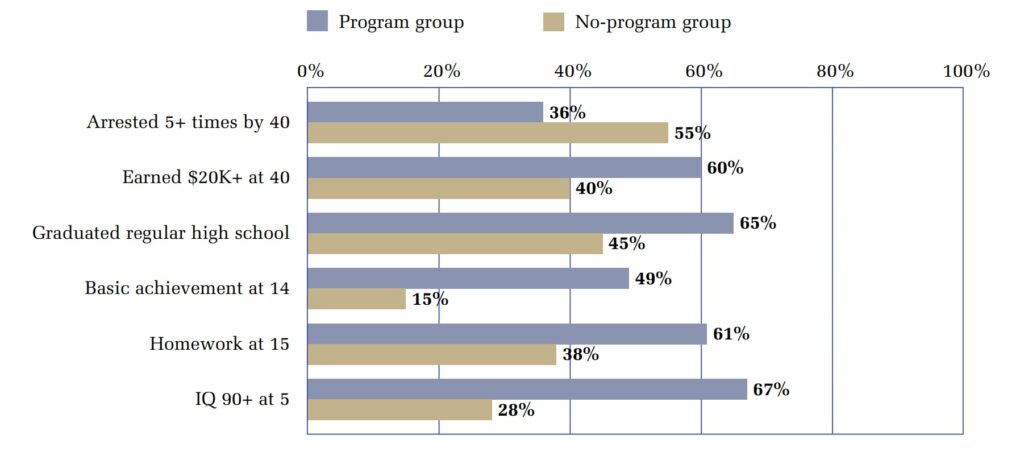
When researchers followed up with participants at age 40, the differences between the program group and the control group were striking — and spanned education, employment, income, and crime. These findings represent some of the clearest evidence available that preschool academic outcomes do not fade after a few years; they persist and compound across a lifetime.
High School Graduation Rates
One of the most consistent findings in the Perry study was a significant gap in high school graduation rates between the 2 groups. At age 40, the program group showed a graduation rate of approximately 65%, compared to roughly 45% in the control group — a difference of 20 percentage points.
The gender breakdown was particularly revealing. Among women in the study, the gap was especially dramatic:
- Program group women: approximately 84% graduated from high school
- Control group women: approximately 32% graduated from high school
This gap of more than 50 percentage points among women suggests that early childhood education may have been especially transformative for girls in this socioeconomic context. Researchers believe several factors contributed to this difference. Program group girls were less likely to be placed in special education, less likely to repeat a grade, and entered school with stronger foundational skills that helped them navigate academic challenges more successfully. High school graduation, of course, is itself a gateway: it determines access to higher education, broadens employment options, and tends to influence long-term health and civic participation.
Employment and Earnings
The economic benefits of the preschool program were visible not just in graduation certificates but in the participants’ actual working lives and paychecks. At age 40, the employment rate among the program group stood at approximately 76%, compared to around 62% for the control group — a gap of 14 percentage points that represents a meaningful difference in economic self-sufficiency.
Income data told a similarly compelling story. When comparing median annual earnings at two different life stages:
- At age 27: Program group median income was approximately $12,000; control group was approximately $10,000
- At age 40: Program group median income rose to approximately $20,800; control group stood at approximately $15,300
The earnings gap actually widened as participants aged — suggesting that the advantages conferred by early education tend to accumulate rather than fade. The skills developed in high-quality preschool, including persistence, communication, problem-solving, and the ability to work cooperatively with others, appear to translate into greater workplace effectiveness and career progression over time. These findings align with broader economic research indicating that investments made in the earliest years of life tend to generate the highest returns of any educational spending.
Crime and Social Behavior
Perhaps the most striking finding in the Perry study was the substantial difference in criminal records between the 2 groups, particularly among men. Among male participants tracked to age 40, the data showed:
- Program group men: approximately 36% had 5 or more arrests on record
- Control group men: approximately 55% had 5 or more arrests on record
Drug-related offenses also occurred at meaningfully lower rates in the program group. This pattern suggests that the self-regulation, social competence, and future orientation cultivated through high-quality preschool may have protective effects that extend well beyond the classroom. Children who learn to manage their impulses, resolve conflicts verbally, and connect their present choices to future consequences appear to be better equipped to navigate the kinds of situations that lead others toward criminal behavior.
From a public policy standpoint, these reductions in crime carry enormous financial implications. Fewer arrests mean lower costs to the criminal justice system, fewer victims, and reduced expenditure on incarceration — all of which feed into the cost-benefit analyses that have led economists to estimate that every dollar invested in the Perry Program generated an estimated return of approximately $7 to $12 to society. The preschool classroom, it turns out, may be one of the most cost-effective crime prevention tools ever studied.
Actionable Insights: Applying the Research to Real-World Preschool Decisions
The Perry findings and the broader body of early childhood education research point to several practical conclusions for parents, educators, and policymakers. Understanding what worked in that Michigan program can guide decisions about what to look for — and what to advocate for — in preschool settings today.
For Parents: Choosing and Enhancing Preschool Experiences
When evaluating a preschool program, the following factors tend to predict quality — and therefore outcomes:
- Teacher qualifications and stability — Look for programs staffed by trained educators who stay in the same classroom rather than turning over frequently. Consistent relationships with caring adults are foundational to healthy development. Why it matters: Children regulate emotion through co-regulation with trusted adults; turnover disrupts this process.
- Low child-to-teacher ratios — Research suggests ratios around 1:5 to 1:6 are optimal for toddlers and preschoolers. Why it matters: Individualized attention is how children receive the scaffolding their development requires, rather than waiting passively for their turn.
- Child-directed play alongside structured activities — Programs that balance teacher-guided learning with ample time for children to choose their own activities tend to produce stronger executive function and intrinsic motivation. Why it matters: Autonomy in early learning builds the kind of intrinsic motivation that sustains academic engagement for years.
- Regular family communication — Programs that actively involve parents through updates, home activities, and open dialogue extend the benefits of preschool into the home environment. How to practice it: Ask the program about its parent communication policies before enrolling, and make a commitment to follow through on any suggested home activities.
For Educators and Policymakers: Lessons Worth Scaling
The Perry study was deliberately conducted with children facing the steepest disadvantages — poverty, low initial test scores, limited educational resources at home. This design choice carries an important implication: the children who benefit most from high-quality preschool are often those who are least likely to access it.
Several policy directions emerge from this reality:
- Prioritize universal access for disadvantaged children — Programs modeled on Head Start program effects research suggest that subsidized or free high-quality preschool for low-income families produces the strongest societal returns. Why it works: The gap between what a disadvantaged child would experience without intervention versus what a high-quality program provides is simply larger, meaning the “dose effect” of preschool is greater.
- Invest in teacher professional development — The Perry Program’s success depended heavily on well-trained educators who shared a coherent philosophy. Raising the educational and training standards for early childhood educators tends to improve program quality across the board. How to practice it: Advocate for competitive compensation and ongoing professional development funding in early childhood education budgets.
- Fund long-term evaluation — Much of what we know about preschool education long-term effects comes from studies that tracked participants for decades. Short-term assessments alone can miss the most meaningful outcomes, including employment, health, and reduced criminal justice involvement. Why it matters: Without long-term data, policymakers may underestimate the true value of early intervention programs and underfund them accordingly.
Frequently Asked Questions
At what age do the benefits of preschool education start to appear?
Research suggests that measurable improvements in language, social skills, and self-regulation tend to appear within the first year of quality preschool participation, often before a child turns 5. Some cognitive gains — such as improved vocabulary and pre-literacy skills — can be detected after just one program year. However, the most significant benefits, including higher graduation rates and better employment outcomes, only become fully visible in later childhood, adolescence, and adulthood, underscoring why long-term tracking matters so much in early childhood education research.
How long do the effects of preschool education actually last?
The HighScope Perry Preschool Program tracked participants until age 40, and meaningful differences between the program group and the control group were still visible at that point — in employment rates, income levels, and criminal records. This suggests that the effects of high-quality early childhood education are not simply a temporary “boost” that fades by middle school, but rather a lasting shift in developmental trajectory. The skills and dispositions built in quality preschool — self-regulation, curiosity, social competence — tend to compound over time rather than diminish.
What are the key features of a high-quality preschool program?
Studies consistently point to 4 core features: qualified and stable teachers, low child-to-teacher ratios (ideally around 1:5 to 1:6), a curriculum that balances child-directed exploration with structured learning, and meaningful family involvement. Programs like the Perry Preschool and Head Start that incorporate all of these elements tend to produce the strongest outcomes. Programs that prioritize one feature while neglecting others — for example, focusing on academic drills but ignoring social-emotional development — generally show weaker and less durable results.
What is the return on investment for society when it funds quality preschool?
Economic analyses of the Perry Preschool Program have estimated a return of approximately $7 to $12 for every $1 invested, when accounting for savings in special education, reduced criminal justice costs, higher tax revenues from better-employed graduates, and lower reliance on social welfare programs. This makes high-quality early intervention programs among the most cost-effective public investments available. Comparable analyses of the Head Start program effects have produced broadly similar conclusions, reinforcing the idea that early childhood education offers exceptional economic value to society beyond its direct benefits to individual children.
Do disadvantaged children benefit more from preschool than children from wealthier backgrounds?
Research generally indicates that children from low-income households or educationally under-resourced home environments tend to show the largest gains from high-quality preschool programs. This is partly because these children have more “room to grow” — the gap between what their home environment provides and what a well-designed program offers is simply larger. That said, early childhood education research also suggests that all children benefit from quality preschool, even those from relatively advantaged backgrounds. The magnitude of benefit varies, but the direction is consistently positive.
Is the Perry Preschool research still relevant today, given how old the study is?
The Perry study was conducted in the 1960s, and some critics note that the specific context — racially segregated Michigan, deep urban poverty, limited alternative support services — may limit how directly its findings apply today. However, the study’s core findings about the value of active learning, low teacher-to-child ratios, teacher quality, and family engagement have been replicated and extended by more recent research, including studies of the Abecedarian Project and various Head Start program evaluations. The fundamental developmental mechanisms the Perry study revealed appear to be robust across different eras and contexts.
Preschool settings provide one of the first structured environments where children regularly interact with peers outside the family. Through negotiating conflicts, practicing sharing, collaborating on projects, and navigating group norms, children develop social-emotional skills that research consistently links to academic success and mental health. Studies indicate that children who enter primary school with stronger self-regulation and peer interaction skills tend to maintain better relationships with teachers, experience less anxiety in academic settings, and show greater resilience when they encounter learning difficulties. These social-emotional foundations may ultimately matter as much as early academic knowledge.
Summary: What Decades of Research Tell Us About Investing in Early Childhood
The evidence accumulated over more than half a century — anchored by the HighScope Perry Preschool Program and reinforced by a wide range of other early intervention programs — paints a remarkably consistent picture. The preschool education long-term effects extend far beyond reading readiness and math skills. They reach into employment prospects, income trajectories, family stability, health, and the likelihood of involvement with the criminal justice system. A 2-year investment in a child’s earliest learning years can, under the right conditions, redirect the arc of an entire lifetime.
This is not a call for anxiety — it is a call for awareness. High-quality preschool education works because it aligns with how children’s brains actually develop: through exploration, relationship, repetition, and gradually expanding challenge. The characteristics that made the Perry Program effective — trained and caring teachers, small groups, child-led inquiry, and family partnership — are achievable in any well-resourced and thoughtfully run setting. Understanding what the research shows is the first step toward making the choices, and the policy arguments, that give every child the foundation they deserve.
If you found this overview of early childhood education research valuable, explore more of our psychology and education articles to understand the science behind how people learn, grow, and thrive — from their very first years all the way through adulthood.