If you’ve ever wondered what makes you tick, taking an mbti 16 types free test could be one of the most revealing things you do this year. The MBTI (Myers-Briggs Type Indicator) is a well-established psychological framework that classifies human personality into 16 distinct types — and understanding your type can genuinely transform how you communicate, work, and relate to others. This article breaks down all 16 types, explains the 4 core dimensions behind the system, and gives you practical guidance on how to take a free personality type test and actually use the results.
Research suggests that approximately 20 million people worldwide take some form of the MBTI assessment each year, making it one of the most widely used personality frameworks in psychology. Whether you’re exploring it for self-discovery, career planning, or improving relationships, understanding the science behind it helps you get far more out of the experience.
Once again, personality researcher and author of Villain Encyclopedia, Tokiwa (@etokiwa999), will provide the explanation.
※We have developed the HEXACO-JP Personality Assessment! It has more scientific basis than MBTI. Tap below for details.

目次
- 1 What Is the MBTI? The 4 Dimensions Explained
- 2 The Complete MBTI Personality Types List: All 16 Types at a Glance
- 3 How to Take an mbti 16 types free test and Get Accurate Results
- 4 How to Actually Use Your MBTI Results: Practical Applications
- 5 Frequently Asked Questions
- 5.1 Is there a reliable mbti 16 types free test I can take online?
- 5.2 What do the 4 letters in an MBTI type mean?
- 5.3 Can my MBTI type change over time?
- 5.4 Which MBTI type is the rarest?
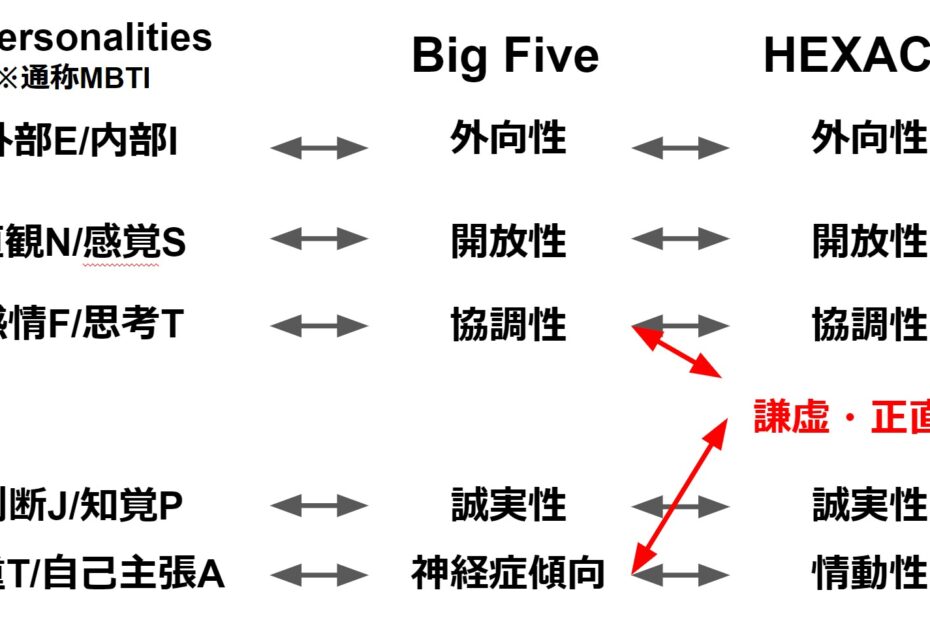
- 5.5 How are MBTI types different from the Big Five personality model?
- 5.6 Can MBTI results help with career decisions?
- 5.7 Is MBTI scientifically valid?
- 6 Summary: Turn Your Type Into a Tool for Growth
What Is the MBTI? The 4 Dimensions Explained
The MBTI is a personality classification system that uses 4 psychological dimensions to sort people into 1 of 16 personality types. Each dimension represents a spectrum between two opposing preferences, and your combination of preferences across all 4 axes produces your unique 4-letter type code. Understanding these dimensions is the foundation of MBTI personality types list literacy — without them, the 16 types are just labels.
- Extraversion (E) vs. Introversion (I): This dimension describes where you tend to direct your energy. Extraverts tend to feel energized by social interaction and external stimulation, while introverts tend to recharge through solitude and inner reflection.
- Sensing (S) vs. Intuition (N): This axis describes how you gather information. Sensing types typically prefer concrete, tangible facts and present-moment details, while Intuitive types tend to focus on patterns, possibilities, and future-oriented thinking.
- Thinking (T) vs. Feeling (F): This dimension reflects how you make decisions. Thinking types tend to prioritize logic and objective analysis, while Feeling types tend to weigh personal values and the emotional impact on others.
- Judging (J) vs. Perceiving (P): This axis describes how you engage with the outside world. Judging types generally prefer structure, planning, and decisiveness, while Perceiving types tend to favor flexibility, spontaneity, and keeping options open.
Studies indicate that your position on each of these 4 dimensions can meaningfully influence career preferences, communication styles, and even stress responses. Importantly, no combination is superior — each of the 16 resulting types reflects a legitimate and valuable way of experiencing the world.
The Complete MBTI Personality Types List: All 16 Types at a Glance
Each of the 16 MBTI types carries a distinct combination of cognitive functions and behavioral tendencies that shape how a person thinks, feels, and acts. To make the list easier to navigate, the 16 types are traditionally grouped into 4 role-based clusters. Research suggests each type accounts for roughly 6–8% of the general population, meaning every type has a meaningful presence in the real world.
The Analysts (NT) — Intuitive Thinkers
Analyst types share a drive for intellectual mastery and tend to excel in strategic or theoretical domains. Their cognitive functions MBTI profile centers on Intuition paired with Thinking, making them natural problem-solvers and systems thinkers.
- INTJ — The Architect: Tends to be highly strategic, independent, and future-focused. INTJs are often described as among the most determined planners of all 16 types.
- INTP — The Logician: Tends to thrive on theoretical analysis and intellectual curiosity. INTPs often seek to understand the underlying mechanics of everything around them.
- ENTJ — The Commander: Tends to combine visionary thinking with decisive leadership. ENTJs are often drawn to roles where they can organize people and resources toward ambitious goals.
- ENTP — The Debater: Tends to be energized by ideas, challenges, and intellectual sparring. ENTPs often enjoy exploring unconventional possibilities and tend to resist being boxed in.
The Diplomats (NF) — Intuitive Feelers
Diplomat types are idealistic and people-oriented. Their cognitive profile emphasizes Intuition combined with Feeling, which tends to make them empathetic, values-driven, and deeply motivated by meaning and human connection.
- INFJ — The Advocate: Tends to hold a rare combination of idealism and strategic insight. INFJs are often described as deeply perceptive and quietly determined to make a positive difference.
- INFP — The Mediator: Tends to be guided by a rich inner world of personal values and creative imagination. INFPs often feel a strong pull toward authentic self-expression.
- ENFJ — The Protagonist: Tends to be a natural mentor and motivator. ENFJs are often drawn to supporting others’ growth and tend to be highly attuned to group dynamics.
- ENFP — The Campaigner: Tends to bring infectious enthusiasm and genuine warmth to relationships. ENFPs are often described as seeing potential everywhere — in ideas and in people.
The Sentinels (SJ) — Practical Guardians
Sentinel types tend to be reliable, structured, and deeply committed to their responsibilities. Their cognitive functions MBTI profile favors Sensing paired with Judging, making them pillars of stability in teams, families, and organizations.
- ISTJ — The Logistician: Tends to be methodical, responsible, and thorough. ISTJs are often described as the backbone of any group — quietly dependable and deeply principled.
- ISFJ — The Defender: Tends to combine warmth with dedication. ISFJs are often highly attentive to others’ needs and tend to go out of their way to provide support.
- ESTJ — The Executive: Tends to be decisive, organized, and results-driven. ESTJs often gravitate toward leadership roles where clear standards and accountability matter.
- ESFJ — The Consul: Tends to be socially aware and community-oriented. ESFJs typically thrive when they can create harmony and a sense of belonging around them.
The Explorers (SP) — Practical Perceivers
Explorer types tend to be spontaneous, hands-on, and highly attuned to the present moment. Their Sensing-Perceiving cognitive profile makes them quick, adaptable, and often gifted with real-world problem-solving skills.
- ISTP — The Virtuoso: Tends to have a natural affinity for understanding how things work. ISTPs are often drawn to mechanical, technical, or physical skill-based activities.
- ISFP — The Adventurer: Tends to express a quiet but deeply felt creativity. ISFPs often value freedom, aesthetic beauty, and living in alignment with personal values.
- ESTP — The Entrepreneur: Tends to be bold, pragmatic, and energized by action. ESTPs often excel in fast-paced environments where quick thinking and direct communication are rewarded.
- ESFP — The Entertainer: Tends to radiate positivity and bring energy to any room. ESFPs are often the people who make social gatherings feel alive and welcoming.
How to Take an mbti 16 types free test and Get Accurate Results
Free personality type tests based on MBTI dimensions typically take between 25 and 35 minutes to complete and involve approximately 90 to 120 questions. While the official, certified MBTI assessment is administered by trained practitioners, many high-quality free versions are available online and can give you a reliable sense of your personality type traits — especially if you approach the test thoughtfully.
Here are 4 research-backed tips to help you get the most accurate result from a free personality type test:
- Answer as your current self, not your ideal self. One of the most common sources of inaccurate results is answering based on who you want to be rather than who you actually are today. Be honest about your real-life tendencies.
- Go with your first instinct. Over-analyzing each question tends to distort results. Your initial gut response usually reflects your genuine preference more accurately than a carefully reasoned one.
- Choose a quiet, focused environment. Distractions during testing can push you toward hasty answers. Taking the test in a calm space with no time pressure improves consistency.
- Take it more than once. If you’re uncertain about your type, consider retaking the test on a different day. If your 4-letter result stays consistent across 2 or 3 attempts, that’s a strong indicator of accuracy.
It’s worth noting that free tests vary in quality. Reputable platforms typically base their questions on the same 4-dimension model as the original MBTI, offering a reasonably reliable portrait of your personality type traits even without formal certification.
How to Actually Use Your MBTI Results: Practical Applications
Knowing your MBTI type is only valuable if you translate that self-knowledge into real-world action. The goal of personality type self-discovery isn’t to create a fixed label — it’s to give you a clearer map of your strengths, blind spots, and growth opportunities. Research suggests that organizations using personality-based insights for team development report measurably better communication and collaboration outcomes, and some estimates suggest that approximately 80% of Fortune 500 companies use some form of MBTI-informed profiling in their people development programs.
Here are 5 concrete ways to put your type to work:
- Career alignment: Use your MBTI type descriptions to identify roles and environments that tend to suit your natural preferences. An INTJ may thrive in strategic planning, while an ESFP may shine in customer-facing or performance-based roles. This doesn’t limit your options — it helps you understand where you’ll likely feel most energized.
- Team dynamics: Understanding the distribution of types on your team helps explain communication friction and unlocks more effective collaboration. For example, a team with many Perceiving types may need structure from a Judging-type member to meet deadlines consistently.
- Communication style adjustments: Knowing whether a colleague tends toward Thinking or Feeling can help you frame feedback more effectively — logical and data-driven for T types, impact-and-values-oriented for F types.
- Stress recognition and management: Each MBTI type tends to show stress in characteristic ways. INTPs under stress may withdraw and become hyper-critical; ESFJs may become overly controlling. Recognizing your pattern helps you intervene earlier.
- Personal growth targeting: Your least-preferred cognitive functions are often your biggest growth frontier. Intentionally practicing skills associated with your non-dominant preferences — such as an ENTP learning to follow through on plans — can lead to meaningful personal development over time.
The key caveat here is important: MBTI describes tendencies, not ceilings. Your type reflects where you naturally gravitate, not what you’re incapable of. Every type has the capacity to grow beyond its default patterns.
Frequently Asked Questions
Is there a reliable mbti 16 types free test I can take online?
Yes — several reputable platforms offer free personality type tests based on the MBTI framework. While the officially certified MBTI assessment requires a licensed practitioner, free versions that follow the same 4-dimension structure (E/I, S/N, T/F, J/P) tend to produce reasonably consistent results. For the most accurate picture, take the test in a quiet environment, answer honestly based on your current self, and consider retaking it once or twice to confirm consistency in your 4-letter result.
What do the 4 letters in an MBTI type mean?
Each letter in your MBTI type code represents your preference on one of 4 psychological dimensions: the first letter (E or I) reflects how you direct your energy; the second (S or N) reflects how you gather information; the third (T or F) reflects how you make decisions; and the fourth (J or P) reflects how you engage with the external world. For example, an ENFJ tends to be outwardly energized, intuitive, feelings-oriented, and structured in their approach to life.
Can my MBTI type change over time?
Research suggests that core MBTI preferences tend to remain relatively stable throughout adulthood, though the expression of those preferences can shift with life experience, stress, and personal growth. Some people do get slightly different results on retesting — particularly on dimensions where their preference is mild rather than strong. This doesn’t necessarily mean your type has changed; it may simply reflect that you sit closer to the middle of that particular spectrum. Repeated testing over time can give you a more nuanced picture.
Which MBTI type is the rarest?
Studies indicate that INFJ tends to be the rarest of all 16 MBTI types, estimated to represent roughly 1–3% of the general population. INFJs are characterized by a rare blend of idealism and strategic clarity — they tend to be deeply empathetic yet unusually future-focused and decisive for an Introverted type. INTJ and ENTJ are also relatively uncommon, particularly among women. By contrast, types like ISFJ and ESFJ tend to appear more frequently across most population studies.
How are MBTI types different from the Big Five personality model?
The MBTI and the Big Five (also known as OCEAN) are both widely used personality frameworks, but they work differently. MBTI classifies people into one of 16 discrete types based on 4 binary dimensions, making it intuitive and easy to apply in everyday conversations and team settings. The Big Five, by contrast, scores personality across 5 continuous trait spectrums without assigning types, which many researchers consider more statistically rigorous. Both approaches have value — MBTI tends to excel in practical self-discovery contexts, while the Big Five is more commonly used in academic research.
Can MBTI results help with career decisions?
MBTI type descriptions can be a genuinely useful starting point for career exploration, though they should be treated as one input among many — not a definitive prescription. Research suggests that certain types tend to gravitate toward and find satisfaction in particular career domains: NT Analysts often thrive in strategy, science, or technology; NF Diplomats often find fulfillment in counseling, teaching, or the arts; SJ Sentinels often excel in administration, law, or healthcare; and SP Explorers often do well in hands-on, dynamic environments. That said, individual skill, values, and circumstances matter just as much as type.
Is MBTI scientifically valid?
The scientific status of MBTI is a nuanced topic. Some researchers note that test-retest reliability can vary — studies suggest that roughly 35–50% of people get a different result on at least 1 dimension when retested after a few weeks. Critics also point out that the binary dimension model oversimplifies what are likely continuous personality traits. However, many studies do find meaningful correlations between MBTI types and real-world behavioral tendencies, occupational preferences, and communication styles. The consensus tends to be that MBTI is a valuable self-reflection tool when used with appropriate context, rather than a hard diagnostic measure.
Summary: Turn Your Type Into a Tool for Growth
The MBTI framework offers a genuinely useful lens for understanding yourself and the people around you. By identifying where you fall across 4 core psychological dimensions — and by seeing how your preferences cluster into one of the 16 personality types — you gain a structured vocabulary for self-awareness that can improve everything from career satisfaction to daily communication. Research suggests that approximately 20 million people engage with this system every year not because personality is fixed and unchangeable, but because understanding your natural tendencies is the first step to working with them intentionally.
The real value of an mbti 16 types free test isn’t the label you get at the end — it’s the questions it prompts you to ask about yourself. Now that you understand what each of the 16 types represents and how the 4 dimensions shape personality type traits, you’re in a much stronger position to interpret your results with nuance. Explore which of the 16 types reflects the way you actually think, decide, and connect — and use that insight as a map for the growth areas you want to develop next.

Writer & Supervisor: Eisuke Tokiwa
Personality Psychology Researcher / CEO, SUNBLAZE Inc.
As a child he experienced poverty, domestic abuse, bullying, truancy and dropping out of school — first-hand exposure to a range of social problems. He spent 10 years researching these issues and published Encyclopedia of Villains through Jiyukokuminsha. Since then he has independently researched the determinants of social problems and antisocial behavior (work, education, health, personality, genetics, region, etc.) and has published 2 peer-reviewed journal articles (Frontiers in Psychology, IEEE Access). His goal is to predict the occurrence of social problems. Spiky profile (WAIS-IV).
Expertise: Personality Psychology / Big Five / HEXACO / MBTI / Prediction of Social Problems
Researcher profiles: ORCID / Google Scholar / ResearchGate
Social & Books: X (@etokiwa999) / note / Amazon Author Page