
Radical right voting behavior is one of the most debated topics in modern political science — and also one of the most misunderstood. Every time a radical right party gains seats in an election, commentators rush to explain it with a single cause: economic hardship, immigration fears, or uneducated voters. But what does the actual data say? A landmark meta-analysis published in the journal Government and Opposition synthesized 46 peer-reviewed studies and 329 individual analyses conducted between 1995 and 2016 to find out exactly who votes for radical right parties in Europe — and the results challenge nearly every popular assumption.
This article breaks down that research in plain language. Rather than demonizing or romanticizing radical right supporters, we look at the psychological, demographic, and attitudinal patterns that research suggests are actually associated with this type of political choice. If you have ever wondered why your neighbor, coworker, or even a family member leans toward right-wing populism — or if you simply want to understand European political trends more deeply — the findings here offer a data-grounded starting point.
Once again, personality researcher and author of Villain Encyclopedia, Tokiwa (@etokiwa999), will provide the explanation.
※We have developed the HEXACO-JP Personality Assessment! It has more scientific basis than MBTI. Tap below for details.

目次
- 1 What Is the Radical Right — and Why Did It Grow?
- 2 Key Individual Predictors of Radical Right Voting Behavior
- 2.1 Anti-Immigration Attitudes: The Most Tested — but Not the Strongest — Predictor
- 2.2 Gender and Radical Right Voting Behavior: Why Men Tend to Lean Right More Often
- 2.3 Occupation and Class: Broader Than the “Blue-Collar” Stereotype
- 2.4 Unemployment: A Surprisingly Weak Predictor
- 2.5 Age and Youth Support: Passion for Change, Not Just Protest
- 3 What These Findings Mean: No Single Profile Exists
- 4 Practical Implications: How to Apply This Research Understanding
- 5 Frequently Asked Questions
- 5.1 What exactly is radical right voting behavior?
- 5.2 What did the meta-analysis find to be the single strongest predictor of radical right party support?
- 5.3 Is it true that radical right voters tend to have lower levels of education?
- 5.4 Why do research results vary so much between different European countries?
- 5.5 Is economic hardship the main driver of right-wing populism causes?
- 5.6 Do authoritarian voting patterns mean radical right supporters are inherently aggressive or dangerous?
- 5.7 Can these findings from European research apply to voters in Asia or other regions?
- 6 Summary: What the Data Really Tells Us About Radical Right Voting Behavior
What Is the Radical Right — and Why Did It Grow?
The radical right is not a new phenomenon, but its electoral growth since the 1990s has been remarkable enough to demand scientific explanation. In political science, radical right parties are broadly defined as parties that combine nativist ideology (placing the interests of native-born citizens above those of immigrants or minorities) with a populist rhetoric that frames politics as a battle between “ordinary people” and a corrupt elite. They tend to advocate strict immigration controls and are deeply skeptical of supranational institutions like the European Union.
What makes their rise puzzling is that it does not follow a single economic script. Some countries where radical right parties surged had high unemployment; others had thriving economies. This inconsistency pushed researchers to look beyond national economic conditions and focus instead on the individual — the actual voter casting the ballot.
- Research period covered: 1995 to 2016 (approximately 21 years of cumulative data)
- Number of studies synthesized: 46 peer-reviewed journal articles
- Individual statistical analyses examined: 329 separate models
- Additional qualitative studies: 14 interview-based studies were also reviewed
The meta-analytic approach used in this research is important to understand. Rather than conducting a single new survey, the researchers gathered the results of dozens of existing high-quality studies and looked for consistent patterns across all of them. This makes the findings more reliable than any single study could be — though it also means they represent tendencies and probabilities, not certainties about any individual voter.
Key Individual Predictors of Radical Right Voting Behavior
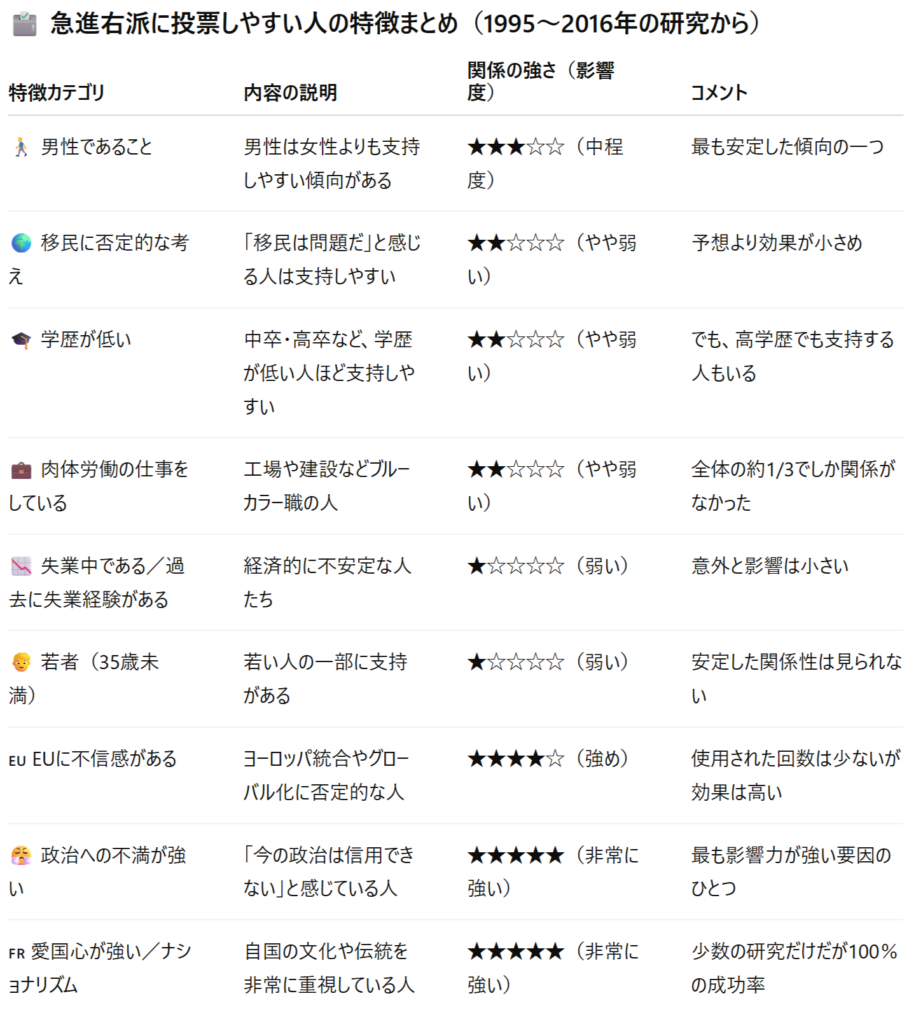
The research identified more than 20 individual-level factors that have been tested as potential predictors of radical right party support — yet the majority of these factors showed weaker or more inconsistent effects than popular wisdom would suggest. Below are the most thoroughly studied predictors, along with the actual success rates the meta-analysis recorded.
Anti-Immigration Attitudes: The Most Tested — but Not the Strongest — Predictor
Anti-immigration attitudes were the single most frequently measured variable in the literature. Across the studies reviewed, this factor was tested 470 times. Of those, approximately 239 analyses (roughly 51%) found a statistically significant positive relationship — meaning people with more negative views of immigration were more likely to vote radical right. However, the remaining 49% of analyses either found no significant relationship or found results pointing in the opposite direction.
This finding is significant precisely because it is more nuanced than the standard narrative. While opposition to immigration does appear to be a meaningful factor, it is far from a perfect predictor. Research suggests that what drives anti-immigration sentiment in this context is often not simple xenophobia, but rather a deeper anxiety about rapid social change, a desire for cultural stability, and a perceived threat to established community norms.
- Anxiety about rapid social change: When neighborhoods transform quickly, long-term residents may feel their sense of belonging is threatened.
- Cultural security concerns: Some voters prioritize preserving local traditions and social cohesion over cosmopolitan openness.
- Perceived unfairness: A feeling that resources or attention are distributed unevenly between established residents and newcomers can fuel resentment.
In short, anti-immigration attitudes do tend to correlate with radical right party support, but they represent only about half the story. Treating this factor as a complete explanation oversimplifies a complex psychological and political reality.
Gender and Radical Right Voting Behavior: Why Men Tend to Lean Right More Often
Among all demographic variables tested, being male showed one of the more consistent associations with radical right party support. Across 224 statistical tests, approximately 55% found that men were significantly more likely than women to vote for radical right parties. While this leaves nearly half of analyses showing no significant gender difference, the overall pattern is one of the stronger demographic signals in the dataset.
What explains this tendency? Research suggests it is less about aggression or hostility and more about a cluster of values that studies indicate men in certain social contexts tend to hold more strongly: a protective orientation toward family and community, a preference for hierarchical social structures, and a stronger attachment to traditional gender roles and national identity. These values tend to align more naturally with the messages radical right parties broadcast.
- Protective identity: A strong sense of responsibility for one’s family and local community can make authoritarian, security-focused political messages more appealing.
- Stability preference: Studies indicate that men on average tend to place slightly higher value on social order and established hierarchies, which aligns with right-wing populist platforms.
- Traditional role identification: In societies where traditional masculinity norms remain strong, parties that emphasize national pride and conventional social structures may resonate more.
Importantly, this is a statistical tendency across large populations — not a statement about any individual man or woman. Many women also support radical right parties, and many men do not. Gender is a contributing factor, not a determining one.
Occupation and Class: Broader Than the “Blue-Collar” Stereotype
One of the most persistent stereotypes about radical right voters is that they are predominantly blue-collar, manual workers — but the data tells a more complex story. Blue-collar occupational status was tested 173 times in the reviewed literature. Only about 36% of those analyses found a statistically significant positive association with radical right voting. Self-employment and farming showed a similar pattern: tested 156 times, with a success rate of approximately 35%.
These numbers suggest that while working-class voters are somewhat overrepresented among radical right supporters, they are far from the only — or even the dominant — social group. Radical right parties have increasingly attracted voters from a wide range of occupational backgrounds, including lower-level white-collar workers and small business owners.
- Pride in labor: Voters across occupational groups who feel their honest work is undervalued by political elites may gravitate toward populist messages that validate their contributions.
- Local economic concern: Farmers and self-employed individuals often have a strong stake in local economic conditions and tend to resist globalization narratives they see as threatening their livelihoods.
- Autonomy values: A high premium on personal responsibility and self-sufficiency — common across many working occupations — aligns with right-wing populist rhetoric about meritocracy.
The takeaway here is that occupational class is a relevant but weak predictor. Radical right voting behavior cuts across class lines more than many political commentators acknowledge.
Unemployment: A Surprisingly Weak Predictor
Perhaps the most counterintuitive finding in the entire meta-analysis is how weakly unemployment correlates with radical right party support at the individual level. Unemployment was tested in 84 analyses, and only about 27% of them found a statistically significant positive relationship. This means that being unemployed does not reliably predict radical right voting across different countries and contexts.
This finding challenges the standard “economic anxiety” narrative that dominates much media coverage of right-wing populism causes. It suggests that the issue is less about objective economic deprivation and more about a subjective sense of injustice — the feeling that one has worked hard and played by the rules, yet has not been rewarded fairly. This distinction between actual poverty and perceived unfairness is psychologically crucial.
- Relative deprivation: People who feel they have fallen behind compared to others — even if not technically unemployed — may be more motivated to protest through their vote.
- Fairness orientation: A strong personal ethic of hard work combined with a perception that the system rewards the wrong people can be a powerful driver of populist support.
- Accountability demand: Rather than helplessness, this tends to reflect a demand for political accountability from people who feel ignored by mainstream parties.
Age and Youth Support: Passion for Change, Not Just Protest
The relationship between youth and radical right voting is real but modest. Being under 35 was tested 325 times in the literature; approximately 29% of those analyses confirmed a significant positive association. This puts youth somewhere in the lower-middle range of predictive strength — present, but not dominant.
Research suggests that when young people do vote for radical right parties, it tends to reflect a genuine desire for political change rather than simple protest. Young voters who feel that mainstream parties offer no meaningful vision for their future, that economic opportunities are shrinking, or that their voices are ignored by establishment politics may find radical right populism appealing precisely because of its bold, confrontational style.
- Future uncertainty: Young people entering uncertain labor markets may be particularly receptive to parties offering simple, definitive answers.
- Political distrust: Low trust in established institutions tends to be higher among younger generations in many European countries, making anti-establishment messaging more resonant.
- Search for identity: Radical right parties’ emphasis on national and cultural identity can offer young people a sense of belonging and meaning that they feel is lacking elsewhere.
This is not a picture of nihilistic rebellion. Rather, it suggests that youth support for radical right parties often reflects deep engagement with political and social questions — just channeled in a particular direction.
What These Findings Mean: No Single Profile Exists
One of the most important conclusions of this meta-analysis is that no single “type” of person reliably predicts radical right party support. Out of more than 20 individual-level factors that researchers have tested across 46 studies and 329 analyses, not one achieved consistently strong predictive power across all contexts. The factor with the highest raw success rate — being male — still failed to reach significance in roughly 45% of studies. Anti-immigration attitudes, despite being the most frequently studied variable, confirmed the expected relationship only about half the time.
This matters enormously for how we talk about right-wing populism causes in public discourse. It means that characterizing all radical right voters as uneducated, economically desperate, or simply xenophobic is not supported by systematic evidence. Instead, the picture that emerges is of a diverse coalition of voters brought together by overlapping but distinct combinations of values, anxieties, and political grievances.
- Values-based motivation: Many supporters are driven by genuine concerns about fairness, community stability, and cultural continuity — not merely fear or hatred.
- Institutional distrust: A recurring theme across studies is deep dissatisfaction with mainstream political parties and media — what researchers call “political alienation.”
- Context dependency: The same individual characteristic can predict radical right voting strongly in one country and not at all in another, depending on the local political landscape, the specific party in question, and the electoral alternatives available.
Understanding this complexity is not about excusing harmful political rhetoric. It is about accurately diagnosing the social and psychological conditions that allow radical right parties to grow — which is a necessary first step toward any meaningful political response.
Practical Implications: How to Apply This Research Understanding
Whether you are a voter, a political educator, a journalist, or simply someone trying to understand a family member’s political choices, the findings of this research carry practical lessons. Here is how to apply what the data shows:
Replace Stereotypes with Specific Questions
Instead of assuming a radical right voter is unemployed, poorly educated, or driven purely by prejudice, ask what specific combination of concerns — economic, cultural, institutional — is motivating their choice. The research shows these voters are a heterogeneous group. Why it works: Stereotyping shuts down understanding; specific inquiry opens it up. How to practice it: When discussing politics with someone whose views differ from yours, ask one genuine question about what matters most to them before offering your own position.
Recognize That Fairness Concerns Are Legitimate — Even When Expressed Problematically
The research consistently suggests that a subjective sense of being treated unfairly is a more powerful driver of populist voter psychology than objective economic deprivation. Many radical right voters are employed, civically engaged, and genuinely concerned about what they perceive as a broken social contract. Why it works: Dismissing fairness concerns as “just” resentment prevents productive political dialogue. How to practice it: Acknowledge the underlying concern (e.g., “I can see why that feels unfair”) before addressing the specific policy position you disagree with.
Understand That Context Changes Everything
Because the same predictors vary in strength across different countries and elections, it is a mistake to apply findings from, say, French or Dutch politics directly to a completely different national context. Why it works: Context-sensitive analysis leads to more accurate predictions and better policy responses. How to practice it: Before citing research on radical right voting, always check whether it matches your specific national or regional context — political systems, party landscapes, and immigration histories vary enormously.
Frequently Asked Questions
What exactly is radical right voting behavior?
Radical right voting behavior refers to the act of casting a ballot for political parties that combine nativist ideology — prioritizing the interests of native-born citizens over immigrants — with populist rhetoric framing politics as a conflict between ordinary people and a corrupt elite. These parties typically advocate strict immigration controls, national cultural protectionism, and skepticism toward international institutions. Research focuses on understanding which individual psychological, demographic, and attitudinal factors are associated with this type of voting choice.
What did the meta-analysis find to be the single strongest predictor of radical right party support?
No single factor emerged as a dominant, reliable predictor. Among demographic variables, being male showed the highest consistency, confirming a positive association in approximately 55% of 224 tests. Among attitudinal variables, anti-immigration attitudes were most frequently studied — tested 470 times — but confirmed the expected relationship in only about 51% of cases. Research suggests that radical right voting is driven by overlapping combinations of values and grievances rather than any one defining characteristic.
Is it true that radical right voters tend to have lower levels of education?
Lower educational attainment has been studied as a potential predictor, but the evidence is inconsistent across studies. The meta-analysis found that education alone does not reliably explain radical right party support. What appears to matter more is not formal education level but rather a subjective sense of being economically and politically left behind — a feeling that one’s contributions are undervalued and that the system is rigged against people like them. This is a different psychological mechanism from simply lacking formal credentials.
Why do research results vary so much between different European countries?
Context matters enormously in political research. The same individual characteristic — such as being in a blue-collar occupation or holding anti-immigration attitudes — can be a strong predictor in one country and statistically insignificant in another. This variation reflects differences in each country’s immigration history, the specific policies and rhetoric of the radical right parties present, the alternatives offered by mainstream parties, and the broader cultural and institutional environment. This is why findings from one national context should never be uncritically applied elsewhere.
Is economic hardship the main driver of right-wing populism causes?
Research suggests that objective economic hardship — such as being unemployed — is a surprisingly weak predictor of radical right voting at the individual level. Unemployment confirmed a positive association in only about 27% of the analyses that tested it. What appears to matter more is a subjective sense of relative deprivation and perceived unfairness: the feeling that one has worked hard and followed the rules but has been overlooked or treated unjustly by the political and economic system. This psychological dimension is distinct from absolute poverty or joblessness.
Research does not support the characterization of radical right voters as uniformly aggressive or dangerous. Studies indicate that authoritarian personality traits — such as a preference for social order, strong in-group loyalty, and deference to traditional authority — are associated with this voting pattern, but these traits also correlate with values like community protection, stability, and fairness. The expression of these values through radical right voting is a political phenomenon shaped by specific social contexts, not a reflection of inherent personal hostility. Understanding this distinction is essential for productive civic dialogue.
Can these findings from European research apply to voters in Asia or other regions?
The meta-analysis focused exclusively on European radical right parties and European electorates, so direct application to other regions requires caution. That said, some of the underlying psychological mechanisms — such as relative deprivation, institutional distrust, and anxiety about rapid social change — are not uniquely European. Research in other regions would need to account for local political party structures, immigration histories, cultural norms around authority, and institutional trust levels before drawing meaningful parallels. The framework is potentially transferable; the specific findings are not automatically so.
Summary: What the Data Really Tells Us About Radical Right Voting Behavior
The meta-analysis of 46 peer-reviewed studies and 329 individual analyses offers a clear overall message: radical right voting behavior is too complex to be reduced to a single cause, a single type of voter, or a single emotion. Anti-immigration attitudes show up as a relevant factor — but only in about half of studies. Being male is somewhat predictive — but not in roughly 45% of cases. Unemployment, despite being a common media explanation, barely clears 27% predictive consistency. What the data consistently points toward instead is a diverse group of voters united by overlapping concerns about fairness, community stability, institutional credibility, and a sense that their values and contributions are being overlooked by mainstream politics.
Understanding this is not a political endorsement — it is an analytical necessity. Misdiagnosing why people vote the way they do leads to ineffective policy responses and deepens social division. If you found yourself reconsidering your assumptions about who supports radical right parties and why, that is exactly what this research was designed to produce. Explore what your own political values and personality traits reveal about how you engage with the world — understanding yourself is always the first step toward understanding others.