
The concept of universal basic happiness philosophy may sound idealistic at first glance, but it represents one of the most carefully reasoned corporate missions in modern psychology and social science. This article unpacks the 3 core pillars behind this philosophy — “happiness,” “basic,” and “everyone” — and explains why each dimension matters for building a society where no one is left behind.
This framework took over 10 years of multi-faceted social activity to develop, including domestic and international policy advocacy and nonprofit work. The result is a philosophy that sits at the intersection of well-being ethics, utilitarianism, and practical social design. Let’s explore it step by step.
目次
- 1 Why “Individual Happiness” Was Chosen as the Starting Point
- 2 What Does “Basic” Happiness Actually Mean? The Universal Basic Happiness Philosophy Defined
- 3 Why “Everyone” Matters: The Limits of Utilitarianism and Happiness for the Majority
- 4 The Mission: Universal Basic Happiness as a New Social Philosophy
- 5 How to Apply This Philosophy in Everyday Life and Organizations
- 6 Frequently Asked Questions
- 6.1 What is universal basic happiness philosophy?
- 6.2 How is universal basic happiness different from universal basic income?
- 6.3 What does Yuval Noah Harari say about happiness in Sapiens?
- 6.4 Why can’t capitalism and democracy alone achieve universal happiness?
- 6.5 How does the “basic happiness line” concept work?
- 6.6 Is the universal basic happiness philosophy related to utilitarianism?
- 6.7 Can this philosophy be applied to a company’s mission?
- 7 Summary: A Philosophy Worth Building Toward
Why “Individual Happiness” Was Chosen as the Starting Point
The first and perhaps most fundamental decision was to prioritize individual happiness above all other social goals. This might seem obvious, but when you examine history and philosophy closely, individual happiness is actually just one of many competing values that societies have organized themselves around.
Consider the wide range of things humans have historically pursued in place of — or above — their own personal well-being:
- Reaching heaven or paradise after death — prioritizing the afterlife over present experience
- Family honor — sacrificing personal comfort for the status of one’s household
- National prosperity — serving the state even at personal cost
- Freedom and autonomy as an end in itself — even when that freedom causes harm
- Scientific or economic progress — advancing civilization regardless of individual suffering
Throughout history, people have gone to war leaving their families behind, worked themselves to death for corporate revenue, or accepted misery in this life on the promise of reward in the next. The concept of “going to heaven” essentially means: “It’s okay to be unhappy now, as long as things are better after death.” But research suggests that whether heaven actually exists cannot be proven — it can only be believed.
Of course, if these paths genuinely lead someone to personal fulfillment, there is no inherent problem. If a person consciously chooses national service or religious devotion as their path to happiness — fully understanding the trade-offs — that is a valid choice. The real issue arises when people are manipulated into these frameworks without full awareness. The Church historically exploited faith to collect money. Governments have used national duty to justify slavery and forced military service. The principle of “self-responsibility” in libertarian societies has been used to abandon people in poverty or illness. And even as GDP rises and technology improves quality of life, suicide rates in many developed nations remain troublingly high.
The conclusion: the number of people who can genuinely, freely, and fully consent to placing something above their own happiness tends to be very small. In most cases, social environments and power dynamics narrow people’s perspectives without their full awareness. That is why individual happiness must be the starting point — not a nice-to-have, but the foundational goal.
What Does “Basic” Happiness Actually Mean? The Universal Basic Happiness Philosophy Defined
Once individual happiness is established as the goal, the next challenge is defining what “happiness” itself actually means — and why the word “basic” is so important. Happiness is notoriously difficult to define, and researchers continue to debate its nature across at least 5 dimensions:
- Conscious vs. unconscious — Is happiness something you actively feel, or does it exist beneath awareness?
- Self-generated vs. externally given — Do you create your own happiness, or does it depend on what others provide?
- Cognitive vs. emotional — Is it something you think your way into, or something you feel in your body?
- Quantitative vs. qualitative — Can happiness be measured numerically, or only described?
- Freedom-based vs. condition-based — Is happiness about doing whatever you want, or meeting certain core conditions?
Because human consciousness is not yet fully understood — if it were, strong artificial general intelligence would already exist — there is no perfect answer. However, the science of happiness has advanced considerably in recent years, and some patterns are becoming clearer.
One particularly influential perspective comes from Yuval Noah Harari’s landmark book Sapiens: A Brief History of Humankind, which addresses happiness in the following way:
“Happiness is not determined by objective conditions such as wealth, health, or even community. It is determined rather by the correlation between objective conditions and subjective expectations. If you want a bullock cart and you get a bullock cart, you are content. If you want a brand new Ferrari and you get only a second-hand Fiat, you feel deprived.”
Yuval Noah Harari, Sapiens: A Brief History of Humankind
This subjective happiness theory — the idea that happiness is shaped more by the gap between expectations and reality than by absolute conditions — has important implications. It means that simply making people wealthier or technologically better-off does not automatically make them happier. What matters is whether their actual life matches what they genuinely need and expect.
Alongside this shared foundation, it’s important to recognize what might be called the diversity of happiness — the fact that different people find joy in different things. Some people love extremely spicy food; others find deep satisfaction in creative hobbies, adventurous sports, or unconventional lifestyles. These individual preferences are valid and worth protecting.
However, the world still contains vast numbers of people whose most basic happiness needs are not being met. Research and observation suggest that when a person’s foundational well-being is unfulfilled, they are significantly more likely to become agents of harm — whether through abuse, domestic violence, bullying, or crime. Addressing basic happiness is therefore not just a personal matter; it has profound social consequences.
Why “Everyone” Matters: The Limits of Utilitarianism and Happiness for the Majority
Even if we agree that individual, basic happiness is the goal, a critical question remains: why should we aim for everyone — not just the majority? This is where the philosophy engages directly with one of the most famous ideas in Western ethics.
In the early 19th century, the philosopher and economist Jeremy Bentham introduced what became known as utilitarianism — the principle of “The Greatest Happiness of the Greatest Number.” Utilitarianism and happiness are deeply intertwined in this framework: society’s overall well-being is defined as the sum of all individual happiness, and the goal is to maximize that total.
In its ideal form, “the greatest number” means everyone, and “greatest happiness” means no one has to sacrifice unnecessarily. But in practice, this ideal almost never holds. Consider a simple scenario: if a university entrance exam has 200 spots and 500 applicants, 300 people will be disappointed. In a democratic vote of 100 people split 51 to 49, the minority of 49 does not get what they want. Competition by its very nature creates winners and losers.
The 2 dominant systems we use to organize society — capitalism and democracy — contain structural limitations when it comes to philosophy of human flourishing for all:
- Capitalism allows those with money to solve their problems by purchasing products and services. Those without money have no such mechanism.
- Democracy allows those who can form coalitions and majorities to resolve their concerns through voting. Those who are minorities — whether by identity, belief, or circumstance — are systematically outvoted.
People who are both financially poor and socially marginalized find themselves with essentially no systemic recourse. They cannot buy solutions, and they cannot vote their way to change. Research indicates that in this position, even self-efficacy — the belief that one can improve one’s own situation — tends to be extremely low. And statistically, a significant proportion of people in this situation end up causing harm to others: through abuse, violence, crime, or other antisocial behavior. They become perpetrators, and in turn create more victims.
Those who manage political and economic systems tend to ignore the poor and marginalized because they represent neither votes nor markets. Without a moral framework specifically designed to include them, they remain invisible to policy. This is why the “everyone” in universal basic happiness philosophy is non-negotiable — it is precisely the people most systems ignore who are most in need of inclusion.

The Mission: Universal Basic Happiness as a New Social Philosophy
Bringing these 3 pillars together — individual happiness, basic happiness, and happiness for everyone — produces the core mission: Universal Basic Happiness (UBH). This is a corporate mission philosophy built not around profit, productivity, or national prosperity, but around the foundational well-being of every person in society.
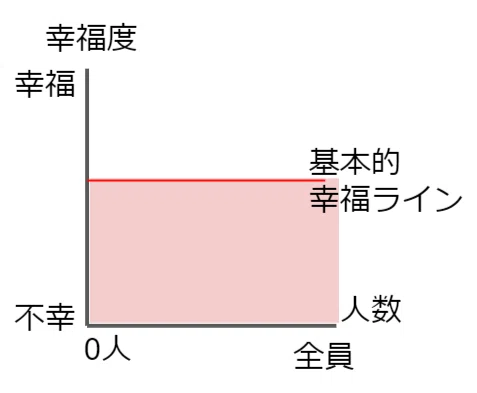
Adopting this philosophy does involve real trade-offs. It’s worth being transparent about them:
- Prioritizing individual happiness means we cannot guarantee religious or ideological rewards (such as heaven), nor can we promise unlimited economic or scientific advancement — although research does suggest that individual happiness and productivity tend to correlate positively.
- Prioritizing basic happiness means not every desire can be fulfilled. Some degree of compromise is inherent in shared social life.
- Prioritizing everyone’s happiness means that absolute individual freedom must be somewhat constrained — because humans are not always rational, and unchecked freedom tends to produce harm to others.
A useful reference point is the Nordic model — countries like Denmark and Finland that maintain high taxes but consistently rank among the happiest in the world. This approach emphasizes well-being ethics over pure growth metrics. That said, even Nordic countries have not achieved full universal happiness; they serve as an approximation, not a finished solution.
The critical philosophical distinction here is: income is a means, not an end. Happiness is the end. The name “Universal Basic Happiness” deliberately echoes the concept of Universal Basic Income (UBI), but places the emphasis on well-being rather than money. A person earning 7 million yen per year (approximately the top 10% of Japanese income earners) may be considered basically happy in a material sense — but even that threshold is not the point. What matters is whether a person’s genuine basic needs are met: access to necessities, free time, meaningful relationships, and a sense of personal worth.
Because capitalism and democracy as currently structured cannot deliver this outcome for everyone, this philosophy calls for ongoing research into the next generation of social systems — systems that may require entirely new institutions, including research universities, think tanks, and cultural organizations to sustain long-term progress.
How to Apply This Philosophy in Everyday Life and Organizations
Universal basic happiness philosophy is not just a macro-level social theory — it offers practical guidance for how individuals and organizations can make decisions more ethically and effectively. Here are 4 actionable ways to apply it:
1. Use Happiness as Your Decision Filter
Before committing to a major life goal — a career, a relationship structure, a financial target — ask honestly: Is this genuinely making me happy, or am I pursuing it because others expect it? Research in subjective happiness theory suggests that mismatches between external achievement and internal expectation are a leading cause of dissatisfaction. Clarifying your own definition of happiness before acting tends to produce better long-term outcomes.
2. Distinguish “Basic” From “Unlimited” Happiness
Not every desire needs to be fulfilled for a person to be fundamentally happy. Identify what your genuine baseline needs are — safety, belonging, autonomy, meaning — and separate these from escalating desires that may never be fully satisfied. This distinction is essential for sustainable well-being and is supported by the Sapiens Yuval Noah Harari framework on expectation gaps.
3. Include the Marginalized in Your “Everyone”
In organizational settings, the tendency is to design for the median user, voter, or employee. Universal basic happiness philosophy challenges this by asking: Who are we leaving out? Whether you manage a team, run a community group, or design a product, actively identifying the people with the least power or visibility — and designing for their basic needs — tends to improve outcomes for everyone, not just the marginalized.
4. Treat Means as Means
Money, status, productivity, and even freedom are all tools for achieving happiness — not happiness itself. When any of these becomes treated as a goal in its own right, the result is often what economists call “means-end inversion.” Organizations that adopt this philosophy as a corporate mission philosophy tend to reorient around employee and customer well-being as their primary metric, using financial performance as a secondary indicator of whether they are achieving that goal.
Frequently Asked Questions
What is universal basic happiness philosophy?
Universal basic happiness philosophy is a social and ethical framework that defines “happiness for everyone at a basic level” as the primary goal of both individual life and social systems. It consists of 3 key pillars: prioritizing individual happiness over ideological or national goals, focusing on “basic” well-being rather than unlimited desire fulfillment, and ensuring that the system works for everyone — including the poor and socially marginalized — rather than just the majority.
How is universal basic happiness different from universal basic income?
Universal Basic Income (UBI) focuses on providing every person with a guaranteed monetary income. Universal Basic Happiness (UBH) goes further: it argues that income is only a means to well-being, not well-being itself. While UBI asks “Does everyone have enough money?”, UBH asks “Is everyone actually happy at a foundational level?” — encompassing factors like relationships, meaning, autonomy, and psychological safety, not just financial security.
What does Yuval Noah Harari say about happiness in Sapiens?
In Sapiens: A Brief History of Humankind, Yuval Noah Harari argues that happiness is not primarily determined by objective conditions like wealth or health, but by the gap between objective conditions and subjective expectations. If you expect a luxury car and receive a modest one, you feel deprived — even if the modest car fully meets your transportation needs. This subjective happiness theory is a cornerstone of the universal basic happiness framework, which focuses on aligning genuine needs with realistic conditions rather than chasing unlimited desires.
Why can’t capitalism and democracy alone achieve universal happiness?
Capitalism allows people with money to solve their problems through purchasing power. Democracy allows people who can form majorities to solve their problems through voting. However, people who are both financially poor and socially marginalized — minority groups with little market influence and few votes — have no systemic pathway to problem resolution under either system. Research and historical observation suggest that this structural exclusion tends to produce higher rates of social harm, including abuse, crime, and violence, creating a cycle that damages society as a whole.
How does the “basic happiness line” concept work?
The “basic happiness line” refers to the threshold at which a person’s fundamental unhappiness is eliminated — not where all desires are fulfilled, but where core needs are met. This includes access to necessities, a reasonable degree of free time, positive social relationships, and a sense of personal value. In Japan, for example, an annual income of approximately 7 million yen is sometimes cited as one marker where basic material needs can be comfortably met — though the framework emphasizes that income alone is not sufficient, and that non-material factors matter equally.
Yes, but it goes beyond classical utilitarianism. Jeremy Bentham’s utilitarianism sought “the greatest happiness of the greatest number,” which in practice often justified sacrificing the minority for the majority. Universal basic happiness philosophy accepts the utilitarian starting point — that happiness should be the measure of a good society — but insists that “greatest number” must mean everyone, with special attention paid to those who are systematically excluded from both markets and democratic majorities.
Can this philosophy be applied to a company’s mission?
Yes. Universal basic happiness philosophy functions effectively as a corporate mission philosophy when a company commits to measuring success by the genuine well-being of its users, employees, and community — rather than by revenue or growth alone. This means actively designing products and services that address foundational human needs, ensuring that marginalized or low-income users are not excluded from benefit, and treating financial performance as a tool for achieving well-being rather than as the ultimate goal.
Summary: A Philosophy Worth Building Toward
The universal basic happiness philosophy is a carefully constructed response to one of humanity’s oldest and most important questions: What kind of society should we build, and for whom? By grounding the answer in individual subjective well-being, setting a “basic” rather than “unlimited” standard, and insisting that everyone — including the marginalized — must be included, this philosophy offers a coherent and actionable framework that goes beyond both utilitarianism and modern capitalism.
It draws on insights from behavioral science, the subjective happiness theory articulated by thinkers like Harari, and over a decade of real-world social advocacy. It acknowledges trade-offs honestly: not everyone’s every desire can be fulfilled, some freedoms must be balanced against collective well-being, and building the institutions to make this vision real will take generations of effort. But the core principle holds: happiness is the end, and everything else is a means.
If this framework resonates with you, the next step is to examine your own definitions. What does “basic happiness” look like for you personally — and who in your community might be missing even that? Start there, and explore how these ideas might apply to your own life, work, and relationships.

Writer & Supervisor: Eisuke Tokiwa
Personality Psychology Researcher / CEO, SUNBLAZE Inc.
As a child he experienced poverty, domestic abuse, bullying, truancy and dropping out of school — first-hand exposure to a range of social problems. He spent 10 years researching these issues and published Encyclopedia of Villains through Jiyukokuminsha. Since then he has independently researched the determinants of social problems and antisocial behavior (work, education, health, personality, genetics, region, etc.) and has published 2 peer-reviewed journal articles (Frontiers in Psychology, IEEE Access). His goal is to predict the occurrence of social problems. Spiky profile (WAIS-IV).
Expertise: Personality Psychology / Big Five / HEXACO / MBTI / Prediction of Social Problems
Researcher profiles: ORCID / Google Scholar / ResearchGate
Social & Books: X (@etokiwa999) / note / Amazon Author Page