
What does an income heritability twin study actually reveal about why some people earn more than others? The answer may surprise you: genetics accounts for only about 20–40% of the differences in individual earnings, meaning the majority of your income potential is shaped by forces outside your DNA. A landmark behavioral genetics study examining over 1,000 Japanese male twins analyzed how much of the variation in education and earnings could be attributed to genes, shared family environment, and personal life experiences. The findings paint a nuanced, and ultimately hopeful, picture of how income inequality develops across a lifetime.
This article breaks down what that research discovered — and what it means for anyone wondering whether their financial future is written in their genes or shaped by their choices.
Once again, personality researcher and author of Villain Encyclopedia, Tokiwa (@etokiwa999), will provide the explanation.
※We have developed the HEXACO-JP Personality Assessment! It has more scientific basis than MBTI. Tap below for details.

目次
- 1 Why Twin Studies Are the Gold Standard for Income Heritability Research
- 2 Income Heritability Twin Study Results: Genetics Explains 20–40% of Earnings Differences
- 3 How Family Environment Shapes Earnings — And Why Its Influence Fades by Age 60
- 4 The Rising Power of Personal Experience: Non-Shared Environment and Income After Midlife
- 5 Genetics, Education, and Income: What the Research Actually Shows About Academic Achievement
- 6 Inequality of Opportunity: What These Findings Mean for Society and for You Personally
- 7 What You Can Actually Do With This Knowledge: Actionable Insights From Twin Study Earnings Research
- 8 Frequently Asked Questions
- 8.1 What percentage of income differences are explained by genetics?
- 8.2 At what age does family environment have the strongest effect on earnings?
- 8.3 Does getting a higher degree guarantee a higher income?
- 8.4 Can someone from a low-income family realistically achieve high earnings?
- 8.5 Why are twin studies considered reliable for studying income heritability?
- 8.6 Is the genetic link to income separate from the genetic link to intelligence?
- 8.7 What does “non-shared environment” mean in the context of income research?
- 9 Summary: Nature Sets the Stage, but Your Life Writes the Story
Why Twin Studies Are the Gold Standard for Income Heritability Research
Twin studies are uniquely powerful tools for separating the effects of genetics and environment on earnings. The core logic is elegant: identical (monozygotic) twins share 100% of their genetic material, while fraternal (dizygotic) twins share approximately 50%, roughly the same genetic overlap as ordinary siblings. Crucially, both types of twins are typically raised in the same household, meaning their shared family environment — parental income, parenting style, neighborhood, household culture — is held relatively constant.
By comparing how similar identical twins are in their earnings versus how similar fraternal twins are, researchers can mathematically estimate three distinct sources of income variation:
- Genetic factors (A): Inherited traits such as cognitive ability, personality, and health that influence earning capacity.
- Shared environment (C): Everything both twins experience equally — family wealth, parental education level, school quality in the neighborhood.
- Non-shared environment (E): Unique life experiences that differ even between twins raised together — a specific mentor, a career-changing encounter, personal health events, or individual choices.
Research using this methodology on over 1,006 Japanese male twins found that all 3 of these components contributed meaningfully to income variation, but their relative importance shifted dramatically depending on the person’s age. This age-dependent pattern is one of the most striking and practically relevant findings from the twin study earnings literature.
Income Heritability Twin Study Results: Genetics Explains 20–40% of Earnings Differences
Across the full sample, genetics and income appear to be connected — but genes explain only a minority fraction of why people earn different amounts. The research estimated that genetic factors account for roughly 20–40% of individual differences in annual earnings. In plain terms, this means that well over half of the variation in what people earn has nothing to do with the genes they inherited from their parents.
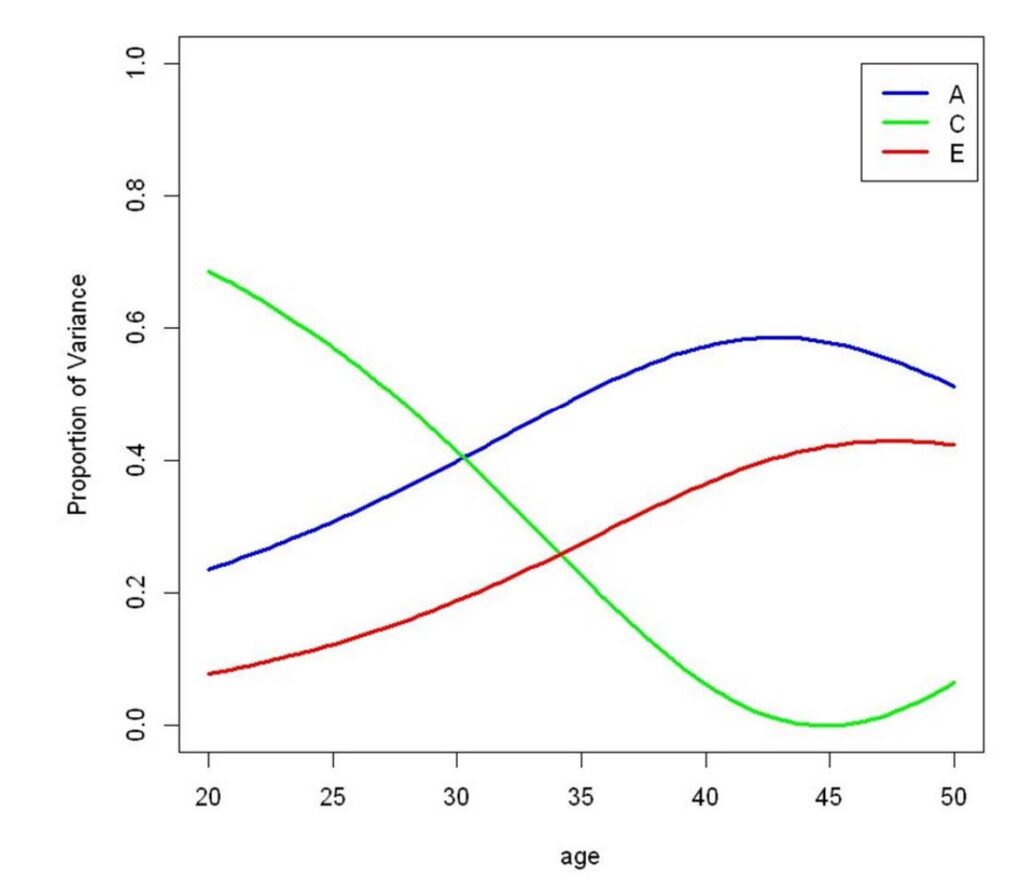
What makes this finding especially interesting is that the absolute influence of genetics on income appears to remain fairly stable across age groups. What changes is the influence of the other factors around it. As people grow older, the cushioning effect of family environment fades, making the genetic contribution look relatively larger by comparison. Specifically, research indicates the following approximate pattern:
- Around age 20: Genetic factors explain approximately 20% of income variation.
- Around age 60: Genetic factors appear to account for close to 40% of income variation — not because genes became more powerful, but because family environment’s influence dropped sharply toward zero.
This distinction matters enormously. The heritability of wealth appearing to “rise” with age is not evidence that your DNA takes over your destiny as you get older. Rather, it reflects that the shared scaffolding of family life gradually loses its grip, leaving individual genetics and personal experience as the primary drivers of income differences in mid-to-late career life.
How Family Environment Shapes Earnings — And Why Its Influence Fades by Age 60
The shared family environment has a powerful influence on earnings in early adulthood, but research suggests this effect diminishes to near zero by the time a person reaches their 60s. Around age 20, shared family environment — things like parental income, educational investment, household culture around learning, and social connections — explains more than 40% of income differences between individuals. This is a larger share than genetics at that stage of life.
The types of family environment factors that influence early earnings and education tend to include:
- Parental income and wealth: Higher-income families can fund tutoring, private schools, extracurricular programs, and university tuition without financial strain.
- Parental education level: Parents who pursued higher education tend to be more engaged in their children’s academic development, communicate the value of education, and provide guidance on career paths.
- Social networks and connections: A family’s social capital — who they know in professional or academic circles — can open doors for internships, introductions, and job opportunities that are invisible to those outside those networks.
- Household learning culture: Families that emphasize reading, intellectual curiosity, or structured study habits shape children’s cognitive habits in lasting ways.
By around age 60, however, this shared family environment component drops to approximately 0% in explaining income variation. This does not mean those early advantages never mattered — they clearly shaped educational and early career trajectories. What it suggests is that over a full working life, the accumulated weight of individual decisions, relationships, career moves, and experiences gradually overwhelms the initial boost or deficit that family background provided. In other words, where you come from matters most when you are young; what you do with your life matters most as you age.
Non-shared environment — the unique life experiences that belong to an individual alone — becomes the single largest driver of income differences by midlife, accounting for more than 60% of variation by around age 60. This is arguably the most actionable finding from the twin study earnings research, because non-shared environment is the category most responsive to personal agency.
Non-shared environmental factors relevant to income include a wide range of experiences:
- Career choices and job changes: The industries, companies, and roles a person pursues across their working life shape earning trajectories in ways unrelated to family background.
- Educational and training investments: Specific certifications, skills developed on the job, or graduate education pursued independently of family expectation all fall into this category.
- Personal relationships and mentors: A single influential mentor, professional network connection, or business partner can significantly alter a person’s income trajectory.
- Life events and timing: Marriage, relocation, health events, or being in the right place at the right time are all non-shared factors with real financial consequences.
Research indicates this category grows from approximately 30% of income variation at age 20 to over 60% at age 60. It is critical to note, however, that not all non-shared environmental factors are fully within a person’s control. Some are genuinely random — economic recessions, industry disruptions, or accidents. This means that while personal effort is important, an overemphasis on individual responsibility risks ignoring the genuine role of chance and structural inequality. Policy conversations about income inequality should account for this complexity rather than defaulting to pure self-determination narratives.
Genetics, Education, and Income: What the Research Actually Shows About Academic Achievement
The relationship between genetics, education, and income turns out to be considerably more complex than a simple chain where “smart genes → good grades → high salary.” The twin research identified several distinct and partially independent pathways through which genes and environment shape both educational attainment and lifetime earnings.
Genetic Factors That Influence Academic Performance Also Tend to Influence Income
Research suggests that the genetic factors influencing academic performance — likely including cognitive ability, conscientiousness, and related traits — also correlate with higher income. This makes intuitive sense: the same underlying capacities that help a person excel academically may also help them perform well professionally. However, this is a correlation, not a proven direct cause. Family environment and opportunity structures interact with these genetic tendencies at every stage.
Importantly, the research also found evidence that genetic factors unrelated to academic performance independently influence income. This suggests traits like interpersonal skills, emotional regulation, physical resilience, or entrepreneurial drive — which may have a genetic component but are not well captured by school grades — also play a meaningful role in determining earnings over a lifetime.
Years of Schooling Alone May Not Directly Drive Income Growth
One of the more counterintuitive findings is that the genetic predisposition toward staying in school longer does not appear to directly translate into higher earnings. In other words, a genetic tendency toward educational persistence seems to be a relatively weak predictor of income, independent of other factors.
A complementary analysis using the same twin dataset estimated the financial return on education at approximately 4.5% per additional year of schooling. While this is a real and positive return, it is modest. Consider what this means practically:
- An extra year of formal education is associated with roughly a 4.5% increase in annual earnings.
- This effect is smaller than the combined influence of individual experience, career decisions, and life circumstances.
- Higher educational credentials open doors to certain career paths but do not guarantee income outcomes.
The strongest driver connecting education to income appears to be the family environment rather than genetics. Families that invest heavily in education — regardless of their children’s natural academic inclination — tend to produce children with more years of schooling, which then indirectly improves career prospects. This finding has direct implications for how we think about inequality of opportunity in education systems.
Inequality of Opportunity: What These Findings Mean for Society and for You Personally
Perhaps the most socially significant takeaway from this research is evidence that family environment creates income inequality independently of genetic differences — raising serious questions about fairness and the equality of opportunity. The study found that shared family environment factors unrelated to academic performance still significantly influenced both educational attainment and income. This means children from wealthier or more educationally engaged families enjoy advantages that have nothing to do with natural talent.
The mechanisms through which privileged family backgrounds transmit income advantages tend to include:
- Direct financial transfer: Wealthy parents can pass down assets through inheritance or gifts, providing children with capital that earns returns independently of their labor income.
- Business succession: Children who take over family enterprises inherit not just assets but established customer bases, supplier relationships, and brand reputation.
- Social capital inheritance: Professional networks, alumni associations, and industry connections built by parents can accelerate a child’s career in ways invisible to outsiders.
- Educational investment: Access to quality tutoring, international programs, private schools, and university preparation that is simply unavailable to families with fewer resources.
The research underscores that these family-based advantages are largest in early adulthood — when young people are making their most consequential decisions about education and career entry. Societies that care about genuine meritocracy, therefore, have the strongest justification to intervene precisely at this life stage, through scholarship programs, subsidized early education, and equal-access professional development opportunities. The data suggests that the “playing field” is least level in the 20s, and becomes more level — though never perfectly so — with time.
What You Can Actually Do With This Knowledge: Actionable Insights From Twin Study Earnings Research
Understanding the nature vs. nurture income equation is not just an academic exercise — it offers genuinely practical guidance for how to think about your own career and financial development. Here are evidence-informed perspectives on what these findings suggest for personal strategy:
Don’t Treat Family Background as Either a Ceiling or a Floor
Whether you grew up in a wealthy household or a struggling one, the research suggests that family environment’s influence on your earnings decreases substantially as you age. This is genuinely encouraging for people from disadvantaged backgrounds: the data indicates that early disadvantage does not permanently determine your earning capacity. Conversely, those from privileged backgrounds should recognize that inherited advantages eventually diminish as a proportion of what drives their income — personal competence and effort become increasingly important over time.
Why it works: Non-shared environment grows to over 60% of income variation by midlife. How to practice it: Focus energy on building skills, relationships, and experiences that are uniquely yours, rather than either leveraging or lamenting your family background.
Invest in Experience, Not Just Credentials
Since the direct causal link between years of schooling and income appears relatively modest (approximately 4.5% per additional year), treating formal education as the sole investment in your earning potential seems unwise. The non-shared environmental factors that increasingly drive income — career moves, skill development, professional relationships — are built through doing, not just through studying.
Why it works: Non-shared environment becomes the dominant income factor by midlife. How to practice it: Actively seek diverse career experiences, cultivate mentorship relationships, and build expertise through applied work alongside any formal education you pursue.
Recognize Luck and Structure Without Being Passive
Because a significant portion of non-shared environmental influence on income is genuinely outside any individual’s control — economic cycles, industry disruptions, health events — it is important not to fall into extreme self-blame or overconfident self-credit for financial outcomes. Research suggests a balanced view: personal agency matters, but so does structural context and random circumstance.
Why it works: Acknowledging the role of chance reduces unnecessary self-blame and promotes more realistic financial planning. How to practice it: Build financial resilience (savings, diverse skills, adaptable career positioning) that can absorb the inevitable role of factors outside your control.
Frequently Asked Questions
What percentage of income differences are explained by genetics?
Research from twin studies suggests that genetic factors explain approximately 20–40% of individual differences in annual income. This means that more than half of the variation in what people earn is determined by factors other than genetics — including family environment and unique personal experiences. The genetic contribution tends to appear larger at older ages, but this is mainly because the influence of family environment fades over time rather than because genetic effects grow stronger.
At what age does family environment have the strongest effect on earnings?
Studies indicate that shared family environment — parental income, educational investment, household culture — has its greatest influence on earnings around age 20, explaining over 40% of income variation at that life stage. By around age 60, this influence drops to approximately 0%. This pattern suggests that early career entry is the period most heavily shaped by family background, while mid-to-late career outcomes increasingly reflect personal choices and accumulated experiences.
Does getting a higher degree guarantee a higher income?
Research suggests the direct causal link between years of schooling and income is relatively modest. Studies estimate the return on each additional year of formal education at approximately 4.5% in annual earnings — a real but limited effect. Many other factors, including career decisions, skill development, professional networks, and life circumstances, appear to have a greater combined influence on lifetime income than educational credentials alone. Higher education opens doors but does not guarantee financial outcomes.
Can someone from a low-income family realistically achieve high earnings?
Yes — the research strongly supports this possibility. While family environment does exert real influence in early adulthood, its impact on income fades substantially with age. By midlife, non-shared personal experiences account for over 60% of income variation, meaning individual career choices, skill-building, and personal relationships become the dominant drivers. Family background is a starting condition, not a fixed ceiling. The data suggests that sustained personal effort and strategic life decisions can meaningfully overcome early disadvantage over a full career.
Why are twin studies considered reliable for studying income heritability?
Twin studies are considered a reliable methodology for studying income heritability because they allow researchers to statistically separate genetic and environmental contributions to income variation. Identical twins share 100% of their genetic material while fraternal twins share approximately 50%, yet both types are raised in the same household. By comparing earnings similarity across these two groups, scientists can estimate how much of the difference in people’s earnings is explained by genes versus shared environment versus unique personal experiences.
Is the genetic link to income separate from the genetic link to intelligence?
Research suggests the two are related but not identical. Genetic factors that influence academic performance do tend to correlate with higher earnings — likely reflecting underlying cognitive abilities. However, twin study evidence also indicates that genetic factors independent of academic performance contribute to income variation. This implies that traits such as interpersonal skills, resilience, drive, or physical health — which have partial genetic components but are not well measured by school grades — also shape a person’s earning capacity across their working life.
In behavioral genetics research, non-shared environment refers to all life experiences that are unique to an individual — even when that person was raised alongside a twin in the same household. In the context of income, non-shared environment includes individual career choices, specific job experiences, personal mentors, health events, timing of major life transitions, and even random chance encounters that altered career trajectories. Research indicates that this category grows from roughly 30% of income variation at age 20 to over 60% by age 60, making it the largest single driver of income differences in mature adulthood.
Summary: Nature Sets the Stage, but Your Life Writes the Story
The evidence from income heritability twin study research delivers a clear and ultimately empowering message: genetics plays a real but limited role in determining your earnings, accounting for roughly 20–40% of individual income differences. Family environment matters enormously in early adulthood — explaining over 40% of income variation around age 20 — but its influence fades to nearly zero by later life. What fills that gap is the accumulated weight of your own unique experiences, decisions, relationships, and career investments, which account for more than 60% of income variation by around age 60.
This is not a story about genetics being unimportant. Genes and income are genuinely connected, and pretending otherwise would misrepresent the science. But it is also not a story of biological determinism. The majority of what makes one person earn more than another comes down to factors that are, at least in part, modifiable — the environments we seek out, the skills we develop, the connections we build, and the choices we make across decades of working life. Inequality of opportunity shaped by family background is real and worth addressing through social policy. And within that reality, personal agency retains meaningful power.
If this research has made you curious about the traits and tendencies you bring to your own professional life — the psychological patterns that shape how you work, earn, and make decisions — explore our other evidence-based profiles to discover which of your personal characteristics are working for you and which ones might be worth developing further.