
When it comes to understanding yourself more deeply, the debate around psychology test vs personality test is more relevant than ever. Many people use these terms interchangeably, but they actually refer to distinct tools with different scopes, scientific rigor, and practical applications. Whether you’ve stumbled across a fun quiz on social media or taken a formal psychometric testing battery at work, knowing the difference can help you make smarter choices about which self-discovery assessment is right for your goals.
This guide breaks down what psychological assessment tools really are, how they differ from casual personality quizzes, what the various types are designed to measure, and how to get the most accurate and useful results when you take one. By the end, you’ll have a clear framework for using these tools as a genuine catalyst for self-growth — not just an entertaining distraction.
Once again, personality researcher and author of Villain Encyclopedia, Tokiwa (@etokiwa999), will provide the explanation.
※We have developed the HEXACO-JP Personality Assessment! It has more scientific basis than MBTI. Tap below for details.

目次
- 1 What Is a Psychology Test? A Clear Definition
- 2 Psychology Test vs Personality Test: Key Differences Explained
- 2.1 Personality Quiz vs. Personality Test: Casual vs. Scientific
- 2.2 Personality Quiz vs. Psychology Test: Are They the Same?
- 2.3 Psychology Test vs. Psychological Scale: Why the Difference Matters
- 2.4 Psychological Examination vs. Psychological Scale
- 2.5 Personality Test vs. Psychological Scale: A Subset Relationship
- 3 5 Key Benefits of Taking a Psychology Test or Self-Understanding Assessment
- 4 The Many Types of Personality Quiz Types and Psychology Assessments
- 5 How to Take a Psychology Test: 5 Practical Tips for Accurate Results
- 6 Frequently Asked Questions
- 6.1 What is the difference between a psychology test and a personality test?
- 6.2 Are online personality quizzes scientifically reliable?
- 6.3 What is a psychological scale, and how is it different from a psychology test?
- 6.4 What is a career aptitude test, and should I trust its results?
- 6.5 Can personality test results change over time?
- 6.6 What is the difference between a psychological examination and a psychological scale?
- 6.7 How should I use psychology test results in real life?
- 7 Summary: Making Sense of Psychology Tests and Personality Assessments
What Is a Psychology Test? A Clear Definition
The Core Definition of a Psychology Test
A psychology test is a structured set of questions or tasks designed to assess an individual’s personality traits, aptitudes, values, or other psychological characteristics. These tools are used across a wide range of settings — from schools and workplaces to clinical environments and research laboratories. They generally fall into 2 main methodological categories:
- Questionnaire method (質問紙法): The most common format, where individuals answer written questions about their thoughts, feelings, or behaviors. The Big Five personality inventory is one well-known example.
- Performance / work-sample method (作業検査法): Individuals complete specific tasks — such as arranging symbols or drawing figures — and their performance patterns reveal psychological characteristics.
It’s important to understand that psychology tests serve as guideposts, not definitive verdicts. Research suggests that no single test can capture the full complexity of a human mind. Results should always be treated as one informative data point among many — a starting place for reflection rather than a fixed label. Used thoughtfully, a psychology test can be a powerful tool for self-understanding and personal development.
Psychology Test vs Personality Test: Key Differences Explained
These terms are often used as if they mean the same thing, but there are meaningful distinctions — particularly when you factor in scientific rigor and intended use. The diagram below maps out how related concepts relate to one another.
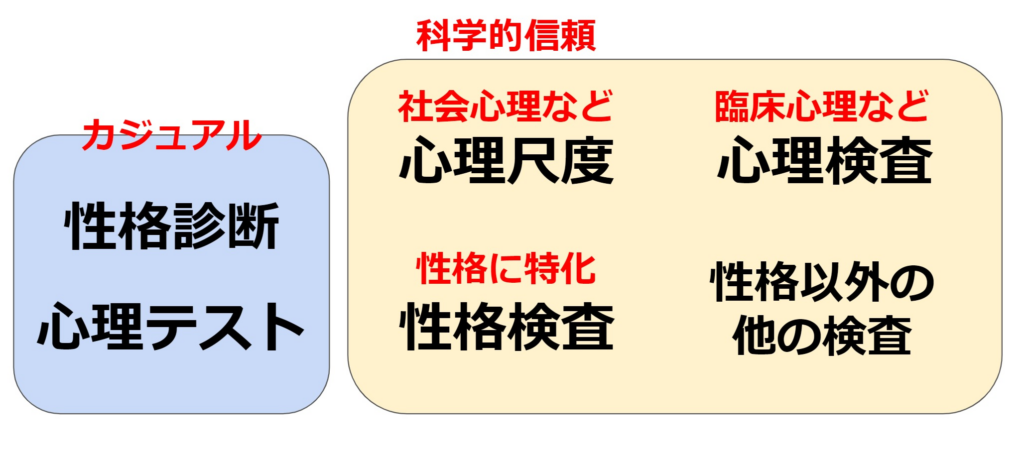
Personality Quiz vs. Personality Test: Casual vs. Scientific
A “personality quiz” (性格診断) — like the popular 16Personalities — refers to a casual, accessible tool anyone can take online or in a magazine, usually for entertainment or light self-reflection. These quizzes are easy to complete, often free, and designed to be engaging rather than scientifically precise.
A personality test (性格検査), by contrast, refers to academically validated instruments — such as the Big Five (OCEAN) model — that are developed and reviewed by psychologists, and whose reliability and validity have been statistically verified. These tend to be administered in professional settings, such as corporate hiring processes or clinical assessments.
In short: personality quizzes are a great entry point for self-exploration, but for genuinely accurate insight, validated psychometric testing is recommended. Think of the quiz as a trailer and the validated test as the full film.
Personality Quiz vs. Psychology Test: Are They the Same?
In everyday casual usage, “personality quiz” and “psychology test” are often treated as interchangeable — and in informal contexts, that’s largely acceptable. Both tend to describe easy, accessible diagnostic tools that the general public can use without professional guidance.
However, there is a subtle but important distinction: psychology tests can measure a broader range of psychological characteristics beyond just personality. They may assess values, stress levels, creativity, cognitive tendencies, or leadership styles — areas that go well beyond what a typical personality quiz covers. So while all personality quizzes can be loosely called psychology tests, not all psychology tests are personality quizzes.
Psychology Test vs. Psychological Scale: Why the Difference Matters
A “psychological scale” (心理尺度) is a scientifically validated measurement tool used primarily in academic and research contexts — quite different from the casual psychology test most people encounter online.
Psychological scales are developed through rigorous statistical processes, including reliability analysis (e.g., Cronbach’s alpha) and validity testing. They are used by researchers in fields like social psychology and personality psychology to measure specific constructs with precision. Using a psychological scale effectively generally requires specialist knowledge, which is why they’re not typically self-administered by the general public.
Psychological Examination vs. Psychological Scale
A psychological examination (心理検査) is a formal assessment tool used specifically within clinical psychology and mental health support settings — such as hospitals, counseling centers, or schools with specialist staff.
Psychological scales, on the other hand, are the dominant measurement tools in foundational research disciplines like personality psychology and social psychology. The key distinction is context: psychological examinations are applied in clinical practice, while psychological scales are used in academic research. Both require professional expertise, but they serve different ends of the psychology spectrum.
Personality Test vs. Psychological Scale: A Subset Relationship
A personality test (性格検査) is best understood as a specialized subset of psychological scales — one that focuses specifically on measuring personality traits rather than broader psychological attributes.
Psychological scales can measure many things: intelligence, aptitude, values, emotional regulation, stress resilience, and more. A personality test narrows that lens to focus exclusively on character and behavioral tendencies. So while every personality test is technically a type of psychological scale, a psychological scale is a much broader category of measurement tool that encompasses far more than just personality.
5 Key Benefits of Taking a Psychology Test or Self-Understanding Assessment
Regardless of which type of tool you use, self-understanding tests offer genuine, practical value when approached thoughtfully. Here are the 5 core areas where they tend to deliver the most insight.
1. Understanding Your Personality
One of the primary reasons people take any kind of psychology or personality test is to get a clearer picture of their own character. Personality tendencies influence how we think, communicate, make decisions, and respond to stress — often in ways we don’t consciously notice.
- Identifying strengths and weaknesses you may have overlooked
- Discovering career aptitude based on your natural tendencies
- Improving relationships by understanding how your style affects others
It’s worth noting that personality is not entirely fixed — research suggests it shifts gradually over time in response to life experiences. So while a test result offers a useful snapshot, it’s best treated as a working hypothesis about yourself rather than a permanent definition. Personality insights are a beginning, not a conclusion.
2. Clarifying Your Core Values
Values-based psychology tests help you identify what genuinely matters to you — which is surprisingly difficult to articulate without structured prompts. Your values shape every major decision you make, from relationships to career paths to daily habits.
- Living more authentically by aligning choices with genuine priorities
- Finding clearer life direction and a sense of personal purpose
- Making decisions more confidently when faced with complex trade-offs
Studies indicate that people who have a clear sense of their own values tend to report higher life satisfaction. A values-focused self-discovery assessment can serve as a powerful mirror, revealing what you’re truly optimizing for — even when you haven’t consciously articulated it.
3. Identifying Strengths and Blind Spots
Everyone has natural strengths and areas where they tend to struggle — but most people are far more aware of one than the other. Psychology tests can help surface both, giving you a more balanced and complete picture of your capabilities.
- Matching your role or career to your genuine abilities and preferences
- Maximizing performance by leaning into what you do naturally well
- Developing targeted strategies to compensate for or improve weaker areas
This kind of balanced self-awareness is especially valuable in professional settings. When you understand where you naturally excel, you can position yourself more strategically — and when you understand your blind spots, you can build support systems or seek collaboration to compensate.
4. Recognizing Your Behavioral Patterns
Many of our behaviors are habitual and automatic — we repeat patterns without realizing it. Behavioral tendency assessments within psychology tests help bring these unconscious patterns into conscious awareness.
- Spotting recurring habits — both productive and counterproductive
- Reinforcing helpful patterns that contribute to your goals
- Interrupting unhelpful cycles before they cause problems
Awareness is the first step to change. Once you can objectively observe your behavioral tendencies — rather than being unconsciously driven by them — you gain the agency to choose differently. This is particularly useful in areas like stress management, interpersonal conflict, and productivity.
5. Discovering Career Aptitude and Direction
A career aptitude test is one of the most practically valuable types of psychological assessment tools available, particularly for students and professionals at a crossroads. Aptitude refers to the natural abilities or inclinations that make certain roles or fields a better fit than others.
- Identifying career paths aligned with your natural skills and interests
- Maximizing job satisfaction by pursuing work that feels meaningful and energizing
- Finding a sense of purpose that extends beyond the paycheck
It’s worth emphasizing that aptitude test results are a guide, not a guarantee. Career fulfillment involves many factors — including effort, opportunity, mentorship, and timing — that no test can fully predict. Use aptitude results as one valuable input among many when making career decisions.
The Many Types of Personality Quiz Types and Psychology Assessments
The world of personality quiz types is far broader than most people realize. Below is a breakdown of the major categories, each serving a different purpose in the landscape of self-understanding.
Personality Tests
These are the most widely recognized type — tools that identify your core personality traits and tendencies. Well-known examples include 16Personalities, the Enneagram, and the Egogram. They typically use questionnaire-based formats and produce results organized into types or dimensional profiles. Results are useful for self-reflection, team communication, and understanding interpersonal dynamics.
Romantic Tendency Tests
These assessments focus specifically on how you approach romantic relationships — your attachment style, emotional needs, and relational patterns. Common subcategories include love values quizzes, romantic dependency assessments, and relationship style inventories. Results can offer useful perspective on patterns in relationships, though chemistry and context will always play a significant role that no quiz can capture.
Career Aptitude Tests
Designed to identify your vocational strengths and preferences, career aptitude tests typically measure 2 main dimensions: interest (what you enjoy) and ability (what you’re naturally good at). These are commonly used by high school students making subject choices, university students selecting majors, and professionals considering a career pivot. Results should be treated as directional guidance rather than a definitive blueprint.
Self-Concept and Self-Esteem Assessments
These tools measure how you perceive yourself — your sense of identity, self-worth, and confidence in your own abilities (often called self-efficacy). Research suggests that a healthy, realistic self-concept is strongly linked to mental well-being and resilience. These assessments can reveal whether your self-perception is overly harsh, unrealistically positive, or relatively well-calibrated — all of which have practical implications for how you navigate challenges.
Stress and Mental Health Check-Ins
Stress-check assessments measure your current psychological load and identify signs of burnout, anxiety, or emotional exhaustion. In Japan, workplace stress checks (ストレスチェック) are legally mandated for companies with 50 or more employees, reflecting the growing recognition of mental health in professional environments. These tools are particularly valuable as early-warning systems — they can prompt action before stress escalates into a more serious mental health concern.
Creativity Tests
These assessments measure your capacity for creative thinking — including divergent thinking (generating many ideas), convergent thinking (finding the single best solution), and creative attitude (your openness to novel approaches). Unlike many psychological traits, creativity is widely considered trainable — meaning low scores should be seen as a starting point for growth rather than a fixed ceiling.
Leadership and Communication Style Tests
Leadership assessments evaluate your natural leadership style, behavioral tendencies as a leader, and suitability for different leadership contexts. Communication style tests, meanwhile, assess how you typically send and receive information — including listening habits and non-verbal awareness. Both tend to be particularly popular in corporate and team-building contexts, where understanding interpersonal dynamics can significantly improve collaboration and output quality.
How to Take a Psychology Test: 5 Practical Tips for Accurate Results
The quality of your results depends heavily on how you approach the test. Here are 5 evidence-informed tips for getting the most meaningful outcomes from any psychological assessment tool.
1. Be Honest, Not Strategic
The single most important rule: answer truthfully, not aspirationally. It can be tempting to select answers that reflect how you wish you were, or how you want to appear. But doing so defeats the entire purpose of the assessment. Psychology tests are tools for you — the more honestly you respond, the more useful the output. If a question genuinely confuses you, note it and move on rather than guessing strategically.
2. Trust Your First Instinct
Many psychology tests are deliberately designed to capture gut reactions rather than considered logical responses. When you overthink a question, you risk replacing your natural tendency with a socially desirable or idealized answer. Research in cognitive psychology suggests that first instincts often reflect authentic preferences more accurately than deliberated responses. Go with your initial reaction — especially when you’re uncertain.
3. Maintain a Steady Pace
Spending too long on any single question can actually reduce the accuracy of your responses. Dwelling on ambiguous questions invites over-analysis and second-guessing. Aim for a consistent, moderate pace — read each question carefully, register your initial response, and move forward. If the test has a time limit, practice beforehand so the pressure doesn’t distort your answers.
4. Receive Results with Openness, Not Defensiveness
Whatever the result says — flattering or challenging — approach it with curiosity rather than judgment. Some people feel deflated by results that highlight weaknesses; others feel falsely validated by overly positive ones. The most constructive mindset is to treat results as a mirror: sometimes accurate, occasionally distorted, always worth examining thoughtfully. Avoid the temptation to either over-identify with a label or immediately dismiss it.
5. Translate Results into Action
A psychology test result that sits unexamined has limited value — the real benefit comes from what you do next. Use insights to identify at least 1 concrete area for growth or 1 strength to more intentionally leverage. Consider sharing results with a trusted friend, mentor, or counselor to get an external perspective. And if a particular area concerns you — such as high stress scores or low self-esteem indicators — treat it as a prompt to seek professional support rather than a label to carry in silence.
Frequently Asked Questions
What is the difference between a psychology test and a personality test?
A psychology test is a broad category that covers any structured tool designed to measure psychological characteristics — including personality, values, stress, aptitude, creativity, and more. A personality test is a specific type of psychology test focused exclusively on character traits and behavioral tendencies. So while every personality test is a type of psychology test, many psychology tests measure things that go well beyond personality alone.
Are online personality quizzes scientifically reliable?
Most free online personality quizzes — including popular ones like 16Personalities — are designed for accessibility and entertainment rather than scientific precision. They can offer useful starting points for self-reflection, but they typically lack the rigorous statistical validation (reliability and validity testing) of academic psychological scales. For high-stakes decisions, such as clinical assessments or professional hiring, validated psychometric tools administered by qualified professionals are strongly recommended.
What is a psychological scale, and how is it different from a psychology test?
A psychological scale is a scientifically validated measurement tool developed for use in academic research. Its reliability and validity are verified through rigorous statistical methods. A psychology test, in everyday usage, typically refers to casual or semi-formal tools accessible to the general public. The key difference is scientific rigor: psychological scales are built for precision in research settings, while casual psychology tests prioritize accessibility and ease of use for self-exploration.
What is a career aptitude test, and should I trust its results?
A career aptitude test is a type of psychological assessment tool designed to identify which fields, roles, or industries align with your natural abilities and interests. It typically measures 2 dimensions: interest (what engages you) and ability (where your skills tend to be strongest). Results can be genuinely useful as one factor in career planning, but they should not be treated as definitive. Career fulfillment depends on many variables — including effort, opportunity, and personal growth — that aptitude tests cannot predict alone.
Can personality test results change over time?
Yes — research suggests that personality traits are relatively stable over short periods but can shift meaningfully across years and decades, particularly in response to major life experiences, personal development efforts, and changing environments. This is why it’s important not to over-identify with any single test result. Taking the same test at different life stages can reveal genuine changes in how you think, behave, and relate to others — which is actually one of the more fascinating uses of repeated self-assessment.
What is the difference between a psychological examination and a psychological scale?
A psychological examination is a formal assessment used in clinical psychology and mental health contexts — such as hospitals, counseling centers, or schools — administered or supervised by trained professionals. A psychological scale, by contrast, is used primarily in research settings within fields like personality psychology and social psychology. Both require expertise, but they serve different purposes: clinical examination focuses on applied assessment of individuals; psychological scales focus on rigorous academic measurement of psychological constructs.
How should I use psychology test results in real life?
The most effective approach is to treat psychology test results as a starting point for reflection, not a final verdict. Look for patterns across multiple tests rather than fixating on one result. Use insights to identify at least 1 strength to leverage and 1 area to develop. If results surface something concerning — such as high stress or low self-esteem — consider speaking with a counselor or mental health professional. Ultimately, the value of any self-discovery assessment lies not in the label it gives you, but in the actions it inspires.
Summary: Making Sense of Psychology Tests and Personality Assessments
Understanding the distinction between a psychology test vs personality test — and how both relate to broader tools like psychological scales and clinical examinations — gives you a much clearer picture of what these tools can and cannot do. Psychology tests are broad, accessible tools for self-exploration; personality tests are a focused subset aimed at understanding character traits; psychological scales are scientifically rigorous instruments for research; and psychological examinations are formal clinical tools administered by professionals.
Each type has its place — and each can offer genuine value when used with the right expectations. Whether you’re using a casual personality quiz to spark a conversation about yourself, a career aptitude test to explore your professional direction, or a validated psychometric testing battery for deeper clinical insight, the key is approaching results with honesty, openness, and a commitment to acting on what you learn.
Now that you know what separates one type of assessment from another, why not put that knowledge to work? Explore the assessments on sunblaze.jp and discover which dimension of yourself you’d like to understand more deeply — your personality, your values, your strengths, or all three.

Writer & Supervisor: Eisuke Tokiwa
Personality Psychology Researcher / CEO, SUNBLAZE Inc.
As a child he experienced poverty, domestic abuse, bullying, truancy and dropping out of school — first-hand exposure to a range of social problems. He spent 10 years researching these issues and published Encyclopedia of Villains through Jiyukokuminsha. Since then he has independently researched the determinants of social problems and antisocial behavior (work, education, health, personality, genetics, region, etc.) and has published 2 peer-reviewed journal articles (Frontiers in Psychology, IEEE Access). His goal is to predict the occurrence of social problems. Spiky profile (WAIS-IV).
Expertise: Personality Psychology / Big Five / HEXACO / MBTI / Prediction of Social Problems
Researcher profiles: ORCID / Google Scholar / ResearchGate
Social & Books: X (@etokiwa999) / note / Amazon Author Page